How NOT To Make A Decision

Adonijah thought he was the obvious heir to the throne so he stated what he believed, “I will be king” (1 Kings 1:5). 

On what evidence did Adonijah base his claim? 

  1. All of his friends said he would make a great king
  2. His father (the king) had always given him everything he wanted
  3. He was handsome and popular
  4. A couple members of the king’s court supported him
  5. No one had ever told him “no” 

While all of this sounded good, Adonijah overlooked some vital points. Like…

  1. …more men backed his brother Solomon to be king than backed him
  2. …his father had the decisive and definitive say in who would be king, and he chose Solomon
  3. …God had chosen Solomon to be king

It’s tempting for us to read the popular sentiment of the moment, or to listen to the cheering voices around us, or even to think that our plans are wise and well thought-out. But this is NOT the right way to make a decision.

Instead, we need to humbly consider three things that are external:

  1. The unbiased, wise counsel of others
  2. The buy-in of key stakeholders
  3. God’s clear “yes”

If these three things are in alignment, you cannot go wrong!

8 Quotes From “How To Listen So People Will Talk”

In How To Listen So People Will Talk you will learn some invaluable skills for taking your relationships and your leadership deeper. Becky Harling has given us an amazing resource! Check out my full book review by clicking here. 

“Honestly, it’s impossible to be a good listener without developing a humble spirit. Think about it. When you’re listening and fully engaged, you allow the other person to have all the attention. Listening forces you to lay aside your agenda. It challenges you to let go of your need to share your opinions, theories, and assumptions in favor of listening to another’s feelings, thoughts, and sentiments. That decision can only come from a heart of humility.” 

“Resist the urge to dive in with your own story. … Whenever you dive in with your own story, you are stealing the microphone from the person who is telling their story. … The best advice is to remember to let someone be the star of their own show. Keep the focus on the person talking.” 

“How is it that we who have problems ourselves are so quick to try to fix someone else’s problem? James was spot on when he wrote, ‘Everyone should be quick to listen, slow to speak’ (James 1:19). I’d like to suggest that a great paraphrase for this verse is, ‘Let everyone be quick to listen and slow to give advice!’” 

“Don’t tell people what to do; ask them questions. … You gain greater insight, they gain greater self-awareness, and the two of you grow closer. … When we dare to ask someone what they want, we give them the opportunity to verbalize their need. … The best questions allow people to explore what’s in their hearts.” 

“When you validate another person’s feelings, you’re basically saying, ‘Your feelings make sense.’ You compassionately acknowledge that the person’s feelings are important and that those feelings are understandable. You don’t correct feelings or instruct a person on how to feel. You simply offer understanding. … Validating someone’s feelings doesn’t necessarily mean you agree with the actions of the other person. … Feelings are neither right nor wrong. They’re just feelings. It’s what we do with those feelings that determines whether or not we sin. … Validate feelings, but only validate actions that line up with Scripture.” 

“In your relationships, what does it look like for you to mimic Jesus and show others how valuable they are? How does your face send the signal, ‘I want to hear what you have to say’? Your nonverbal signals act as a green light, inviting others to share their feelings.” 

“Conflict can be transformational. In the chaos of an argument, if you will listen to understand and focus on meeting the others need, you’ll be more able to work as a team, coming up with a solution that satisfies both. In the end, your relationship will emerge stronger and more resilient.” 

“People are dying to feel heard, and unless we’ve purpose in our hearts to offer our full presence to others, we’ll drift through life distracted and dishonor those who matter to us in the process.” 

How To Listen So People Will Talk (book review)

If this title was the switched, I’ll bet a lot of people would snap it up. Why? Because all of us want to be heard. In fact, some people are dying to be heard! Which is exactly why Becky Harling hits the nail on the head for ultimate, intimate, life-changing conversations in her book (very aptly titled) How To Listen So People Will Talk.

If Christians are going to follow the teachings of Jesus, there are two relationship principles that must be followed: (1) Love others and (2) serve others. There is no better way to love and serve those around us than by letting them know how deeply we are listening to them. 

Becky introduces us to at least eight major principles to raise our listening game. She uses her own life experiences, lessons that Jesus taught, the wisdom from Scripture, and even some insights from those in the psychological fields. Becky says, “People feel more loved and valued if we are actively and attentively listening to them.” And these principles will help you do just that. 

In addition to Becky’s insightful teachings, she concludes each chapter with some follow-up lessons and exercises to help us begin to apply the lessons to our conversations. 

How To Listen So People Will Talk is a game-changing book! I encourage all leaders—pastors, parents, teachers, coaches—as well those who want to enrich the relationships they have in their lives to get a copy of this book. 

I am a Bethany House book reviewer. 

A Leader’s Priority

But now your kingdom must end…because you have not kept the Lord’s command (1 Samuel 13:14). 

How tragic! 

Saul, as the first king ever of Israel, could have set the standard. He could have raised the bar high. He could have been the measuring stick by which every other king in Israel’s history was judged. But he missed out on all that.

It was not only tragic but short-sighted too. The prophet Samuel told Saul, “How foolish! You have not kept the command the Lord your God gave you. Had you kept it, the Lord would have established your kingdom over Israel forever. 

Saul’s priority was about appearances. Saul’s priority was about betting on a sure winner. Saul’s priority was about working his agenda.

A mark of a godly leader is one who has made obedience to God’s Word his first priority. 

The psalmist tells us some of the benefits—

  • God’s Word keeps us pure
  • God’s Word keeps us from sin
  • God’s Word is the key to God’s blessings
  • God’s Word strengthens us
  • God’s Word preserves us
  • God’s Word does us good
  • God’s Word keeps us from going astray
  • God’s Word lights our path

Make God’s Word your first—and highest—priority! 

This is part 22 in my series on godly leadership. You can check out all of my posts on this topic by clicking here.

Lost Intimacy


“People don’t lose intimacy when they stop talking, but when they stop listening. Leaders seldom realize how much their listening empowers the other person. Because they are leaders, the sheer act of listening speaks volumes that even a great speech can’t communicate.” —John Maxwell

Everyone’s A Critic

These are wise words from John Maxwell in The Maxwell Leadership Bible

Then Miriam and Aaron spoke against Moses because of the Ethiopian woman whom he had married; for he had married an Ethiopian woman. (Numbers 12:1)

Leaders can bank on two truths. First, they will be criticized. Second, criticism always changes the leader. Unhappy people tend to attack the point person.

Moses’ only family criticized him. Notice what God and Moses teach us on how to handle criticism (Numbers 12):

  1. Maintain your humility. (v. 3)
  2. Face the criticism squarely. (v. 4)
  3. Be specific about the issue. (vv. 5-8)
  4. Lay out consequences. (vv. 9, 10)
  5. Pray for the criticizers. (vv. 12, 13)
  6. Restore them when appropriate. (v. 14)

Beyond that, consider the ways leaders should handle criticism:

  1. Understand the difference between constructive and destructive criticism.
  2. Look beyond the criticism to see the critic.
  3. Guard your own attitude toward the critic.
  4. Keep yourself spiritually in shape. Associate with people of faith.
  5. Wait for time to prove the critic wrong.
  6. Concentrate on your mission; change your mistakes.

You might also want to check out—

Both Immovable And Flexible

The vision of Isaiah…in the days of Uzziah, Jotham, Ahaz, and Hezekiah, kings of Judah (Isaiah 1:1). 

Israel (the 10 northern tribes) was in the final stages of collapse, with kings only serving short spans, idolatry running rampant, and enemies closing in on every side. Isaiah boldly proclaimed that Judah was on the same path unless she repented and turned wholly to God.

Isaiah had the same message for four kings:

  • Uzziah—who started off well, but fell away from God
  • Jotham—who faithfully served God
  • Ahaz—who never wanted to serve God
  • Hezekiah—who led a powerful revival in the return to worshiping God alone

Isaiah’s message never waivers. Through 66 chapters, 4 monarchs, and 60 years of ministry, Isaiah never compromises, waters down, nor alters the message God has given him.

But he does use different methods to deliver God’s consistent message—sometimes he thunders, sometimes he weeps, sometimes he uses illustrated messages, sometimes he speaks plainly, and sometimes he uses word pictures.

A mark of a godly leader is one who is both immovable and flexible.

Immovable on God’s principles; flexible on his delivery.

Can that be said of you and me?

This is part 21 in my series on godly leadership. You can check out all of my posts on this topic by clicking here.

Appropriately Proactive

Saul realized that his troops were rapidly slipping away… (1 Samuel 13:8).

The men of Israel saw what a tight spot they were in; and because they were hard pressed by the enemy, they tried to hide in caves, thickets, rocks, holes, and cisterns. Some of them crossed the Jordan River and escaped into the land of Gad and Gilead. 

Meanwhile, Saul stayed at Gilgal, and his men were trembling with fear. Saul waited there seven days for Samuel, as Samuel had instructed him earlier, but Samuel still didn’t come. Saul realized that his troops were rapidly slipping away. So he demanded, “Bring me the burnt offering and the peace offerings!” And Saul sacrificed the burnt offering himself.

Saul stayed … Saul waited … and as a result, Saul sinned.

Saul ended up being inappropriately reactive, and thus committing a sin. His reaction to his men slipping away, hiding, and defecting was to act in a way that was inappropriate for anyone but the priest.

It’s been said that action has killed its thousands, and reaction has killed its tens of thousands. But if only Saul would have proactively sought God, or proactively formed a battle strategy, or proactively spoke an encouraging word to his men, or proactively moved out with his troops—anything(!) but just sit still—perhaps his legacy as king wouldn’t have been so short lived.

When leaders aren’t appropriately proactive, they risk becoming inappropriately reactive.

A mark of a godly leader is one who is appropriately proactive.

This is part 20 in my series on godly leadership. You can check out all of my posts on this topic by clicking here.

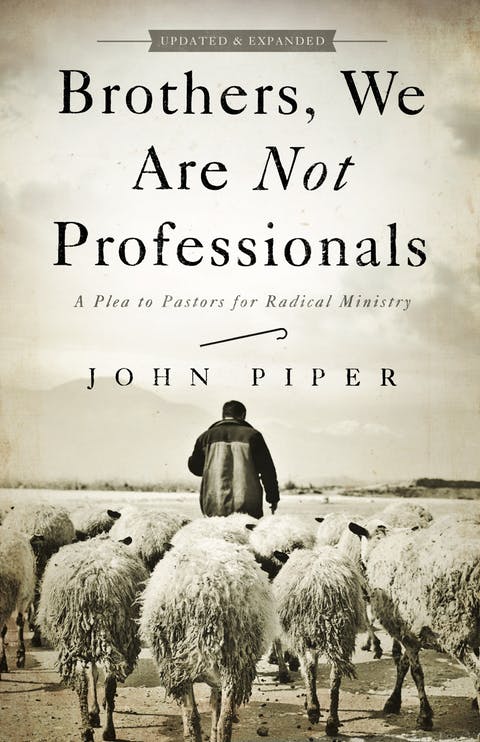
11 Quotes From “Brothers, We Are Not Professionals”

John Piper has written a book that I think every pastor should read: Brothers, We Are Not Professionals. You can read my review of this book here. Below are just a few quotes that caught my attention.

“We pastors are being killed by the professionalizing of the pastoral ministry. The mentality of the professional is not the mentality of the prophet. … The professionalization of the ministry is a constant threat to the offense of the gospel.”

“I defined spiritual leadership as ‘knowing where God wants people to be and taking the initiative to get them there by God’s means in reliance on God’s power.’ …  So the goal of spiritual leadership is to muster people to join God in living for God’s glory.”

“The Son of Man has not come seeking employees. He has come to employ Himself for our good.”

“In this fallen world, the tide is always going out. That is, the affections of our people have for God Himself (as distinct from His gifts) are continually prone to shrink. Our job is to tilt the world, by the power of the Spirit and the Word, so that the tide rolls in again.”

“A pastor who feels competent in himself to produce eternal fruit knows neither God nor himself.”

“Salvation is a gift of God (Ephesians 2:8). Love is a gift of God (1 Thessalonians 3:12). Faith is a gift of God (1 Timothy 1:14). Wisdom is a gift of God (Ephesians 1:17). Joy is a gift of God (Romans 15:13). Yet as pastors we must labor to ‘save some’ (1 Corinthians 9:22). We must stir up the people to love (Hebrews 10:24). We must advance their faith (Philippians 1:25). We must impart wisdom (1 Corinthians 2:7). We must work for their joy (2 Corinthians 1:24). We are called to labor for that which is God’s alone to give. The essence of the Christian ministry is that its success is not within our reach.”

“Are not our people really yearning to be around a man who has been around God? Is it not the lingering aroma of prayer that gives a sense of eternity to all our work?”

“Few things frighten me more than the beginnings of barrenness that come from frenzied activity with little spiritual food and meditation.”

“The domestication of God is a curse on preaching in our day. We need to recover reality and the language of majesty and holiness and awe and glory.”

“He knows that the only way he can deliver God’s message to God’s people is by being rooted in it and by saturating his sermon with God’s own revelation in the Bible. The Bible-oriented preacher wants the congregation to know that his words, if they have any abiding worth, are in accord with God’s words. He wants this to be obvious to them. That is part of his humility and his authority. Therefore, he constantly tries to show the people that his ideas are coming from the Bible. He is hesitant to go too far toward points that are not demonstrable from the Bible.”

“Our salvation and the salvation of those who hear us week after week depend in large measure on our faithful attention to personal holiness and sound teaching” [see 1 Timothy 4:16]. … Oh, how earnest we should be in attending to ourselves and the soundness and helpfulness of our teaching!”

A Leader’s Appropriate Anger

…he became very angry (1 Samuel 11:6).

Sometimes we think of godly leaders as always being cool, calm, and collected. But to remain calm when the situation calls for a vigorous response is unbecoming of the title of “godly” leader, and may even be a sin.

The Israelite city of Jabesh-Gilead had been surrounded by the forces of King Nahash. His terms of surrender to these Israelites was unduly harsh: “I will gouge out the right eye of every one of you as a disgrace to all Israel! (v. 2).

When this message got to King Saul, “the Spirit of God came powerfully upon Saul, and he became very angry.” He sent messengers to all of Israel demanding all the able-bodied men to come out to join his army in counter-attacking King Nahash.

Notice that what prompted Saul’s anger was God’s Spirit coming upon him. Since Israel was about to be disgraced, Saul had to act! Also notice this: “And the Lord made the people afraid of Saul’s anger, and all of them came out together as one” (v. 7).

The opposite of love is not hate; the opposite of love is apathy. God expresses strong emotions without sinning. When the Spirit of God made Saul angry at the oppression and potential disgrace of His people, Saul acted. To not act—to shrug his shoulders in apathy and say, “That’s not my problem”—would have been a sin.

Sometimes Christians want to suppress a strong feeling of hate or anger. But when God hates something or is angry at something, we would do well to pay attention to that and feel and act as God would have us act. The Bible tells us not to sin in our anger, but it never tells us not to be angry. 

Anything that is keeping someone from God’s love or God’s presence should arouse our righteous anger to do righteous things.

A mark of a godly leader is one who knows the right things to hate.

This is part 19 in my series on godly leadership. You can check out all of my posts on this topic by clicking here.