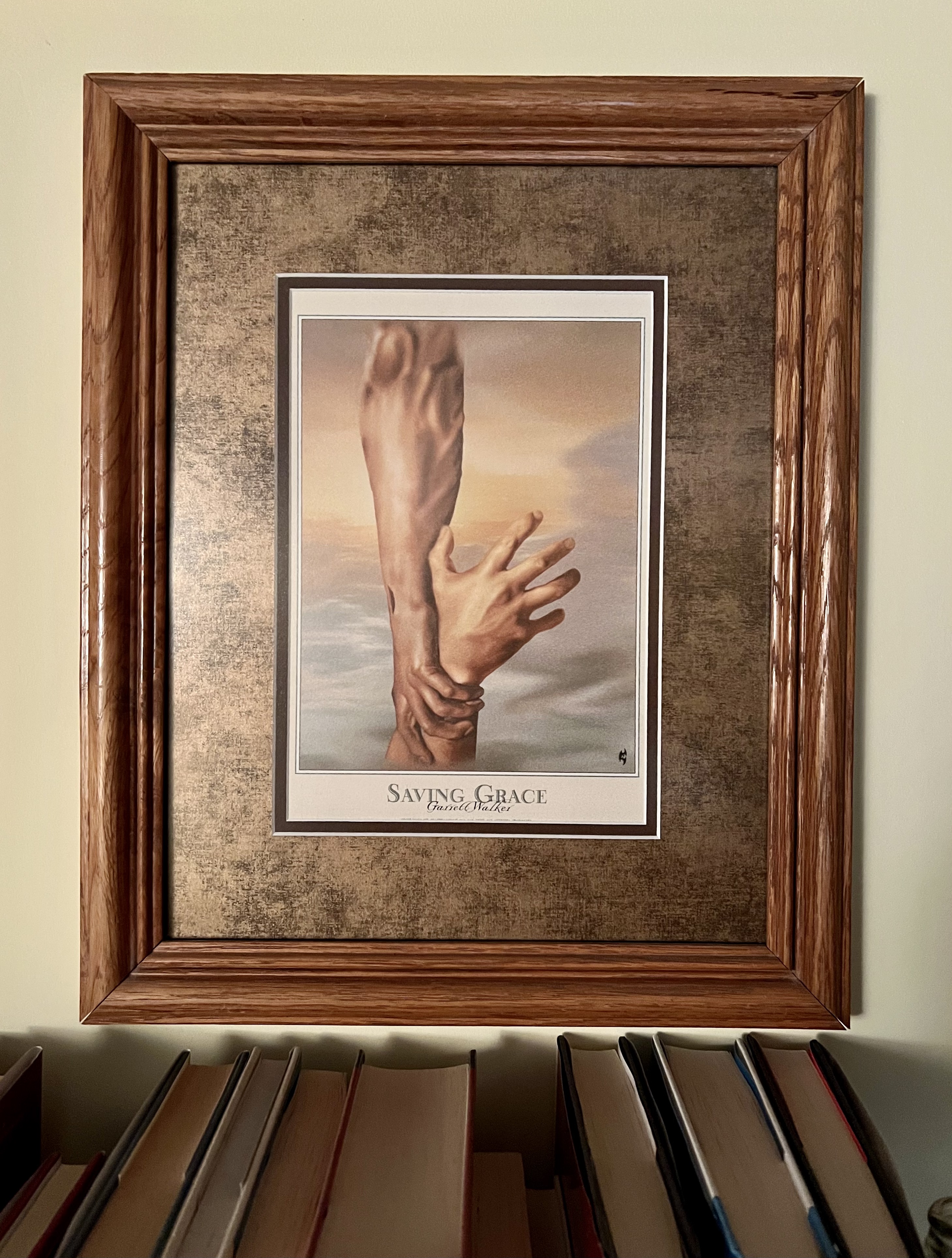
Psalm 22 is a prayer of raw desperation. I love how transparent David is with his emotions. Many people would hide this sort of thing: never daring to admit that they had doubts. But David freely admits that he’s frustrated by what is happening—or actually not happening—in his life.
I see three points of David’s desperation:
God, why don’t You answer me (vv. 1-2).
God, why don’t You defend my honor (vv. 6-8).
God, why don’t You rescue me (vv. 11-18).
Do you think David had a right to say these things against God? Remember Jesus said them too!
Do you think David was over-reacting when he said these things? Remember Jesus said them too!
David truly, deeply, felt these things. He truly believed that God wasn’t answering him, or defending him, or rescuing him. At least, AS HE THOUGHT GOD SHOULD!
But David says something VITAL after each of his points of desperation. It’s summed up in one conjunction each time…
Yet (vv. 3-5).
Yet (vv. 9-10).
But (vv. 19-21).
In all of these David recalls past history. David looks to the past to help him look to the future.
He BACKCASTS so that he can have a better FORECAST!
Looking back gives David assurance of God’s faithfulness. This assurance gives David hope for the future. So now look how he responds in his present desperate situation:
I will declare Your name (v. 22a)
I will praise You (v. 22b)
He calls others to join him in praise (v. 23)
He realizes that God has not hidden His face… but He has listened to his cry for help (v. 24)
He decides to praise God in spite of the temporary disappointments, giving all glory to God (vv. 25-31)
This is what is called a typio-prophetic Messianic psalm: what David experienced, Jesus would both experience and fulfill. So although Jesus cried out, “My God, My God, why have You forsaken Me,” He too could backcast to forecast and get the strength He needed to persevere…
Let us fix our eyes on Jesus, the Author and Perfecter of our faith, Who for the joy set before Him endured the Cross, scorning its shame, and sat down at the right hand of the throne of God. (Hebrews 12:2)
This is why I’m a big believer in journals: writing things down now will give you ammunition for future trials. Then when you are in those trials, you can backcast to get a better forecast of the hope for God’s deliverance. That will give you joy in the present, just like David. And just like Jesus!
Listen to the podcast of this post by clicking on the player below, and you can also subscribe on Apple or Spotify.
The waters looked choppy, the waves seemed so strong, and the rocks where the surf crashed on the shore seemed like cruel, dull, black teeth. And who knew what was under the surface of the water that I couldn’t see? Just the thought of swimming in those murky gray-green waters made my stomach twist into knots! But my friend announced, “I’m going for a swim.”
I tried to talk him out of it, “You’re joking, right? Do you realize how dangerous that is?”
“Relax,” my friend tried to reassure me with an unconvincing smile, “I know what I’m doing. I’ve swum in waters like these before, lots of times. I can handle it.” He headed off toward that pounding, angry sea with what seemed to be a swagger of confidence, but there was something in his eyes that seemed to be silently imploring me, “Please, save me!”
My friend had been going through a rough patch. His business which started out so well was now on the brink of closing in this crummy economy. Instead of realizing there was not much he could do in this downturn, my friend began to think that he was the failure. Recently at church—where turning from one’s sordid past is supposed to be celebrated—some scoundrels dredged up his past and used it as a cruel weapon against him. These mean-spirited, unforgiving people were jealous of my friend’s success in allowing Jesus to help him turn his life around. My friend did nothing wrong, but the spiteful words of these hypocritical church-attendees made him relive his forgiven past. Although he didn’t say it, I knew these hurtful words caused him to second-guess his value to God. And now, just last week, my friend happened to be in the wrong place at the wrong time and was charged by the police with a minor misdemeanor. No jail time nor fines were going to be imposed on him, just a few hours of community service. But yet again my friend’s self-esteem took a hit as he walked through this embarrassing process.
So now here he is feeling beat up, thinking to himself, “I’m a worthless failure,” walking toward something dangerous. I can’t understand why. Is he trying to escape reality? Does he really feel that poorly about himself? Doesn’t he see how much his wife and his friends love him? Does he feel so dead inside that this dangerous behavior makes him feel something again? Or does he feel too much and this dive into risky waters is merely an attempt to numb the pain, to self-medicate away the accusing thoughts?
While I was contemplating all of this, I didn’t realize what my friend had done. He had not only reached the shore and waded into the swirling waters, but he was now bobbing quite far from shore. All I could see was his head and shoulders. And his blank, lifeless, passionless face.
He seemed to be bobbing further and further away from me, and closer and closer to those vicious teeth-like rocks.
I ran down to the shore, as close to that angry ocean as I could get, and yelled. I don’t know whether he was ignoring me or couldn’t hear me, but he didn’t respond. He bobbed farther away and I yelled louder and waved my arms. I pointed at the rocks looming closer and closer with every swell of the sea. I screamed until my throat was raw. He drifted farther from me. He waved. And I heard just two distinguishable syllables above the pounding surf and howling wind, “…okay….”
“Okay?! Do you think it’s okay?! You’re killing yourself! It’s not okay!” My friend’s face changed. No longer was it a blank stare, there was emotion there now. I blinked my eyes against the spray of the ocean; I looked intently at my friend’s face. Then I saw it etched in the lines on his forehead. I saw it in his eyes. Panic!
I stared at him, my mind racing what to do. And then I heard it: two more syllables distinguishable above the roar. Two syllables that shot me into action: “Help me!”
I frantically looked around and spotted a tattered, faded orange life vest. It was really only half a life vest, but at least it still floated. It was tangled in seaweed and stained with muddy sand. I grabbed it, ran toward the shore, and flung the life vest toward my friend. It wasn’t a very good throw. Whether it was the wind or my weak attempt, the orange vest didn’t get very close to him. But even so, what was more disturbing was that my friend didn’t even make a movement toward it.
I got frustrated and stomped my foot in anger. Angry at my poor first attempt at a rescue, and angry that my friend made no attempt to reach out for what I had thrown him. I looked around again. I spotted an unattended lifeguard station 75 yards away. I raced to it and found an intact white life ring with a bright red cross emblazoned on it. I grabbed the life ring, sprinted back as close to my friend as I could get, and heaved the life ring as far as I could. It flew through the air. It seemed unimpeded by the wind, and landed within a few feet of my friend! The white and red ring stood out clearly in the dark waters!
I almost let out a shout of victory! Salvation for my friend was within arm’s reach of him! Yet my friend didn’t move. He wouldn’t reach for the help that was right there.
“Does your friend need help?” a strong voice behind me asked.
I wheeled around to see a tall, athletic man. A Lifeguard! “Yes! Yes, he needs help!”
The Lifeguard looked out across the churning waves and saw my friend getting closer and closer to those jagged rocks. It seemed like the next swell of the sea would dash him on those black sea-teeth. “Yes,” the Man said, “I can help him.”
My heart leaped and then seemed to stop in the very next heartbeat. The Lifeguard wasn’t moving. He just stood there looking at my friend.
“I can help him,” he repeated, “If he will simply ask for My help.”
“He did ask for help,” I argued. “I’ve been trying to help him.”
“No, he really doesn’t want help,” the Lifeguard said. “I can save him, but he has to ask Me to do it. And,” he added turning to look at me, “you have to leave.”
“What? He’s my friend! I’m not leaving him!”
“If he is your friend, you have to. You have to love him enough to leave him to Me. He’s been here before, and I have rescued him before. But as long as you’re here throwing flotation devices to him he will keep the rescue attempts alive without ever actually allowing himself to be rescued. The most loving thing you can do for your friend is leave him to Me.”
“How long?” I asked quietly, knowing in my heart that noble Lifeguard was right.
“That all depends on him,” the Lifeguard said. “As soon as you leave, that may get his attention and he may call out for My help immediately. Or he may wait until things get even more desperate. It’s his choice. I am the only One who can save him from this surf now. But he must call on Me before he is smashed on the rocks. I will not leave this spot. I will not sleep or become distracted. I will never leave your friend because I love him. I love him even more than you love him. So the sooner you leave him to Me, the sooner he can cry out for My help.”
I stood there weighing the Lifeguard’s words. I knew He was right, yet I didn’t want to leave my friend. And then He repeated, “The most loving thing you can do for your friend is leave him to Me.”
So I walked away.
That was last night. No word from the Lifeguard or my friend yet. I’m still waiting—and praying—that my friend will cry out for help to the only Lifeguard that can save him now.
I did the most loving thing I could have done. I left my friend to Him.
This is a weekly series with things I’m reading and pondering from Oswald Chambers. You can read the original seed thought here, or type “Thursdays With Oswald” in the search box to read more entries.

A Religious Poser
It is difficult to evade pose in religious life. … If you have the idea that your duty is to catch other people, it puts you on a superior platform at once and your whole attitude takes on the guise of a prig….
The religious pose is based, not on a personal relationship to God, but on adherence to a creed. Immediately we mistake God for a creed, or Jesus Christ for a form of belief, we begin to patronize what we do not understand. When anyone is in pain the thing that hurts more than anything else is pose….
From Baffled To Fight Better
How do I avoid religious posing?
Develop a deeply intimate, highly personalized relationship with Jesus Christ.
Allow everyone around me to have their own deeply intimate, highly personalized relationship with Jesus Christ.
I cannot fake it, nor can I ask someone to be just like me or believe just like me. I need to let God be as original with everyone else as He is with me.
This is a weekly series with things I’m reading and pondering from Oswald Chambers. You can read the original seed thought here, or type “Thursdays With Oswald” in the search box to read more entries.
Unconscious Blasphemy
For you to say, “Oh, I’m no saint,” is acceptable by human standards of pride, but it is unconscious blasphemy against God. You defy God to make you a saint, as if to say, “I am too weak and hopeless and outside the reach of the atonement by the Cross of Christ.” Why aren’t you a saint? It is either that you do not want to be a saint, or that you do not believe that God can make you into one.
To Him who is able to keep you from stumbling and to present you before His glorious presence without fault and with great joy—to the only God our Savior be glory, majesty, power and authority, through Jesus Christ our Lord, before all ages, now and forevermore! Amen. (Jude 1:24-25)
His idea is that the Jesus that is presented in the Bible—which is also the Jesus that is presented to someone who doesn’t have a personal relationship with Him—is different from the Jesus people see in the organized church and in professing Christians. The Jesus in the Bible (or before someone becomes a Christian) is seen in freedom and abundant life. But the Jesus in the church (or after someone becomes a Christian) is a rule-keeping killjoy.
Honestly, I expected this book to be a church-bashing book. I excepted Rubel Shelly to come out blasting away on the rephrase I-love-Jesus-but-I-can’t-stand-His-followers! So I was more than pleasantly surprised right from the first chapter—appropriately titled “Pro-Jesus and Pro-Church”—that this book was not taking that track. Instead, Shelly makes the distinction between “institutionalized religiosity” and a vibrant personalized relationship between God and mankind. Then out of the overflow of this personalized relationship with God, a Christian’s outward lifestyle toward others should be notably more Christ-like.
This book is not targeted at any one segment. There are parts that every pastor would do well to heed. Then there are other parts that anyone who calls themselves Christian should read. And there are even parts that those not involved in a church or a relationship with Christ should take note of.
If, by the title, you were expecting to see the church get beat up, you will be sadly disappointed. However, if you feel like the Church has no room for improvement, you will not only be disappointed, but probably a bit angered too! On the other hand, those who love Christ and love His Bride (the Church), and want to see the Church operating more as she should, you will find much to process in this book.
I believe God brings us to certain places and experiences in our lives to develop more of His nature in us. One of the aspects of God’s nature is His empathy. That word literally means to be in suffering with someone. Throughout all of history, God continually tells humanity, “I feel what you feel. When you suffer, I suffer too.” The Bible also tells us that Jesus experienced everything we will ever experience, and knows just how we feel.
So this week I’m experiencing what it’s like to be a single parent. Betsy is visiting her family in California, so I’m home with our kids. Granted this is not even close to what true single parents have to cope with. They do it for years, and I’m struggling with just a week. But my week-long experience is developing greater empathy in me.
I’ve got my usual slate of activity for this week, and then I come home to a crying child who is dealing with a rough relationship issue at school. And then I’m trading texts with a coach, trying to work out details for a practice schedule for another child. And then I’m juggling how to get my kids to three different activities, which all start at almost the same time. And then I’m trying to figure out the family meals, and squeezing in a trip to the grocery store. And then I’m having a discussion with my kids about a housekeeping issue. And then … and then … and then …
God’s design was for our kids to have two parents: a Mom and a Dad. When one parent is missing, I believe God gives extra grace to the remaining parent to operate in both roles. But that isn’t God’s ideal. Into this void, Christians are supposed to step in.
Support organizations that assist single parents.
Better yet: volunteer at one of these organization.
Invite a single-parent family over to dinner at your house.
Be a mentor.
If your kids are going somewhere a single parent’s kids are, offer to help carpool.
Guys, be a father-figure to fatherless kids.
Ladies, be a mother-figure to motherless kids.
Let a single parent drop off his/her kids at your house so that parent can have some alone time.
Take a single parent out for coffee and let them vent.
Provide a scholarship to a camp for single-parent kids.
The cliché said, “It takes a village to raise a child.” I think it’s even better this way: It takes a loving Church to raise a healthy, well-balance FAMILY.
Sometimes I read about this debate whether churches should be “attractional” or “missional.” The first approach says that church should attract people first, and then share the gospel with them. The second approach says that if churches simply focus on sharing the gospel they will then attract people.
Either-or. Either missional or attractional.
What about both-and?
Consider the life of Jesus. No one would ever argue that He wasn’t “on mission” all the time. In fact, numerous times He says, “I’m doing what My Father wants me to do,” or even, “It’s not time for me to do that yet.” Jesus was missional.
And yet… “Tax collectors and other notorious sinners often came to listen to Jesus teach. This made the Pharisees and teachers of religious law complain that He was associating with such sinful people—even eating with them! (Luke 15:1-2). People loved being around Jesus. Jesus was attractional.
Jesus exemplified both-and missional-attractional. I think He was able to perfectly balance this because of the work of the Holy Spirit. I can aim for the both-and of missional-attractional in my life … I can give it my best shot. But the only way I can truly achieve anything is by allowing the Holy Spirit to shape and direct my life, just as He did for Jesus. Henry & Melvin Blackaby, in their book Experiencing The Holy Spirit, wrote:
“The world doesn’t need to see good people giving their best to God; they need to encounter God doing in and through us what only He can do! …Our best isn’t good enough when it comes to kingdom work; we need the Holy Spirit in our lives if we’re going to be of use to God.”
I need the Holy Spirit in my life if I’m going to be of use to God, and be of any benefit to people.
I need the Holy Spirit in my life if I’m going to balance both-and missional-attractional like Jesus.
“When our Lord looked at us, He saw not only what we were—He was faithful in seeing what we could become! He took away the curse of being and gave us the glorious blessing of becoming.” —A.W. Tozer
The word blessing in the Greek is a compound word made up of good + words. Just as Jesus blessed us—said the good word that He prepared us for something more than a life enslaved to sin—shouldn’t we too say good words to others about what they could become?
There is ZERO excuse for anyone who calls themselves a Christian to ever say anything but good words to others. If God only says good words to you and about you, how much more so should Christians be speaking good words to and about others!
Jesus took away the curse of being trapped as we were, and gave us the blessing of becoming who He truly intends for us to be. Let’s do the same thing for other people.
Make a covenant: I will only use my words to bless others; that is, I will only say good words to them and about them. I will speak only those words that tell them about the masterpiece that they are.
Listen to the podcast of this post by clicking on the player below, and you can also subscribe on Apple, Spotify, or Audible.
Things seem to be going very, very well for Israel! Check out what Isaiah wrote:
Their land is fullof silver and gold; there is no end to their treasures. Their land is full of horses; there is no end to their chariots.
Sounds like a success story to me!
But wait: the next verse sounds a bit ominous:
Their land is full of idols; the people worship things they have made with their own hands.
Money? Yes.
Influence? Lots.
Prosperity? For everyone.
Idolatry? Widespread.
They were no longer looking to God, but they were looking to what they had made with their own hands. In other words, they made Money their god.
Money can save us!
Money can fix all our problems!
Without Money we are lost!
Only those with Money can be saved!
Sadly, I believe what was said of Israel 2500 years ago could be said of the United States of America today. In God We Trust is printed on all our currency, but it really has become In Money We Trust. We have made Money our god.
Don’t believe me? How do you think most people would answer these fill-in-the-blanks:
I need _____________ to get clothes.
Without _____________ I cannot feed my family.
If I lost _____________ today I would be devastated.
I frequently think about how more _____________ in my life would make my life better.
What should go in the blank: Money or God? Again, let’s let Jesus have the final word: “No one can serve two masters. Either you will hate the one and love the other, or you will be devoted to the one and despise the other. You cannot serve both God and money” (Luke 16:13).
There was no more terrible death than death by crucifixion. Even the Romans themselves regarded it with a shudder of horror. Cicero declared that it was “the most cruel and horrifying death.” Tacitus said that it was a “despicable death.” It was originally a Persian method of execution. It may have been used because, to the Persians, the earth was sacred, and they wished to avoid defiling it with the body of an evil-doer. So they nailed him to a cross and left him to die there, looking to the vultures and the carrion crows to complete the work. The Carthaginians took over crucifixion from the Persians; and the Romans learned it from the Carthaginians.
Crucifixion was never used as a method of execution in the homeland, but only in the provinces, and there only in the case of slaves. It was unthinkable that a Roman citizen should die such a death. Cicero says: “It is a crime for a Roman citizen to be bound; it is a worse crime for him to be beaten; it is well nigh parricide for him to be killed; what am I to say if he be killed on a cross? A nefarious action such as that is incapable of description by any word, for there is none fit to describe it.” It was that death, the most dreaded in the ancient world, the death of slaves and criminals, that Jesus died.
The routine of crucifixion was always the same. When the case had been heard and the criminal condemned, the judge uttered the fateful sentence: Ibis ad crucem, “You will go to the cross.” The verdict was carried out there and then. The condemned man was placed in the centre of a quaternion, a company of four Roman soldiers. His own cross was placed upon his shoulders. Scourging always preceded crucifixion and it is to be remembered how terrible scourging was. Often the criminal had to be lashed and goaded along the road, to keep him on his feet, as he staggered to the place of crucifixion. Before him walked an officer with a placard on which was written the crime for which he was to die and he was led through as many streets as possible on the way to execution. There was a double reason for that. There was the grim reason that as many as possible should see and take warning from his fate. But there was a merciful reason. The placard was carried before the condemned man and the long route was chosen, so that if anyone could still bear witness in his favor, he might come forward and do so. In such a case, the procession was halted and the case retried. —William Barclay, Commentary on John