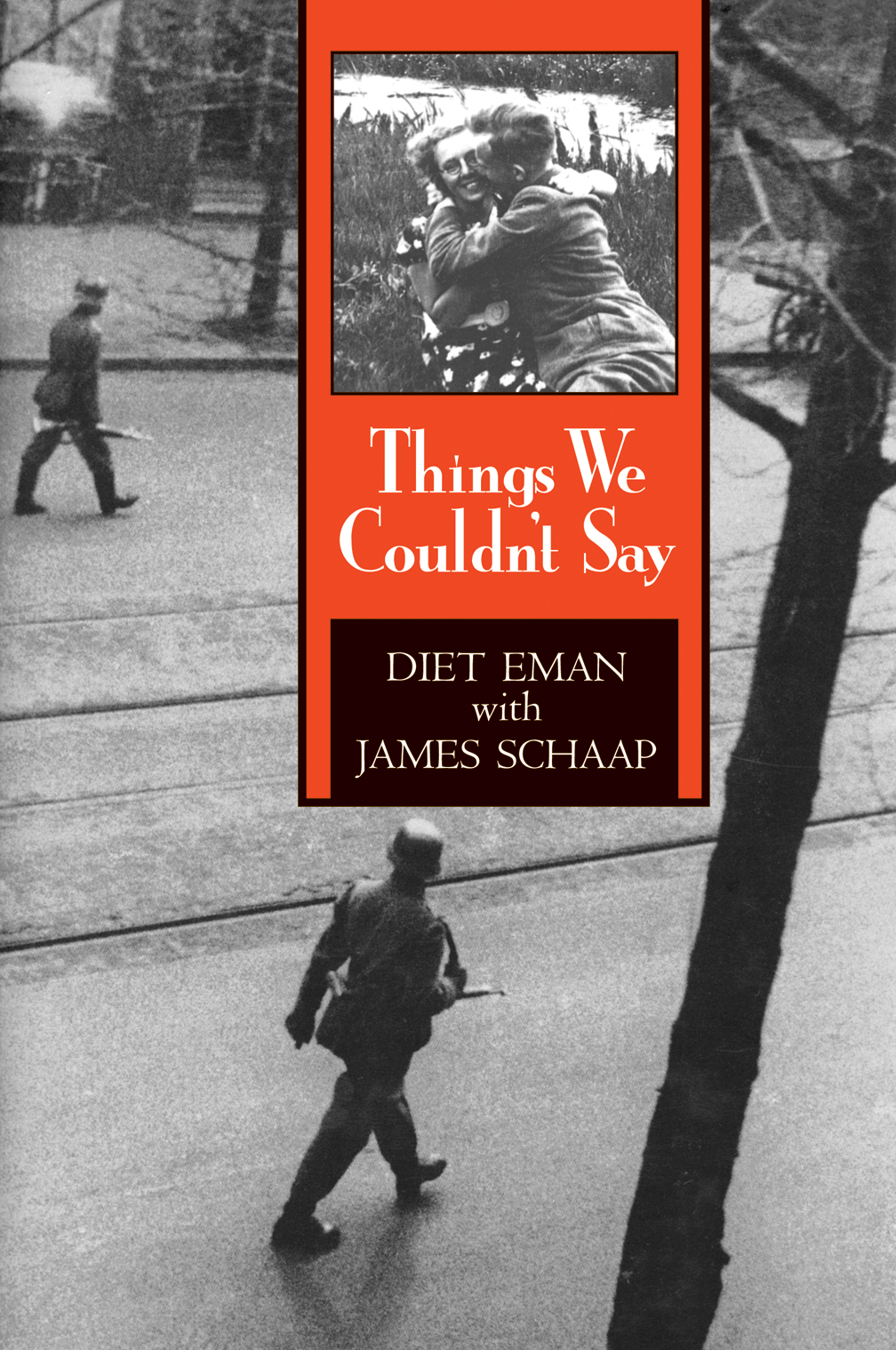
Things We Couldn’t Say (book review)

EMANPBBACK.qxdIt’s not often that a historical memoir could read like a spy thriller, but that’s exactly how Things We Couldn’t Say by Diet Eman reads.

Diet (pronounced “deet”) was a young girl when the Nazis invaded The Netherlands where she lived, and she quickly got caught up the Dutch Underground resistance against their unwelcome invaders. Alongside her fiancee, her family members, and several of her friends, they worked at hiding Jews from the Gestapo. This involved all of the tricks you would thrill at in any modern-day telling of espionage, with read page-turning excitement.

Part of the interesting underlying plot in this story is Diet’s love for her fiancee Hein and both of their families. Diet and Hein were constantly changing their names and residence to keep the Gestapo from catching up with them, yet they still found time to write some amazing love letters back and forth to each other. Their love was a bright light in a very dark time, and makes their involvement in this dangerous business even more impressive.

Not only is this a story about human ingenuity, but also about God’s divine provision as well. Diet records time after time that God miraculously provided for safety and provision and favor in order to keep alive. At the end of the war, every single one of the Jews Diet and Hein helped hide and care for were still alive!

For those reasons alone Things We Couldn’t Say is a fascinating read, but it’s an important read too. In the postscript Diet talks about her reluctance to write this book because of the painful memories it would reawaken. She said, “When the war ended we all said, ‘This can never happen again.’ But now polls show that 22 percent of the U.S. population does not believe there was a Holocaust. The story has to be retold so that history does not repeat itself.”

I can’t recommend this book strongly enough for readers of any age!

Holocaust Remembrance Week

Reagan quote at Holocaust MuseumOne of the more sobering times of my week in Washington, D.C., was the afternoon we spent at the Holocaust Museum. The dehumanizing atrocities perpetrated by one group of people on another group of people is almost unimaginable.

And yet there it was—all the nauseating evidence of man’s evil right before my eyes. It was so overwhelming that I had to hurry past the final exhibits.

Commander of the Allied Forces Dwight Eisenhower wrote to George C. Marshall, the chairman of the U.S. Joint Chief Of Staff—

“…the most interesting—although horrible—sight that I encountered during the trip was a visit to a German internment camp near Gotha. The things I saw beggar description. While I was touring the camp I encountered three men who had been inmates and by one ruse or another had made their escape. I interviewed them through an interpreter. The visual evidence and the verbal testimony of starvation, cruelty and bestiality were so overpowering as to leave me a bit sick. In one room, where they were piled up twenty or thirty naked men, killed by starvation, George Patton would not even enter. He said that he would get sick if he did so. I made the visit deliberately, in order to be in a position to give first-hand evidence of these things if ever, in the future, there develops a tendency to charge these allegations merely to ‘propaganda.’” (emphasis added)

A statement from President Ronald Reagan, from 1988, is etched on the wall of the Holocaust Museum—

“We who did not go their way owe them this: We must make sure that their deaths have posthumous meaning. We must make sure that from now until the end of days all humankind stares this evil in the face … and only then can we be sure that it will never arise again.” (emphasis added)

The rise to power of the Nazis was swift. Their evil was initially unopposed. Few voices spoke out, and even few were heeded. We must never allow this to happen again!

As George Santayana said, “Those who do not learn from history are doomed to repeat it.” As revolting as it is, we must learn from this lesson. You must look this evil in the face. You must allow your children to look this evil in the face. If we don’t, we will be doomed to live through these unthinkable atrocities all over again.

Night (book review)

Night by Elie Wiesel is not an easy read. But it is a vital read. In order to ensure that the evil perpetrated on the Jewish people by the Nazi regime never, ever happens to any other people group again, we must read what is not easy for us to read.

This book is the heart-wrenching account of the atrocities committed by the Nazis during the Holocaust. But it’s not simply a factual retelling of these horrendous events. Night takes you right into the utter despair felt by people who were completely dehumanized. People who were treated less humanely than animals. People who lived in the midst of pure Evil.

Elie Wiesel tells his firsthand account as a teenage boy forcibly removed from his home, separated from his mother and sisters, stripped of his dignity, treated in despicable ways, struggled with his anger toward God, and watched his father die right before his eyes. No one should have had to endure such things.

Elie Wiesel survived to tell his story, so that he could become the voice for the voiceless oppressed. What a great lesson for all of us to learn! We, too, should speak up for those who cannot. As Elie said in his Nobel Peace Prize acceptance speech:

We must take sides. Neutrality helps the oppressor, never the victim. Silence encourages the tormentor, never the tormented. Sometimes we must interfere. … Human suffering anywhere concerns men and women everywhere. … And action is the only remedy to indifference, the most insidious danger of all. … One person of integrity can make a difference, a difference of life and death.

Please read this book, and then be one person of integrity who makes a difference.