What Are These?

What happens when you read the Bible? Do you just read it, or do you ask questions of it? Some people seem hesitant to ask any questions, but the Bible itself is full of questions.

Zechariah was a prophet in the Old testament. If anyone would have been familiar with God’s Law, it would have been this guy. He grew up as a P.K. (priest’s kid), with several generations of religious leaders in his family tree. Yet as he was being shown the word of the Lord, he realizes how special it is, and wants to make sure he fully grasps it. So he fires away with the questions:

  • What are these?
  • What are these coming to do?
  • Where are you going? 
  • What is it? 
  • Where are they taking it?

The Word of God is living, active, and powerful. I should inquiry of it: what does this mean?

The same Holy Spirit that inspired the biblical writers is the same Holy Spirit Who will illuminate your mind to understand it.

All you have to do is ask!

See The Invisible

Noted New Atheist Richard Dawkins says,

“Faith is the great cop-out, the great excuse to evade the need to think and evaluate evidence. Faith is belief in spite of, even perhaps because of, the lack of evidence. … Faith is not allowed to justify itself by argument.”

I wholeheartedly—and even respectfully—disagree.

The Bible does define faith as “Being sure of what we hope for and certain of what we do not see.” Just a few verses later there is an even stronger statement about faith: “Without faith it is impossible to please God.

I have evaluated the evidence. I have thought long and hard about the options. I can justify all of the arguments. And my faith stands strong!

God wants all who call on Him to grow in God-pleasing faith. So I’m really excited to dive into our brand new series called SEE THE INVISIBLE this Sunday.

I hope you can join me at 10:30am this Sunday at Calvary Assembly of God.

Backcasting

Psalm 22 is a prayer of raw desperation. I love how transparent David is with his emotions. Many people would hide this sort of thing: never daring to admit that they had doubts. But David freely admits that he’s frustrated by what is happening—or actually not happening—in his life.

I see three points of David’s desperation:

  1. God, why don’t You answer me (vv. 1-2).
  2. God, why don’t You defend my honor (vv. 6-8).
  3. God, why don’t You rescue me (vv. 11-18).

Do you think David had a right to say these things against God? Remember Jesus said them too!

Do you think David was over-reacting when he said these things? Remember Jesus said them too!

David truly, deeply, felt these things. He truly believed that God wasn’t answering him, or defending him, or rescuing him. At least, AS HE THOUGHT GOD SHOULD!

But David says something VITAL after each of his points of desperation. It’s summed up in one conjunction each time…

  • Yet (vv. 3-5).
  • Yet (vv. 9-10).
  • But (vv. 19-21).

In all of these David recalls past history. David looks to the past to help him look to the future.

He BACKCASTS so that he can have a better FORECAST!

Looking back gives David assurance of God’s faithfulness. This assurance gives David hope for the future. So now look how he responds in his present desperate situation:

  • I will declare Your name (v. 22a)
  • I will praise You (v. 22b)
  • He calls others to join him in praise (v. 23)
  • He realizes that God has not hidden His face… but He has listened to his cry for help (v. 24)
  • He decides to praise God in spite of the temporary disappointments, giving all glory to God (vv. 25-31)

This is what is called a typio-prophetic Messianic psalm: what David experienced, Jesus would both experience and fulfill. So although Jesus cried out, “My God, My God, why have You forsaken Me,” He too could backcast to forecast and get the strength He needed to persevere

Let us fix our eyes on Jesus, the Author and Perfecter of our faith, Who for the joy set before Him endured the Cross, scorning its shame, and sat down at the right hand of the throne of God. (Hebrews 12:2)

This is why I’m a big believer in journals: writing things down now will give you ammunition for future trials. Then when you are in those trials, you can backcast to get a better forecast of the hope for God’s deliverance. That will give you joy in the present, just like David. And just like Jesus!

My Blind Spot

Listen to the podcast of this post by clicking on the player below, and you can also subscribe on AppleSpotify, or Audible.

Blind spots can be deadly. I simply don’t see what’s right there until—wham!—it crashes into me.

These blind spots have been called our “unconscious incompetence” zone. I’m not doing well in a certain area, but I just don’t know it yet until—wham!

Up to that point everything seems fine, but wise King Solomon said, “Smugness will destroy fools” (Proverbs 1:32).

It seems there are two ways I could deal with my unconscious incompetencies. (1) I could wait until I get blindsided by one of them; or (2) I could ask the Holy Spirit to reveal them to me. Neither option seems very pleasant, but if I’m going to get hit—wham!—it seems like a better option to let Someone who loves me, and wants the best for me, to do it (see Hebrews 12:5-11).

David thought so too. He prayed—

Search me thoroughly, O God, and know my heart! Try me and know my thoughts! And see if there is any wicked or hurtful way in me, and lead me in the way everlasting. (Psalm 139:23-24)

Or, how about Sir Francis Drake’s prayer:

Disturb us, Lord, when
We are too well pleased with ourselves,
When our dreams have come true
Because we have dreamed too little,
When we arrived safely
Because we sailed too close to the shore.

Disturb us, Lord, when
With the abundance of things we possess
We have lost our thirst
For the waters of life;
Having fallen in love with life,
We have ceased to dream of eternity
And in our efforts to build a new earth,
We have allowed our vision
Of the new Heaven to dim.

Disturb us, Lord, to dare more boldly,
To venture on wider seas
Where storms will show Your mastery;
Where losing sight of land,
We shall find the stars.

We ask You to push back
The horizons of our hopes;
And to push us into the future
In strength, courage, hope, and love.

The wham! moments will come. The question is how do you want them to come?

►► Would you please prayerfully consider supporting this ministry? My Patreon supporters get behind-the-scenes access to exclusive materials. ◀︎◀︎

Help! I’m A Single Parent!

I believe God brings us to certain places and experiences in our lives to develop more of His nature in us. One of the aspects of God’s nature is His empathy. That word literally means to be in suffering with someone. Throughout all of history, God continually tells humanity, “I feel what you feel. When you suffer, I suffer too.” The Bible also tells us that Jesus experienced everything we will ever experience, and knows just how we feel.

So this week I’m experiencing what it’s like to be a single parent. Betsy is visiting her family in California, so I’m home with our kids. Granted this is not even close to what true single parents have to cope with. They do it for years, and I’m struggling with just a week. But my week-long experience is developing greater empathy in me.

I’ve got my usual slate of activity for this week, and then I come home to a crying child who is dealing with a rough relationship issue at school. And then I’m trading texts with a coach, trying to work out details for a practice schedule for another child. And then I’m juggling how to get my kids to three different activities, which all start at almost the same time. And then I’m trying to figure out the family meals, and squeezing in a trip to the grocery store. And then I’m having a discussion with my kids about a housekeeping issue. And then … and then … and then …

God’s design was for our kids to have two parents: a Mom and a Dad. When one parent is missing, I believe God gives extra grace to the remaining parent to operate in both roles. But that isn’t God’s ideal. Into this void, Christians are supposed to step in.

  • Support organizations that assist single parents.
  • Better yet: volunteer at one of these organization.
  • Invite a single-parent family over to dinner at your house.
  • Be a mentor.
  • If your kids are going somewhere a single parent’s kids are, offer to help carpool.
  • Guys, be a father-figure to fatherless kids.
  • Ladies, be a mother-figure to motherless kids.
  • Let a single parent drop off his/her kids at your house so that parent can have some alone time.
  • Take a single parent out for coffee and let them vent.
  • Provide a scholarship to a camp for single-parent kids.

The cliché said, “It takes a village to raise a child.” I think it’s even better this way: It takes a loving Church to raise a healthy, well-balance FAMILY.

It’s time for Christians to be that Church!

Thursdays With Oswald—Revised Views Of God

This is a weekly series with things I’m reading and pondering from Oswald Chambers. You can read the original seed thought here, or type “Thursdays With Oswald” in the search box to read more entries.

Revised Views Of God

     The sign of dishonesty in a man’s creed is that he finds out defects in everyone save himself. … Trouble always arises when men will not revise their views of God. … It is a most painful thing for a man to find that his stated views of God are not adequate….

     The man who rests in a creed is apt to be a coward and refuse to come into a personal relationship with God. The whole point of vital Christianity is not the refusal to face things, but a matter of personal relationship.

From Baffled To Fight Better

Every time I read God’s Word I should be confronted with the reality that I don’t know it all. I don’t have it figured out. That’s because the Word is perfect, and I’m not. So the Holy Spirit uses the Word of God to point out flaws in my creeds and theology that need to change.

For the word of God is living and active. Sharper than any double-edged sword, it penetrates even to dividing soul and spirit, joints and marrow; it judges the thoughts and attitudes of the heart. (Hebrews 4:12)

I also need to remember that a creed is a cold, impersonal thing. But my relationship with Jesus Christ is vibrant and personal. Just as I continue to learn new things about my wife (even after 21 years of marriage), I continue to learn new things about my Savior (even after 40+ years of walking with Him).

Changing and revising my creeds is a sign of a mature, healthy relationship.

Thursdays With Oswald—Work-In-Progress

This is a weekly series with things I’m reading and pondering from Oswald Chambers. You can read the original seed thought here, or type “Thursdays With Oswald” in the search box to read more entries.

Work-In-Progress

     If you are a worker whom God has sent, and have learned to live under His shadow, you will find that scarcely a day goes by without your Father revealing the need of further chastening. If any child of God is free from the goads of God, he is not in the line of the succession of Jesus Christ.

From Approved Unto God

The writer of Hebrews said the same thing

And have you forgotten the encouraging words God spoke to you as His children? He said, “My child, don’t make light of the Lord’s discipline, and don’t give up when He corrects you. For the Lord disciplines those He loves, and He punishes each one He accepts as His child.”

It’s true: No pain, no gain. God will continue to work on you and me as His child.

Faith-Filled Vocabulary

Listen to the podcast of this post by clicking on the player below, and you can also subscribe on AppleSpotify, or Audible.

I love this short story in Judges 13. There’s this woman, who for whatever reason, cannot have a baby. The Bible doesn’t say whether she had multiple miscarriages or just simply couldn’t get pregnant. Perhaps her husband’s body wasn’t “cooperating” in the process. In any case, this is a couple who desperately wants a child to carry on their family line, but they have been frustrated.

And then an amazing thing happens!

There must have been countless couples who were childless, but an angel from God shows up to this barren woman and says, “You are going to have a baby boy!” This thrilled (and probably somewhat dazed) mother-to-be runs to tell her husband Manoah what has just happened.

We know from the Book of Hebrews that the definition of faith is being sure of what we hope for and certain of what we do not see. But how do we express this faith? … this hope? … this certainty in unseen things?

It starts with our everyday vocabulary choices.

Look at Manoah’s vocabulary. When he hears this news from his wife, he doesn’t say, “Yeah, right!” Instead, he prays this incredible faith-filled prayer:

“O Lord, I beg You, let the man of God You sent to us come again to teach us how to bring up the boy who is to be born.”

Not: “I need more proof.” Or even: “A child.” But: “The boy that is to be born.”

God answers this prayer and the angel appears again. Once again Manoah’s faith-filled vocabulary is on full display for us:

When Your words are fulfilled, what is to be the rule for the boy’s life and work?”

Not: “If.” Or even: “I hope.” But: “When Your words are fulfilled.”

What a great example from Manoah!

Is there something for which you are waiting on God? Do you feel like He’s given you an assurance in your heart for this? Then change your vocabulary—let it be faith-filled vocabulary.

Change your Ifs to Whens to show that you are confident of what you hope for and certain of what you do not see. 

►► Would you please prayerfully consider supporting this ministry? My Patreon supporters get behind-the-scenes access to exclusive materials. ◀︎◀︎

Worry Unlearned

We started a new series yesterday called The Stranglehold Of Worry. The word worry originated with shepherds. When a wild dog or a wolf had killed a sheep by grabbing it by its throat and choking it to death, the shepherds said that sheep had been worried to death.

In modern times, researchers at Purdue University found that worrying can chop 16 years off of someone’s life. Not only does worry rob your life of years, but it can also rob your years of life.

What exactly is worry? Fear is our natural response to real threats, like a car heading toward you in your lane of traffic. Worry is our response to perceived threats (to unseen things), like the car that may head toward your kids’ car when they are driving.

Get this clear: worry is being fearful of the unseen.

Compare that to the Bible’s definition of faithNow faith is being sure of what we hope for and certain of what we do not see. Worry and faith both operate in the unseen dimension.

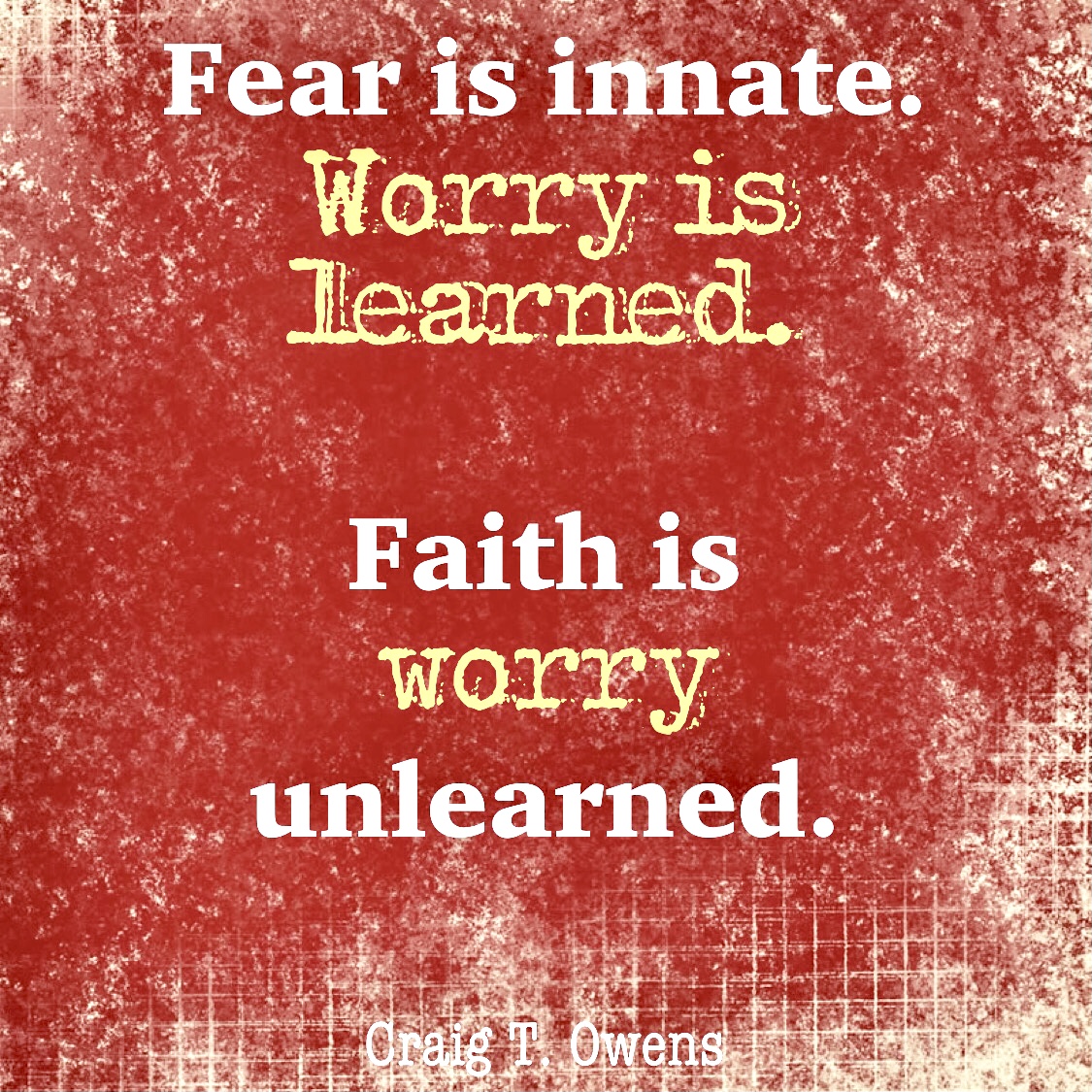
Fear is innate, but worry is learned.

Faith is worry unlearned.

Worry tells your brain a story about bad things that may happen.

Faith tells your brain a story about good things that should happen. Based on what you’ve already experienced of God’s power, what you’ve already seen in God’s provision, or what you already know of God’s promises, your faith in God can help you unlearn your worry.

The prophet Jeremiah tended to be a worrywart. Maybe that’s why he’s been called the “weeping prophet.” But in the middle of his worrying, he unlearns his worry by using his faith to tell a different story about God’s provision, power, and promises:

I well remember [the bad things], and my soul is downcast within me. Yet this I call to mind and therefore I have hope: Because of the LORD’s great love we are not consumed, for His compassions never fail. They are new every morning; great is Your faithfulness. I say to myself, “The LORD is my portion; therefore I will wait for Him.”

Did you notice that Jeremiah talked to himself? He wrote, “I say to myself.” If you have a tendency to worry, it’s time to start talking to yourself and telling yourself a different story. Instead of being fearful of the bad things you cannot see, why not be hopeful of the good things of God you can see?

Let your faith in God help you unlearn your worry. You can overcome worry and anxiety by telling yourself a new faith-filled, hope-oriented story. You can recall God’s faithfulness in the past, and apply it to your current circumstance.

What stories are you telling yourself today? Share with others how you overcame, or are in the process of overcoming worry now. Your faith story will help others overcome and unlearn their worry too.

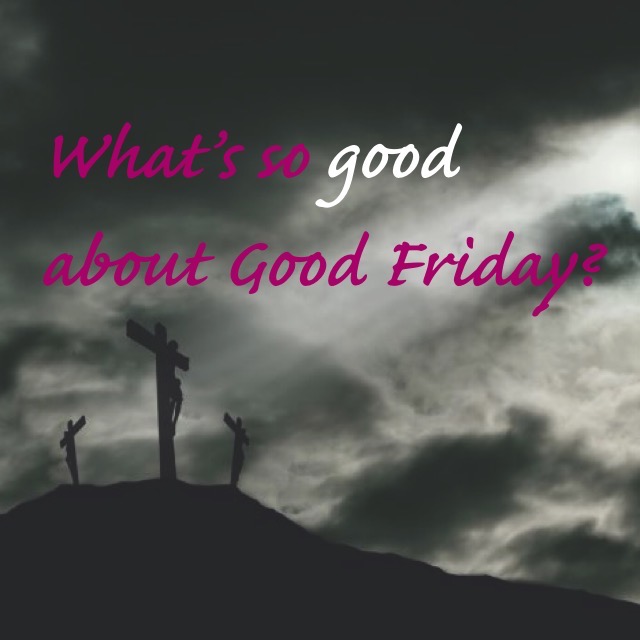
What’s So Good About Good Friday?

Good Friday? Good for whom?

For you and me? Yes.

Good for Jesus, no. It was Bad Friday for Him, wasn’t it?

Or was it?

The writer of Hebrews says, “For the joy set before Him, Jesus endured the Cross, scorning its shame.”

What joy?

It was for the joy of what was nailed to the Cross.

So what exactly was nailed to the Cross?

Isaiah records an usual statement from God –

Comfort, comfort My people, says your God. Speak tenderly to Jerusalem, and proclaim to her that her hard service has been completed, that her sin has been paid for, that she has received from the Lord’s hand double for all her sins.

That seems unfair! We receive double (!) for our sins! Here’s a brief video where I explain what this means culturally –

Only when invoices were paid-in-full did they get doubled-up.

The Bible tells us that we’ve all sinned, and that the invoice or penalty for our sin is death. We have the IOUs of sin nailed to the door of our heart where God says “You owe Me your life!” But we cannot pay this debt by ourselves.

But Jesus can. And Jesus did! Check this out –

He personally carried our sins in His body on the Cross…. (1 Peter 2:24, NLT)

Having cancelled and blotted out and wiped away the handwriting of the note with its legal decrees and demands which was in force and stood against us. This He set aside and cleared completely out of our way by nailing it to His Cross. (Colossians 2:14, AMP)

That’s what is good about Good Friday. Jesus knew that taking our sins on His body, and then allowing His body to be nailed to the Cross, would double-up and nail-down our sin once and for all!

When Jesus said, “It is finished!” He was really saying, “It is was paid-in-full!”