Steppin’ Up

Hard workHere’s a really simple true-false quiz for you. Anyone who has ever been in church should be able to handle this one simple question. Are you ready? Your one question is—True or False: The Bible contains the Word of God?

The answer is FALSE! The Bible doesn’t contain the Word of God, the Bible IS the Word of God.

  • It is inerrant = without error.
  • It is infallible = without mistake.
  • It is universally applicable regardless of age or culture.

The worldview which dominates today is usually one of pragmatism. That means people do what feels right to them in the moment, and then they determine the rightness or wrongness of their decision based on the outcome. In other words, if they like how things turned out they must have done something right, and if they don’t like the results then they must have done something wrong.

Christians, however, need to see the short-sightedness of this. The Apostle Peter shows the contrast between how accurate God’s Word is and how false teachers want to “exploit you with stories they have made up” (see 2 Peter 1:20-2:3), and how destruction is the end result for those with a pragmatic worldview.

It is by no means an easy thing for Christians to discipline themselves to have a consistent biblical worldview. It’s easy to simply reject something because it doesn’t appear to be “churchy” or receive something because it’s been done in the church for years. The hard work comes in this:

This week I’d like to give you the same challenge I gave my congregation: How can you STEP UP your involvement in the Word this week?

  • Do you need to read the Bible more?
  • Do you need to read the Bible better?
  • Do you need to meditate more on what you’ve read in the Bible?
  • Do you need to re-look at some things you’ve automatically rejected or received?
  • Do you need the Holy Spirit to overhaul your worldview?

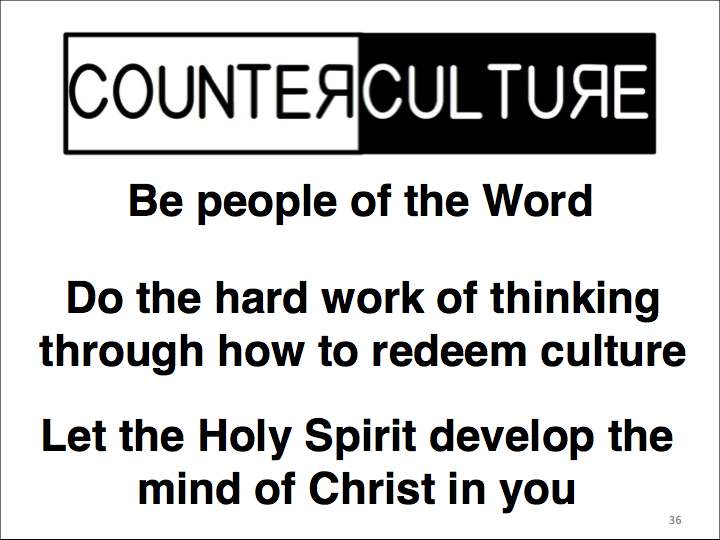
Counter Culture

Counter Culture [web]counter culture [koun-ter kuhl-cher] noun the culture and lifestyle of those people, especially among the young, who reject or oppose the dominant values and behavior of society.

What are the “dominant values and behavior” of today? Many Christians would say that what is “dominant” today appears to be those values and behavior counter to the teaching of the Bible. Can that be true?

If that is true, then how are Christians supposed to live? Are Christians supposed to adapt or modify what we believe to match the “dominant” behavior of the day?

Actually, I believe Christians are to live out a biblical worldview, and that doing so actually makes those Christians the ones who are living true counter culture lifestyles. It is that counter culture lifestyle which pleases God and attracts others to Him.

Join me this Sunday as we explore what the Bible teaches about being counter culture.

Links & Quotes

link quote

These are links to articles and quotes I found interesting today.

“The patience of hope does not turn men and women into monks and nuns, it gives men and women the right use of this world from another world′s standpoint.” —Oswald Chambers

The proper place of science in our culture: Science And Its Limits

Astronomers, cosmologists and physicists are always trying to explain the “missing” parts of their evolutionary theories: Missing Galaxy Mass Found

Very good! The Non-Physical Sides Of Sex

“You may think it out of place for me to say so, but in our churches today we are leaning too heavily upon human talents and educated abilities. We forget that the illumination of the Holy Spirit of God is a necessity, not only in our ministerial preparation, but in the administrative and leadership functions of our churches.” —A.W. Tozer

“It is not the man who has too little, but the man who craves more, who is poor.” —Seneca

“Selfish religion loves Christ for His benefits, but not for Himself.” —David Brainerd

“Few marriages can make it if both partners are hiding out from God. Show me a marriage without one partner that is close to Jesus, and I’ll show you a marriage with little chance of survival. At least one of the partners must be in daily consultation with the Lord. It is best when both husband and wife are talking to Him, but if one partner is running from God, it is all the more important that the other be able to run to a secret closet of prayer for help and direction. A praying wife can often save her marriage, as can a praying husband. Love alone is not enough to keep a marriage strong—only God’s power can do that. That power is at work right now, healing and keeping marriages. Where Jesus rules, the marriage can make it.” —David Wilkerson

Links & Quotes

link quote

These are links to articles and quotes I found interesting today.

“Once we receive the revelation of God’s glory, we cannot continue in our old ways of treating others. That must all change.” —David Wilkerson

“Do we regularly think ‘WHAT’S RIGHT WITH IT?’ instead of ‘what’s wrong with it?’ Do our opinions, as naive as they may seem to be, lift the spirits of others and promote thankfulness, joy and love? Is this how we approach our relationships, our jobs and our church? Do we look for the negative and annoying? Will we drive away from service tomorrow saying, ‘I didn’t like that song’ … or, ‘I thought that message lacked substance’ … or, ‘_______ was really rude today’ … or …  something else unkind or unnecessary? I’m guilty of negative opinions too… I’m not proud of this fact and I’m determined to see it radically change in 2014.” —Chilly Chilton

West Michigan is great place to live, and find a job, and get involved with great church: Why Unemployment Is High In Parts Of Michigan

“No Christian and, indeed, no historian could accept the epigram which defines religion as ‘what a man does with his solitude.’ It was one of the Wesleys, I think, who said that the New Testament knows nothing of solitary religion.” —C.S. Lewis

Muslims are finding Jesus! A Wind In The House Of Islam

Stunning Photos Of Earth From Above

A touching story about Hockeytown′s famous #9: The Best Gift Ever Given To Gordie Howe

A great reminder/challenge from Max Lucado: Someday

Tim Elmore′s helpful advice for anyone working with youth: Six Steps To Prepare For The Coming Culture Shift

“I used to ask God to help me. Then I asked if I might help Him. I ended up by asking Him to do His work through me.” —Hudson Taylor

Links & Quotes

link quote

These are links to articles and quotes I found interesting today.

“C.S. Lewis wrote that the most dangerous ideas in a society aren’t the ones argued, but the ones assumed. For most of us—myself included—it’s tempting to take up arms and jump in the trenches every time a loud and headline-grabbing controversy breaks. But if Lewis was right, it’s not the moments of intense crossfire that are the most culturally significant. They come and go. But it is those times, like the Grammy Awards, when culture doesn’t react, that really signal where we are” (John Stonestreet). Read John′s full commentary: Why The Grammys Mattered More Than Miley

[VIDEO] Very fun: The Great Grasshoppers!

7 More Ways Husbands & Wives Injure Each Other Without Even Knowing It

“The best style of prayer is that which cannot be called anything but a cry.” —Charles Spurgeon 

[VIDEO] Amazing (and cold!!): Surfing Lake Michigan


8 Quotes From “I Never Thought I’d See The Day”

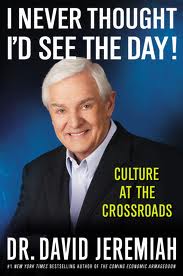
I Never Thought I'd See The DayYou can read my book review of Dr. David Jeremiah’s I Never Thought I’d See The Day by clicking here. These are eight quotes that especially caught my attention in this book. Unless the quotes are otherwise attributed, they are from Dr. Jeremiah.

“I’ve shaken my fist in anger at stalled cars, storm clouds, and incompetent meteorologists. I’ve even, on one terrible day, that included a dead alternator, a blaring tornado-warning siren, and a horribly wrong weather forecast, cursed all three at once. I’ve fumed at furniture, cursed at crossing guards, and held a grudge against Gun Barrel City, Texas. I’ve been mad at just about anything you can imagine.

“Except unicorns. I’ve never been angry at unicorns.

“It’s unlikely you’ve ever been angry at unicorns either. We can become incensed by objects and creations both animate and inanimate. We can even, in a limited sense, be bothered by the fanciful characters in books and dreams. But creatures like unicorns that don’t exist—that we truly believe not to exist—tend not to raise our ire. We certainly don’t blame the one-horned creatures for our problems.

“The one social group that takes exception to this rule is atheists. They claim to believe that God does not exist and yet, according to empirical studies, tend to be the people most angry at Him.” —Joe Carter

“While the atheist arrogantly persists in the delusion that his reason is fully capable of figuring out all that there is, the religious believer lives in the humble acknowledgment of the limits of human knowledge, knowing that there is a reality greater than, and beyond, that which our senses and minds can ever apprehend.” —Dinesh D’Souza

“God brought two perfect, sinless people together in the Garden of Eden, a man and a woman who knew the perfect love of God. They did not get married to find love but to walk together in the unity and purpose God created them to fulfill: the primary task of birthing and raising the next generation. And in the process, love happened.”

“It is significant that while Adam was single, satan did not approach him or tempt him to disobey God. He waited until after Adam’s marriage to launch his attack. You would think it easier to attack one person instead of two, but by waiting he was able to attack not just an individual, but also God’s foundational building block for harmony and stability—marriage. By attacking marriage, he was able to create division and disharmony between humans themselves as well as between humans and God.”

“The oneness found in marriage is the same kind of oneness found in the Trinity.”

“We can be lulled into complacency by adopting uncritically the principle of submission to government on the assumption that the Christian history of our nation makes it safe to let our leaders do our thinking for us. But we cannot do this in our post-Christian nation where God’s Word is being marginalized. Nothing could be more dangerous for Christians and churches than to wander thoughtlessly down this path of increasing biblical indifference—a path that could well lead to a place where the Bible is not merely marginalized, but banned outrightly.”

“If the Church is being ignored because we preach the message of ‘Jesus Christ and Him crucified’ (1 Corinthians 2:2), or because the Gospel has become ‘a stumbling stone and rock of offense’ (Romans 9:33) to the world, that’s one thing. But if we are deemed irrelevant because we’re an anemic version of the world’s entertainment options or because we aren’t playing the world’s game nearly as well as the world does, then that’s another thing. That’s a tragedy.”

“William Tyndale wisely sought to avoid the confusion between ‘Church” and ‘church’ by translating ekklesia as ‘congregation’ instead of ‘church.’ …We must maintain a clean understanding of the difference between Church and church—and the priority of the former over the latter. Church buildings can necessitate huge investments of resources for construction and maintenance, and they are only temporary. Keeping the focus on people is the biblical priority and will result in the Church’s remaining relevant.”

I Never Thought I’d See The Day (book review)

I Never Thought I'd See The DayThe subtitle of Dr. David Jeremiah’s book is the most telling—I Never Thought I’d See The Day: Culture At The Crossroads. It is true that our American culture is at a crossroads, and decisions will have to be made now that could very well effect the direction of the church, and of this nation.

As a side note, I have a bit of an issue with the title of the book. To think we’d never see the day where our culture was sliding away from God’s standard is a bit of hyperbole. Any student of history knows that cultures have always gone through such things many, many times. What is true with American culture now has been true with other cultures, in other eras, on other continents. However, this by no means that Dr. Jeremiah has misdiagnosed where America is now.

Before a cure can be realized, a patient must first know he is sick. Then he must go to a doctor and be willing to follow the prescribed course of treatment. In many ways, Americans know something’s “not quite right” with our society, but have been unable to pinpoint the root cause. Dr. Jeremiah correctly diagnoses an American culture that has become increasingly humanistic, antagonistic toward Jesus, pluralistic, and obstinate toward the teachings of the Bible. In each chapter, Dr. Jeremiah diagnoses one symptom of our disease, and lays out a God-honoring cure.

Here’s the million dollar question: Will we follow the course of treatment?

In the last chapter, Dr. Jeremiah says,

I am pessimistic about man’s ability, independent from his Creator-God, to solve the problems he creates—especially problems of enormous scale such as those our nation and the world face today. I am, however, an optimist about God. And it is toward Him that we must turn our attention….

I Never Though I’d See The Day is a sobering read. Each chapter shows us just how far from God we’ve slid (that’s the pessimistic part), but then Dr. Jeremiah lays out a plan to bring us back to a God-fearing society (that’s the optimistic part). It’s a very interesting read which I especially think church leaders and God-fearing civic leaders must read.

I am a Faith Words book reviewer.

Check out some quotes from this book here.

The Next Christians (book review)

If you’re anything like me, you might feel that a lot of recently-released books and the current research results seem to paint a rather bleak picture of the church. Reading these works makes it sound like the church is in decline, it has lost its authority in the community, and people are finding Christianity less and less relevant in their lives. But Gabe Lyons has “the good news about the end of Christian America” in his book The Next Christians.

Where many Christians are either withdrawing from mainstream society, or are selling-out to it in an attempt to be accepted (Gabe calls these the Separatists or Culturals, respectively), Gabe happily points out that the next Christians coming to the forefront are Restorers. These Christians are not running away from culture, but are running to it in a way that makes the Gospel both relevant and appealing.

Gabe points out that the Restorers are defined by six descriptive phrases:

  • Provoked, not offended when they confront the unbiblical in culture
  • Creators, not critics of what mainstream culture is producing
  • Called, not just employed in “a job”
  • Grounded in Christian disciplines, not distracted by the tasks around them
  • Committed to their community, not isolating themselves from it
  • Countercultural, without attempting to become “relevant”

The Next Christians made me stand up and cheer, “Yes! This is how I want to live!” I could hardly put this book down. Now that I’ve finished reading it, I’ll be referring to these concepts again and again, both in my personal life, and in my calling as a pastor.

If you are ready to see Christians reassume their place in society like the Bible describes it, you will love reading The Next Christians.

I am a Doubleday book reviewer.

Receive Reject Redeem

At Calvary Assembly of God, we talked about the culture of media in our series In It Not Of It.

The main point I made yesterday is that we need to be aware of the messages the media is sending out, but not pre-occupied by those media messages.

Then we need to decide what part(s) of media we can receive, what part(s) we must reject, and what part(s) we can attempt to redeem.

The final point I would add for Christians who want to biblically engage their culture, is a point I made yesterday—

Instead of criticizing media … critique it. That means skillfully and artfully addressing it.

Instead of condoning media … challenge it by asking “Is this the best message” questions.

When deciding to receive, reject or redeem—or critique and challenge—use this filter from Philippians 4:8.

Does this pass the filter of being true … noble … right … pure … lovely … admirable … excellent … praiseworthy? If so, I can defintiely receive it. However, if it doesn’t meet ALL of these criteria, then I must decide if I can redeem it. If can’t redeem it, then it must be rejected.

Engaging Culture

There has been a debate in religious circles for a long, long time about how involved Christians should be in culture.

  • Get close to outsiders. But how close is too close?
  • Be friendly with your neighbors. But how friendly is too friendly?

The debate usually has two extremes: Either get immersed in your world, or don’t even touch a thing of this world. I hate either-or’s!

Instead I think there is a both-and balance that is very biblical. We need to ENGAGE our culture. Engaging culture means that we understand it and can relate to it, but we don’t give in to it nor compromise with it.

We Must Be In It But Not Of It

I’ll be addressing this topic in a new series at Calvary Assembly of God. I hope you’ll be able to join me to learn about the biblical ways we should be engaging our culture.