8 Quotes From “I Never Thought I’d See The Day”

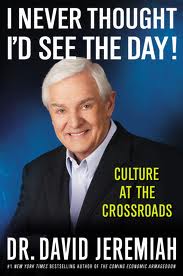
I Never Thought I'd See The DayYou can read my book review of Dr. David Jeremiah’s I Never Thought I’d See The Day by clicking here. These are eight quotes that especially caught my attention in this book. Unless the quotes are otherwise attributed, they are from Dr. Jeremiah.

“I’ve shaken my fist in anger at stalled cars, storm clouds, and incompetent meteorologists. I’ve even, on one terrible day, that included a dead alternator, a blaring tornado-warning siren, and a horribly wrong weather forecast, cursed all three at once. I’ve fumed at furniture, cursed at crossing guards, and held a grudge against Gun Barrel City, Texas. I’ve been mad at just about anything you can imagine.

“Except unicorns. I’ve never been angry at unicorns.

“It’s unlikely you’ve ever been angry at unicorns either. We can become incensed by objects and creations both animate and inanimate. We can even, in a limited sense, be bothered by the fanciful characters in books and dreams. But creatures like unicorns that don’t exist—that we truly believe not to exist—tend not to raise our ire. We certainly don’t blame the one-horned creatures for our problems.

“The one social group that takes exception to this rule is atheists. They claim to believe that God does not exist and yet, according to empirical studies, tend to be the people most angry at Him.” —Joe Carter

“While the atheist arrogantly persists in the delusion that his reason is fully capable of figuring out all that there is, the religious believer lives in the humble acknowledgment of the limits of human knowledge, knowing that there is a reality greater than, and beyond, that which our senses and minds can ever apprehend.” —Dinesh D’Souza

“God brought two perfect, sinless people together in the Garden of Eden, a man and a woman who knew the perfect love of God. They did not get married to find love but to walk together in the unity and purpose God created them to fulfill: the primary task of birthing and raising the next generation. And in the process, love happened.”

“It is significant that while Adam was single, satan did not approach him or tempt him to disobey God. He waited until after Adam’s marriage to launch his attack. You would think it easier to attack one person instead of two, but by waiting he was able to attack not just an individual, but also God’s foundational building block for harmony and stability—marriage. By attacking marriage, he was able to create division and disharmony between humans themselves as well as between humans and God.”

“The oneness found in marriage is the same kind of oneness found in the Trinity.”

“We can be lulled into complacency by adopting uncritically the principle of submission to government on the assumption that the Christian history of our nation makes it safe to let our leaders do our thinking for us. But we cannot do this in our post-Christian nation where God’s Word is being marginalized. Nothing could be more dangerous for Christians and churches than to wander thoughtlessly down this path of increasing biblical indifference—a path that could well lead to a place where the Bible is not merely marginalized, but banned outrightly.”

“If the Church is being ignored because we preach the message of ‘Jesus Christ and Him crucified’ (1 Corinthians 2:2), or because the Gospel has become ‘a stumbling stone and rock of offense’ (Romans 9:33) to the world, that’s one thing. But if we are deemed irrelevant because we’re an anemic version of the world’s entertainment options or because we aren’t playing the world’s game nearly as well as the world does, then that’s another thing. That’s a tragedy.”

“William Tyndale wisely sought to avoid the confusion between ‘Church” and ‘church’ by translating ekklesia as ‘congregation’ instead of ‘church.’ …We must maintain a clean understanding of the difference between Church and church—and the priority of the former over the latter. Church buildings can necessitate huge investments of resources for construction and maintenance, and they are only temporary. Keeping the focus on people is the biblical priority and will result in the Church’s remaining relevant.”
I Never Thought I’d See The Day (book review)

I Never Thought I'd See The DayThe subtitle of Dr. David Jeremiah’s book is the most telling—I Never Thought I’d See The Day: Culture At The Crossroads. It is true that our American culture is at a crossroads, and decisions will have to be made now that could very well effect the direction of the church, and of this nation.

As a side note, I have a bit of an issue with the title of the book. To think we’d never see the day where our culture was sliding away from God’s standard is a bit of hyperbole. Any student of history knows that cultures have always gone through such things many, many times. What is true with American culture now has been true with other cultures, in other eras, on other continents. However, this by no means that Dr. Jeremiah has misdiagnosed where America is now.

Before a cure can be realized, a patient must first know he is sick. Then he must go to a doctor and be willing to follow the prescribed course of treatment. In many ways, Americans know something’s “not quite right” with our society, but have been unable to pinpoint the root cause. Dr. Jeremiah correctly diagnoses an American culture that has become increasingly humanistic, antagonistic toward Jesus, pluralistic, and obstinate toward the teachings of the Bible. In each chapter, Dr. Jeremiah diagnoses one symptom of our disease, and lays out a God-honoring cure.

Here’s the million dollar question: Will we follow the course of treatment?

In the last chapter, Dr. Jeremiah says,

I am pessimistic about man’s ability, independent from his Creator-God, to solve the problems he creates—especially problems of enormous scale such as those our nation and the world face today. I am, however, an optimist about God. And it is toward Him that we must turn our attention….

I Never Though I’d See The Day is a sobering read. Each chapter shows us just how far from God we’ve slid (that’s the pessimistic part), but then Dr. Jeremiah lays out a plan to bring us back to a God-fearing society (that’s the optimistic part). It’s a very interesting read which I especially think church leaders and God-fearing civic leaders must read.

I am a Faith Words book reviewer.

Check out some quotes from this book here.

My Brothers

My brothersPastor, I love how the Apostle James consistently addresses his audience in his epistle. Over a dozen times in his five short chapters, Pastor James addresses his congregation as my brothers (sometimes the phrase is even my dear brothers).

The word brothers is always the Greek word adelphos, which means from the same womb. James didn’t elevate himself, nor put down others in the church; he constantly put himself on the same plain. He was saying, “Look, I struggle with what you struggle with—we all have the same issues. I’m not immune to these things because I’m the so-called leader of the Jerusalem church. I have to keep alert and keep on working in these areas too!”

Sometimes James adds the adjective dear (or as the KJV says, beloved). This word is from the root word which means to be fond of someone, to love dearly, or to be well pleased. James, in essence, is saying, “I like you! You’re not just someone that goes to church with me, but you’re a dear friend.”

As the adage goes—People don’t care how much you know until they know how much you care. So almost every point James covers in this epistle is introduced by the my brothers tag. It’s his way of reminding them, “I’m sharing this with you because I really like you, and I want us to grow closer to God together.”

Wow! What a great example for me as a pastor. I’m not immune to struggles. I’m not in a separate category. I’m in this with my dear brothers and sisters, and I want us to all overcome and grow in our level of intimacy with God together.

UPDATE: This is one of the major themes in my book for pastors called Shepherd Leadership. I hope you will check it out!

The Contemplative Pastor

Search mePastors can get caught in a rut, just like anyone in any number of other professions. That’s why it’s so vital for us to pause often to make sure we haven’t slipped into something without being aware of its impact.

It is absolutely vital for pastors to have regular quiet time with God. Read the Word, pray, contemplate, read other pastors (especially the “old guys”), pray, and contemplate some more. Let the Holy Spirit point out to you any blind spots.

I’ve been contemplating two quotes from the “old guys” over the last few days.

[1] “We prefer to build up converts to our own point of view.” —Oswald Chambers

I want to make sure I’m always allowing the Holy Spirit to be as unique with others as He is with me. I need to be cautious that I’m not making my practices the universal practices for everyone. I need to give these converts a solid biblical foundation, and then let the Spirit build them up as He knows best.

[2] “Recollect, as ministers, that your whole life, your whole pastoral life especially, will be affected by the vigor of your piety. If your zeal grows dull, you will not pray well in the pulpit; you will pray worse in the family, and worst in the study alone. When your soul becomes lean, your hearers, without knowing how or why, will find that your prayers in public have little savor for them; they will feel your barrenness, perhaps, before you feel it yourself.” —Charles Spurgeon

I need to be a praying pastor. My sermons must be birthed in prayer before I deliver them, and sealed in prayer after I deliver them; my appointments must be covered in prayer; my schedule must be directed by prayer; my relationships must be nurtured through prayer. I must be in prayer continually if I am to be effective at anything.

My fellow pastor, I hope you are taking the time to contemplate: to be quiet as you ponder how the Holy Spirit is speaking to you. It is absolutely vital for the health of the part of the Body of Christ to which we minister.

Performance-Oriented Church?

D.A. CarsonOh, my fellow pastor, may this never (ever!) be said of our churches…

We have become so performance-oriented that it is hard to see how compromised we are. Consider one small example. In many of our churches, prayers in morning services now function, in large measure, as the time to change the set in the sanctuary. The people of the congregation bow their heads and close their eyes, and when they look up a minute later, why, the singers are in place, or the drama group is ready to perform. It is all so smooth. It is also profane. Nominally we are in prayer together addressing the King of Heaven, the sovereign Lord. In reality, some of us are doing that while others are rushing on tiptoes around the stage and others, with their eyes closed, are busy wondering what new and happy configuration will confront them when it is time to take a peek. Has the smoothness of the performance become more important to us than the fear of the Lord? Has polish, one of the modern equivalents of ancient rhetoric, displaced substance? Have professional competence and smooth showmanship become more valuable than sober reckoning over what it means to focus on Christ crucified?” —D.A. Carson (emphasis added)

Nicest Of Compliments

On Sunday my amazing church took some time to express their appreciation to me. It was very humbling and gratifying to hear how God has allowed me to invest in the lives of such wonderful people.

After the service, I was munching on some cake and talking with some folks. I approached one lady in our church to ask about a situation in her life. It turns out that the situation I was asking about was one of those “tip of the iceberg” things. She then proceeded to unload all of the frustrations she’s been carrying around over the past couple of weeks.

It was nice hearing the kind words of my congregations, but this lady’s rant (that was her word for it) was one of the nicest compliments!

Why do I say this? Because she felt comfortable enough to lose the mask, drop the pose, and be real!

Read the Psalms and you will see how many times the psalmists let loose in God’s presence. They tell God how difficult things have been, how many bad guys are out to get them, and how rotten they feel. They unload all of these raw emotions in His presence, and that is the first step toward receiving God’s healing.

In the New Testament, Christians are encouraged to bear one another’s burdens, but that’s awfully hard to do if we keep our burdens to ourselves.

Church should be the safest place for us to unload the burdens we are carrying! That’s why I felt like I received such an amazing compliment when this precious lady felt secure enough to share what was really going on.

I pray that you have a church or Christian friends with whom you can unload your over-taxing burdens. And I pray that you can be the church where others feel safe enough to trust you with their burdens.

No Competition In Church

What great words from A.W. Tozer!

“It is too bad that anything so obvious should need to be said at this late date, but from all appearances, we Christians have about forgotten the lesson so carefully taught by Paul: God’s servants are not to be competitors, but co-workers. … A local church, as long as it is indwelt by the Holy Spirit, cannot entertain the psychology of competition. When it begins to compete with another church, it is a true church of God no longer; it has voided its character and gone down onto a lower level. The Spirit that indwells it is no longer divine; it is human merely, and its activities are pitched on the plane of the natural. … The Holy Spirit always cooperates with Himself in His members. The Spirit-directed body does not tear itself apart by competition. The ambitions of the various members are submerged in the glory of the Head, and whatever brings honor to the Head meets with the most eager approval of the members. We should cultivate the idea that we are co-workers rather than competitors. We should ask God to give us the psychology of cooperation. We should learn to think of ourselves as being members in particular of one and the same body, and we should reject with indignation every suggestion of the enemy designed to divide our efforts.”

As Tozer said, it is too bad that we have to be reminded of the fact that the church should never be in competition with itself. It makes me appreciate all the more the relationship the churches in Cedar Springs have with each other!

Attaboy!

October has been designated as Clergy Appreciation Month. Some pastors live from “Attaboy!” to “Attaboy!” from their congregation, so October is like a feast for them!

But the apostle Paul has a slightly different perspective on this. More than getting an “Attaboy!” from a church congregation, he is joyful over the “Attaboy!” he hears from God.

For what is our hope, our joy, or the crown in which we will glory in the presence of our Lord Jesus when He comes? Is it not you? Indeed, you are our glory and joy.

For now we really live, since you are standing firm in the Lord. How can we thank God enough for you in return for all the joy we have in the presence of our God because of you? (1 Thessalonians 2:19-20; 3:8-9)

Paul’s goal is seeing people who have been changed because of their relationship with Jesus. And these changed lives are all the reward he desires!

YOU ARE OUR GLORY AND JOY! 

Pastor, it’s nice when you get the “Attaboys!” from your congregation. But what’s even better is to help your congregation enter into a deeper relationship with Christ, and then hear the “Attaboy!” from God Himself!

What an amazing joy that we get to play a small role in helping people stand firm in the Lord!

Thursdays With Oswald—Not A Saint, But Many Saints

Listen to the podcast of this post by clicking on the player below, and you can also subscribe on AppleSpotify, or Audible.

This is a weekly series with things I’m reading and pondering from Oswald Chambers. You can read the original seed thought here, or type “Thursdays With Oswald” in the search box to read more entries.

Not A Saint, But Many Saints 

     The Book of God is insistent on this: we cannot develop a holy life alone, it would be a selfish life, without God in it and wrong. …

     Beware of isolation; beware of the idea that you have to develop a holy life alone. It is impossible to develop a holy life alone, you will develop into an oddity and a peculiarism, into something utterly unlike what God wants you to be. The only way to develop spiritually is to go into the society of God’s own children, and you will soon find how God alters your set. God does not contradict our social instincts, He alters them. 

From Biblical Psychology 

I’ve got news for you: It’s not about you as an individual.

If you have asked God to forgive you of your sins because you believed that Jesus paid the price for your salvation on the Cross, you haven’t just been saved from death; you’ve also been saved to a fuller life. A key component of this fuller life is your interaction with other Christians.

Search through the New Testament and you will find that the word saint never appears in the singular form—it’s always plural: saintS.

I need other Christians to help form Christlike character in me, and other Christians need me to do the same for them. Don’t ever buy into the lie that you can be a Christian and live an isolated life.

You are a part of the Body of Christ. Don’t rob the Body of your vital role! Together we saintS are so much stronger and more effective than a solitary, isolated saint.

►► Would you please prayerfully consider supporting this ministry? My Patreon supporters get behind-the-scenes access to exclusive materials. ◀︎◀︎

THAT Kind Of Church

Listen to the podcast of this post by clicking on the player below, and you can also subscribe on AppleSpotify, or Audible.

The book of James is written to a bunch of Christians. James knew his audience was the Church (see James 1:1).

Keep that firmly in mind when you read these words from James 3:2—

We all stumble in many ways. (New International Version)

For we all often stumble and fall and offend in many things. (Amplified Bible)

Indeed, we all make many mistakes. (New Living Translation)

I hate to break the news to you, but that means:

  • Your pastor’s not perfect
  • Your church isn’t perfect
  • You’re not perfect

You attend a church with people who stumble, and offend, and mess it up. Your pastor stumbles, and offends, and messes up. And so do you!

Isn’t that wonderful?! We all make mistakes! So we all need to give and receive the same forgiveness. We all need to extend grace to others and receive grace from others. You need to help others back up when they stumble, and you need to admit when you’ve stumbled, and let others help you get back up.

Abraham Kuyper wrote—

“Sin is a destroyer that creeps in everywhere. Therefore we must expect an imperfect church. In fact, we church members carry the sin of the world with us into the church, too often hiding it under a veil of spirituality. If the church were not the Bride of His Son, surely God would in holy wrath destroy not first of all the church, but rather first of all the wretched sin-ridden church.”

To these beautifully imperfect Christians, James concludes his teaching with these words:

Confess your sins to each other and pray for each other so that you may be healed. The prayer of a righteous man is powerful and effective. … My brothers, if one of you should wander from the truth and someone should bring him back, remember this: Whoever turns a sinner from the error of his way will save him from death and cover over a multitude of sins. (James 5:16, 19-20)

Yeah, let’s be THAT kind of church!!

►► Would you please prayerfully consider supporting this ministry? My Patreon supporters get behind-the-scenes access to exclusive materials. ◀︎◀︎