Savoring It

For those of you who asked, here is the quote I shared this morning from John Piper—

“If you don’t read the Word and memorize the Word and meditate on the Word daily and delight in the Word and savor it and have your mind and emotions shaped by the Word, you will be a weak Christian at best. You will be fragile and easily deceived and easily paralyzed by trouble and stuck in many mediocre ruts. But if you read the Word and memorize important parts of it and meditate on it and savor it and steep your mind in it, then you will be like a strong tree planted by streams of water that brings forth fruit. Your leaf won’t wither in the drought and you will be productive in your life for Christ.”

If You’re Going To Do It, Then Do It

Have you ever watched someone attempt something they really didn’t want to do? Like when a parent asks a child to pull weeds in the garden—they go grumbling, dragging their feet, finding excuses to delay starting, pull a couple of weeds, and then complain about the heat. Is it any wonder that the job takes twice as long and is completed half as well as it should have been?!?

Solomon wrote this:

Whatever your hand finds to do, do it with all your might… (Ecclesiastes 9:10).

In other words, it’s like my Mom used to always remind me: If anything’s worth doing, it’s worth doing well!

Don’t go halfway. Put all you’ve got into it and get it done. And done well.

I think Solomon (and my Mom) would have loved Seth Godin’s blog post called Outsmart

Outsmart

or…

Outlead

Outcare

Outmaneuver

Outinvest

Outlisten

Outconnect

Outgive

Outlearn

Outwork

Outspend

Outrespect

Outinnovate

Outrisk

Outpersevere

Outinspect

Outproduce

Outrisk

Outlove…

In my opinion, no one should work harder, more enthusiastically, better, smarter, and more lovingly than one who calls themselves a follower of Jesus Christ. Check out my ongoing series of posts on godly leadership.

Perfect? Yes!

The opening words of Psalm 119 describe the end result of going through what I’m calling the P119 Spiritual Workout. In a word: Blessed.

In fact, this word is so exciting that the Hebrew language uses the emphatic thought here. Bringing that into English means that the first two verses of this chapter both begin…

O!! How blessed!!

That’s a wonderful goal, but the next two verses seem to bring us crashing back to earth. In order to enjoy these heights of blessing we are asked to live like this:

  • They do nothing wrong as they walk in His ways (v. 3).
  • God’s precepts are to be fully obeyed (v. 4).

Yikes! Nothing wrong?! Full obedience?! No mistakes?!

Even Jesus said, “Be perfect, therefore, as your Heavenly Father is perfect” (Matthew 5:48).

But pay attention to this: The sign of a maturing Christian is not one who never sins; the sign of a maturing Christian is one who is closing the gap between sin and repentance.

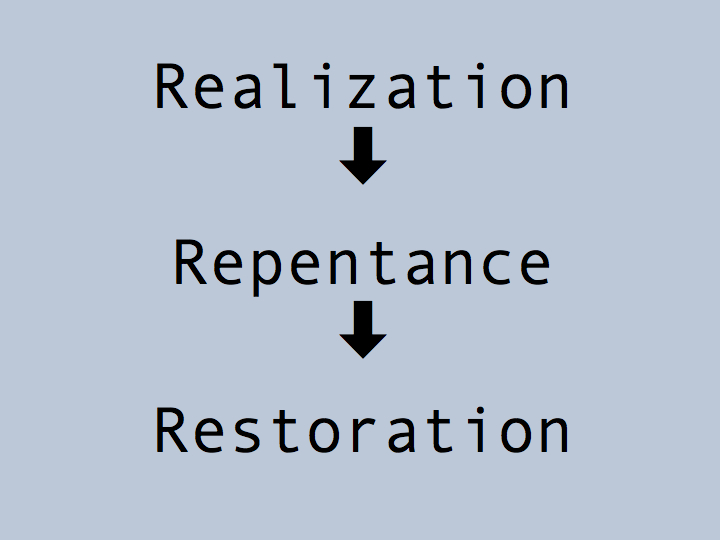
How does that work? Here’s the progression…

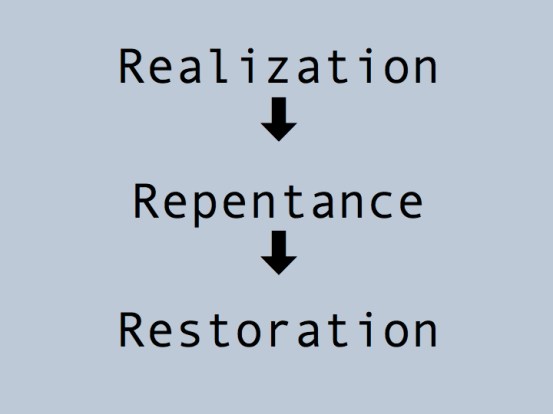
Realization of sinRepentance of sin → Restoration of God’s blessing

The time gap between our repentance and God’s restoration is faster than the blink of an eye—faster than you can even comprehend. What often takes us a while is moving from realization to repentance. Instead, we explain, and justify, and make excuses, and drag our feet.

But a maturing Christian invites the inspection of the Holy Spirit through the reading of God’s Word and then is quick to realize sin and repent from it. When God restores us, do you know how we appear to Him? PERFECT!!

So realizing our sin, repenting of that sin, and experiencing God’s restoration is the fastest way to live as those who do nothing wrong and who are fully obeying God’s precepts.

Don’t wait any longer: realize and repent, and then experience God’s restoration as you stand perfect in His presence!

If you have missed any of the messages in our P119 series, you can access them all by clicking here.

Thursdays With Oswald—In Christ I Can

This is a weekly series with things I’m reading and pondering from Oswald Chambers. You can read the original seed thought here, or type “Thursdays With Oswald” in the search box to read more entries.

In Christ I Can

     We are made sons and daughters of God through the Atonement and we have a tremendous dignity to maintain; we have no business to bow our necks to any yoke saving the yoke of the Lord Jesus Christ [Matthew 11:28-30]. …

     Every detail of our physical life is to be absolutely under the control of the new disposition which God planted in us by means of identification with Jesus Christ, and we shall no longer be allowed to murmur ‘can’t.’ There is no such word as ‘can’t’ in a Christian’s vocabulary if he is rightly related to God; there is only one word and that is ‘can.’

From Biblical Psychology

Sometimes Christians are known more for what we’re against than what we’re for. I think Oswald Chambers would say that is because we don’t really understand the full power of the Atonement.

We can better understand that word by saying it “at one-ment.” We have been made one with Christ. You hear this in Jesus’ prayer for us in John 17, I in them and You in Me, in order that they may become one and perfectly united, that the world may know and definitely recognize that You sent Me and that You have loved them even as You have loved Me.”

When we are in this sort of relationship, we don’t even say can’t to sin. Instead, we say I can live a holy life because of Christ in me!

As Paul said, we can say:

I CAN do everything through Christ Who gives me strength. (Philippians 4:13)

Thoughts From C.S. Lewis

I’ve been re-reading some of my notes that I made on a collection of essays from C.S. Lewis. He is one of my favorite authors, always helping me to see the spiritual realm in a whole new light.

These are just a few quotes that have me thinking…

“A live body is not one that never gets hurt, but one that can to some extent repair itself. In the same way a Christian is not a man who never goes wrong, but a man who is enabled to repent and pick himself up and begin over again after each stumble—because the Christ-life is inside him, repairing him all the time, enabling him to repeat (in some degree) the kind of voluntary death which Christ Himself carried out.”

“There are two ways in which the human machine goes wrong. One is when human individuals drift apart from one another, or else collide with one another and do one another damage. The other is when things go wrong inside the individual—when the different parts of him either drift apart or interfere with one another.”

“Those cautions which the tempter whispers in our ears are all plausible…. That is the truth in the temptation. The lie consists in the suggestion that our best protection is a prudent regard for the safety of our pocket, our habitual indulgences, and our ambitions.”

“When a man is getting better he understands more and more clearly the evil that is still left in him. When a man is getting worse he understands his own badness less and less. … Good people know about both good and evil: bad people do not know about either.”

If you haven’t read C.S. Lewis for yourself, he writes in so many different genres that you can find something for almost any taste: science fiction, children’s fairy tales, theology, apologetics, and on and on. He was truly gifted by God to see our world in a different light, and you will be greatly enriched by reading as much as you can from this master author.

Do You Know Your Community?

Jesus called His followers to be salt and light. It’s pretty easy to figure out that the salt cannot season the food if it stays in the saltshaker, and the light cannot illuminate the darkness if it stays covered up. In order to season and shine in your community, you have to know your community.

And, pastor, that starts with you.

What you do is a much more effective sermon that what you say. Pastor, you need to know your community, so that you can be involved in your community, so that you and your church can season and shine in your community together.

So let me ask a couple of questions:

  • Do you know your Mayor / City Manager / Township Supervisor? If you don’t know them, how can you affirm their leadership (Romans 13:1-7)?
  • Do you attend City / Township Council meetings? If you don’t, how will you know what issues they’re wrestling with? If you don’t know those issues, how can you pray effectively for them (1 Timothy 2:1-2)?
  • Are you involved in your community? Don’t just assume people in your community will come to your church to sit among stranger to hear a stranger speak; instead, be so involved in your community that they will come to church to fellowship with friends and hear a friend speak (John 2:1-2).

I opened with the question, “Do you know your community?” But maybe a better way to ask this is, “Does your community know you?”

Does the community come to you to ask for help? This may be the best barometer of your involvement in your community: how often they seek your help or assistance in addressing issues within your community.

If you’re not as involved as you should be, the good news is that it’s never too late to start! Go get involved—go season and shine!

Can We Truly Call Ourselves “Christian”?

These are eye-opening statistics from noted church researcher Thom Rainer:

  • 82% of unchurched people are likely to attend church if someone invites them.
  • 7-out-of-10 unchurched people have never been invited in their entire lifetime!
  • That’s because only 2% of church members invite someone to come.

Friends, this ought not be!

I’m looking myself squarely in the mirror when I ask this:

Why am I not inviting more people?!

Check out what J.C. Ryle wrote:

“We ought to feel compassion when we think of the wretched state of unconverted souls, and the misery of all men and women who live and die without Christ. No poverty like this poverty! No disease like this disease! No slavery like this slavery! No death like this…. I lay it down boldly, as a great principle, that the Christianity which does not make a person feel for the state of unconverted people is not the Christianity which came down from heaven hundreds of years ago, and is [displayed] in the New Testament. It is a mere empty name.”

I don’t want to be a Christian in name only. I want my life to embody the love and life of Christ. He loved all of humanity so much that He came to die as payment for our sins. He paid the price so we could live.

Why am I not telling more people about this incredible, life-changing news?!

I want to make a HUGE dent in these statistics!

Growing Faith = Growing Praise

But grow in the grace and knowledge of our Lord and Savior Jesus Christ. To Him be glory both now and forever! Amen. (2 Peter 3:18)


The mark of a Christian who is growing and maturing in faith is one who is always increasing their praise level.

The more knowledge we have of Him,

the more we realize the grace He’s lavished on us,

the more glory we should be giving Him…

now AND forever!

Amen.

Boring Christianity?

I read a lot of reports, books, and surveys that talk about the number of unchurched people in America. Sadly, my experience is that most of these are actually dechurched people. In other words, they are folks who were involved in a church at one point in their lives, but then felt like church wasn’t doing it for them any longer.

I’m not sure that I have the answer that will cure this. Actually I’ve got a lot more questions:

  • Are pastors helping people grow in their faith?
  • Are churches engaging their community in ways that make people want to be involved?
  • Are Christians tackling the pressing needs in their society?
  • Do people in local communities even think of asking the church to help with issues in their hometown?

I think the answer might be “No” to all of these questions.

“I suspect that most Christians today are fairly satisfied with the state of their faith. They have a ‘good enough’ experience of Jesus and they’re not really thirsting for much more. But the job of pastors is to help people realize that splashing around in the mud puddle of faith is nothing compared with sailing on the ocean of God’s grace and power (as C.S. Lewis says). We must whet the appetites of our people for a greater experience of the Lord’s reviving power. When we do, they will begin to seek it more fervently.” —T.M. Moore

“We’ve given people just enough of Jesus to be bored, but not enough to be transformed.” —David Kinnaman

“The outer courts are filled with distraction. It’s hard to hear. The holy place is still. And when you get into the inner courts, all the other voices vying for our attention are silenced. I’m afraid that most of us live most of our lives in the outer courts. We’re too Christian to enjoy sin, but we’re too sinful to enjoy Christ. It’s time to press in. It’s time to press on.” —Mark Batterson

If we are truly living as disciples of Jesus Christ, Christianity should be the most exciting, rewarding, and fulfilling way to live! That’s how I want it to be for me and for my church! What about you?

In Visible Fellowship (book review)

This is the second book that Jon Walker has written as a modern-day commentary of a classic Dietrich Bonhoeffer work. This time around Jon takes a look at Bonhoeffer’s Life Together in his book called In Visible Fellowship. (Jon’s first book is Costly Grace, looking at Bonhoeffer’s The Cost Of Discipleship. You can read my review of that book by clicking here.)

In visible fellowship is a phrase that Dietrich Bonhoeffer used to describe the importance of how Christians interact with each other. To Bonhoeffer, it wasn’t so much how Christians behaved in church on Sundays, but how they interacted with each other the other six days of the week. He wanted those outside of the Christian community to see something so attractive and appealing about the way the Christian community operated “in visible fellowship” with each other.

In Visible Fellowship is an excellent companion piece to Life Together. Whereas Costly Grace could almost stand on its own, In Visible Fellowship is probably best read in conjunction with Life Together. In other words, I would highly recommend that both be read at the same time.

Since Jon notes, “There is no such thing as independent study in the curriculum of Christ,” I would further recommend that In Visible Fellowship and Life Together be read with other Christians. A small group could read Life Together, and then use In Visible Fellowship as their study guide as they gather together. Toward this end, each chapter has some excellent questions that should really stimulate lively conversations.

I’m a huge fan of Dietrich Bonhoeffer, and Jon Walker has done an excellent job in bringing some thought-provoking contemporary views to these classic works. I recommend In Visible Fellowship (especially when read with Life Together).

I am an ACU Press book reviewer.