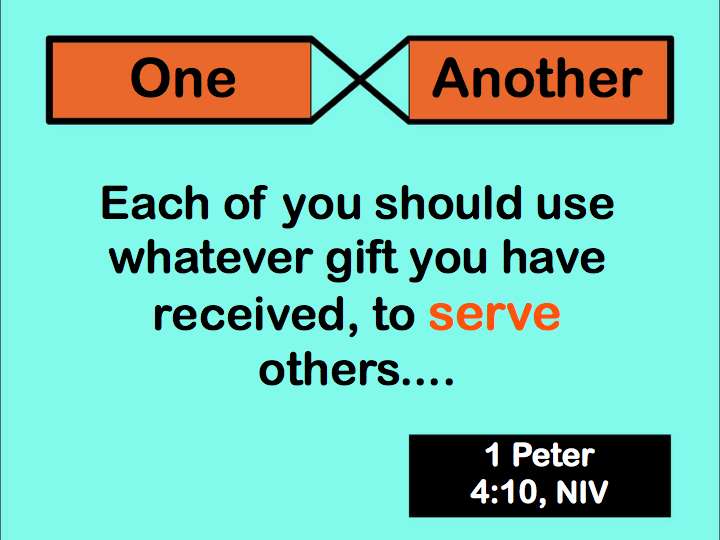
This morning we wrapped up our series called Life Together—where we looked at the one another phrases in the New Testament that related to the Church—with the thought of serving one another.
I think this 1-minute video from John Maxwell captures this thought about servanthood well…
From The Personalized Promise Bible we looked at this prayer that comes from the servanthood example of Jesus in John 13:13-17—
Jesus is my Mentor and the Lord of my life. He has left me an example of the greatest servitude the world has ever known. I will do as he did and wash the feet of my brothers and sisters in Christ. I will see the real good and benefit of others through humble service. With a tender heart of compassion, I will take the time to do good to those around me. Through this generosity of service and willingness to give of myself to others, no matter how humbling the service may be, I store up for myself favor upon favor, and blessing upon blessing.
We had a great time helping spiff up Cedar Springs this weekend. For the third year in a row, I believe the group from Calvary Assembly of God was one of the largest (if not the largest) group which came out for the Earth Day cleanup. So we donned our bright yellow shirts, our trash grabbers, and lots and lots of garbage bags and went to work.
This slideshow requires JavaScript.
Huge thanks to Betsy, Harrison, Samantha, Brandon, Stanley, Valerie, Judy, Stephanie, Selena, and Sophie for all your hard work!
Listen to the podcast of this post by clicking on the player below, and you can also subscribe on Apple, Spotify, or Audible.
We have become a numbed culture: we try to soften every blow, water down each negative report, ask only surface questions in the hopes that no one will really tell us how much they’re hurting, and then medicate away every symptom. But these symptoms are screaming to be noticed!
Dr. Paul Brand the renown hand surgeon and missionary to leprosy patients in India, wrote:
“Pain contributes daily to a normal person’s quality of life…. Every normal person limps occasionally. Sadly, leprosy patients do not limp. Their injured legs never get the rest needed for healing…. This inability to ‘hear’ pain can cause permanent damage because the body’s careful responses to danger will break down. … A body only possesses unity to the degree that it possesses pain…. We must develop a lower threshold of pain by listening, truly listening, to those who suffer. … The body protects poorly what it does not feel.” —Dr. Paul Brand & Philip Yancey, In His Image
The Gospels often talk of the compassion of Jesus. His compassion led Him to teach the confused, feed the hungry, and heal the sick. The phrase usually used in the NKJV is descriptive: Jesus was moved with compassion. In other words His feelings moved Him to action.
The Old English way of describing compassion was to say someone was “moved in his bowels.” This is because when someone else is suffering it should be like a kick in my gut too.
Jesus gravitated toward the hurting, but in one story He told, Jesus related something different about His Father’s compassion. It’s the story we now call the story of the prodigal son. In this story Jesus said His Father watched the horizons every day to see if His wayward child would return. When He saw this child coming into view, God saw his slumped shoulders, He could detect his heavy heart and worn-out body. Then Jesus says something amazing, “The Father was moved with compassion and He RAN TO HIS SON!”
If our Heavenly Father runs TO another’s pain, what right do we have to ever run AWAY from it?
If we are to be God-honoring in our interaction with others, we need to—as Dr. Brand says—lower our threshold of pain. We need to feel what others feel, to feel it like a kick in our own gut, and then move toward the pain with help and healing and restoration.
Christians—if we are truly Christ-like—should be known as the most compassionate people of anyone.
So we need to always be asking: What am I doing to let this compassion be seen in my life?
Check out all of the other messages in our series Live Togetherby clicking here.
When God-fearing people are concerned with the direction their nation is heading, when they are upset over the lack of biblically-sound laws, when they are pained over the cultural trends, God gives them just one recourse: Prayer.
Furthermore, God gives them only one place to look: In the mirror.
If My people, who are called by My name, will humble themselves and pray and seek My face and turn from their wicked ways, then I will hear from heaven, and I will forgive their sin and will heal their land. (2 Chronicles 7:14)
May 2 has been designated as a National Day Of Prayer, and I sincerely hope you will find a time and a place to pray for our country.
Calvary Assembly of God will be open from noon to 1pm for a time of prayer. If you can’t join us, please make an altar wherever you happen to be to humble yourself and pray. It’s the only recourse we have!
Listen to the podcast of this post by clicking on the player below, and you can also subscribe on Apple, Spotify, or Audible.
A quick survey: Please raise your hand if any of these pertain to you:
Have you ever had a disagreement with someone?
Have you had a disagreement with someone you love?
Have you had a disagreement with someone you love, who also called themself a Christian?
If you raised your hand, you joined 100% of my congregation who answered “yes” to all three.
When we are in close proximity to anyone, there will be conflict. In fact, close proximity usually leads to more conflict because closeness increases friction. For a Christian the issue is not if we will have conflict with others in the Church, but how will we navigate and resolve these conflicts.
The apostle Paul wrote a thank you letter to the church at Philippi, in which he speaks in some of the most glowingly loving terms of any of his letters. Clearly, this was a group of people close to his heart. So when he heard about a conflict between two ladies in this congregation, he took time to address it publicly in his letter—
I plead with Euodia and I plead with Syntyche to be of the same mind in the Lord. (Philippians 4:2)
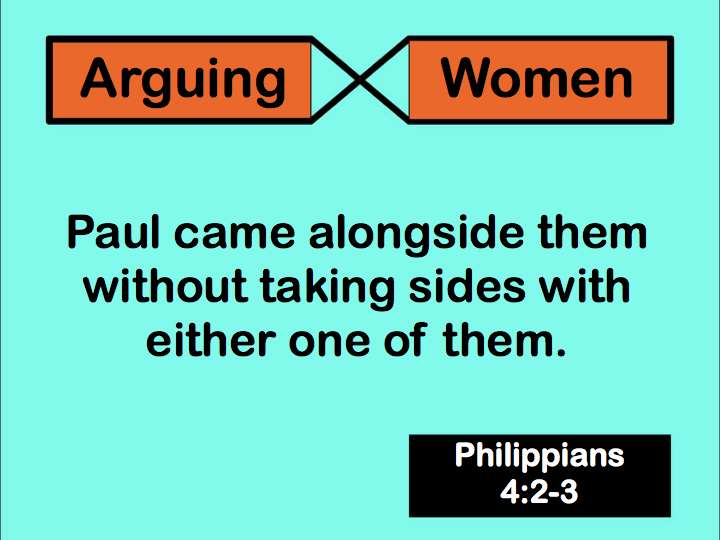
We don’t know why these ladies were arguing but notice that Paul doesn’t take sides. He simply says, “I please with Euodia AND I plead with Syntyche.” The word for plead means someone who comes alongside to help. In using this terminology, Paul gives us an important principle:
We can come alongside those in conflict without taking sides with either one of those in conflict.
In the next verse, Paul implores the rest of the church to join him in this alongsided-ness—
And I exhort you too, my genuine yokefellow, help these two women to keep on cooperating…. (v. 3 in the Amplified Bible)
In other words, Paul wants the rest of the church to embrace these at-odds sisters, also without taking sides. He addresses the members of the church as yokefellow. It’s not a word we use too often today (although it is still in the dictionary), but it paints a crystal clear picture of our role. Here’s what we CAN’T do as yokefellow:
Look away
Mind our own business
Hope the situation will work itself out
Try to navigate around the problem
Instead, we embrace the conflict by embracing those in the conflict. We help them to cooperate and to work in harmony in the Lord (v. 2 in the Amplified Bible). It’s our responsibility to help maintain the bonds of peace so that the Body of Christ can grow in a way that is healthy and God-honoring.
Do you know someone in conflict right now? Are you in the conflict yourself? Ask God to show you how you can come alongside—not take sides—with those in this conflict so that you can help bring about peace.
When God created the earth, He directed Adam and Eve to care for His creation. Today it’s just as important for us to be good stewards of our Heavenly Father’s beautiful world.
So I’m excited that Calvary Assembly of God is going to be involved in the cleanup efforts in our hometown of Cedar Springs. For the fourth year in a row we’ll be picking up the junk that seems to accumulate around our waterways and in our public areas. We’ll be pulling on our waders so we can walk into Cedar Creek to remove the things that shouldn’t be in there. The fish and wildlife will be happier, and I bet our Creator will be too!
We’re meeting behind the fire station off of Main Street on Saturday, April 27, at 10am. If you are in the area, please come join us.
Although all of the cleanup efforts are concentrated on one day, my hope is that it will become an ongoing lifestyle for us to always be caring for our community.
Listen to the podcast of this post by clicking on the player below, and you can also subscribe on Apple, Spotify, or Audible.
I remember when I was a teenager having such an ache in my legs at night. I’d be laying on my bed trying to sleep, but I couldn’t get comfortable because of that dull, unrelenting ache in my legs. I’d go ask my Mom what was going on, and her reply was simple: “Those are growing pains.”
In order to grow in any area of our lives—physically, emotionally, mentally, relationally—we have to go through a certain amount of pain.
No pain, no gain.
The process is not always a lot of fun, but that’s why we have to keep our eyes on the goal. The process may not be something we like, but the end results will make the pain worth it.
For instance, you may not like dieting but you like the weight loss or lower cholesterol numbers, so you stick with it. You may not like saying, “I’m sorry, I was wrong, please forgive me” but you like the healed relationship, so you say it.
Throughout the New Testament the phrase one another is frequently used to address how members of the Body of Christ should relate to each other. God desires that all of us operate interdependently with one another. In order to get there, we must get ready for some growing pains!
In Ephesians 4:2, Paul tells us what is required to get to a place of unity and maturity in the Church:
Be completely humble (the King James Version says lowliness). This Greek word means not letting our thoughts rise far from the ground. In other words, we are thinking of ourselves as God thinks of us, not independently as a self-made man or woman, but viewing all of my success as God-appointed. This process toward interdependence starts in our thoughts—in our attitudes about ourselves and about others.
Gentle means strength under control. Gentleness says, “I could do this, but for your sake I won’t.”
Patient interaction (KJV: longsuffering) with others is allowing them the freedom to grow just as others allowed me the freedom to grow.
Bearing with one another in love. Think of a load-bearing wall in a building that is holding up the weight of the roof and walls. When we bear with one another we are helping to share the burdens.
Being humble with ourselves and gentle and patient with others is the way we go through the growing pains of bearing with one another in love. The process may not be a lot of fun, but the end result is something that glorifies God, that’s why we must stick with one another through all our growing pains.
Check out all of the other messages in our series Live Togetherby clicking here.
One of the things that stands out so clearly about the first century church is this—they really liked being around each other! Even though the early Christians faced persecution, rejection by the Jewish religious leadership, and even martyrdom, they truly enjoyed a special bond with one another.
In fact, that’s the key phrase: one another. The New Testament says they were devoted to one another, they helped one another, they prayed with one another, they confessed their sins to one another, they opened up their homes to one another, and on and on. This doesn’t mean they were without problems and personality clashes at times, but they found that one another was so much more enjoyable and productive than being on their own.
This Sunday at Calvary Assembly of God as I begin a brand new series called Enjoying Life Together With One Another. If you missed any of the messages, you can check them out here:
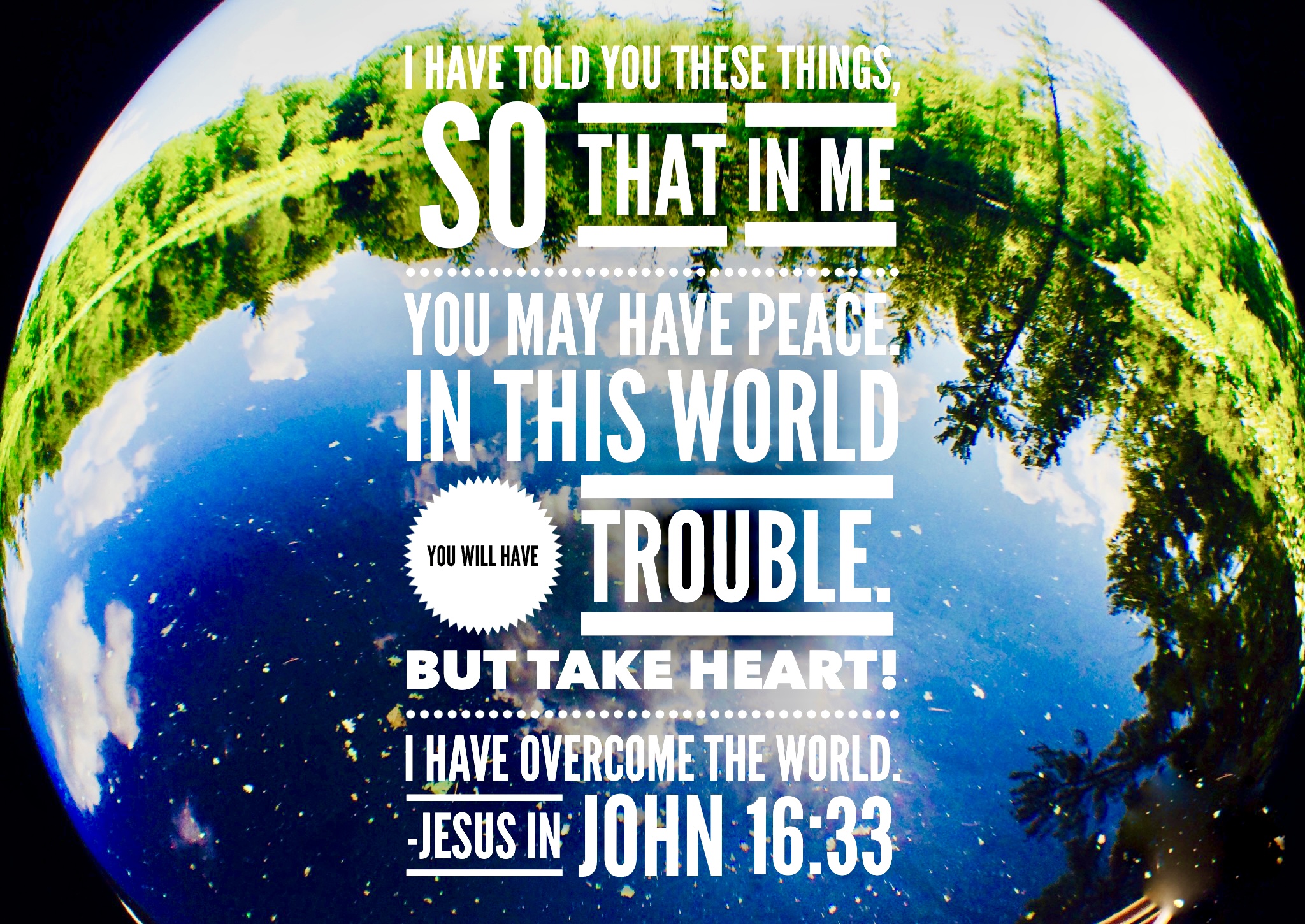
On Friday I had the privilege of sharing the message at our combined Good Friday service, where all the churches in Cedar Springs came together. I talked about the contrast Jesus presents to us from John 16:33. Quite simple it goes like this:
In the world = trouble
In Jesus = peace
This morning our Easter breakfast drama confronted (sometimes comically) the various conspiracy theories about the death and resurrection of Jesus. Then I shared how the biblical account of Jesus’ resurrection is not only the most plausible, reasonable and logical of accounts, but it is also the only option which gives us lasting hope.
It’s amazing to think that my “job” allows me to speak the words of life, the hope of freedom, the promise of eternal life, the beauty of a relationship with Christ. I am truly blessed and humbled to do what God has called me to do.
Listen to the podcast of this post by clicking on the player below, and you can also subscribe on Apple, Spotify, or Audible.
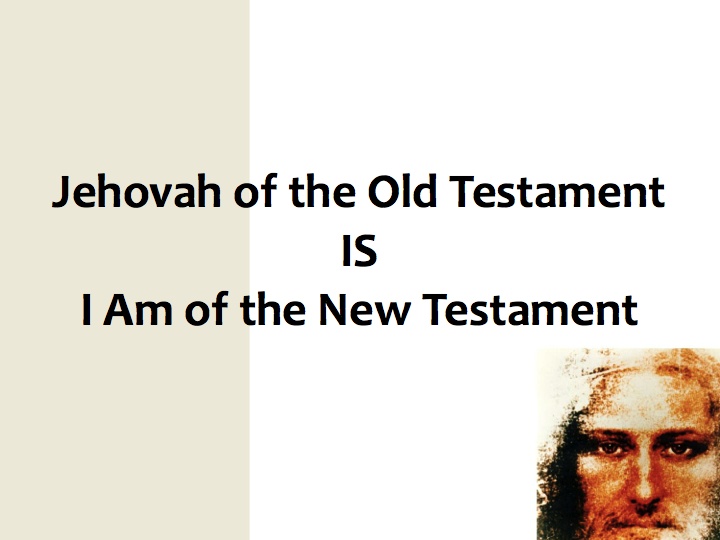
One of the misconceptions about Jesus is that He first appears on the scene in a manger in Bethlehem. Nothing could be further from the truth! Jesus appears in the opening words of the Bible—In the beginning God created—and in the last words of the Bible—Yes, I am coming soon. And He appears in every word in between!
B.B. Warfield has a great picture of the Old Testament being a mansion with richly-decorated, beautifully-ornate rooms, but which are dimly lit. So with just the Old Testament by itself, it is hard to appreciate the magnificent beauty that’s there. In Jesus, the light is turned on, and we can now appreciate the glory and majesty that was always there!
So notice how the “I Am” statements shine a bright light on the titles of “Jehovah”—
Jehovah Jireh (I Am Your Provider) → I am the Bread of Life (John 6:35)
Jehovah Rapha (I Am Your Healing) → I am the Resurrection and the Life (John 11:25-26)
Jehovah Nissi (I Am Your Source) → I am the Vine (John 15:5)
Jehovah Shalom (I Am Your Peace) → I am the Light of the world (John 8:12)
Jehovah Raah (I Am Your Shepherd) → I am the Good Shepherd (John 10:11)
Jehovah Sabaoth (I Am Your Wall Of Protection) → I am the Gate (John 10:9)
Jehovah Tsid-kenu (I Am Your Righteousness) → I am the Way, Truth, and Life (John 14:6)
Jehovah Shammah (I Am Here) → I am the Alpha and Omega (Revelation 1:8; 22:13).
In essence Jesus is saying “I Am Jehovah in all His fullness.” So what are we to make of that? What are we to make of Jesus Christ? Here’s how C.S. Lewis addressed that very question:
“This is a question which has, in a sense, a frantically comic side. For the real question is not what are we to make of Christ, but what is He to make of us? The picture of a fly sitting deciding what it is going to make of an elephant has comic elements about it. But perhaps the questioner meant what are we to make of Him in the sense of ‘How are we to solve the historical problem set us by the recorded sayings of this Man?’
“The problem is to reconcile two things. On the one hand you have got the almost generally admitted depth of sanity of His moral teaching, which is not very seriously questioned, even by those who are opposed to Christianity. In fact, I find when I am arguing with very anti-God people that they rather make a point of saying, ‘I am entirely in favor of the moral teaching of Christianity….’
“On the one side clear, definite moral teaching. On the other, claims which, if not true, are those of a megalomaniac, compared with whom Hitler was the most sane and humble of men. There is no halfway house and there is no parallel in other religions. If you had gone to Buddha and asked him, ‘Are you the son of Bramah?’ he would have said, ‘My son, you are still in the vale of illusion.’ If you had gone to Socrates and asked, ‘Are you Zeus?’ he would have laughed at you. If you had gone to Mohammed and asked, ‘Are you Allah?’ he would first have rent his clothes and then cut your head off. If you had asked Confucius, ‘Are you Heaven?’ I think he would have probably replied, ‘Remarks which are not in accordance with Nature are in bad taste.’
“The idea of a great moral teacher saying what Christ said is out of the question. In my opinion, the only person who can say that sort of thing is either God or a complete lunatic suffering from that form of delusion which undermines the whole mind of man.” (emphasis mine)
In this quote, C.S. Lewis gives us three choices about Jesus. We can either say (1) He is a liar, (2) He is a lunatic, or (3) He is who He says He is.



 This morning we wrapped up our series called Life Together—where we looked at the one another phrases in the New Testament that related to the Church—with the thought of serving one another.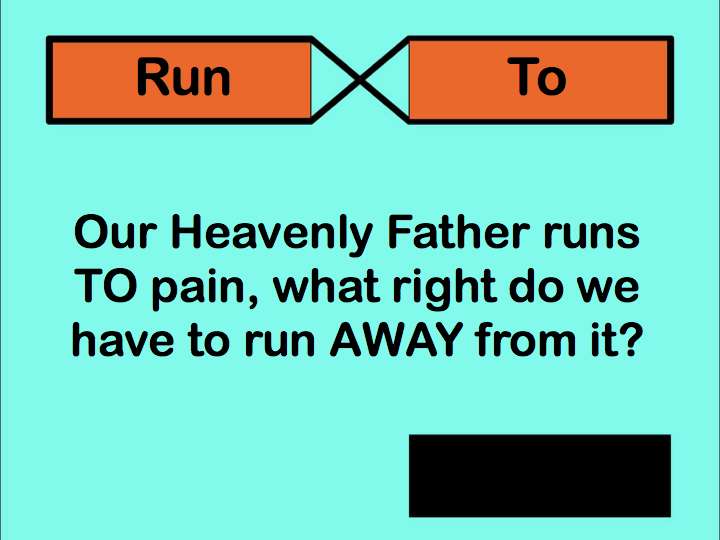







 Craig T. Owens