In our series called The Star Of CHRISTmas, Pastor Josh reminded us that Jesus is the North Star.
The North Star never wavers, never moves; it’s always constant.
But as Josh reminded us, light pollution sometimes makes it hard to see the North Star. The bright lights of the city, airplane lights, and even street lights make it difficult to know for sure we are following the North Star.
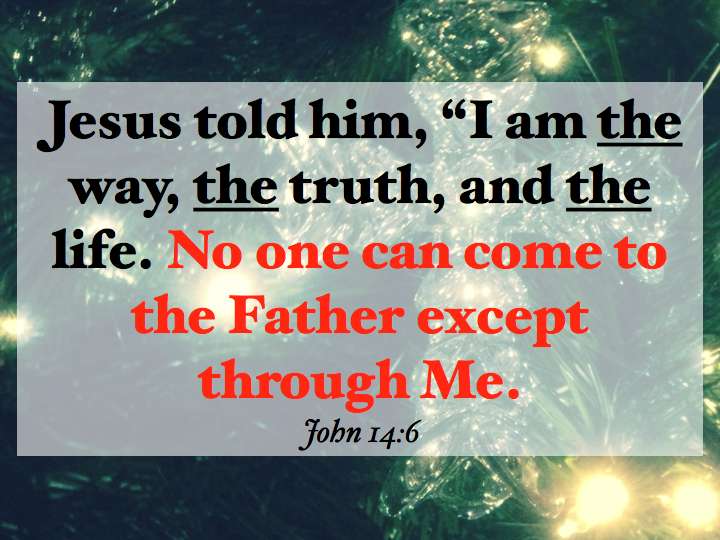
Jesus is the North Star—“I am the way, the truth, and the light” (John 14:6). But there are so many things that bring light pollution to His bright, unwavering, unchanging light. Lights that say, “This is important,” or “This light will get you where you need to go,” or even “All lights are equal.”
In this busy time of year, it’s important for us to take the time to filter out light pollution, and make sure that we are truly following Jesus. David prayed a great prayer, “Search me, O God, see if there is any offensive ways in me” (Psalm 139:23-24). It’s a great prayer for us to pray too.
Check out the other ways Jesus shined brightly at His Advent in our series The Star Of CHRISTmas.
Listen to the podcast of this post by clicking on the player below, and you can also subscribe on Apple, Spotify, or Audible.
In astronomical terms, a supernova is an explosion almost beyond compare. For a brief moment the explosion is the brightest point in the universe, sending enriching energy reverberating in every direction.
There was a supernova in the opening words of the Old Testament—in the beginning God created (Genesis 1:1). There was an explosion of God’s love that was the brightest spot in the universe He just created. But shortly after a supernova explodes, it appears to go dark for a period of time.
In history this could be seen as the time in-between the in the beginning of the Old Testament and the time before Jesus is born. Isaiah describes this as a people walking around in darkness and gloomy distress. Then all of sudden Isaiah says a great light explodes on the scene—
Nevertheless, there will be no more gloom for those who were in distress…. The people walking in darkness have seen a great light; on those living in the land of deep darkness a light has dawned. … For to us a Child is born, to us a Son is given, and the government will be on His shoulders. And He will be called Wonderful Counselor, Mighty God, Everlasting Father, Prince of Peace. (Isaiah 9:1-2, 6)
The reverberation of God’s supernova in the opening words of the Old Testament show up again in the opening words of the New Testament—A record of the genealogy of Jesus Christ (Matthew 1:1). The light of Jesus exploded on the scene!
And the Christ became flesh and tabernacled among us; and we actually saw His glory, such glory as an only begotten Son receives from His Father, full of grace and truth. (John 1:14)
Because of the energy released in the supernova of Creation and the reverberation of Christ’s First Advent, we are the beneficiaries. Astronomers tell us that the explosion of a supernova makes it possible for other stars to be born. That’s you and me!
Live clean, innocent lives as children of God, shining like bright stars in a world full of crooked and perverse people. (Philippians 2:15)
May this Advent season remind you of the supernova explosion of love of Jesus Christ, and our ability to shine brightly because of His life in us. Shine brightly!
Check out the other ways Jesus shined brightly at His Advent in our series The Star Of CHRISTmas.
I’m really enjoying preparing for our 3-week Christmas series called The Star Of CHRISTmas. If it’s not obvious to you by the way I wrote that title, I believe the star of Christmas is CHRIST!
We will be learning how Jesus Christ’s birth in Bethelehem was the…
SUPERNOVA which brings light into the Old Testament’s darkness, and allows other stars (that’s us!) to be born.
MORNING STAR which shines brightest just before the dawn and replaces a feeling of fear with the confidence of favor.
NORTH STAR which helps us keep going in the right direction despite the circumstances around us.
If you are able tojoin usover the next couple of Sundays at 10:30am, we would love to celebrate The Star of CHRISTmas with you!
‘Tis the season we are supposed to be thankful. As Thanksgiving Day approaches, many people will gather around a dinner table and share what they are thankful for this year, and then quickly move on to the turkey and football. But we never quite finish the thought: Yes, we are thankful, but to whom are we thankful?
Consider some of these clichés we use:
The ball bounced my way.
I thank my lucky stars!
Wow, must be good clean living!
Whew, I caught a lucky break there.
It’s about time something went my way.
In all of these phrases we are saying, “I did something to get what I got. I did the right things, or I was in the right place at the right time.”
God says, “My people shall be satisfied with My goodness” (Jeremiah 31:14). Notice He says MY goodness.
Contrast this with what Moses warned in his farewell address. He said, when you have been blessed make sure you give the thanks to God, and don’t forget all He has done for you. If we forget to thank God, the inevitable result is pride in our own abilities, or in our own luck. YOU may then say to YOURSELF, “MY power and the strength of MY hand has made this lucky break for ME” (see Deuteronomy 8:10-20).
Notice the MY has been changed from God to me. I have made a god out of my luck. Or even worse, I have enthroned MYSELF and dethroned God.
The only guard against this is continual, uninterrupted gratitude to God for His goodness—Be joyful always; pray continually; give thanks in all circumstances, for this is God’s will for you in Christ Jesus (1 Thessalonians 5:16-18).
Don’t make a god out of luck, but make sure the One True God is the center of your thankfulness this week, and all year long!
Some folks asked me to share the quotes I used in my message today in our Grateful Heart series. Ask, and you shall receive!
“It is no wonder that the Lord’s people should be satisfied with the goodness of their Lord. Here is goodness without mixture, bounty without stint, mercy without chiding, love without change, favor without reserve. If God’s goodness does not satisfy us, what will? What! are we still groaning? Surely there is a wrong desire within if it be one which God’s goodness does not satisfy.” —Charles Spurgeon
“Gratitude unlocks the fullness of life. It turns what we have into enough, and more. It turns denial into acceptance, chaos into order, confusion into clarity. It can turn a meal into a feast, a house into a home, a stranger into a friend. Gratitude makes sense out of our past, brings peace for today, and create a vision for tomorrow.” —John Maxwell
I’m looking forward to wrapping up this series next Sunday!
The wise King Solomon said, “Anxiety in a man’s heart weighs him down…” (Proverbs 12:25). And now medical science proves it.
There’s the physical weight of anxiety:
Digestion of food is hindered
Sleep is disrupted
Short-term memory is hampered
Immune system is depressed
Heart disease risks are elevated
Not to mention the emotional and relational weights of anxiety
But do you know what brings an almost immediate bounce-back from these conditions? Feeling and expressing gratitude.
The feelings of gratitude…
Release endorphins (the feel-good hormone)
Make good memories easier to recall
Strengthen relationships
Improve overall physical health
The verse I quoted earlier from Proverbs was only the first half of the verse. The full verse says, “Anxiety in a man’s heart weighs him down, but a good word makes him glad.” Science tells us that it doesn’t matter if those good words are words others say to us, or words we say to ourselves, or words we say to others. Our bodies cannot tell the difference, so any grateful/thankful/positive words cancel out the heaviness of anxiety!
Try it! Keep a gratitude journal … write a letter to someone you haven’t properly thanked for their investment in your life … make it a point to compliment others … speak more positively to yourself. Those grateful words are not only the antidote to the anxiety weighing you down now but also the inoculation against future anxiety.
As we approach Thanksgiving Day, many people begin to get their thanks on! They will start rehearsing for their family gathering when someone might ask them, “What are you thankful for this year?”
But I want to make the case for practicing gratitude all year long!
There are emotional, physical, psychological and relational benefits to being a thanks-filled person. Truly those with grateful hearts have strong, healthy hearts … both physically and emotionally.
“Gratitude unlocks the fullness of life. It turns what we have into enough, and more. It turns denial into acceptance, chaos into order, confusion into clarity. It can turn a meal into a feast, a house into a home, a stranger into a friend. Gratitude makes sense out of our past, brings peace for today, and create a vision for tomorrow.” —John Maxwell
Please join me the next two Sundays at Calvary Assembly of God as I share some of the medical research and biblical truths that will reveal the year-round, whole-person benefits of being grateful.
Philadelphia, as most people know is “The City of Brotherly Love.” The original Philadelphia in Asia Minor was founded in the second century BC by a man named Attalus who, quite the contrary to cultural norms, kept his brother in a position of power and influence alongside him.
Where many leaders were suspicious of anyone who could make a claim on the throne, Attalus loved (the Greek word is phileo) his brother (Greek adelphos meaning “from the same womb”), so the city took on this name and attitude as well. After the city was leveled by an earthquake in 17 AD, Emperor Tiberius sent the funds needed to rebuild. Out of gratitude to the emperor’s generosity there was a movement to rename the city Neocaesarea in his honor. But the people liked being known for their brotherly kindness, so the name Philadelphia stuck.
At least it stuck in name only. As the first century progressed, Philadelphians bowed more and more to Rome’s influence and this city once known for kindness to all began to persecute Christians.
This reminds me of the United States of America today. Our pledge of allegiance still includes “one nation under God,” and “in God we trust” is still on our currency, and we haven’t repealed the First Amendment which gives us freedom of religion. It appears that we are a “Christian nation,” but in name only.
Many cast the blame far and wide, but as Jesus addressed the people in the first city of Philadelphia (see Revelation 3:7-13), we see the blame is on those self-professing Christians who didn’t live Christ-like lives. They were Christians in name only.
For those who “have kept My Word and not denied My name” Jesus promises a list of rewards longer than the list for any of the other seven churches addressed in the book of Revelation! Those promises are still in effect for those who will not deny Christ. More specifically for those who by their words and their lifestyle hold true to Jesus Christ.
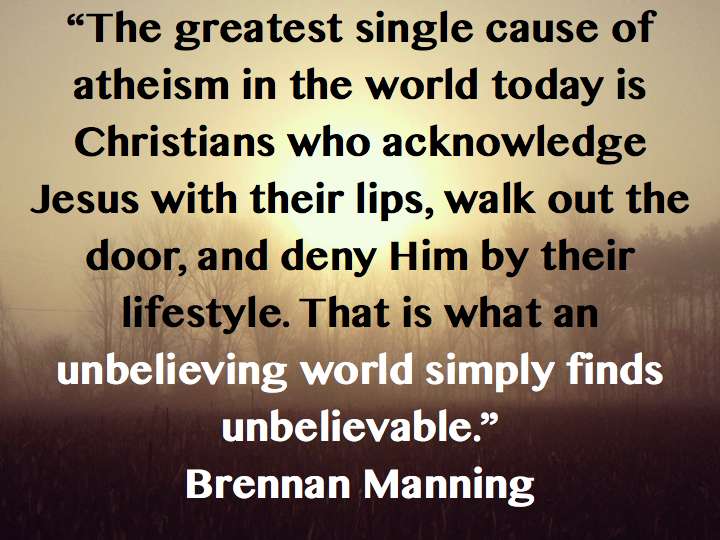
Brennan Manning was exactly right when he said, “The greatest single cause of atheism in the world today is Christians: who acknowledge Jesus with their lips, walk out the door, and deny Him by their lifestyle. That is what an unbelieving world simply finds unbelievable.”
My prayer is that Christians everywhere would be known not just by the name Christian, but by the way they hold true to Christ and His Word!
Please join me next Sunday as we look at the last of the churches in our series The 7-Star Church.
It’s a focus of far too many people: “I’ve got to make a name for myself.” It’s nothing new but has been going on as long as men have been on earth.
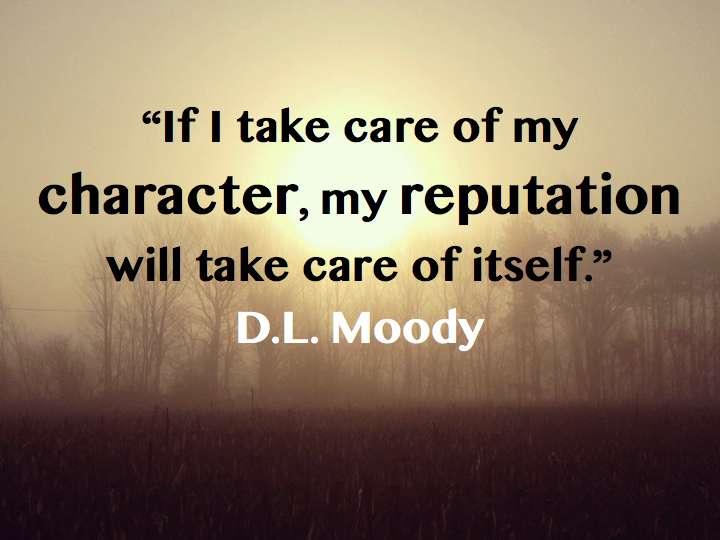
In Revelation 3, Jesus is addressing the church in Sardis about their pursuit of a reputation. Jesus tells them, “You have definitely made a name for yourself. People know you are making things happen, and you have a reputation of being successful.” Sounds good, right? Except Jesus goes on to say, “But I’m not concerned about your reputation; I’m more interested in your character.”
Jesus uses the same Greek word four times in just six short verses to show the progression He is looking for to go from a popular reputation to godly character:
You have tried to make a name for yourself, but your focus is wrong (Rev. 3:1).
The name you should focus on is My name—you should be glorifying Me, not yourself (v. 4).
If you glorify Me, I will make sure your name is never erased from the Book of Life (v. 5a).
Not only that, if you glorify Me, I will personally introduce you to My Father. I will say, “This one is Mine!” (v. 5b)
Wow!
Contrast that with people who say, “Jesus, didn’t we do some pretty amazing things in Your name? Did you check us out?!?” And Jesus will reply to them, “I never knew you because you were only using Me to make yourself look good” (see Matthew 7:21-23; Revelation 3:2).
I am not living for the applause of men, but only for the applause of nail-scarred Hands.
I don’t want the headlines here, but I want to hear my Lord say, “Well done, good and faithful servant!”
I don’t want a reputation here, but I want a godly character in Heaven.
That’s the name I want!!
If you are near Cedar Springs this weekend, please join us for part six of this series The 7-Star Church.
Jesus takes the church of Thyatira to task because they are tolerating someone with a Jezebel spirit to remain in a position of leadership and influence (Revelation 2:18-29). This is still a message to the church today!
However, for some reason Christians have made “confrontation” a dirty word. We don’t confront people in error, especially those who are in leadership positions within their church. Perhaps equally as wrong: when we do confront, we do it in a way that is destructive.
The goal of confrontation is restoration, not destruction!
In Revelation 2, Jesus gives us five steps toward healthy, biblical, God-honoring confrontation:
Don’t tolerate a Jezebel spirit by remaining silent (v. 20). Instead we need to follow the principles in Matthew 18:15-17 and 1 Timothy 5:19.
Allow the one whom you’ve confronted time to repent (v. 21a).
If they don’t repent, don’t rescue them from God-inflicted punishment (vv. 21b-23).
Run away from secrets (v. 24). If something more than Scripture is required by the Jezebel leader, reject it.
Don’t run away from the situation, but hold on to Jesus until Jesus returns (vv. 25-28).
Not one human is infallible, but Jezebel not only claims infallibility, but also demands blind allegiance to her teachings. But it is just as wrong to tolerate Jezebel as it is to confront her unbiblically; Jesus opposed both.
One way for us to always avoid these two extremes: Try to out-serve one another, just as Jesus directed us—
“You know that the rulers of the Gentiles lord it over them, and their high officials exercise authority over them. Not so with you. Instead, whoever wants to become great among you must be your servant, and whoever wants to be first must be your slave—just as the Son of Man did not come to be served, but to serve, and to give His life as a ransom for many.” (Matthew 20:25-28)
If you are near Cedar Springs next Sunday, please join me as we continue our series on The 7-Star Church.



 In our series called The Star Of CHRISTmas, Pastor Josh reminded us that Jesus is the North Star.
![The Star Of Christmas [web]](https://craigtowens.com/wp-content/uploads/2008/12/the-star-of-christmas-web.jpg)



![A Grateful Heart [web]](https://craigtowens.com/wp-content/uploads/2013/11/a-grateful-heart-web1.jpg)