This Day In Christian History (book review)

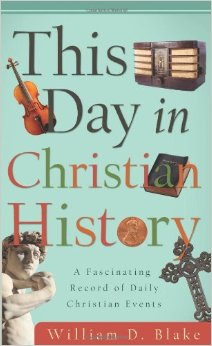
This DayFor history buffs, This Day In Christian History by William D. Blake is a great book to keep handy all throughout the year. Each day you will find two historical items which have had a lasting impact on church history.

The two calendar items each day will take less than 60 seconds to read, but I found that on many days it opened the door of curiosity for me to do some additional research on that event or person. You will also find:

  • A brief biographical sketch of notable people in church history
  • Memorable quotes
  • Some mind-blowing “did you knows” (that you can use to impress your friends)
  • The rich history that all Christians share in common

A very fun book to read each day of the year.

12 Quotes From “Keeping The Ten Commandments”

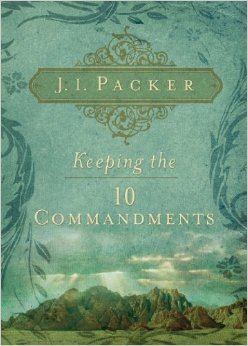
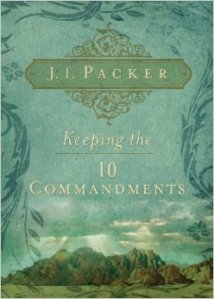
Keeping The Ten CommandmentsJ.I. Packer wrote a very readable, but scholarly, book examining how 21st-century people should live out the biblical Ten Commandments. You can read my full book review by clicking here, but I’m sharing some of my favorite quotes below.

“God’s love gave us the law just as His love gave us the gospel, and as there is no spiritual life for us save through the gospel, which points us to Jesus Christ the Savior, so there is no spiritual health for us save as we seek in Christ’s strength to keep the law and practice the love of God and neighbor for which it calls.”

“Where the law’s moral absolutes are not respected, people cease to respect either themselves or each other; humanity is deformed, and society slides into the killing decadence of mutual exploitation and self-indulgence.”

“The negative form of the Commandments has positive implications. ‘Where a sin is forbidden, the contrary duty is commanded’ (Westminster Larger Catechism, Question 99). The negative form was needed at Sinai (as in the West today) to curb current lawlessness that threatened both godliness and national life.” 

“Moral permissiveness, supposedly so liberating and fulfilling, is actually wounding and destructive: not only of society (which God’s law protects), but also of the lawless individual, who gets coarsened and reduced as a person every time.”

“Law-keeping is that life for which we were fitted by nature, unfitted by sin, and refitted by grace, the life God loves to see and reward; and for that life liberty is the proper name.”

“The Bible, however, takes promises very seriously; God demands full faithfulness of our vows. Why? Partly because trustworthiness is part of His image, which He wants to see in us; partly because without it society falls apart.”

“We honor God by respecting His image in each other, which means consistently preserving life and furthering each other’s welfare in all possible ways.”

“We have in us capacities for fury, fear, envy, greed, conceit, callousness, and hate that, given the right provocation, could make killers out of us all. … When the fathomless wells of rage and hatred in the normal human heart are tapped, the results are fearful.”

“When you lie to put someone down, it is malice; when you lie to impress, move, and use him, and to keep him from seeing you in a bad light, it is pride.”

“Reformed theologians said that God’s law has three uses or functions: first, to maintain order in society; second, to convince us of sin and drive us to Christ for life; third, to spur us on in obedience, by means of its standards and its sanctions, all of which express God’s own nature.”

“What is God’s ideal? A God-fearing community, marked by common worship (commandments 1, 2, 3) and an accepted rhythm of work and rest (commandment 4), plus an unqualified respect for marriage and the family (commandments 5, 7), for property and owner’s rights (commandments 8, 10), for human life and each man’s claim on our protection (commandment 6), and for truth and honesty in all relationships (commandment 9).”

“When God’s values are ignored, and the only community ideal is permissiveness, where will moral capital come from once the Christian legacy is spent? How can national policy ever rise above material self-interest, pragmatic and unprincipled? How can internal collapse be avoided as sectional interests, unrestrained by any sense of national responsibility, cut each other down? How can an overall reduction, indeed destruction, of happiness be avoided when the revealed way of happiness, the ‘God first, others next, self last’ of the Commandments, is rejected? The prospects are ominous. May God bring us back to Himself and to the social wisdom of His Commandments before it is too late.”

Keeping The Ten Commandments (book review)

Keeping The Ten CommandmentsI am just completing a series of messages at my church on the Ten Commandments. This was no small undertaking, and one that I undertook with great reverence. I knew I needed some scholarly resources to guide my study time, and there is none who fits the bill better than J.I. Packer and his work Keeping The Ten Commandments.

Packer is indeed a most-learned man, but he has a God-given gift to discuss doctrine and theology on a level that is accessible to even someone like me! He doesn’t water-down the biblical doctrines contained in the Ten Commandments, but he presents God’s intent in them in a way that the reader can immediately grasp and then put into action.

Before looking at each of the commandments individually, Packer opens the book with a couple of chapters giving us a bird’s-eye view of how the Ten Commandments fit in with the balance of Scripture. Then he walks us through the commandments one-by-one, and concludes with a couple of chapters that help us live out the commandments today. Each chapter includes a “for further study” list of questions and Bible verses, which I highly recommend.

For getting to know the Ten Commandments better, Keeping The Ten Commandments should definitely be on your reading list.

Our Definition Of ‘Christian’

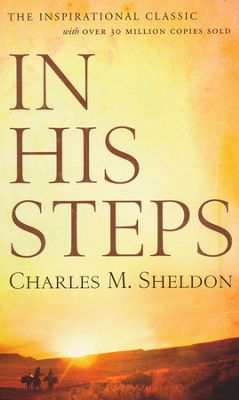
In His StepsIn His Steps by Rev. Charles Sheldon challenged me to really look at my personal definition of being a Christian. One of the characters in Sheldon’s book hit me with this—

“It is the personal element that Christian discipleship needs to emphasize. ‘The gift without the giver is bare.’ The call of this age is a call for a new discipleship, a new following of Jesus, more like the early, simple, apostolic Christianity when the disciples left all and literally followed the Master. Nothing but a discipleship of this kind can face the destructive selfishness of the age, with any hope of overcoming it. … But if our definition of being a Christian is simply to enjoy the privileges of worship, be generous at no expense to ourselves, have a good, easy time surrounded by pleasant friends and by comfortable things, live respectably, and at the same time avoid the world’s great stress of sin and trouble because it is too painful—if this is our definition of Christianity, then surely we are a long way from following the steps of Him who trod the way with tears of anguish for a lost humanity.” 

You can read my full book review of In His Steps by clicking here. And I quote another thought-provoking passage from this book here.

What Would Happen…?

In His StepsIn His Steps by Rev. Charles Sheldon is a timeless classic that every Christian should read (you can check out my book review by clicking here). This quote is a part of the final message that one of the main characters, Pastor Henry Maxwell, delivers at a prominent church in Chicago.

What would happen if in this city every church member should begin to do as Jesus would do? It staggers our minds to imagine the results! We all know that certain things would be impossible that are now practiced by church members. What would Jesus do in the matter of wealth? How would He spend it? How would Jesus be governed in the making of money? Would He take rentals from saloons? From tenement property? 

What would Jesus do about the great army of unemployed who tramp the streets and curse the church, or are indifferent to it, lost in the bitter struggle for the bread that tastes bitter when it is earned on account of the desperate conflict to get it? Would He say it was none of His business? 

What would Jesus do in the center of a civilization that hurries so fast after money that the girls employed in great business houses are not paid enough to keep soul and body together without fearful temptations? Where the demands of trade sacrifice hundreds of lads in a business that ignores all Christian duties toward them in the way of education and moral training and personal affection? Would Jesus, if He were here today as a part of our age and commercial industry, feel nothing, do nothing, say nothing in the face of these facts that every businessman knows?

How would you answer Pastor Maxwell’s questions?

In His Steps (book review)

In His StepsI first read In His Steps by Rev. Charles Sheldon when I was a teenager. I loved the book then, but I was absolutely fascinated by it while I was re-reading it this time!

In His Steps is the story of a pastor named Henry Maxwell, who lives and pastors in the town of Raymond, New York. The story was originally delivered chapter by chapter by Rev. Sheldon to his Sunday evening congregation during the summer of 1896. As each chapter was presented, the attendance grew and grew until the church building was packed to standing room only.

The whole premise of the book is a simple one: what would happen if each one of us were to live our lives moment to moment by one simple question—what would Jesus do? The story is told through the lives of Henry Maxwell and others in his congregation, as they come to grips with just what this means for them. At the end of the book, the “What would Jesus do” movement has spread, and Pastor Maxwell is asked to speak at a prominent church in Chicago. He concludes his message with this thought—

“Suppose that ‘What would Jesus do?’ were the motto, not only of the churches but of the businessmen, the politicians, the newspapers, the working men, the society people. How long would it take, under such a standard of conduct, to revolutionize the world? What is the trouble with the world? It is suffering from selfishness. No one ever lived who had succeeded in overcoming selfishness like Jesus. If men followed Him, regardless of results, the world would at once begin to enjoy a new life.” 

In His Steps is a powerful book! Simple to read, yet challenging to apply. I highly recommend this to anyone who wants to be more of a disciple of Jesus Christ. “What would Jesus do?” shouldn’t be just a clever question, but a way of life!

14 Quotes About Thinking From “The Moral Foundations Of Life”

The Moral Foundations Of LifeAs I noted in my review of The Moral Foundations Of Life (you can read that review by clicking here), Oswald Chambers wanted Christians to think more deeply about their relationship with Jesus Christ, and then live differently because of their new way of thinking. Here are some of his quotes related to a Christians’ thought life.

“When we become spiritual we have to exercise the power of thinking to a greater degree than ever before. We starve our mind as Christians by not thinking.” 

“The Atonement of our Lord never contradicts human reason, it contradicts the logic of human intellect that has never partaken of regeneration.”

“Is Jesus Christ’s teaching God-breathed to me? There is an intention that seeks God’s blessings without obeying Jesus Christ’s teaching. We are apt to say with sanctimonious piety, ‘Yes, Jesus Christ’s teaching is of God’; but how do we measure up to it? Do we intend to think about it and act on it?” 

“The old idea that we cannot help evil thoughts has become so ingrained in our minds that most of us accept it as fact. But if it is true, then Paul is talking nonsense when he tells us to choose our thinking, to think only on those things that are true, and honorable, and just, and pure.” [Philippians 4:8-9; 2 Corinthians 10:5]

“We are so extraordinarily fussy that we won’t give ourselves one minute before God to think, and unless we do we shall never form the habit of abiding. We must get alone in secret and think, screw our minds down and not allow them to wool-gather.” 

“If a man lets his garden alone it very soon ceases to be a garden; and if a saint lets his mind alone it will soon become a rubbish keep for satan to make use of.”

“If we have been storing our minds with the Word of God, we are never taken unawares in new circumstances because the Holy Spirit brings back these things to our remembrance and we know what we should do; but the Holy Spirit cannot bring back to our minds what we have never troubled to put there.” 

“Think of the sweat and labor that a scientific student will expend in order to attain his end; where do we find men and women concentrating with the same intensity on spiritual realities?”

“As soon as you get down to pray you remember a letter you ought to write, or something else that needs to be done, a thousand and one little impertinences come in and claim your attention. When we suspend our own activities and get down at the foot of the Cross and meditate there, God brings His thoughts to us by the Holy Spirit and interprets them to us. … God has not the remotest opportunity of coming to some of us, our minds are packed full with our own thoughts and conceptions.” 

“The devil does not need to bother about us as long as we remain ignorant of the way God has made us and refused to discipline ourselves; inattention and our own slovenliness will soon run away with every power we have. … All we need is grit and gumption and reliance on the Holy Spirit. We must bring the same determined energy to the revelations in the God’s Book as we bring to earthly professions. Most of us leave the sweat of brain outside when we come to deal with the Bible.”

“God will not bring every thought and imagination into captivity; we have to do it, and that is the test of spiritual concentration. The inattentive, slovenly way we drift into the presence of God is an indication that we are not bothering to think about Him. … God gives us the Holy Spirit not only for holy living but for holy thinking, and we are held responsible if we do not think concentratedly along the right lines.” 

“Glean your thinking; don’t allow your mind to be a harborage for every kind of vagabond sentiment; resolutely get into the way of disciplining your impulses and stray thinking.”

“We have to transform into real thinking possession for ourselves all that the Spirit of God puts into our spirits.” 

“An undisciplined imagination will destroy reliable judgment more quickly even then sin.”

The Moral Foundations Of Life (book review)

The Moral Foundations Of LifeI have written extensively on how much Oswald Chambers’ writings have impacted my life and thinking. In his book The Moral Foundations Of Life, Chambers himself discusses how much a Christian’s thought life impacts the way that he lives. This book is a collection of lectures (or as Chambers called them “talks”) on the thought life of Christians.

Two quotes from David Lambert, a friend of Chambers and a man who helped get his books published, sets the stage for this outstanding book—

“One of Chambers’ primary goals as a teacher was to challenge Christians to think. An equally important objective was to encourage believers to act. In Chambers’ mind, the brain and the body were not enemies but allies in the effort to live a life that glorified God. …

“I see sometimes in London the preparations being made for the sure foundations of one of the great modern buildings to be erected there. Far below the surface-level men and machines toil patiently on work which soon will be hidden, but which alone will make the towering building secure. These Talks on Moral Foundations take us to that depth below the surface of our everyday life where the foundations are laid for enduring sainthood. They deal profoundly with such matters as Habit, Thinking, the Will, Behavior. The subject of Christian ethical obligation is of paramount importance in the thought life of today. The very basis of our religion, our moral and spiritual standing, is being challenged. Here will be found a valiant answer to the secular, skeptical and lawless questionings of our time.”

I could not have said it better myself! This is another outstanding book which all Christians should endeavor to read.

13 More Quotes From “The Love Of God”

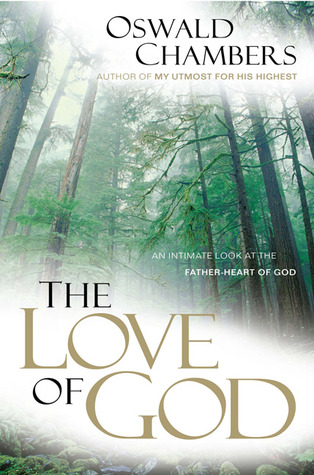
The Love Of GodI practically wear out my highlighter when I am reading Oswald Chambers, as there is so much rich content! I have already shared some quotes from his book The Love Of God (which you can read by clicking here). Here are a few more quotes…

“Do get out of your ears the noisy cries of the Christian world we are in—‘Do this and do that.’ Never! ‘Be this and that, then I will do through you,’ says Jesus.”

“In the natural world everything depends upon our taking the initiative, but if we are followers of God, we cannot take the initiative, we cannot choose our own work or say what we will do; we have not to find out at all, we have just to follow. … Everything Our Lord asks us to do is naturally frankly impossible to us. It is impossible for us to be the children of God naturally, to love our enemies, to forgive, to be holy, to be pure, and it is certainly impossible to us to follow God naturally; consequently the fundamental fact to recognize is that we must be born again.”

“Suppose Our Lord had measured His life by whether or not He was a blessing to others! Why, He was a ‘stone of stumbling’ to thousands, actually to His own neighbors, to His own nation, because through Him they blasphemed the Holy Ghost, and in His own country ‘He did not many mighty works there because of their unbelief’ (Matthew 13:58). If Our Lord had measured His life by its actual results, He would have been full of misery.” 

“We get switched off when instead of following God we follow Christian work and workers.”

“God engineers our circumstances as He did those of His Son; all we have to do is to follow where He places us.” 

“The way God’s life manifests itself in joy is in a peace which has no desire for praise. When a man delivers a message which he knows is the message of God, the witness to the fulfillment of the created purpose is given instantly, the peace of God settles down, and the man cares for neither praise nor blame from anyone.”

“If we make sin a theological question and not a question of actual deliverance, we become adherents to doctrine, and if we put doctrine first, we shall be hoodwinked before we know where we are.” 

“The freedom of Jesus is never license, it is always liberty, and liberty means ability to fulfill the law of God. … If I am following God’s love as exhibited in the Lord Jesus Christ and He has made me free from within, I am so taken up with following Him that I will never take advantage of another child of God.”

“God does not give us the mind of Christ, He gives us the Spirit of Christ, and we have to see that the Spirit of Christ in us works through our brains in contact with actual life and that we form His mind. Jesus Christ did not become humbled—‘He humbled Himself’ [Philippians 2:5].” 

“We are only what we are in the dark; all the rest is reputation. What God looks at is what we are in the dark—the imaginations of our minds; the thoughts of our heart; the habits of our bodies; these are the things that mark us in God’s sight.”

“The strain on a violin string when stretched to the uttermost gives it its strength; and the stronger the strain, the finer is the sound of our life for God, and He never strains more than we are able to bear. We say, ‘sorrow, disaster, calamity’; God says, ‘chastening,’ and it sounds sweet to Him though it is a discord in our ears.” 

“Some of us are so amazingly lazy, so comfortably placed in life, that we get no inner winging. … If we put the body and the concerns of the body before the eternal weight of glory, we will never have any inner winging at all, we will always be asking God to patch up this old tabernacle and keep it in repair. But when the heart sees what God wants, and knows that the body must be willing to spend and be spent for that cause and that causes alone then the inner man gets wings.”

“If you think of suffering affliction you will begin to write your own epitaph, begin to dream of the kind of tombstone you would like. That is the wrong standpoint. Have your standpoint in the heavenlies, and you will not think of the afflictions but only of the marvelous way, God is working out the inner weight of glory all the time, and you will hail with delight the afflictions which our Lord tells us to expect (John 16:33), the afflictions of which James writes (James 1:2), and of which Peter writes (1 Peter 4:12).” 

You can read my review of The Love Of God by clicking here.

5 Quotes On Law & Grace From “Transforming Grace”

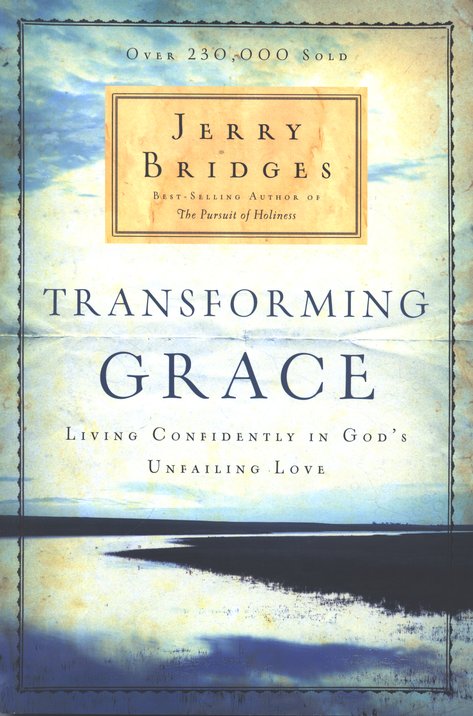
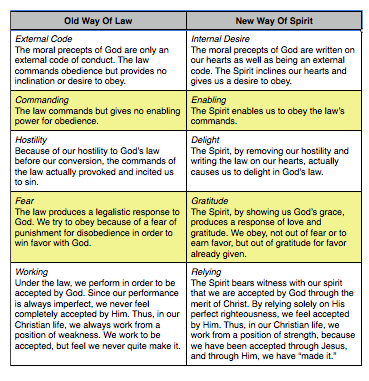
Transforming GraceJerry Bridges wrote a book that was an eye-opener for me called Transforming Grace. I’ve shared a couple of other posts with quotes from this book (you can read them by clicking here and here), but these quotes zero-in on the battle some people have in their minds between law and grace.

“Under a sense of legalism, obedience is done with a view to meriting salvation or God’s blessing on our lives. Under grace, obedience is a loving response to salvation already provided in Christ, and the assurance that, having provided salvation, God will also through Christ provide all else that we need.”

(click for a larger view)

(click for a larger view)

You can download a PDF version of this chart here → Law and Grace  ←

“Do you view God’s moral precepts as a source of bondage and condemnation for failure to obey them, or do you sense the Spirit producing within you an inclination and desire to obey out of gratitude and love? Do you try to obey by your own sheer will and determination, or do you rely on the Spirit daily for His power to enable you to obey? Do you view God as an ogre who has set before you an impossible code of conduct you cannot keep, or do you view Him as your divine Heavenly Father who has accepted you and loves you on the basis of the merit of Christ? In other words, in terms of your acceptance with God, are you willing to rely solely on the finished perfect work of Jesus, instead of your own pitifully imperfect performance?”

“We are much more concerned about someone abusing his freedom than we are about his guarding it. We are more afraid of indulging the sinful nature than we are of falling into legalism. Yet legalism does indulge the sinful nature because it fosters self-righteousness and religious pride. It also diverts us from the real issues of Christian life by focusing on external and sometimes trivial rules.” 

“That is the way a lot of manmade ‘dos and don’ts’ originate. They begin as a sincere effort to deal with real sin issues. But very often we begin to focus on the fence we’ve built instead of the sin it was designed to guard against. We fight our battles in the wrong places; we deal with externals instead of the heart. … For all of us, it may be good to have some fences, but we have to work at keeping them as just that—fences, helpful to us but not necessarily applicable to others. … I’m not suggesting you jump over fences just to thumb your nose at the people who hold on to them so dearly. We are to ‘make every effort to do what leads to peace and mutual edification’ (Romans 14:19). Use discretion in embracing or rejecting a particular fence. But don’t let others coerce you with manmade rules. And ask God to help you see if you are subtly coercing or judging others with your own fences.”

“Spiritual disciplines are provided for our good, not for our bondage. They are privileges to be used, not duties to be performed. … I do think we should actively promote spiritual disciplines. They are absolutely necessary for growth in our Christian lives. And since ours is a largely undisciplined age, many believers are losing out on the benefits of those disciplines that could help them grow to maturity in Christ. But we should promote them as benefits, not as duties.” 

You can read my full book review of Transforming Grace by clicking here.