Takin’ Him To Lombard Street

Listen to the podcast of this post by clicking on the player below, and you can also subscribe on AppleSpotify, or Audible. 

As missionaries, we are people sent on a mission. We are sent to everyone everywhere. We are to take Him to every street where God sends us.

“Main Street” (or Jerusalem) is a great place to start, and probably a place where we will always have work to do. These will typically be the people that are most like us—people with whom we will have the most in common. 

There are others that need to hear the Good news of forgiveness that Jesus has made available. As our circle of witness widens, we may have less in common with those with whom we are interacting. This may take us out of our comfort zone, but since the Holy Spirit is in us we will never be out of our empowerment zone! 

But you will receive power when the Holy Spirit comes on you; and you will be My witnesses in Jerusalem, and in all Judea (Acts 1:8). 

We need to ask two questions: 

  1. What did it mean then? Judea was still compromised of Jewish people, but it was the area slightly outside the neighborhood of Jerusalem. 
  2. What does it mean now? These are people very similar to people on Main Street, but we are starting to see more differences. These differences often become the source of controversies. 

I’m going to describe some people in our Judea as cultural Christians but not biblical Christians. In the time of Jesus we could think of the Pharisees: People who would call themselves godly because they have set their own standards. 

Lombard Street in San Francisco is a short, curvy street. This is a one-way street and motorists are only supposed to drive 5 mph, and still there are frequent controversies on the right-of-way between homeowners, motorists, work crews, bicyclists, and pedestrians. Everyone thinks their way is the right way. 

How do we take the message of Jesus to those on our “Lombard Street”?

(1) Distinguish the biblical from the non-biblical. 

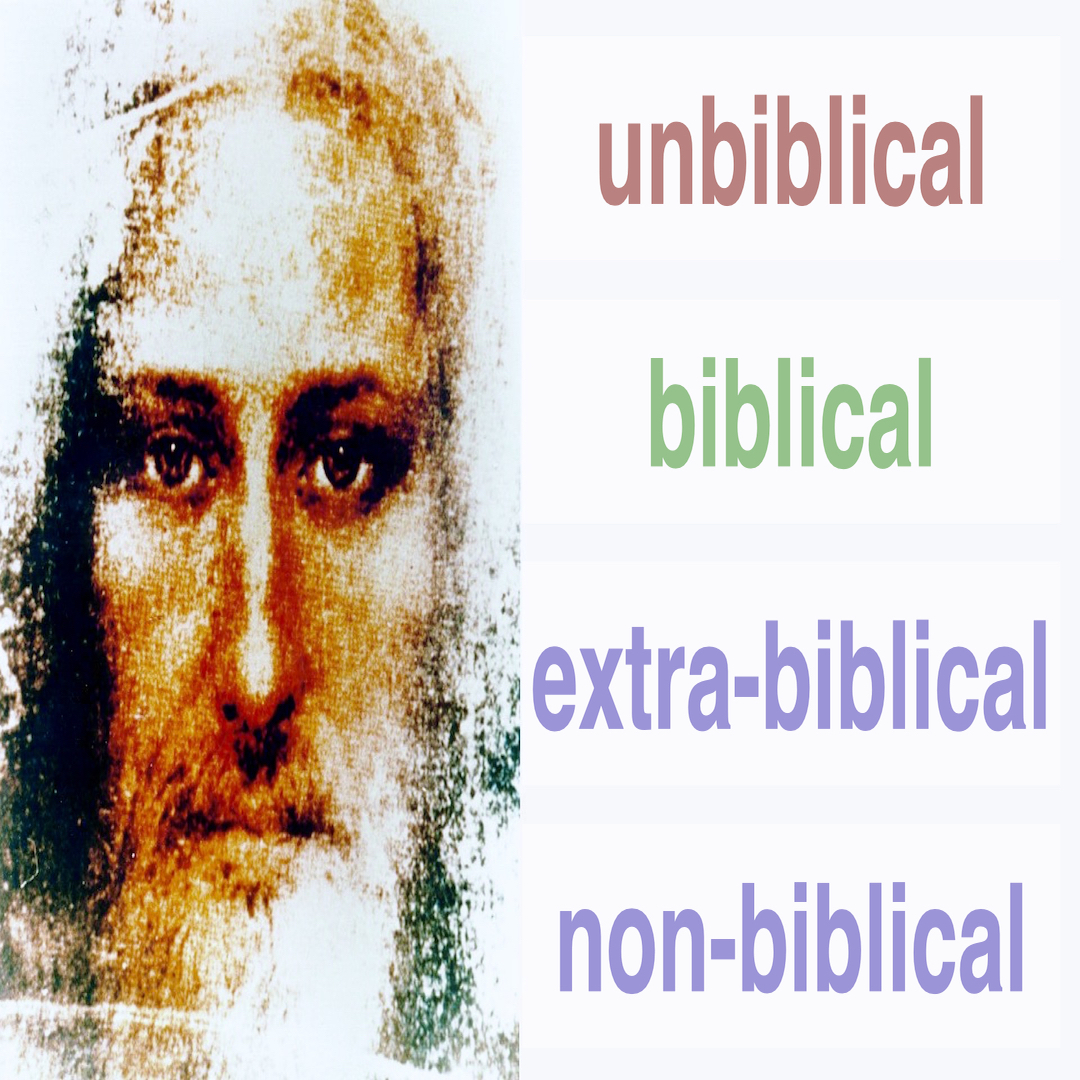
Both the Pharisees that interacted with Jesus and today’s cultural Christians seem to quote more from their own traditions than they do from the Scripture, so we need to distinguish that the source of our beliefs is from God’s inspired Word. (I share more about the concept of biblical, unbiblical, and non-biblical in this post.) 

A great example for us is how Jesus answered two questions from an expert in the Mosaic law: How do I earn eternal life? Who is my neighbor? See Luke 10:25-37.

(2) Stick to Scripture and your personal story.  

Remember that the person with an experience is never at the mercy of the person with an argument. When the Sanhedrin questioned the legitimacy of the healing of a lame man, Luke wrote, “But since they could see the man who had been healed standing there with them [Peter and John], there was nothing they could say” (Acts 4:14)! 

Love the personal story of the healed blind man in John 9! 

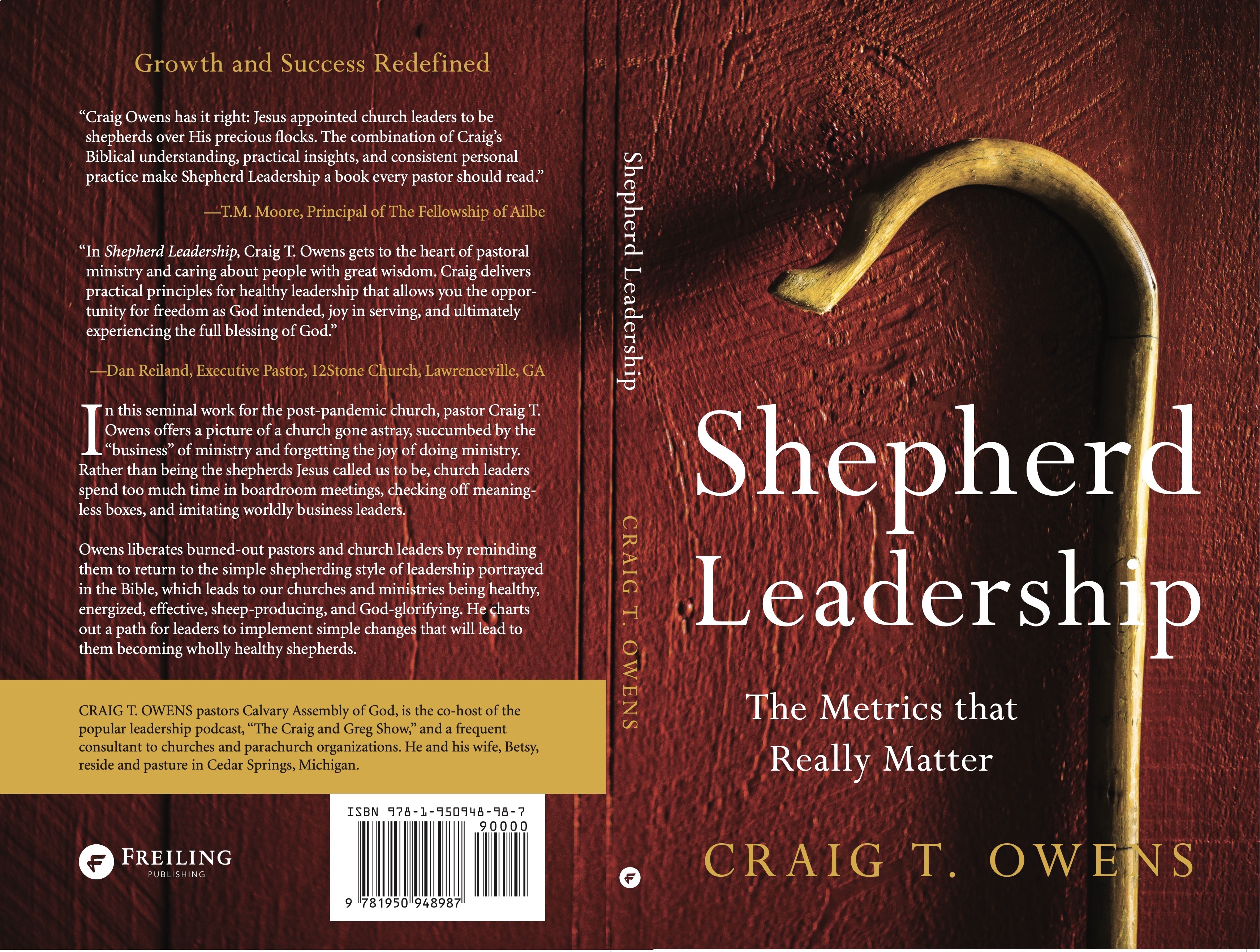
Judea can be translated “he shall be praised.” We glorify Jesus not by arguing with those on Lombard Street, but by simply proclaiming biblical truth and our personal testimony. 

Sing to the Lord, all the earth; proclaim good news of His salvation from day to day. Tell of His glory among the nations, His wonderful deeds among all the peoples. (1 Chronicles 16:23-24) 

As we stick with the Scripture and our personal testimony, the Holy Spirit will use our witness to open minds to the Good News of Jesus (2 Corinthians 3:18-4:5). 

Follow along with all of the streets we are looking at in our series Takin’ Him to the streets by clicking here.

►► Would you please prayerfully consider supporting this ministry? My Patreon supporters get behind-the-scenes access to exclusive materials. ◀︎◀︎
Opportunity Leadership (book review)

Listen to the podcast of this post by clicking on the player below, and you can also subscribe on AppleSpotify, or Audible. 

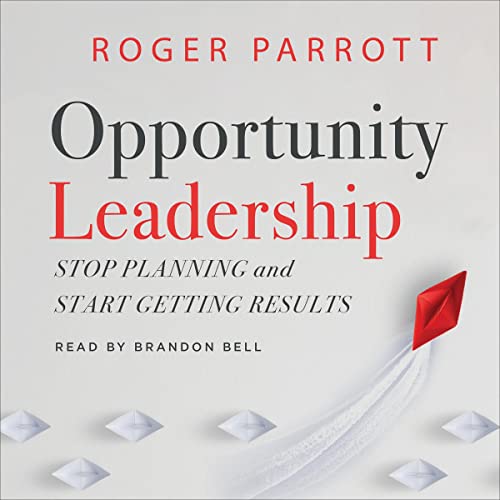
When I wrote my book, I was attempting to bring church leaders back to the biblical foundation for what it means to be a pastor. In a very similar fashion, Roger Parrott does this same thing for ministry leaders in his book Opportunity Leadership. 

Parrott is the president of a vibrant Christian university. As anyone who has been in the arena of higher education will tell you, making long-range plans is at the foundation of everything the administration and faculty do. But Parrott asks where did we get this model? Is this something we see in the Bible? 

Actually, we see verses that subordinate human plans to God’s plan. Verses like, “Many are the plans in a person’s heart, but it is the Lord’s purpose that prevails” (Proverbs 19:21) or, “They tried [planned] to enter Bithynia, but the Spirit of Jesus would not allow them to” (Acts 16:7). This is why Parrott makes the case that we are missing out on what God has in store for us because we only want Him to work on our carefully-made plans.

Parrott makes the case that their university has grown and seized opportunities because they were open and responsive to the doors God presented them, instead of missing out because they were blinded by their plans. 

Obviously, switching to this model will take tremendous buy-in from the point leader all the way through the entire organization. So the bulk of Opportunity Leadership helps prepare Christian leaders to change their paradigm, prepare for the inevitable pushback, and help their teammates move forward. 

I thoroughly enjoyed this book—finding myself saying, “Yes!” frequently as I was reading it—and I am confident all Christian leaders will benefit from reading this insightful work. 

►► Would you please prayerfully consider supporting this ministry? My Patreon supporters get behind-the-scenes access to exclusive materials. ◀︎◀︎
The Biblical Metric Of Success

Listen to the podcast of this post by clicking on the player below, and you can also subscribe on AppleSpotify, or Audible.

I was asked to share an article on the Converge Coaching blog.

There is no shortage of books that define “success” in our business or ministry endeavors, but as Christians, let’s try to get a more precise definition—a biblical definition.

I did a quick search for the words “success” or “successful” in just the New International Version of the Bible, and I was somewhat surprised by two things. First of all, the relatively few times this word is used: Only 25 times in the entire Scripture. We read of prayers offered for a successful journey, or a king’s reign, or a building project, success that comes to someone because of God’s favor on their life, or success in battle.

The second thing that surprised me: The word “success” isn’t used in the New Testament. The reason this surprised me is because without there being even a close second, Jesus has to be the most successful person who ever walked this planet. No one ever taught like He did, performed the miracles He did, or willingly laid down His life and was resurrected like He was. And yet the word “success” is never attached to His life.

This means we are left to draw some Holy Spirit-illuminated inferences from the Bible on how to define success. You may ask, “Why do we even need to know what ‘success’ is?” I would say we need a biblical definition for success to avoid the inevitable feelings of failure that come if things aren’t going as well as we thought they should.

In business, we often define success as revenue growth or a healthy net profit. In ministry, we typically measure success by church attendance, the number of people launched into ministry, or the amount of money given to missions work.

But what happens if we apply these metrics to the work Jesus did while He was on Earth? We see His disciples fretting over not having enough money to buy food for the congregation, and Jesus mentioning He often didn’t have a bed to sleep in, or the fact that Jesus only had one set of clothes. As a businessman, Jesus wouldn’t be considered successful by any current metrics. Even as a ministry leader, the congregation that gathered after Jesus was resurrected back to life only numbered 120 people. So if we consider Jesus as a pastor, His church wasn’t exactly thriving according to modern metrics.

After Peter’s sermon on the day of Pentecost (Acts 2) and his sermon following the healing of the lame man (Acts 3), we don’t hear much about quantitative growth throughout the rest of the Book of Acts. But in the balance of the Book of Acts, in the teachings of Jesus, and in the instructions in the epistles, we do hear substantially more about qualitative growth.

I think the clear message is that qualitative metrics are much more important to God than quantitative measurements. Specifically, I think we see the emphasis on two important qualities for godly leaders: faithfulness and excellence.

Solomon wrote, “Whatever you do, do well” (Ecclesiastes 9:10 NLT), and Paul told us, “Whatever you do, do it all for the glory of God” (1 Corinthians 10:31 NIV). These things tell us that our best effort is always required—no cutting corners, no half-measures, no bare-minimum effort. Instead, we should always do the best that we can, always striving for excellence.

My Grandma drilled a poem into my memory whenever I wanted to stop at “good enough.” She would say—

Good, better, best
Never let it rest
Until your good is better
And your better is best

How long do we do this excellent work? Until our Master returns.

Jesus said, “Who then is the faithful and wise manager, whom the master puts in charge of his servants to give them their food allowance at the proper time? It will be good for that servant whom the master finds doing so when he returns” (Luke 12:42-43 NIV).

Our devotion to these qualitative metrics of faithfulness and excellence can only truly be judged by listening to the Holy Spirit each day. He alone can speak to each of our hearts about our level of excellence and faithfulness for that day. He alone can help us know what true success is. We need to listen to His voice so that we don’t get distracted, disillusioned, and possibly even de-railed by trying to measure up to others’ quantitive metrics of success.

After all, ultimate success for any leader is to hear the applause from nail-scarred hands as our Master says, “Well done—excellently and faithfully done—My good and faithful servant!”

I can think of no better definition of success.

►► Would you please prayerfully consider supporting this ministry? My Patreon supporters get behind-the-scenes access to exclusive materials. ◀︎◀︎
Unity Enhances Our Witness

Listen to the podcast of this post by clicking on the player below, and you can also subscribe on AppleSpotify, or Audible. 

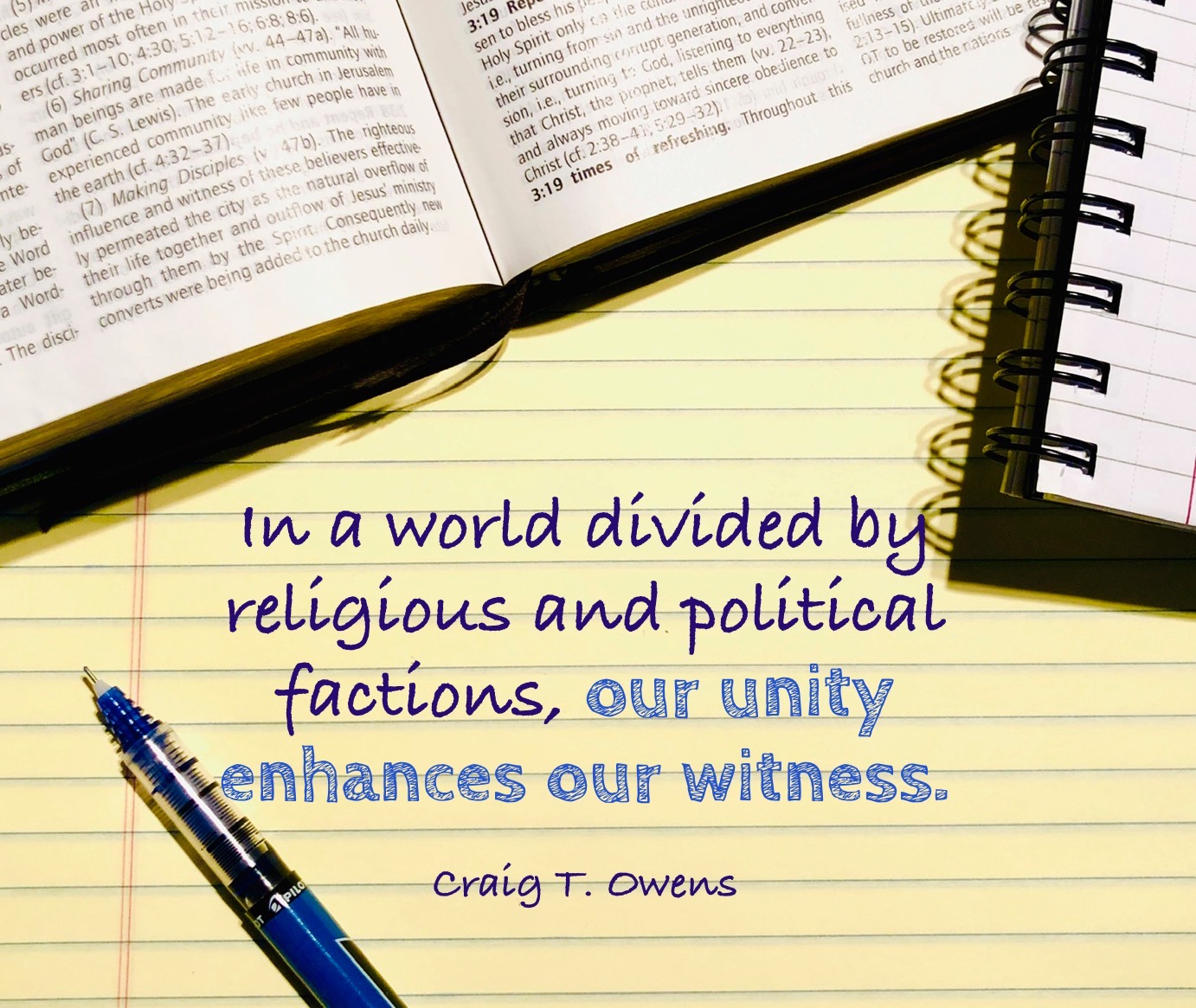
Last week we mentioned that one of the things the Holy Spirit did after the Day of Pentecost was to unite individual Christians into the Church. In a world divided by religious and political factions, the unity of the Christians set them apart. Is our culture any different? Of course not! So the unity that the Holy Spirit brings is just as vital today. 

In Psalm 133, David longs for this unity among believers. This psalm is in the collection of “Songs of Ascent.” That means that pilgrims to Jerusalem sang these songs as they literally went up the hill to Jerusalem. Psalm 133 opens with David singing, “How good and pleasant it is when brothers and sisters live together in unity” (v. 1). 

Maybe David thought back to the time when people were joining him to give him support as king—David went out to meet them and said to them, “If you have come peaceably to me to help me, my heart shall be knit to you” (1 Chronicles 12:17 AMP). In the next two verses of Psalm 133, David explains how this unity from being knit together is seen as a blessing. 

Last week, we talked about the blessing of peace the priests pronounced on the people. That word for “peace” is shalom which could be defined as “nothing missing.” But couldn’t we also say that shalom is “no one missing”? Yes, because each and every part of the Body of Christ is vital and indispensable! 

We see this same unity when the followers of Jesus were baptized in the Holy Spirit on the Day of Pentecost. Acts 2:1 says these Christians were “all together” (or some translations say “one accord”). This is one word in Greek (homothumadon) which describes the beauty of unity. One Greek dictionary defines this word,  “The image is almost musical; a number of notes are sounded which, while different, harmonize in pitch and tone. As the instruments of a great concert under the direction of a concert master, so the Holy Spirit blends together the lives of members of Christ’s church.”

This picture of a majestic musical is further amplified in the next verses of Acts 2 where people from all over the world heard these Christians praising God in their own native tongues. Luke goes on to use homothumadon again and again throughout Acts to show what a powerful testimony their unity was to the watching world.  

Paul emphasized the need for unity in the Church when he wrote—

As a prisoner for the Lord, then, I urge you to live a life worthy of the calling you have received. Be completely humble and gentle; be patient, bearing with one another in love. Make every effort to keep the unity of the Spirit through the bond of peace. There is one body and one Spirit, just as you were called to one hope when you were called; one Lord, one faith, one baptism; one God and Father of all, who is over all and through all and in all. (Ephesians 4:1-6) 

How does the Holy Spirit help us handle our differences and keep this unity? We first need the Spirit’s help to distinguish whether it’s a biblical, unbiblical, or non-biblical issue. 

  • Biblical issues must send us back to the Bible to find the truth (2 Timothy 3:16-17). 
  • Unbiblical issues—where a brother or sister is living in a way contrary to Scripture—call on us to speak the truth in love and correct in love only after allowing the Holy Spirit to examine our own lives (Ephesians 4:15; Matthew 7:1-5; James 5:19-20). Notice that we are to do this with fellow brothers and sisters, not with those outside the Church.  
  • Non-biblical issues are the trickiest. These are issues over which we should immediately stop fighting as we defer to the weakest brother or sister (Romans 12:10, 14:19-21).  

(I wrote much more about biblical, unbiblical, and non-biblical issues here, and how to correctly apply the principle of confrontation here.)

The Church needs this unity today. We need to be in “one accord.” In a world divided by religious and political factions, our unity enhances our witness.

If you’ve missed any of the messages in our series We Are: Pentecostal, you can check them all out by clicking here. 

►► Would you please prayerfully consider supporting this ministry? My Patreon supporters get behind-the-scenes access to exclusive materials. ◀︎◀︎

Is “Bigger” An Unbiblical Metric?

Listen to the podcast of this post by clicking on the player below, and you can also subscribe on AppleSpotify, or Audible. 

Many “church growth experts” will tell people how to grow their church. But when we say “grow,” what exactly do we mean? Does that mean more people? Does that mean more engaged church members? Or is it a combination of both? 

But more importantly: What does the Bible say about church growth? Does it give us any indication about whether church growth should be quantity or quality?

I taught on this subject with some summer ministry interns. Take a look…

I unpack this idea in much greater depth in my book Shepherd Leadership: The Metrics That Really Matter. My book is available in print or ebook, and in audiobook through either Audible or Apple.

►► Would you please prayerfully consider supporting this ministry? My Patreon supporters get behind-the-scenes access to exclusive materials. ◀︎◀︎