Is Confrontation A Dirty Word?

ConfrontationJesus takes the church of Thyatira to task because they are tolerating someone with a Jezebel spirit to remain in a position of leadership and influence (Revelation 2:18-29). This is still a message to the church today!

However, for some reason Christians have made “confrontation” a dirty word. We don’t confront people in error, especially those who are in leadership positions within their church. Perhaps equally as wrong: when we do confront, we do it in a way that is destructive.

The goal of confrontation is restoration, not destruction!

In Revelation 2, Jesus gives us five steps toward healthy, biblical, God-honoring confrontation:

  1. Don’t tolerate a Jezebel spirit by remaining silent (v. 20). Instead we need to follow the principles in Matthew 18:15-17 and 1 Timothy 5:19.
  2. Allow the one whom you’ve confronted time to repent (v. 21a).
  3. If they don’t repent, don’t rescue them from God-inflicted punishment (vv. 21b-23).
  4. Run away from secrets (v. 24). If something more than Scripture is required by the Jezebel leader, reject it.
  5. Don’t run away from the situation, but hold on to Jesus until Jesus returns (vv. 25-28).

Not one human is infallible, but Jezebel not only claims infallibility, but also demands blind allegiance to her teachings. But it is just as wrong to tolerate Jezebel as it is to confront her unbiblically; Jesus opposed both.

One way for us to always avoid these two extremes: Try to out-serve one another, just as Jesus directed us—

“You know that the rulers of the Gentiles lord it over them, and their high officials exercise authority over them. Not so with you. Instead, whoever wants to become great among you must be your servant, and whoever wants to be first must be your slave—just as the Son of Man did not come to be served, but to serve, and to give His life as a ransom for many.” (Matthew 20:25-28)

If you are near Cedar Springs next Sunday, please join me as we continue our series on The 7-Star Church.

Check out this clip about confrontation—

The Sin Of Silence

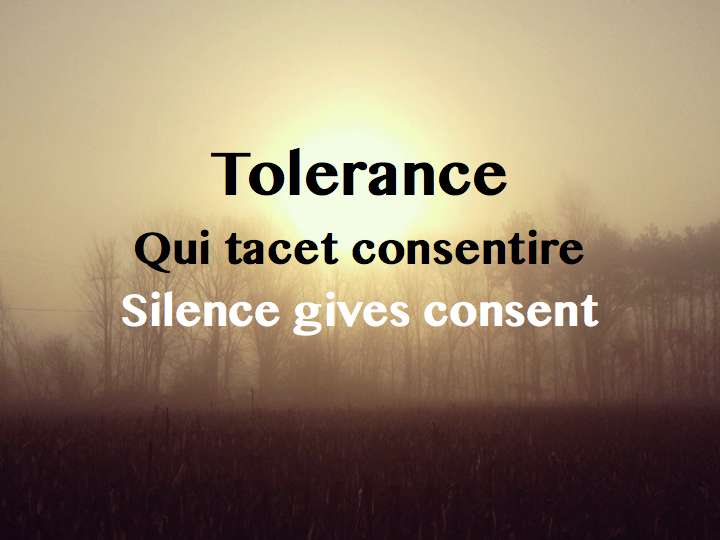
Qui tacet consentire“All that is necessary for the triumph of evil is that good men do nothing.” —Edmund Burke

This is as true for Christians as it is for anyone else.

In addressing the church at Pergamum (see Revelation 2:12-17), Jesus calls the Christians out for their silence. He tells them that what He has against them is their close relationship with those who hold to unbiblical ideas.

Pergamum’s sin is our sin in the USA today: tolerance. We let things slide, hoping to get along with others, trying not to rock the boat, trying to avoid being labeled a “hater,” and finding ways to be everyone’s friend.

There is a Latin phrase used in legal circles that says: Qui tacet consentire, which means Silence gives consent. If you don’t speak up to challenge what is stated, it is assumed that you believe it.

Jesus calls the church at Pergamum to repent for their tolerance. He calls for them to speak the truth of God’s Word. Twice the phrase is used to remind us of God’s Word being sharper than a double-edged sword.

Our job as Christians is not to win an argument, bring conviction, or become the sin police. Our job is to speak God’s truth in love.

True friends speak out when someone they care about is making a foolish choice. True Christians loving speak The Truth when the world around them is selling out to a convenient lie.

“In keeping silent about evil, in burying it so deep within us that no sign of it appears on the surface, we are implanting it, and it will rise up a thousandfold in the future. When we neither punish nor reproach evildoers … we are ripping the foundations of justice from beneath new generations.” —Alexander Solzhenitsyn

I will be continuing our series The 7-Star Church: Becoming The Church That Pleases Christ next Sunday. If you are in the area, I would love to have you join me.

Bible-Taught Or Spirit-Taught

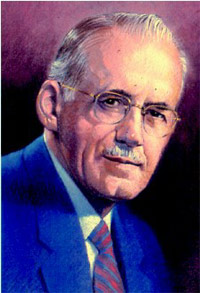
A.W. Tozer“We must be willing to obey if we would know the true inner meaning of the teachings of Christ and the apostles. I believe this view prevailed in every revival that ever came to the church during her long history. Indeed a revived church may be distinguished from a dead one by the attitude of its members toward the truth. The dead church holds to the shell of truth without surrendering the will to it, while the church that wills to do God’s will is immediately blessed with a visitation of spiritual powers. Theological facts are like the altar of Elijah on Carmel before the fire came, correct, properly laid out, but altogether cold. When the heart makes the ultimate surrender, the fire falls and true facts are transmuted into spiritual truth that transforms, enlightens, sanctifies. The church or the individual that is Bible taught without being Spirit taught (and there are many of them) has simply failed to see that truth lies deeper than the theological statement of it.” —A.W. Tozer

What do you think, pastor? Is your church Bible taught, or Spirit taught? Is there a difference? If so, how can you move your church into this deeper place?

Unpopular Preaching?

Walter Russell Bowie

Walter Russell Bowie

“The Christian church does not need more popular preaching, but more unpopular preaching.”

—Walter Russell Bowie

What do you think this means? Is Bowie right?

The Apostle Paul said preaching about Christ would be a stumbling block (unpopular) to some. Even Jesus didn’t preach a popular message.

In my opinion, we preach the Word of God. Period. Not our opinion, not a message to gather a crowd, not a message to entertain. Just preach the Word. It will be unpopular with the self-satisfied and sanctimonious, but it will be a welcome message to the lost and desperate.

What do you think?

God Answers Prayer

God Answers Prayer“It was to save lives that God sent me ahead of you. … It was not you who sent me here, but God” (Genesis 45:5, 8). This is what Joseph said to his brothers that beat him up, threw him in a pit, sold him to some slave traders, and then went back and told a big, fat lie to their father Jacob about Joseph being killed by a wild animal.

When the brothers threw Joseph in that pit and were bartering with the slave traders, the Bible says that Joseph pleaded for his life. I have a hunch that Joseph pleaded with God too. But God didn’t answer that prayer.

When Joseph was falsely accused of molesting an official’s wife and thrown into prison, Joseph probably prayed for God to get him out of prison now! But God didn’t answer that prayer. 

I’m sure Joseph’s father Jacob was praying that somehow Joseph would be returned to him. That maybe he wasn’t really dead after all. How long did Jacob pray that prayer? A year? Five years? Twenty years? But God didn’t answer that prayer.

When the devastating famine hit Canaan, I’ll bet Joseph’s brothers prayed that God would bless their crops and livestock and save them from the famine. But God didn’t answer that prayer. 

Aha!! But God DID answer all of those prayers. 

Not in the timing they wanted, but in His perfect timing “to save your lives by a great deliverance” (Genesis 45:7).

Are you praying hard for something? How long have you been praying? Keep at it…

GOD ANSWERS PRAYER PERFECTLY!

21 Quotes From “All In”

All InAll In by Mark Batterson is the sequel to his fantastic book on prayer called The Circle Maker. All In is the challenge to followup our prayer times with bold action. You can read my full book review by clicking here. These are some of the quotes I especially liked from All In—

“When did we start believing God wants to send us to safe places to do easy things?”

“You cannot be in the presence of God and be bored at the same time. For that matter, you cannot be in the will of God and be bored at the same time.”

“The Rich Young Ruler may rank as one of the most religious people in the pages of Scripture. The text tells us that he kept all the commandments. He did nothing wrong, but you can do nothing wrong and still do nothing right. By definition, righteousness is doing something right. We’ve reduced it to doing nothing wrong. … [Jesus] asks the Rich Young Ruler to ante up everything. Why? Because He loved the Rich Young Ruler too much to ask for anything less! We focus on what Jesus asked him to give up but fail to consider what He offered up in exchange.”

“God cannot reveal His faithfulness until we exercise our faith.”

“The first step is always the longest and the hardest. And you can’t just take a step forward into the future. You also have to eliminate the possibility of moving backward into the past.”

“One of our fundamental spiritual problems is this: we want God to do something new while we keep doing the same old thing.”

“When we cling too tightly to what God did last, we often miss what God wants to do next.”

“We all want to spend eternity with God. We just don’t want to spend time with Him. We stand and stare from a distance, satisfied with superficiality. We Facebook more that we seek His face. We text more than we study The Text. And our eyes aren’t fixed on Jesus. They’re fixed on our iPhone and iPads—emphasis on ‘i.’ Then we wonder why God feels so distant.”

“You cannot go to church because you are the church. … Your workplace is your mission field. Your job is your sermon. Your colleagues are your congregation.”

“Our lack of guts is really a lack of faith. Instead of playing to win, we play not to lose.”

“There are two kinds of people in the world—those who ask why and those who ask why not. Going all out is asking why not. Why people look for excuses. Why not people look for opportunities. Why people are afraid of making mistakes. Why not people don’t want to miss out on God-ordained opportunities.”

“We treat failure and success like their antonyms. Failure is a part of every success story. Think of it as the prologue.”

“No matter what tool you use in your trade—a hammer, a keyboard, a mop, a football, a spreadsheet, a microphone, or an espresso machine—using it is an act of obedience. It’s the mechanism whereby you worship God. It’s the way you do what you are supposed to do.”

“I’ve discovered that if I don’t take the first step, God generally won’t reveal the next step.”

“It doesn’t matter what you do, God wants to help you do it. He wants to favor your business plan, your political campaign, your manuscript, your lesson plan, your legal brief, your film, and your sales pitch. But you’ve got to position yourself for that favor by acting in obedience. And if God knows He’ll get the glory, He will bless you beyond your ability, beyond your resources.”

“Courage doesn’t wait until situational factors turn in one’s favor. It doesn’t wait until a plan is perfectly formed. It doesn’t wait until the tide of popular opinion is turned. Courage only waits for one thing: a green light from God. And when God gives the go, it’s full steam ahead, no questions asked.”

“Opportunities typically come disguised as impossible problems.”

“When it comes to sinful rationalizations, we are infinitely creative. But it’s our rationalizations that often annul His revelations. When we compromise our integrity, we don’t leave room for divine intervention. When we take matters into our own hands, we take God out of the equation. When we try to manipulate a situation, we miss out on the miracle.”

“Integrity won’t keep us from getting thrown into a fiery furnace, but it can keep us from getting burned.”

“It’s much easier to act like a Christian than it is to react like one!”

“There has never been and never will be anyone like you, but that isn’t a testament to you. It’s a testament to the God who created you. And that means no one can worship God like you or for you. You are absolutely irreplaceable in God’s grand scheme. And God is jealous for you—all of you.”

16 Quotes from “Fight”

FightGuys, it’s time to unleash the godly warrior inside of you, and Fight by Craig Groeschel can help you do just that (you can read my full book review by clicking here). These are some of my favorite quotes from Fight

“The virtue of strength is determined by how it’s used. If it’s used to love and to protect, it’s good. Unfortunately, it can also be used to inflict harm, and that’s not consistent with what we see of God’s character in the Bible. He calls us to fight for what’s right. And a worthy is only as worthy as his cause.”

“Gentleman, God created you with the heart of a warrior. Until there’s something you’re willing to die for, you can’t truly live.”

“Men don’t plan to destroy themselves. The problem is that we have an enemy who does.”

“You have to stop trying to do it in your own strength. Because our spiritual enemy, satan, is an expert at making strong men weak. Fortunately, and don’t miss this, our God specializes in making weak men strong.”

“Lust says, ‘I want it.’ Entitlement says, ‘I deserve it.’ And pride says, ‘I can handle it.’ … You can fight using your own limited power. Or you can tap into the all-powerful, limitless God who wants to help you win every battle for His causes. Here’s how:

  • Turn ‘I want it’ to ‘I want God.’
  • Turn ‘I deserve it’ to ‘I deserve death.’
  • Turn I can handle it’ to ‘I can’t handle anything without God.’

“Pride is always born of our insecurities. When we don’t know who we are in Christ, we use pride to try to fill that void. … So many of us try to define ourselves by our accomplishments, to find worth in what we’ve done, instead of in Whom we belong to. We want to rely on our achievements, our victories, our trophies, our wins to define us instead of acknowledging God as the source of all good things in our lives.”

“If there’s one thing you can count on self-pity for, it’s exaggeration. Every time you start thinking about how bad things are, it’s like a game to make sure everything is as bad as it could be. You’ll catch yourself using extreme words like never, always, and forever.”

“We get stuck in these negative loops of self-judgment and condemnation that are not from God. His Spirit always leads us to confession, to changing directions and going God’s way, to a fresh start, to grace. Often God has forgiven us, but our emotions haven’t caught up. I’m convinced this is just another form of our pride—wanting to be in control of ourselves and not rely on God. We’d rather hate ourselves than risk the vulnerability and humility required to depend on Him. It seems easier to expect the worst than to put our hope in God.”

“If you let your need drive you to God, God will meet your deepest need. … When you return to God and give your weakness to Him, only then will your strength return. But it’s ultimately not your strength; it’s His strength.”

“If you’re a ‘real’ guy, then you’re supposed to be a sexual beast, a stud, a leader of the pack, a stallion the ladies can’t resist—right? Wrong. You’re supposed to be a man stronger than his physical urges or emotional responses. You’re supposed to be a warrior who’s willing to fight for something more important. And that’s a battle that’s fought one temptation at a time.”

“Don’t dare be strong in just business or at your job. Don’t dare be strong just in your hobbies or at some sport. Don’t dare settle for being strong just physically. Focus your strength on leading those around you into righteousness. … Don’t settle for being strong at what doesn’t last and weak at what does. Tap into the warrior within Don’t fight just the meaningless battles. Fight for what matters most. And fight for your life.”

“If you’re going the wrong way, stop. Stop now. Fall on your knees and fight like a man.”

“When we strip men of permission to fight back at the appropriate time, we emasculate them. We stifle the spirit of the warrior that God placed within them, the spirit that yearns to fight for what’s right. When men feel stripped of power, it’s that much easier to give in to temptation. If they’ve never learned to fight, then it’s hard to know how to fight the deadliest enemy of all.”

“Remorse is a common response to failure, but there’s a much better one: repentance. Instead of turning inward or deflecting outward, you turn upward. Instead of allowing yourself to get stuck, you stop and then let God move you through it. You drop the guilt, the regret, the anger, and the self-pity and return to the Lord. Repentance means owning up to your mistakes and accepting responsibility. … Remorse is a feeling based primarily on guilt (a selfish emotion), keeping our attention on the past. Repentance is turning away from that wrong, turning away from the past, and turning our attention to changing our future. Remorse builds an emotional monument to our sin, then stands there gazing at it while we feel bad. Repentance is turning one hundred eighty degrees away from our sin and then walking away from it. With each step, repentance moves farther away from that sin. And it doesn’t look back.”

“You are not what you did; you are who God says you are.”

“Giving your life one time is easy. You know what’s hard? Giving your life daily. Paul said, ‘I die every day’ (1 Corinthians 15:31). Real men give their lives daily.”

The Despised Pastor

The Despised PastorSurveys reveal that people in the United States do not have a highly favorable view of evangelical Christians, nor of pastors of evangelical Christian churches.

I agree with John Maxwell’s maxim that everything rises and falls on leadership, so this unfavorable view of evangelical Christians must be addressed first in the pastorate. The 2400-year-old words from the prophet Malachi still ring true today—

“The words of a priest’s lips should preserve knowledge of God, and people should go to him for instruction, for the priest is the messenger of the Lord of Heaven’s Armies. But you priests have left God’s paths. Your instructions have caused many to stumble into sin. You have corrupted the covenant I made with the Levites,” says the Lord of Heaven’s Armies. “So I have made you despised and humiliated in the eyes of all the people. For you have not obeyed me but have shown favoritism in the way you carry out my instructions.” (Malachi 2:7-9)

Uh oh!

Is it possible, my dear fellow pastor, that if we become men and women of the Word of God that the views of the population might begin to change?

Thursdays With Oswald—The Word & The Words

This is a weekly series with things I’m reading and pondering from Oswald Chambers. You can read the original seed thought here, or type “Thursdays With Oswald” in the search box to read more entries.

Oswald Chambers

The Word & The Words

     The Bible is the Word of God only to those who are born from above and who walk in the light. Our Lord Jesus Christ, the Word of God, and the Bible, the words of God, stand or fall together, they can never be separated without fatal results. A man’s attitude to our Lord determines his attitude to the Bible. 

     The “sayings” of God to a man not born from above are of no moment; to him the Bible is simply a remarkable compilation of literature—“that it is, and nothing more.” All the confusion arises from not recognizing this. 

     But to the soul born from above, the Bible is the universe of God’s revealed will. The Word of God to me is ever according to my spiritual character; it makes clear my responsibility to God as well as my individuality apart from Him. 

From Christian Disciplines (emphasis mine)

Do you agree with Chambers on this viewpoint?

In light of this, how will you view Scripture differently?

Mouth-To-Mouth

Mouth to mouthI’ve notice that when someone feels physically tired, mentally unengaged, spiritually embattled, emotionally dry, or just plain worn out, they have an audible physical sign that is almost universal.

Those people sigh.

A sigh is an involuntary response that signifies frustration and a call for help. It should also be a reminder of the best place to find that help.

In Psalm 119, the chapter is organized in 8-verse segments. I like to look at the “bookend” verses of each section, as it usually gives a good idea of what that section is focusing on. The section called kaph has this bookended statement—

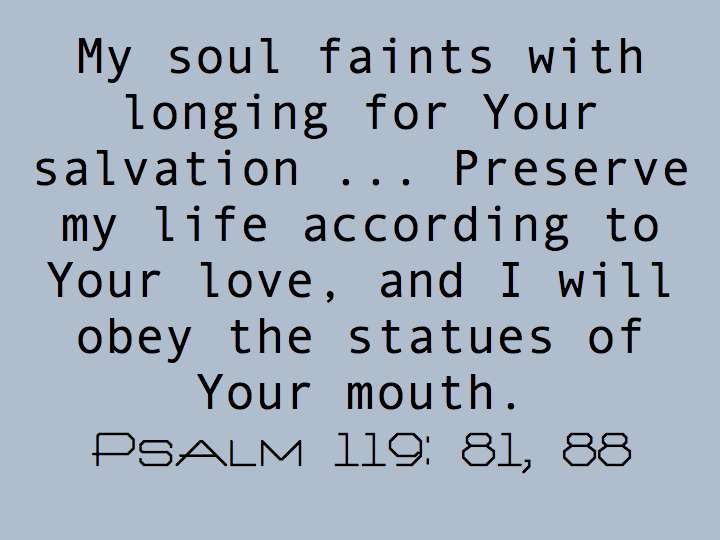
My soul faints with longing for Your salvation … Preserve my life according to Your love, and I will obey the statues of Your mouth (Psalm 119:81, 88).

Follow this progression:

  • When God created man, He breathed a soul into him. So we are created by His breath.
  • Jesus said that man does not live by bread alone, but by every word that comes from the mouth of God. God’s Word is inspired, which means it is literally God-breathed. So our soul is sustained by the breath of God.

The psalmist says his soul is sighing and wasting away, but he recognizes that his God-breathed soul can be restored through the God-breathed word. So in verse 88 he is asking God to give him mouth-to-mouth (or perhaps mouth-to-soul) resuscitation! 

The psalmist talks about clinging tenaciously to God’s Word as if it were his only lifeline … because it is! So whenever you find yourself sighing, let that be a reminder that you can get your spiritual resuscitation from the breath of God: His Word. Hold on to it as if your very life depended on it … because it does!

If you have missed any of the messages in our P119 series, you can access them all by clicking here.