Question marks invite a conversation; whereas, periods or exclamation points tend to end the conversation. Clearly, God enjoys dialogue.
God sometimes asks questions to get Zechariah to evaluate his surroundings or the prevailing culture. Sometimes God asks Zechariah a question to get him to clarify what he is seeing or thinking.
But without a doubt, most of the questions are posed by Zechariah to either God or to the angelic messenger who sometimes serves as Zechariah’s guide. Not once does God nor the angel tell Zechariah to hold his tongue. Zechariah’s questions are never belittled nor treated as though they were a bother. Nor are his questions ignored.
Rather, every single question is answered.
God enjoyed talking with Adam and Eve in the garden of Eden, He walked and talked with Enoch, He listened to the questions asked by Job and the psalmists, and here He engages Zechariah in conversation too.
Prayer is never designed to be a monologue—with us just speaking to God—nor is Bible reading designed to be a monologue—with just God speaking to us. Both prayer and Bible reading are used by the Holy Spirit to keep a dialogue active and engaging. You and I should never be afraid to approach God with our questions, nor should we be afraid to listen to the questions God asks us.
The dialogue between us and God builds an intimacy that cannot be developed in any other way. So keep asking those questions!
Listen to the podcast of this post by clicking on the player below, and you can also subscribe on Apple, Spotify, or Audible.
I’m a bit of a nut about the exactness of words, so one of my pet peeves is the incorrect use of imply and infer. “Imply” is something I do as the speaker; “infer” is something you do as the listener. Or you might say implying is like throwing and inferring is like catching.
A big problem arises when I infer something that you didn’t imply. Or even worse, when I infer something based on something you didn’t say. People will often say something like this, “Since Jesus didn’t specifically talk about ________ then it must be okay.” In logic, this would be called an argument from ignorance: concluding that an action must be acceptable because it has not been specifically stated to be unacceptable.
Statement #10 in our series asking “Is that in the Bible?” is—Love your neighbor. Is that in the Bible? Yes!
Later on, Jesus would add to this Deuteronomy 6:5—Love the Lord your God with all your heart and with all your soul and with all your strength—to answer the question about the greatest commandment of all.
In Leviticus 19, the Hebrew word for love means love in the broadest sense of the word, and neighbor means a friend or a fellow citizen. Unfortunately, the rabbis inferred that someone not a Jew was therefore an enemy and therefore not worthy of love. They further inferred that the opposite of love was hate.
Matthew Henry commented, “They were willing to infer what God never designed.”
Statement #11 is—Hate your enemy. Is that in the Bible? Yes, in the fact that it appears in print in Matthew 5:43, but it doesn’t appear in the Scripture that Jesus knew. It had become so ingrained in the thinking of people that they now assumed it was in the Bible.
In many ways, the Old Testament laws were easier to live out because they were all external and easy to measure, like don’t murder or don’t sleep with someone who isn’t your spouse. But Jesus made it a heart issue—He said lust is the same as adultery and hate is the same as murder.
Jesus also made love for enemies a heart issue. The word He used for love in the Greek is agape—the same word describing God’s love for His enemies in John 3:16—For God so LOVED the world, that He gave His one and only Son, that whoever believes in Him would not perish but would have everlasting life.
Jesus said our enemies were really our neighbors and were worthy of sacrificial love because they, too, were loved by God.
Matthew 5:44 is shortened in the NIV and has a footnote explaining that the longer verse was not seen in the earlier manuscripts. But given the fact that Jesus demonstrated everything found in the longer version of this verse, I think we are safe in using it. So let’s look at the response Jesus calls us to from the NKJV: But I say to you, love your enemies, bless those who curse you, do good to those who hate you, and pray for those who spitefully use you and persecute you.
Here’s what Jesus says it means for us to love our enemies:
(2) Help the haters. Jesus said we are to do those things that are beautiful and excellent—like the Good Samaritan did for his enemy-turned-neighbor (see Luke 10:25-37).
(3) Pray for the persecutors. Talk to God about them; don’t talk to others about them.
This response from Christians toward people whom others would call an enemy is totally unexpected by the world. This unexpected response will begin to draw enemies toward Jesus (1 Peter 2:12). If we will treat enemies and neighbors, they may soon become brothers and sisters in the family of God!
When the world hits us Christians out of hate, let’s respond with unexpected love: blessing those who curse us, helping those who hurt us, and praying for those who persecute us.
According to 1 Corinthians 12-14, the Holy Spirit operates in nine different gifts to both evangelize the sinner and edify the saints. The apostle Paul says that these gifts are available to all Christians who will allow the Holy Spirit to operate through them.
Listen to the podcast of this post by clicking on the player below, and you can also subscribe on Apple, Spotify, or Audible.
A meme that makes me chuckle every time I see it is a “quote” attributed to Abraham Lincoln in which he says, “The problem with quotes found on the internet is that they are often not true.”
(Not to spoil the joke for you, but unless Lincoln knew how to time travel to the future, I don’t think he knew about the modern internet! 😂)
I love this meme because it captures something that so many people fall into: a quick acceptance of a statement without verifying its source or thinking through the implications of the statement’s truthfulness.
Some insightful comments sound Shakespearean, but William never wrote them.
Some pieces of wisdom sound Socratic, but Socrates never taught them.
Some religious maxims sound godly, but the Bible never recorded them.
I would like to invite you to join me as we relaunch this series called Is That In The Bible? I think you may be surprised to discover just how many phrases we call biblical aren’t, and how many phrases there are that we never realized are actually in the Bible.
By the way, if you have a phrase that you would like to have us explore in this series, please leave it in a comment below. You may want to check out the questions we addressed in both the first installment and second installment of this series.
In this installment of this series, we asked: Is this in the Bible…
According to 1 Corinthians 12-14, the Holy Spirit operates in nine different gifts to both evangelize the sinner and edify the saints. The apostle Paul says that these gifts are available to all Christians who will allow the Holy Spirit to operate through them.
Listen to the podcast of this post by clicking on the player below, and you can also subscribe on Apple, Spotify, or Audible.
Pastor, I’m sure you are busy this week. But then again, aren’t you always busy?
I’ve got a quick but powerful question to ask you that will make a world of difference in how you are prepared to meet the demands of your week. Check this out…
Dietrich Bonhoeffer said, “We are reading the Word of God as God’s Word for us. Therefore, we do not ask what this text has to say to other people. For those of us who are preachers that means we will not ask how we would preach or teach on this text, but what it has to say to us personally.”
According to 1 Corinthians 12-14, the Holy Spirit operates in nine different gifts to both evangelize the sinner and edify the saints. The apostle Paul says that these gifts are available to all Christians who will allow the Holy Spirit to operate through them.
If you would like to join us in person for this class, here is where you can find us. If you have missed any of the classes in this series, check them out here:
This is a weekly series with things I’m reading and pondering from Charles Spurgeon. You can read the original seed thought here, or type “Thursdays With Spurgeon” in the search box to read more entries.
Listen to the podcast of this post by clicking on the player below, and you can also subscribe on Apple, Spotify, or Audible.
Froth Or Substance?
Many of you will read a novel from beginning to end, and what have you got? A mouthful of froth when you have done. But you cannot read the Bible—that solid, lasting, substantial, and satisfying food goes uneaten, locked up in the cupboard of neglect, while anything that man writes, as a catch of the day is greedily devoured. ‘I have written for him the great things of My law, but they were considered a strange thing’ [Hosea 8:12].
From The Bible
The Bible is the most important book anyone can read, contemplate, and apply to their lives. Yet far too many people say, “I just don’t have enough time to sit down to read the Bible.” Sadly, these same people take a lot of time on much less meaningful activities.
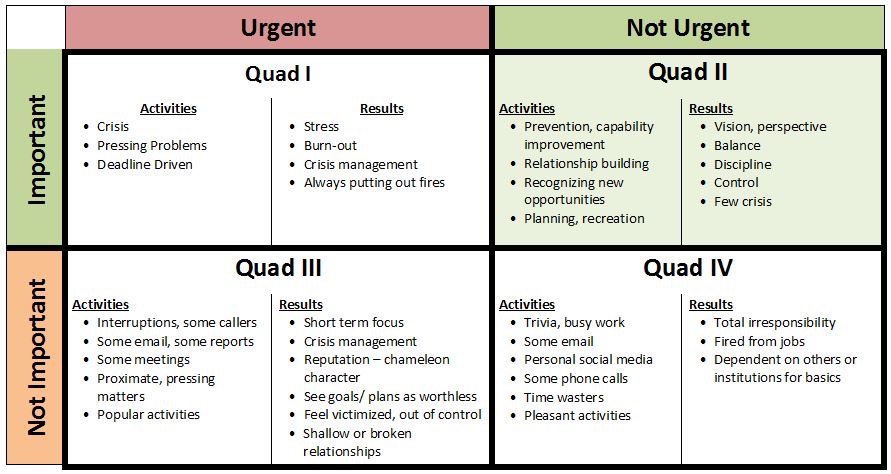
One thing that has been immensely helpful to me is the Urgent/Important grid Stephen Covey talks about in his book The Seven Habits Of Highly Effective People. Your Bible reading is never urgent—that is, an alarm will not go off to tell you it is time to read. However, your Bible reading is hugely important.
Covey discusses how we can put all of our activities into one of the four quadrants in this chart:
Your Bible reading time is definitely a Quadrant II activity, and the best place to find time for this activity is by eliminating things in Quadrant IV—the activities Spurgeon would call froth. In my book Shepherd Leadership: The Metrics That Really Matter, I discuss how leaders can use this grid to increase their leadership effectiveness.
The bottom line: We all must make sure we are eliminating the froth so that we have time for the great Substance that can only be found in God’s Word.
And then check out chapter 10 in Shepherd Leadership—“Can’t, Won’t or Don’t”—to learn how to use this grid to help you make the time for those important Quadrant II activities.
According to Romans 12, all Christians have been given a unique gift package by God. We are to use these motivational gifts to make God’s Kingdom more visible and more desirable.
This week we discuss the gifts of teaching and exhortation. You may download the participant’s notes and the gifts assessment I use in this lesson:



 In the first six chapters of the book of Zechariah, question marks appear 18 times.





 Craig T. Owens