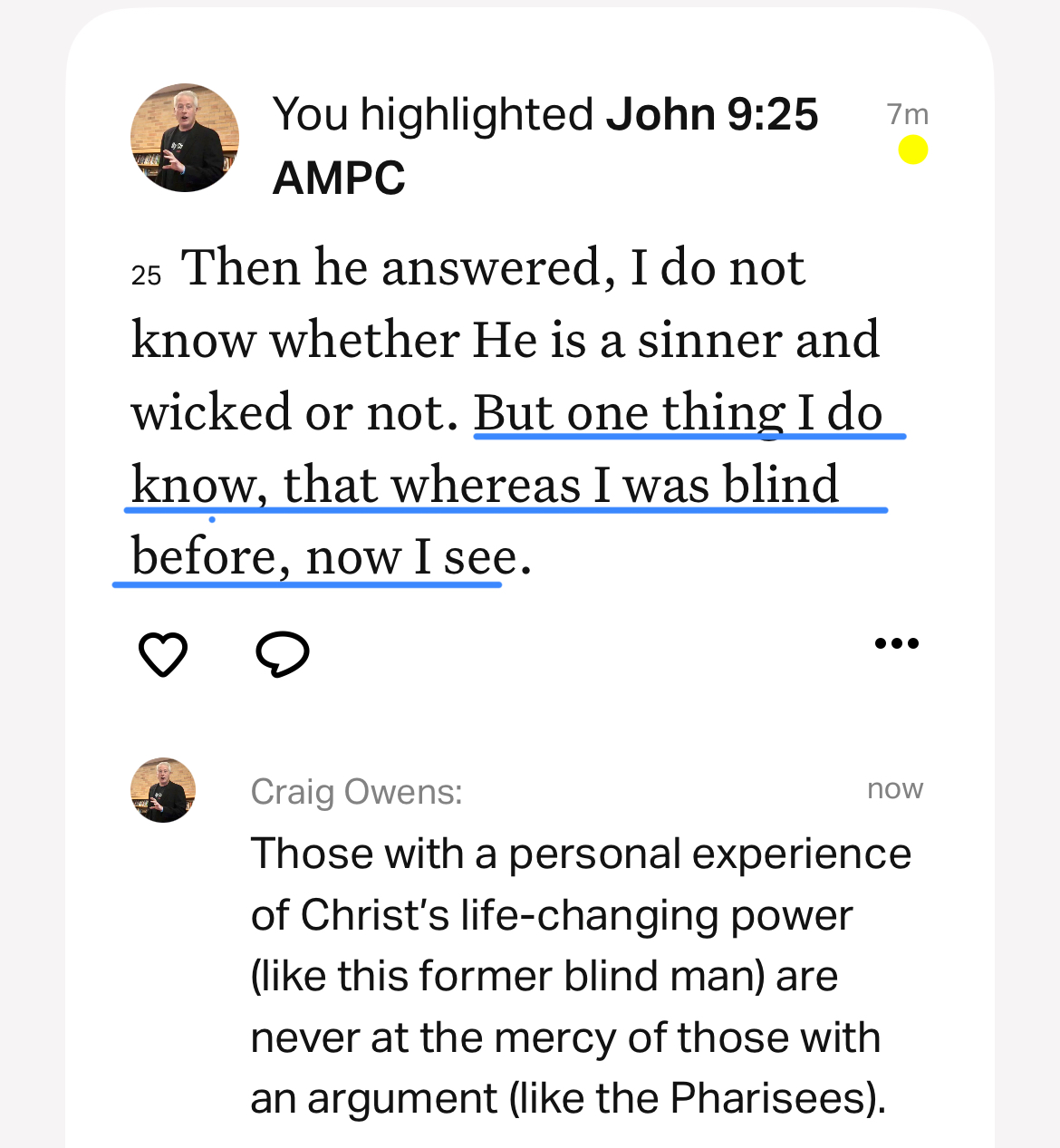
The religious leaders asked a man who had been healed by Jesus of his blindness whether he though Jesus had sinned by healing on the Sabbath. He said, “I do not know whether He is a sinner and wicked or not. But one thing I do know, that whereas I was blind before, now I see” (John 9:25).
I find it interesting that the Pharisees didn’t try to argue whether or not this man had truly been healed—that was obvious to everyone!—but they wanted to discredit Jesus and call Him a sinner because He healed on the Sabbath day.
Those with a personal experience of Christ’s life-changing power (like this former blind man) are never at the mercy of those with an argument (like the Pharisees).
In fact, this man who can now see not only has the most sound logic, but he has immediately become an evangelist for Jesus as well!
The man replied, “Well, this is astonishing! Here a Man has opened my eyes, and yet you do not know where He comes from. That is amazing! We know that God does not listen to sinners; but if anyone is God-fearing and a worshiper of Him and does His will, He listens to him. Since the beginning of time it has never been heard that anyone opened the eyes of a man born blind. If this Man were not from God, He would not be able to do anything like this.” (John 9:30-33)
I love this truism: The man with an experience is never at the mercy of the man with an argument. I have blogged extensively about this. Check out these posts.
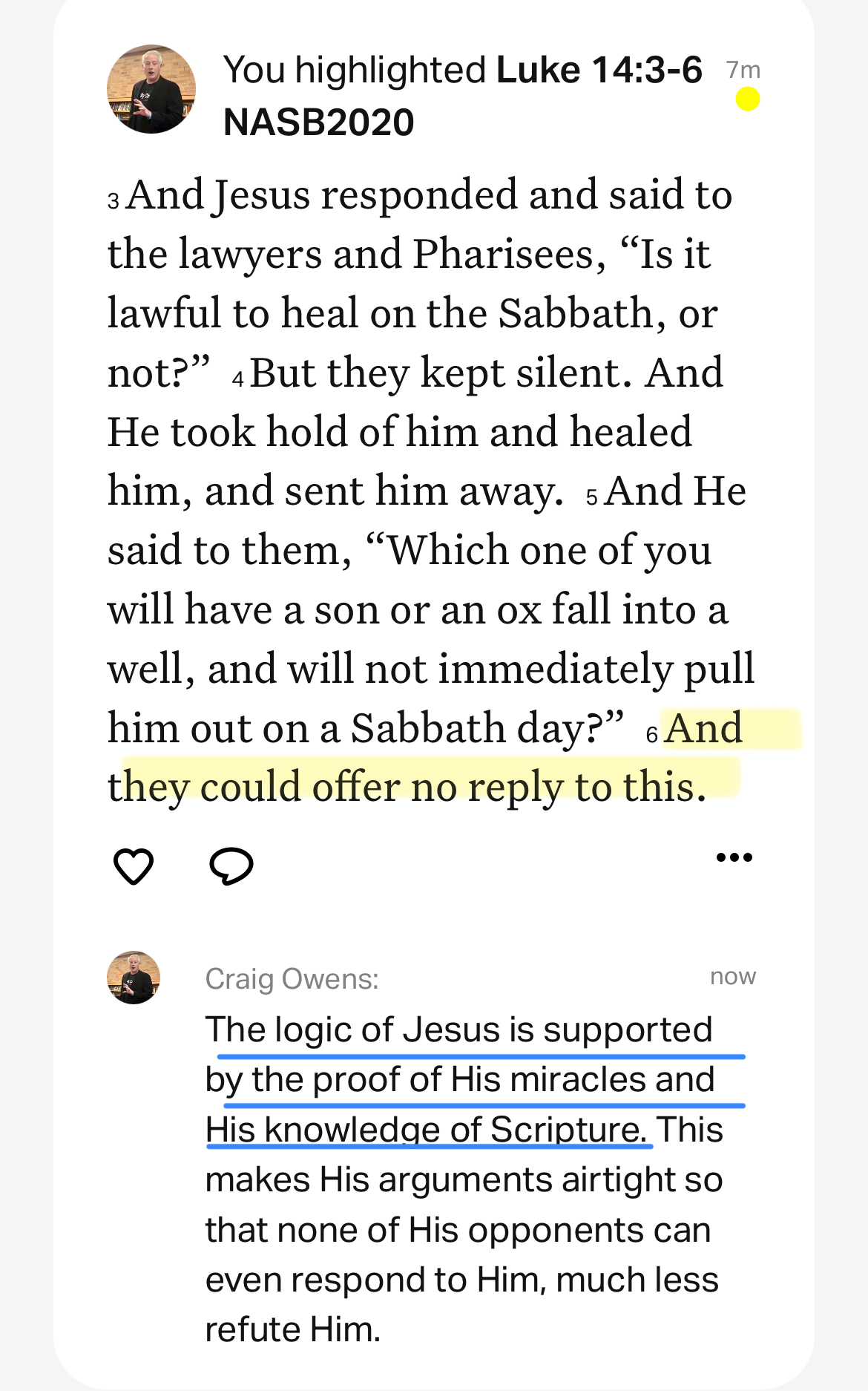
And Jesus responded and said to the lawyers and Pharisees, “Is it lawful to heal on the Sabbath, or not?” But they kept silent. And He took hold of him and healed him, and sent him away. And He said to them, “Which one of you will have a son or an ox fall into a well, and will not immediately pull him out on a Sabbath day?” And they could offer no reply to this.
The logic of Jesus is supported by the proof of His miracles and His knowledge of Scripture. This makes His arguments airtight so that none of His opponents can even respond to Him, much less refute Him.
We have the same things available to us:
(1) The Word of God which the Holy Spirit illuminates to our minds, and which He helps us use when critics attack.
(2) The example of our lives which have been changed by a personal encounter with Jesus.
(3) The logical connection of Scripture to the situation in which we find ourselves.
By it’s very definition, stepping out of your comfort zone is UNcomfortable and sometimes fearful. God promises to be close by while you’re in the Discomfort Zone!
I have lots of new content every week, which you can check out on my YouTube channel.
“Some believe it is only great power that can hold evil in check, but that is not what I have found. I have found it is the small everyday deeds of ordinary folk that keep the darkness at bay. Small acts of kindness and love.” —J.R.R Tolkien
“It cannot be exaggerated how much God hates our trying to do His work when it comes to vengeance or vindication. Whether it be vengeance or vindication, either is solely the Lord’s sovereign right. He does not like it when you or I try to punish someone, to vindicate ourselves, making ourselves look good or clearing our own names.” —R.T. Kendall
The world’s arguments are a lot of noise and very little substance. Don’t get into a shouting match, but quietly, gently, and respectfully keep returning to God’s Word. Charles Spurgeon was once asked how he could defend the Bible and he responded, “The Bible is like a lion: I let it out and it defends itself!”
Listen to the podcast of this post by clicking on the player below, and you can also subscribe on Apple, Spotify, or Audible.
People get into fights for lots of silly reasons. But one thing that causes many hurt feelings and harsh responses is gossip. This is one of the “sheep bites” I discuss in great detail in my book When Sheep Bite.
In the chapter “When Sheep Gossip About You,” I wrote—
The first part of the antidote when you have heard gossip spoken about you is to remember that God has also heard the gossip spoken about you. This is what Jesus demonstrated for us. Peter, who was there to hear all of the gossip spoken about Jesus, wrote, “He did not retaliate when He was insulted, nor threaten revenge when He suffered. He left His case in the hands of God, who always judges fairly” (1 Peter 2:23 NLT). …
There was no need for Moses to respond to these gossipers because the One “who always judges fairly” said to these gossipers, “Why then were you not afraid to speak against My servant Moses?” (Numbers 12:8). When God takes up our cause, let’s not try to take it out of His perfectly just hands. …
Just because God has called you to be His under-shepherd, and just because you may have been innocent of wrongdoing, you don’t have license to “lord it over” those who have gossiped about you. Moses described himself as humble—more humble than anyone else. He wasn’t bragging, but he wrote those words under the inspiration of the Holy Spirit. An insecure leader feels the need to defend himself against any slight against his character, whether it is a real or perceived attack. But the humble leader knows that God’s calling comes with God’s protection.
Solomon wrote, “Avoiding strife is an honor for a person, but any fool will quarrel” (Proverbs 20:3).
Anyone can start a fight—it’s not hard at all! Especially when someone has spoken foolishly, ignorantly, or even maliciously against you in their gossip.
Butonly strong people can walk away from a fight.
Only wise people can remain quiet when a fool tries to provoke them into an argument.
Only God-fearing people can entrust themselves to the One who keeps perfect records of the insults and slander thrown at them—just as Jesus did.
Be that kind of leader!
If you are a pastor, you know the painful bites of gossip. This is just one of several sheep bites I diagnose to help shepherd leaders find a healing, biblical response. Please check out my book When Sheep Bite.
Listen to the podcast of this post by clicking on the player below, and you can also subscribe on Apple, Spotify, or Audible.
God is precise in His promise making and promise keeping. He doesn’t just fulfill promises in a vague way or in “the spirit of the law,” but He attends to the jots and tittles of every single detail.
But people living in darkness sometimes don’t like the light.
When we feel like our message of hope is being ignored or rejected (or we’re even being persecuted for sharing the truth) we have a natural emotional response that begins to bubble up. That emotion is anger. How do I know this? Because Jesus experienced this too.
We can do two things with our anger:
We can blast skeptics with righteous judgment <or>
We can follow the example of Jesus
In The Pilgrim’s Progress, Faithful told how a man came and beat him because he had broken the law. Even when Faithful begged for mercy the man said, “I don’t know how to show mercy to anyone.” This man was Moses the Lawgiver. Faithful explained what finally gave him relief: “He would have finished me off, but then One came by, and told Him to stop. I did not know Him at first, but as He went by, I saw the holes in His hands and in His side and I concluded that He was Jesus.”
Moses had every right to be angry, and he expressed it a way that tried to finish off Faithful.
Jesus also got angry, but let’s see what He did with it.
In Matthew 12:9-10 we see the motive of the skeptics: catch Jesus doing something wrong. This opposition came from the religionists—they weren’t interested in the truth, they were interested in proving themselves right and righteous.
As they are asking their entrapping question, Luke tells us that “Jesus knew what they were thinking” (Luke 6:8). And Mark tells us that Jesus then asked a question of His own (Mark 3:4-5). These religionists refused to answer His question, and their stubborn hearts made Jesus deeply angry!
So Jesus answered His own question, concluding that the Sabbath was the day that god intended for healing and helping. To prove this point, Jesus then healed the shriveled hand of the man who stood before Him (Matthew 12:11-14). In response to this, the Pharisees plotted with the Herodians on how to kill Jesus (Mark 3:6).
Matthew then writes, “Aware of this, Jesus withdrew from that place (Matthew 12:15). He didn’t withdraw in fear, but in complete awareness of His Father’s plan. Part of that plan was not for Jesus to win argument, but for Him to win souls.
Perhaps in His anger in the moment, Jesus would have spoken words that were too harsh. There is a time to speak, but it’s usually not in the heat of the moment. In fact, Laurence J. Peter rightly said, “Speak when you are angry, and you will make the best speech you’ll ever regret.”
So in fulfillment of another prophetic word given in Isaiah 42, Jesus withdrew to continue His teaching and healing ministry (Matthew 12:17-21).
What does this mean for us today? I think we can see five important responses in these prophetic words:
I am to serve others as Jesus did—even those who want to silence me.
I can let the Holy Spirit use this opposition to bring greater fruitfulness out of my life (Galatians 5:19-26).
Listen to the podcast of this post by clicking on the player below, and you can also subscribe on Apple, Spotify, or Audible.
One of the teachers of the law came and heard them debating… (Mark 12:28).
The “them” in this verse are the Pharisees, the Herodians, the Sadducees, and Jesus. Mark especially loves this Greek word syzeteo, using it six times in his Gospel. Neither Matthew nor John uses this word at all. Luke uses it four times: twice in the Gospel of Luke and twice in the Book of Acts. This word appears nowhere else in the New Testament.
Syzeteo is a compound word that means a joint pursuit. Check out some of the ways this word is translated:
debating (NIV)
arguing (NASB)
disputing (AMP)
lively exchanges of questions (MSG)
reasoning together (NKJV)
The phrase “reasoning together” may sound familiar to you. It appears in the Old Testament when God says, “Come now, and let us reason together” (Isaiah 1:18). This is just one word in Hebrew (yāḵaḥ), which is defined as making something clear by demonstrating or proving.
Whether in the Old or New Testaments, this is not considered to be one-upmanship, or attempting to get the knockout punch, or trying to prove one’s superiority. It is a legitimate journey of discovery—asking good questions, truly listening to the answer (not just listening to respond or counter), and then processing the other’s words before responding. Plato defined syzeteo as seeking or examining together.
The teacher of the law noticed “that Jesus had given them a good answer.” He then asked a follow-up question. After hearing the reply from Jesus, he said, “Well said,” and reiterated Christ’s answer. To this Jesus noted “that he had answered wisely” and said to the teacher, “You are not far from the kingdom of God” (Mark 12:28-34).
The word “argue” used to mean the presenting of premises that led to a conclusion. Then the other person would perhaps challenge one of the premises to maybe show a different conclusion. These arguments or debates weren’t screaming matches and they certainly weren’t intended to be over trivial matters.
So should Christians debate? I would say yes IF all of these conditions are true:
…IF this isn’t a trivial matter which has no impact on eternity.
…IF I can ask good questions and truly listen to the other person’s answer.
…IF I can have an attitude of journeying together toward the truth found in God’s Word.
…IF I can humbly receive the truth that is spoken to me by the other person.
True Christian debating is not bantering with the other person, not attempting to score a “gotcha!” against the other person, not wanting to win an argument. The only true win comes when both parties arrive at the truth given to us in Scripture. This is true reasoning together.
Listen to the podcast of this post by clicking on the player below, and you can also subscribe on Apple, Spotify, or Audible.
Plato said, “Arguments, like men, are often pretenders.” This is both true and a logical syllogism. It is true because men often pretend, and they design their arguments to support their pretenses.
One of my favorite classes in college was “Introduction to Logic.” In fact, it is one of my few college textbooks that is still in my personal library today. It always struck me that God created logic. That means He is infinitely logical.
So we can restate Plato’s quote like this, “God’s arguments, like God Himself, are always authentic, logical, and valid.”
In my Bible study time, I often highlight the words that denote premisses and conclusions. In just Ezekiel 36 alone I find:
therefore (6x)
because (2x)
then (6x)
for (1x)
so that (1x)
We can argue against God’s logic, and we can even try to invalidate His arguments. But to do so makes me illogical. God not only gives the premisses and the conclusion, but He makes them both logical and valid. God told Jeremiah, “I am watching to see that My word is fulfilled” (Jeremiah 1:12).
So any of my attempts to redefine or re-order or invalidate what God has logically presented ultimately brings disorder, collapse, and frustration. It is far better for me to simply follow the premisses and trust God to bring about His promised—and logical—conclusion.
I encourage you to look for these logic statements as you read the Bible yourself. Here is a Bible study from Proverbs 2 that can help get you started.
Listen to the podcast of this post by clicking on the player below, and you can also subscribe on Apple, Spotify, or Audible.
One of my favorite classes that I took in college was a philosophy class where we studied the rules of logic. I found it so intriguing to learn how to construct or deconstruct an argument by looking at the premises and its conclusion.
One of the keywords that we would look at is “therefore.” This helped us understand what the conclusion of an argument was. If the argument was made well, what came after the “therefore” was a natural progression from the premises. With that in mind, I always keep an eye out for the “therefores” when I am reading my Bible.
Except I have noticed that God frequently uses “therefore” in unexpected ways.
The classic rules of logic lay out connecting and supporting premises that flow to a natural “therefore” conclusion. But God’s conclusions typically defy natural, conventional logic. His conclusions are frequently supernatural!
Notice a couple of examples from Isaiah. God’s people are suffering the natural consequences for their open rebellion against God. In my mind, the natural “therefore” would be: “You are getting what you deserve.” However, God’s supernatural “therefore” is: “I have taken this cup of My wrath from you” (Isaiah 51:21–22).
In another example, the way God’s people were behaving and the way the enemies of God’s people were treating them, the natural “therefore” that I would expect is: “No one revered God’s name any longer.” But God’s supernatural “therefore” declares: “All people will know My name. All people will know I have fulfilled what I foretold, and all will revere Me” (Isaiah 52:6).
Ultimately, these supernatural conclusions were proven true by Jesus. Our Savior drank our cup of wrath on our behalf and gave us His cup of righteousness in its place. The natural conclusion of Christ’s work for us is also God’s supernatural conclusion: God exalted Jesus to the highest place of honor and reverence (Philippians 2:5–11).
My natural logic fails. God’s supernatural logic succeeds. Always!
His supernatural conclusions should always lead to my revering and glorifying Him even more. Let me encourage you in your Bible study time to pay close attention to God’s “therefores” and rejoice in His Christ-exalting supernatural work.
This is a weekly series with things I’m reading and pondering from Charles Spurgeon. You can read the original seed thought here, or type “Thursdays With Spurgeon” in the search box to read more entries.
Listen to the podcast of this post by clicking on the player below, and you can also subscribe on iTunes or Spotify.
Stop Arguing
Our religion is not based upon opinions, but upon facts. We hear persons sometimes saying, ‘Those are your views, and these are ours.’ Whatever your views may be is a small matter; what are the facts of the case? We must, after all, if we want a firm foundation, come down to matters of fact. …
Beloved friends, let us never tamper with the truth of God. I find it is as much as I can do to enjoy the comfort of the truth and to learn the spiritual lessons of God’s Word without setting up to be a critic upon it. And I find it immeasurably more profitable to my own soul to believingly adore than unbelievingly to invent objections, or even industriously to try to meet them. The meeting of objections is an endless work. When you have killed one regiment of them, there is another regiment coming on, and when you have put to the sword whole legions of doubts, doubters still swarm upon you like the frogs of Egypt! It is a poor business. It answers no practical end. It is far better to firmly believe what you profess to believe and to follow out to all the blessed consequences all of the truths of God that, in your own heart and soul, you have received of the Lord.
From If There Is No Resurrection
I have presented evidence numerous times that makes it reasonable to believe that the Bible is God’s inspired Word (check out my posts here, here, here, and here). And yet there are still people who stubbornly want to argue that the Bible is made-up stories, or that there was no such person as Jesus, or that if there were a Jesus, He was just a good man but not God Himself who was raised from the dead. These arguments are nothing new. Paul had to address them just a few years after Jesus had ascended back to heaven, so what would make us think that we would escape those doubters?
As Spurgeon says, there is so much more joy when we simply “believingly adore” the God who is revealed to us on the pages of Scripture than it is to address such flimsy arguments. So that is what I typically do. Trying to debate with someone who won’t even accept basic facts is typically an unprofitable use of my efforts because they usually aren’t open to listening to what I have to say.
Instead, I simply remember this: The one with a personal experience of a life-changing encounter with a risen Savior is never at the mercy of the critic with only a handful of arguments! So you can simply say to that argumentative critic, “I know how different my life is because Jesus is in me and I am in Him.”
Stop arguing with close-minded critics and start adoring the God who loves you!
…And because of this I rejoice. Yes, and I will continue to rejoice (Philippians 1:18).
Paul is in prison, yet he tells his friends that he is choosing to rejoice. Wow!
Not only that, but this same imprisoned man also reminds his friends to…
… let their joy in Jesus overflow
… conduct themselves in a manner worthy of the gospel of Christ
… continue to have a servant’s attitude like Jesus
… don’t give in to complaining or arguing
… look out for the interests of other people
… rejoice in the Lord
… don’t rest on their laurels
… forget the past and press on toward the future
John Maxwell has noted that most people have uphill dreams but downhill habits. That is definitely not a winning combination!
Paul is making his friends aware of the possible downhill habits that may hold them back from their uphill dreams, and using himself as an example. This first step—awareness—is vital if we are going to break free of the things that are pulling us away from our God-given dreams.
Solomon wrote, “The path of life leads UPWARD for the prudent to keep them from GOING DOWN to the realm of the dead” (Proverbs 15:24).
Being prudent is saying, “I’m always on the lookout for what’s best.”
None of us can go UP by ignoring our downhill habits, or even trying to coast through life. The only way to achieve our uphill dreams is to ask the Holy Spirit to reveal our downhill habits so that we can make a plan to turn those around.
Making my own way Getting a mentor / partner (4:9)
Being discontent Being content (4:11-12)
Trying to be self-made Striving to be Christ-reliant (4:13)
A good prayer for all of us who have uphill dreams that we want to achieve—Holy Spirit, reveal to me my downhill habits. I acknowledge that I need Your help to see and break these habits. Then help me to replace them with Christ-honoring uphill habits that will allow me to achieve the purpose God has for my life.



 The religious leaders asked a man who had been healed by Jesus of his blindness whether he though Jesus had sinned by healing on the Sabbath. He said, “I do not know whether He is a sinner and wicked or not. But one thing I do know, that whereas I was blind before, now I see” (John 9:25).














 Craig T. Owens