Myth Buster

Dick BrogdenGuest Blogger: Dick Brogden

Currently there is an inordinate emphasis on size and speed when it comes to the development of the church. Church history soberly shows that orthodoxy tends not to spread as swiftly as heresy and that bad teaching outpaces good. It is the slow, steady repeated truth of God that builds the enduring church. The largest church at the end of the first century was found in Rome, thought by most scholars to be around two hundred members. The churches in Ephesus, Corinth, Philippi, Colosse, and Thessalonica (among others) were most probably between fifteen and fifty. The record of Acts takes place over about fifty years. Biblical precedent indicates that it takes about a generation to get a few churches to what we now consider modest size. One myth is that the church has to grow quickly; another that a strong church is a big church. The best churches tend to grow slowly and steadily, and the normal first century church comprised less than fifty people.

Disciples, too, are forged over time. If a church is but a collection of disciples, then it makes sense that strong churches require time to become solid. Another common myth today in mission is that all new disciples need is the Bible and the Holy Spirit. As appealing as this sounds, it has never been true in history, and if we are honest, it has not been true for any of us experientially. Consider how many books, sermons, mentors, friends, and external inputs help shape and form our spirituality over time. None of us grew to where we are without multiple sources of input over disparate seasons, all the input submitted to the authority of Holy Spirit and the Word. Biblically there always remains the need for an outside catalyst to help correct our biases and heresies. A group of people studying the Scriptures can just as easily end up pooling ignorance as illumining one another. Acts 15 is a classic example of ongoing external input necessary for the formation of strong disciples and churches. The negative example of external input (requiring circumcision) does not negate the massive, ongoing positive external input.

Paul and Barnabas report the wonderful turning of the Gentiles to Jesus. They also report the negative external pressure. James and the counsel respond by correcting the error and reinforcing what is necessary. In Acts 15:20, James delineates what they should not do–former religious forms and rituals. Paul reminds the council that coming to Jesus demands conversion (v. 3) and James cites Peter that the Gentiles must come out of false religion (v. 14). In Acts 15:32, Judas and Silas “exhort and strengthen the brethren with many words.” In verse 35, Paul and Barnabas teach and preach to the Gentiles and in verse 36, Paul and Barnabas commit to revisit their converts to ensure they are walking correctly. Disciples and churches are forged over time. Let us continue to believe that God will do great things and bring millions into His church. Let us continue to understand that it is slow, steady, life-on-life work to make disciples and build churches.

No Self-Made Men

I get so tired of people calling themselves “a self-made man.” There is no such thing! It is equally as distasteful when pastors pat themselves on the back talking about “the ministry I have built.”

Dick Brogden

Dick Brogden

Here are important words to remember—

“Wherever we go in ministry and mission, we either benefit from the labor of others or we contribute to the future benefit of those that will follow. If we see fruit, we can be assured that it is not solely due to our dedication or vision but because others went ahead of us and did the hard work. Often prayer accomplishes this hard work. Regularly those on the ground preceding us did this hard work.” (Dick Brogden)

And this—

What, after all, is Apollos? And what is Paul? Only servants, through whom you came to believe—as the Lord has assigned to each his task. I planted the seed, Apollos watered it, but God has been making it grow. So neither the one who plants nor the one who waters is anything, but only God, who makes things grow. The one who plants and the one who waters have one purpose, and they will each be rewarded according to their own labor. For we are co-workers in God’s service; you are God’s field, God’s building. (1 Corinthians 3:5-9)

What do you think?

Unpopular Preaching?

Walter Russell Bowie

Walter Russell Bowie

“The Christian church does not need more popular preaching, but more unpopular preaching.”

—Walter Russell Bowie

What do you think this means? Is Bowie right?

The Apostle Paul said preaching about Christ would be a stumbling block (unpopular) to some. Even Jesus didn’t preach a popular message.

In my opinion, we preach the Word of God. Period. Not our opinion, not a message to gather a crowd, not a message to entertain. Just preach the Word. It will be unpopular with the self-satisfied and sanctimonious, but it will be a welcome message to the lost and desperate.

What do you think?

Painful Love

Sometimes pastors don’t want to say “No” to someone in their congregation because they don’t want to hurt them. Sometimes pastors don’t confront someone in their sinful choices because it seems “mean spirited” to do so.

David Wilkerson

David Wilkerson

Love must be tough. Love sometimes inflicts pain.

“Love inflicts pain, even as it does no harm (Romans 13:10). True love repeatedly disappoints, hurts, confronts, refuses, and disciplines. This is certainly how God has loved us, and we should not expect to love others without hurting them. Love hurts but does not harm. God’s minister bears the sword, but not in vain (v. 4) and with the hope that long-term health will come from short-term faithful wounds.” —Dick Brogden

“Elijah’s hatred for the sins of Israel sprang out of his very strong love for God’s people. He was not a people hater, only a sin hater. He was not a man of revenge, but rather a man whose heart yearned for Israel’s return to the Lord.” —David Wilkerson 

11 Quotes From “Alone”

AloneAlone should be read and discussed by parents and teens to help find the right balance of technology usage in our lives. You can read my book review by clicking here. Below are some of the quotes that stood out to me from Alone.

“Maybe God created Adam to be needy. … Maybe Adam’s relationship with God was not built in fullness but contained a hole God created inside of humanity so we might recognize the importance of each other. It was (and is) brilliant.”

“Friendship has to be accompanied by experience. … The illusion of friendship is making everyone in the world think we’re perfect. … Instead of time spent experiencing life together, we’ve turned our world into a self-shaped, self-regulated, self-indulgent, me-centered life.”

“We are now a culture that wants to deal with relationships on our time. … Relationships are work. They’re inconvenient. They’re exciting and spontaneous. You can’t apply some formula for relationships and expect to walk out of the room with a load of friends.” 

“When you realize what role you have to play here on the planet, the most beautiful sense of belonging begins to awaken inside your soul. The world begins making sense. No matter what you’re doing, if God has gifted you in it, you’re going to have a high level of functioning.”

“Don’t get me wrong: Hard work and dedication are important factors as we help people understand significance, but in the end, our short lives are shaped by the relationships we make along our own journey. And if those relationships are filled with people who believe in us, the lonely factor fades away and we are recognized for the abilities we do have rather than the ones we don’t. Paul said it clearly: ‘I remind you to fan into flame the gift of God, which is in you through the laying on of my hands’ (2 Timothy 1:6). What can you do to fan someone else’s flame? Who in your life fans yours?”

“Maybe it’s because we’ve replaced the idea of risk and adventure with the idea of wealth and comfort. Loneliness begins to creep into a man’s life when adventure and risk are taken out of the equation, when men have to replace their God-given desires with something ‘more responsible.’ … Men need to sense that what they are doing in the world is courageous. They need to feel the sense of responsibility and freedom. They need to have opportunities to express their manhood.”

“There is no perfect girlfriend. There is no perfect employee. There is no perfect friend. There is no perfect body type or student or athlete. There’s no such thing as a perfect woman who finds the perfect role for her perfect situation. Those who continue to assign a high value to that mythical person who has it all together are driving themselves mad with the idea that they can achieve her. It’s from this feeling of failure, of never measuring up, that the loneliness sets in.” 

“The first step in understanding true joy is defining what joy actually is. It’s a feeling. It’s an emotion. It’s a state of mind. It’s the ability to know that the desires of your heart are being fulfilled. It’s not happiness. It’s not the constant state of euphoria. It’s not everything lining up perfectly. … In modern times, joy happens when we interact with each other. When we see a friend’s smile giving us validation that he or she is interested in being with us: joy. When we hear the words ‘How are you?’ in an honest tone, with honest body language behind it: joy. When we have an opportunity to rest in the fact that someone else wants us to be the person God created us to be: ultimate joy.”

“The quickest way to initiate friendship is to give people freedom to be themselves.”

“‘Oh, you did sooo well in your game,’ she said, walking past, rolling her eyes. Versus … ‘I can’t believe you! You’re the most awesome basketball player I’ve ever seen,’ she said, putting her arm around her friend in celebration. See the difference? Authentic versus agenda-driven. Caring for someone versus using someone. When a tribe is built … When experience glues relationships together … When you can rest in the joy that certain relationship gives you … Loneliness starts to fade away. But you can’t do that on Facebook.”

“If we can take the value of the social networking scene and combine it with real-time relationships, we might see this trend of loneliness take a positive direction. What would life look like if we could really experience life together? Community is important. To be able to contribute to the life of the community is even more fulfilling.” 

16 Quotes From “Firsthand”

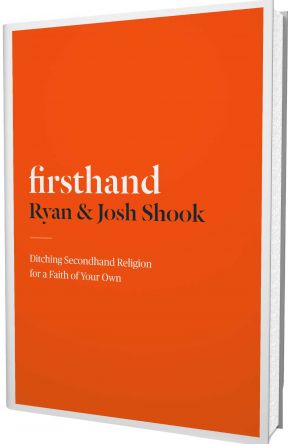
FirsthandI strongly encourage Christian parents to put a copy of Firsthand into the hands of their children, high school age and older. This book will help them think through making their faith in Jesus something personal to them. You can read my book review by clicking here. Below are some quotes that stood out to me. All of these quotes are by the authors, unless otherwise noted.

“You must be emptied of that of which you are full, so that you may be filled with that of which you are empty.” —Augustine

“One of the most liberating and powerful statements of all time comes from the lips of Jesus: ‘You will know the truth, and the truth will set you free’ (John 8:32). And we’re writing this chapter to tell you something that will set you free. The only way we’ve been able to experience freedom is by making the choice to get completely gut-level honest with God and others.

“God can use you and me through our brokenness, but first we have to get real and vulnerable with Him and with others. I think this powerful ‘get real’ dynamic works for a few reasons. First of all, being real with God and those around us invites us to drop the pride and pretense and to walk in humility. Second, honesty invites us to live every day in gratitude for the incredible grace that Lord has shown us. And third, since now we know we can’t make it on our own—and that’s okay—we’re ready to invite God’s power to do for us what we can’t do for ourselves. Paul said in 2 Corinthians 12:9, ‘I will boast all the more gladly about my weaknesses, so that Christ’s power may rest on me.’ This turns the concept of weakness and vulnerability on its head. We are saying that God makes up for our weaknesses. We are admitting that He is ready to work through them. Our weaknesses can actually become our greatest assets because they draw us closer to the Lord. And once we see how God can use them, we have all the more reason to be open about our struggles.”

“When all you see is a life in pieces, remember: the Remodeler wants to change you from the inside out. And He’s at work building your character to match His great calling and purpose for your life.”

“We have to decide, moment by moment, if we want to act changed or be changed.”

“It is more important to live one word of Scripture than it is to memorize volumes.” —Tim Hansel

“When our faith looks like a long list of things we should do, it’s usually a sign we’re not really focused on knowing God today for ourselves. Firsthand faith is all about a relationship with the God who is always faithful.”

“God is no less with you in your doubts that He is with you in your certainties.”

“Firsthand faith means we’re not afraid to bring our burning questions directly to God. But it also means that we’re not afraid to simply relax in His love. Even when all our questions haven’t yet been answered.”

“The needs of this world are endless. So whenever we feel a divine disturbance, it’s essential that we respond with firsthand action. If we don’t, it will quickly turn into secondhand bitterness.”

“James tells us that faith without works is dead (James 2:26). The most certain way to go back to living a secondhand faith is to refuse to act upon the Holy Spirit’s movement in your heart…. When you do not respond to a divine disturbance of the Holy Spirit, you get bitter and you criticize. That helps no one. … When you don’t respond to a divine disturbance in your life, you become the greatest obstacle between an unbelieving world and a loving God—a judgmental Christian.”

“Your eternal footprint—the impact you make on this earth—will be determined by whether you respond to the calling of the Spirit of the Lord in your heart to love a broken world, to step into the gifts and passions the Lord has blessed you with yo meet the needs that others overlook.”

“When we set out to discover our own firsthand faith, we were disillusioned with church. We had seen how imperfect the church could be, and we were certain that church was the problem. Coming full circle with our firsthand faith, we now realize that church was not the problem. The problem was out view and definition of the church itself. It took us a long time to understand that church wasn’t a building or a pastor or a sermon series. It’s easy to point out everything wrong with the church when you stand outside it and approach it with a consumer mentality. We thought the church had given us a secondhand faith, when in reality we had chosen to avoid a firsthand relationship with the community of Christ follower we claimed to care about.”

“The church is messy and imperfect because it is made up of broken and imperfect people. Are you sitting on the sidelines because the people in your church are imperfect or ‘just not like you’? … God designed you to be in community with your local church. He designed you to have firsthand relationships not only with Him but also with the people in your church. You can come up with plenty of excuses not to get involved and reasons that your church has it wrong, but when was the lat time you looked inside yourself and really searched your own heart for issues?”

“You can try to live out a firsthand faith on your own for as long as you want, but until you live out that faith in a community, you will never realize your full potential in Christ.”

“As a Christian, you are part of a movement that will outlast you, and you are part of the Firsthand Generation. As communities of believers rise up, we will gain momentum and create a movement that is stronger than anything we could ever accomplish on our own. Perhaps God is calling you to gather people and become a leader in the Firsthand Generation. Take up the challenge.”

Embracing Conflict

Listen to the podcast of this post by clicking on the player below, and you can also subscribe on AppleSpotify, or Audible.

A quick survey: Please raise your hand if any of these pertain to you:

  • Have you ever had a disagreement with someone?
  • Have you had a disagreement with someone you love?
  • Have you had a disagreement with someone you love, who also called themself a Christian?

If you raised your hand, you joined 100% of my congregation who answered “yes” to all three.

When we are in close proximity to anyone, there will be conflict. In fact, close proximity usually leads to more conflict because closeness increases friction. For a Christian the issue is not if we will have conflict with others in the Church, but how will we navigate and resolve these conflicts.

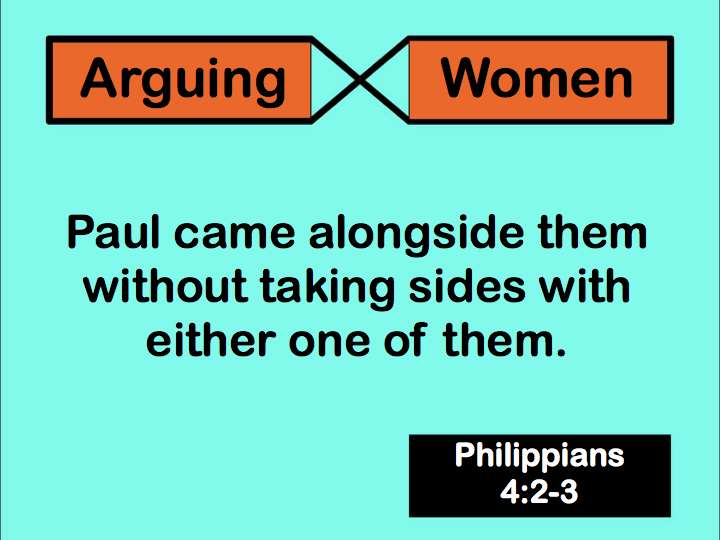
The apostle Paul wrote a thank you letter to the church at Philippi, in which he speaks in some of the most glowingly loving terms of any of his letters. Clearly, this was a group of people close to his heart. So when he heard about a conflict between two ladies in this congregation, he took time to address it publicly in his letter—

I plead with Euodia and I plead with Syntyche to be of the same mind in the Lord. (Philippians 4:2)

We don’t know why these ladies were arguing but notice that Paul doesn’t take sides. He simply says, “I please with Euodia AND I plead with Syntyche.” The word for plead means someone who comes alongside to help. In using this terminology, Paul gives us an important principle:

We can come alongside those in conflict without taking sides with either one of those in conflict.

In the next verse, Paul implores the rest of the church to join him in this alongsided-ness

And I exhort you too, my genuine yokefellow, help these two women to keep on cooperating…. (v. 3 in the Amplified Bible)

In other words, Paul wants the rest of the church to embrace these at-odds sisters, also without taking sides. He addresses the members of the church as yokefellow. It’s not a word we use too often today (although it is still in the dictionary), but it paints a crystal clear picture of our role. Here’s what we CAN’T do as yokefellow:

  • Look away
  • Mind our own business
  • Hope the situation will work itself out
  • Try to navigate around the problem

Instead, we embrace the conflict by embracing those in the conflict. We help them to cooperate and to work in harmony in the Lord (v. 2 in the Amplified Bible). It’s our responsibility to help maintain the bonds of peace so that the Body of Christ can grow in a way that is healthy and God-honoring.

Do you know someone in conflict right now? Are you in the conflict yourself? Ask God to show you how you can come alongside—not take sides—with those in this conflict so that you can help bring about peace.

If you have missed any messages in this series called Life Together, you can find them all by clicking here.

►► Would you please prayerfully consider supporting this ministry? My Patreon supporters get behind-the-scenes access to exclusive materials, like a map and an app I just shared to help with your personal Bible study time. ◀︎◀︎

No Conspiracies Here

Listen to the podcast of this post by clicking on the player below, and you can also subscribe on AppleSpotify, or Audible. 

Could it really be this simple? Could it be that Jesus died and rose again just like the Bible says? Or does it need to be more complicated than that? Are there other theories that seem to fit the facts?

At the feast of Pentecost where Jewish people from all over the world convened in Jerusalem just 50 days after the resurrection of Jesus, Peter stood up to address them:

  • He began, “Fellow Jews and all of you who live in Jerusalem…” (Acts 2:14). He addressed both local residents and guests from faraway lands.
  • Peter began by saying, “Jesus of Nazareth was a Man accredited by God to you by miracles, wonders and signs, which God did among you, as you yourselves know” (v. 22). No one shouted Peter down or disputed this claim. Quite possibly because there were those in this audience who had personally seen or experienced one of Jesus’ miracles.
  • The he announced, “God has raised this Jesus to life, and we are all witnesses of the fact” (v. 32). Anyone could have easily refuted this claim because the tomb of Jesus was within walking distance of where they were standing, and yet no one disputed this claim.

(Check out all of the Scripture references in this post by clicking here.)

A short time later, after healing a lame man outside of the temple, Peter and John were hauled before the Sanhedrin (the rulers and elders of the people [Acts 4:8]). This was the very group who had convinced the Roman governor Pontius Pilate to have Jesus crucified.

  • They addresses this group by saying, “It is by the name of Jesus Christ of Nazareth, Whom you crucified but Whom God raised from the dead, that this man stands before you healed” (v. 10). Once again, they didn’t dispute this, but they just told them to stop preaching in this name of Jesus (v. 17).

Paul was a devout member of this Jewish religious leadership until he had a personal encounter with Jesus. It became awfully difficult for Paul to argue that Jesus was dead, when he had personally seen Him and talked with Him!

Paul’s former colleagues had him arrested to stand trial before the Romans. The Roman governor Festus noted that the claims of the Jews against Paul were “about a dead man named Jesus Who Paul claimed was alive” (Acts 25:19). This is nearly 30 years after the resurrection of Jesus occurred. King Agrippa didn’t scoff this off. In fact, Paul said he was glad to talk to the king since “the king is familiar with these things…. I am convinced that none of this has escaped his notice, because it was not done in a corner” (Acts 26:26). Again, Agrippa didn’t dispute the claim of Jesus’ resurrection, but simply accused Paul of trying to convert him to Christianity.

There is something in our hearts that wants the resurrection to be true.

  • We don’t want to work all our lives for nothing.
  • We don’t want to invest in a relationship, only to have that end when the other person dies.
  • We want there to be something more. We want there to be something that makes sense of the world.
  • Only the resurrection of Jesus the Christ helps us make sense of life. Only His resurrection gives us lasting hope. 

An old song by the band Kansas says:

Deep within the hardest heart

There is something there that knows

There’s a hunger life can never fill

Til you face the One Who rose

There were two followers of Jesus who were out for a walk on the evening of the day of the resurrection. They, too, were trying to figure out if the news reports they heard about Jesus’ resurrection was fact or fiction. Jesus met them on the road (although they didn’t recognize Him) and He walked and talked with them. He explained how all of the things in the Bible pointed to these facts: a Savior would come, a Savior would die, and a Savior would be raised to life again. As Jesus sat down to eat with them, they recognized Who He was, and then He disappeared from their sight. As they hurried back to tell the other disciples, they said, “Didn’t our hearts burn within us as He talked” (Luke 24:32).

Does it take faith to believe the biblical resurrection story? Yes!

Does it take faith to believe the conspiracy theories? Yes!

But I believe that not only is the resurrection account more plausible, but it’s more satisfying too. The resurrection of Jesus rings true because IT IS TRUE, and because you were created by God to believe this truth so you could be in a relationship with Him forever.

►► Would you please prayerfully consider supporting this ministry? My Patreon supporters get behind-the-scenes access to exclusive materials. ◀︎◀︎

The Present Of Presence

Listen to the podcast of this post by clicking on the player below, and you can also subscribe on AppleSpotify, or Audible.

The words Paul writes to Timothy (his young protege) are the wise counsel of a seasoned veteran to a young pastor. These are words of wisdom that pastors should be especially attentive to, but they also apply to anyone who is in a position of leadership (like a parent, teacher, coach, or employer).

After challenging Timothy to set an example by his lifestyle, Paul adds these words—

Be diligent in these matters; give yourself wholly to them, so that everyone may see your progress. Watch your life and doctrine closely. Persevere in them, because if you do, you will save both yourself and your hearers. (1 Timothy 4:15-16)

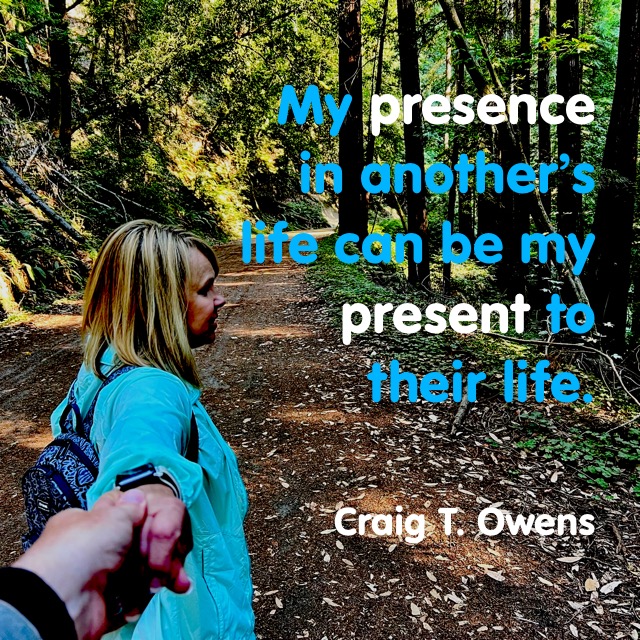
“So that everyone may see your progress.” Quite simply: you have to be present—you have to be around people so they can see what’s going on in your life. Your presence in their lives is your present to their lives!

I need to monitor what I’m doing and why I’m doing it; what I’m teaching and how I’m teaching; what I believe and why I believe it.

I need to have goals and benchmarks. I need to make my goals—and my successes and failures in hitting my goals—known to others.

I need to be in it for the long haul. It’s awfully difficult to be an example in the present if my eyes and thoughts are always on “the next thing” down the road.

Look at the blessings—the presents—of living this way: You will save both yourself and your hearers.

Not only is my presence a present to others, but having others present in my life is a present to me! The present of presence works both ways! 

Are you living so that everyone may see your progress? If not, start giving the present of your presence today!

►► Would you please prayerfully consider supporting this ministry? My Patreon supporters get behind-the-scenes access to exclusive materials. ◀︎◀︎

Keepin’ It Balanced

This has been a very full week for me—and it’s only Wednesday morning! Sometimes when things get busy, I tend to get unbalanced.

No, I don’t mean I’m losing my mind! I mean I tend to hyper-focus on some things and almost lose sight of other things. 

One thing I always make time for is my Bible reading time. So as I was reading Paul’s second letter to the Thessalonians, I quickly spotted the balance Paul called us to:

  • Watch for God and stay occupied.
  • Be aware of evil but not obsessed with it.
  • Be sensitive but not reactionary.
  • Keep an eye on current events and balance them with Scripture.
  • Pray for yourself and pray for others.
  • Be busy but not a busybody.
  • Work hard and trust God.
  • Warn a brother that’s in error and continue to love him.

Ah, yes, I needed that! I hope it helps you too.