A Tour Of The Tabernacle

Listen to the podcast of this post by clicking on the player below, and you can also subscribe on AppleSpotify, or Audible. 

I was absolutely fascinated by a Messianic Jew’s insights on the Old Testament Tabernacle, and how every aspect of it pointed to Jesus the Messiah. 

The overview of the construction of the Tabernacle starts in Exodus 25 and covers the next fifteen chapters in that book. Here are a few of my main takeaways from my friend’s teaching. 

All of the Scriptures I mention can be found here. 

The materials for the Tabernacle are brought as a freewill offering given by freed slaves (Exodus 25:1-2). This gold, silver, bronze, linens, and other materials were gifts from the Egyptians when the Israelites left on the night of the Passover. 

The Tabernacle is at the center of the Israelite camp (Numbers 2:1-34), signifying God’s presence in the center of our lives. When the Israelite community moved out, the tribe of Judah went first. Judah means “praise.” What a great reminder to let praise to God be at the forefront of all we do! 

In Exodus 27:16, the materials to be used for the curtains compromising the entrance to the Tabernacle are blue, purple, and scarlet. The blue is for sky (Heaven), the purple designates royalty, and the scarlet signifies the blood of the sacrifices. Jesus came to earth as royalty from Heaven, and by His shed blood He opens the way for all of us to be with Him in Heaven forever! Jesus said He was the only way to Heaven (Hebrews 2:14-15; John 14:6). 
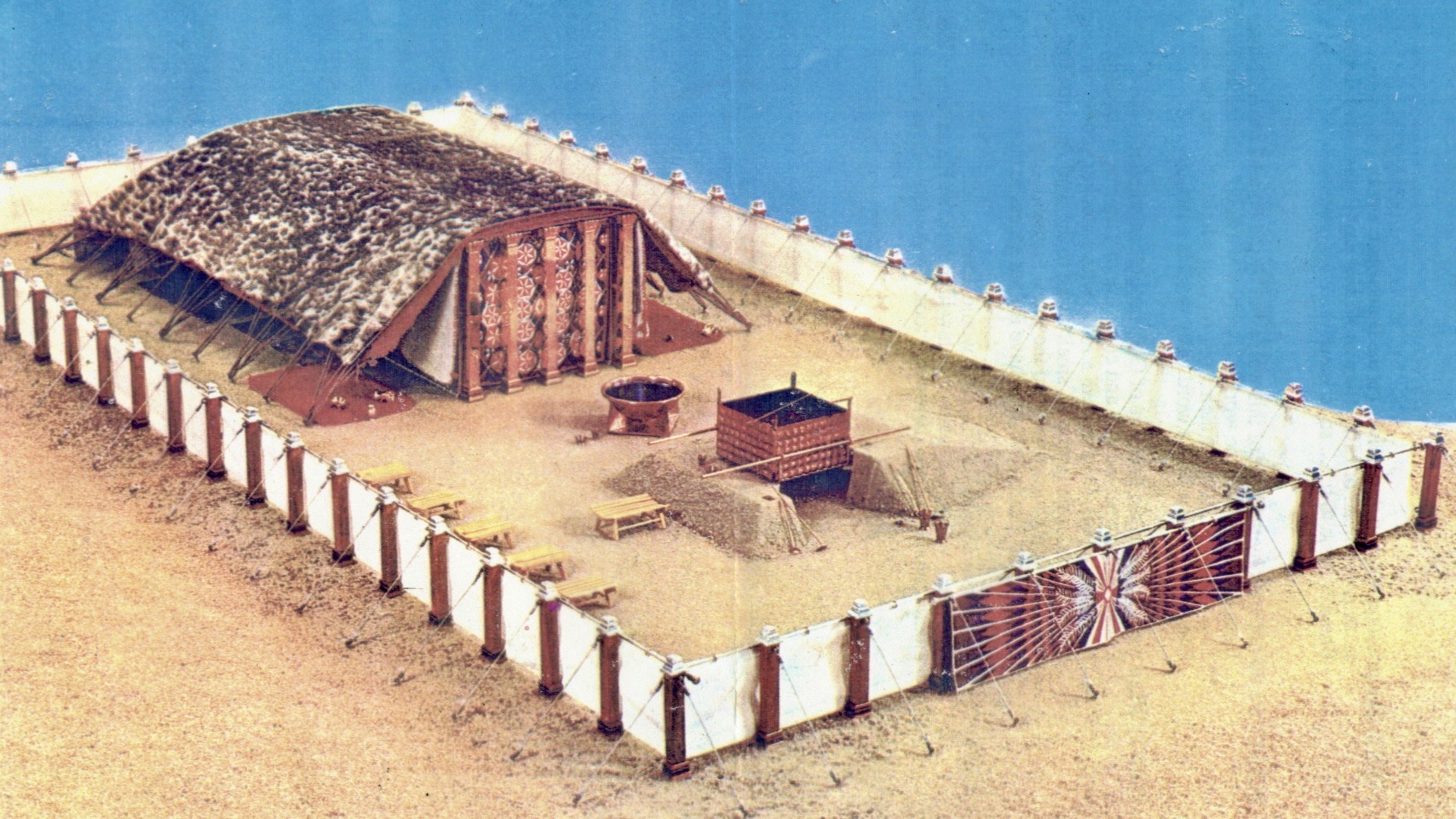
The bronze altar for cleansing was just inside the entrance (Exodus 27:1-8). The worshiper offered this sacrifice in place of their sin. The priests would then move to the laver to wash off the dirt of the world. It’s important to note that the priests wash at the laver, not in the laver. Jesus is the One who washes us and cleanses us (Ephesians 5:26). 

There are four different coverings over the Holy Place. As the priest progresses farther into the Holy Place, the coverings become thicker, so less outside light is visible. 

  • First covering (Exodus 26:1) was blue, purple, and scarlet yarns (like the colors at the entrance) with cherubim woven into the fabric. The priests looking up would see these angels. 
  • Second covering (v. 7) was goat’s hair. Goats were used for sin offerings, reminding the priests that there was a sacrifice to cleanse them so they could approach the presence of God. 
  • Third covering (v. 14) was a red-dyed ram skin, showing the blood that covers us. 
  • Fourth covering (v. 14) was the durable leather of a badger. Now there would have been very little light from outside, but the angels would still be seen for those inside the Holy Place. 

In the Holy Place was the showbread (sometimes called the bread of presence) pointing to Jesus as our Bread of Life (Exodus 25:23-30; John 6:35). Also in the Holy Place was the lampstand filled oil (vv. 31-37). Only one stick holds the oil and supplies the other six branches. The priests could only work by the light of God. Jesus is our light (John 8:12). And we also find the altar of incense here (30:1-7). This was a unique perfume that wasn’t used anywhere else. The prayers of the saints that arise before the throne in Heaven as said to rise as incense (Psalm 141:2; Revelation 5:8). Worshipers in God’s presence are saturated with the aroma of Jesus (2 Corinthians 2:14-15). 

In the Holy of Holies is the ark of the covenant of the Lord (25:10-22). Inside the ark were the stone tablets that contained the Ten Commandments. On top of the ark, overshadowed by the wings of two huge cherubim angels, was the mercyseat or atonement cover. Notice that mercy is over the Law, and that the blood of the sacrifice of Jesus covers my disobedience and makes me at one with God (the literal definition of atonement). 

How beautifully all of these aspects of the earthly Tabernacle point to Jesus (Hebrews 8:5, 10:1)! And even more amazingly, Jesus fulfilled every requirement in this Tabernacle to make it possible for all who put their faith in Him to enter the Heavenly Tabernacle and remain in His presence for ever and ever! 

►► Would you please prayerfully consider supporting this ministry? My Patreon supporters get behind-the-scenes access to exclusive materials. ◀︎◀︎

Thursdays With Oswald—Jeremiah 24

Oswald ChambersThis is a weekly series with things I’m reading and pondering from Oswald Chambers. You can read the original seed thought here, or type “Thursdays With Oswald” in the search box to read more entries.

Jeremiah 24

[These are notes from Oswald Chambers’ lecture on Jeremiah 24.] 

     The estimate a Christian must hold of his own value is what he is worth to God. You cannot judge whether you are right with God by His blessings because “He makes His sun to rise on the evil and on the good, and sends rain on the just and on the unjust” [Matthew 5:45]. God is not meant to bless us; the vital question is—What am I worth to God? In times of affliction am I giving way to self-pity? am I badgering the throne of God for Him to bless me, or am I saying, “Though He slay me, yet will I wait for Him” [Job 13:15]? … 

     The question, “What do you see, Jeremiah?” is the call for Jeremiah to state clearly to himself what it is he sees. ‘Two baskets of figs set before the temple of the Lord’—these symbolize the people as they appear before God. They have been trying to bring wrong things to the altar, and now God is saying He will destroy the evil and wrong out of the nation.

     “Therefore, I urge you, brothers, in view of God’s mercy, to offer your bodies as living sacrifices, holy and pleasing to God—this is your spiritual act of worship” (Romans 12:1). This verse refers to an abiding law, individually and nationally: we cannot consecrate to God anything that is sinful. We cannot present our bodies “a living sacrifice” to God unless we have been cleansed from sin; He won’t have them. The call in this verse is not for sanctification, but for the service of the sanctified. We could never begin to be of worth to God in service until we have been through what is represented in the atoning sacrifice of Our Lord Jesus Christ. That is why the majority of us are of no worth to God. We are of no value to God until we enter into the experience of instantaneous, continuous sanctification, then our “spiritual act of worship” is the offering of ourselves “as living sacrifices, holy and pleasing to God,” and we no more bother about ourselves.

From Notes On Jeremiah

This is, without a doubt, a challenging word from Oswald Chambers that deserves some time for us to thoughtfully consider it. 

Can God use me? Am I allowing the Holy Spirit to continually and instantaneously stamp the image of Jesus more clearly in my life? Or am I saying, “I’m good like this. I don’t need to go any further”? 

God wants to use us for His glory. Are we allowing ourselves to be in a place where we can be used “as living sacrifices, holy and pleasing to God”? 

George Whitefield On Developing Godly Attributes

George Whitefield“The fruit of the Spirit (Galatians 5:22-23) do not automatically become evident in our lives. If we are not discerning enough to recognize their availability to us, to desire them, and then to nourish them in our thoughts, they will never become embedded in our nature or behavior. Every further step of spiritual growth in God’s grace must be preceded by acknowledging our lack of a godly attribute and then by exhibiting a prayerful determination to obtain it. …

“Today many people are attempting to use their mental capacity and logical thinking to obtain sanctification, yet this is nothing but a religious fabrication. They believe that if they just mentally put themselves on the altar and believe the altar provides the gift of sanctification, they can then logically conclude they are fully sanctified. Then they go happily on their way, expressing their flippant, theological babble about the ‘deep’ things of God.

“Yet the heartstrings of their old nature have not been broken, and their unyielding character, which they inherited from Adam, has not been ground to powder. Their soul has not throbbed with the lonely, gushing groans of Gethsemane. Having no scars from their death on Calvary, they will exhibit nothing of the soft, sweet, gentle, restful, victorious, overflowing, and triumphant life that flows like a spring morning from an empty tomb.” —George Whitefield

Altar To Alter

Listen to the podcast of this post by clicking on the player below, and you can also subscribe on AppleSpotify, or Audible.

The process of sanctification—or as I like remember the word: saint-ification—is the process whereby the Holy Spirit develops Christlike character in us. His process is immediate, personalized, and ongoing. In other words, the Spirit is intimately and immediately involved in every aspect of our lives.

Christlikeness in us is described in the Bible with phrases like…

  • Being made new in the attitude of your minds; and putting on the new self, created to be like God in true righteousness and holiness (Ephesians 4:23-24).
  • Conformed to the likeness of God’s Son (Romans 8:29).

The Holy Spirit is often portrayed as fire. In fact, the Bible says that Jesus will baptize you with the Holy Spirit and with fire (Matthew 3:11). This is because in order for Christlike character to be formed in us, that character will have to be forged in us. Forged in the Spirit’s fire.

Look at two examples:

  • Until the time came to fulfill his dreams, the Lord tested Joseph’s character (Psalm 105:19).
  • Even though Jesus was God’s Son, He learned obedience from the things He suffered (Hebrews 5:8).

Here’s what I’ve learned—

We must altar our lives so that the Holy Spirit can alter our lives.

Unless we yield to what the Holy Spirit wants to do with us, He cannot and will not bring about the changes that will lead to more Christlikeness being revealed in us.

It may be painful to altar our lives, but the apostle Paul says, “I consider that our present sufferings are not worth comparing with the glory that will be revealed in us” (Romans 8:18).

You altar, and then watch the Holy Spirit alter your life in a way that reveals God’s glory!

►► Would you please prayerfully consider supporting this ministry? ◀︎◀︎

Altared To Be Altered

Altared and AlteredI love this verse from Isaiah: Whether you turn to the right or to the left, your ears will hear a Voice behind you, saying, “This is the way; walk in it” (Isaiah 30:21). This foreshadowing of the Holy Spirit in the life of a Christian is powerful.

The Voice can be an audible voice, but not always. Sometimes the Holy Spirit says, “This is the way” through different modes. Things like:

  • Discernment. This is the Spirit’s help when we would normally rely on our own common sense (see Acts 5:3 and Acts 16:6-7).
  • Prompts. These motivate us to do something productive (Acts 8:29).
  • Checks. The flip side of promptings, these checks are to stop us from doing something unproductive (Acts 10:9-20).

But here’s an important thing to remember: The Voice of the Holy Spirit is not perceived by those people intent on doing things their own way. The Voice may be speaking, but those people are simply not tuned-in. The individuals that hear the Voice saying, “This is the way” are those who are determined to obey what the Voice says to them.

In Romans 12, Paul says that as our act of spiritual worship we lay our lives on the altar: we give up trying to control our own lives. He goes on to say that when we do this, we will quickly discover what God’s good, perfect and pleasing will is. In other words, we will be receptive to His Voice leading us into His perfect plan for us. So the Holy Spirit can direct us only after we’ve given up trying to direct our own affairs. Or said another way—

I altar my life, and the Holy Spirit will alter my life

“Oh, this baptism of the Holy Spirit is an inward presence of the personality of God that lifts, prays, takes hold, and lives in us with a tranquility of peace and power that rests and says, ‘It is all right.’ …Oh, this God of grace! Oh, this willingness for God to let us see His face! Oh, this longing of my soul that cannot be satisfied without more of God!” —Smith Wigglesworth