Does Either-Or Work?

Sometimes I read about this debate whether churches should be “attractional” or “missional.” The first approach says that church should attract people first, and then share the gospel with them. The second approach says that if churches simply focus on sharing the gospel they will then attract people.

Either-or. Either missional or attractional.

What about both-and?

Consider the life of Jesus. No one would ever argue that He wasn’t “on mission” all the time. In fact, numerous times He says, “I’m doing what My Father wants me to do,” or even, “It’s not time for me to do that yet.” Jesus was missional.

And yet… “Tax collectors and other notorious sinners often came to listen to Jesus teach. This made the Pharisees and teachers of religious law complain that He was associating with such sinful people—even eating with them! (Luke 15:1-2). People loved being around Jesus. Jesus was attractional.

Jesus exemplified both-and missional-attractional. I think He was able to perfectly balance this because of the work of the Holy Spirit. I can aim for the both-and of missional-attractional in my life … I can give it my best shot. But the only way I can truly achieve anything is by allowing the Holy Spirit to shape and direct my life, just as He did for Jesus. Henry & Melvin Blackaby, in their book Experiencing The Holy Spirit, wrote:

“The world doesn’t need to see good people giving their best to God; they need to encounter God doing in and through us what only He can do! …Our best isn’t good enough when it comes to kingdom work; we need the Holy Spirit in our lives if we’re going to be of use to God.”

I need the Holy Spirit in my life if I’m going to be of use to God, and be of any benefit to people.

I need the Holy Spirit in my life if I’m going to balance both-and missional-attractional like Jesus.

Stuff Christians Like (book review)

As a fourth-generation Pentecostal, I’ve grown up in the church. I readily recognize that Christians (like any other group) develop their own vocabulary and set of “acceptable” behaviors. But can you spot them? Jon Acuff has spotted them, and puts them on display in Stuff Christians Like.

This book is funny! I know some people think every discussion about anything related to the Bible and church needs to be stone-faced serious. I don’t happen to be one of those people. I see some great comedy in Scripture, and I have certainly seen even more in the church.

Jon writes—as any comedian does—in exaggerated terms. This is what makes his topics so enjoyable to read. He comes close to being irreverent, but never quite crosses the line. But in the process, Jon helps us to see what we often miss, but what those who don’t regularly attend church see so clearly.

If you’re easily offended, or don’t think Christians should laugh at themselves, stay away from this book. But if you enjoy lighthearted comedy with an underlying purpose, you will enjoy Stuff Christians Like.

Everywhere And Everywhen

Wise words from G. Morgan Campbell:

“The Christian is to seek the upper things, setting his mind upon them, and everywhere and everywhen he is to be hoping for, and endeavoring after, the ultimate. That is the simple meaning of prayer: reaching forward, wishing forward, desiring forward, seeking the upper, the higher, the nobler.”

The Bible is clear, too, about us praying everywhere and everywhen for the very best:

  • We ought always to pray and not to turn coward, faint, lose heart, and give up (Luke 18:1)
  • God has seen how I never stop praying for you (Romans 1:9)
  • For I always pray to the God of our Lord Jesus Christ, the Father of glory, that He may grant you a spirit of wisdom and revelation (Ephesians 1:17)
  • In all my prayers for all of you, I always pray with joy (Philippians 1:4)
  • Our prayers for you are always spilling over into thanksgivings. We can’t quit thanking God our Father and Jesus our Messiah for you! (Colossians 1:3)
  • Epaphras always prays earnestly for you, asking God to make you strong and perfect, fully confident that you are following the whole will of God (Colossians 4:12)
  • We always thank God for all of you and pray for you constantly (1 Thessalonians 1:2)
  • We ought always to thank God for you, and rightly so, because your faith is growing more and more (2 Thessalonians 1:3)
  • I give thanks to my God for you always when I mention you in my prayers (Philemon 1:4)
  • Pray for us. We have no doubts about what we’re doing or why, but it’s hard going and we need your prayers (Hebrews 13:18)

Someone needs your prayers today.

Will you keep on praying for a friend that he or she will be able to

…reach forward

…wish forward

…desire forward

…seek the upper, the higher, the nobler!

MacArthur (book review)

General Douglas MacArthur was popularly called “America’s General,” and Mitchell Yockelson’s biography—MacArthur: America’s General—does an admirable job in telling us how he earned this well-deserved moniker.

(As an aside: I have really enjoyed all of the books in the Thomas Nelson Generals series. You can read my reviews of George S. Patton here, and Robert E. Lee here.)

MacArthur’s influence is still being felt at West Point as we train our future military officers, and around the world, where General MacArthur had a prominent role in three wars. And, if his advice about Vietnam had been heeded, perhaps his influence would have extended through four wars.

How did he achieve such prominence? It’s the classic debate: are great leaders born or made? In Douglas MacArthur’s case the answer is a resounding “Yes!” Yes, he was born into a family with a strong military heritage. MacArthur certainly benefited from the influence of his grandfather (a judge), his father (a decorated, combat veteran and general), and his mother (who used her charm to sway many influential people). But these family members could only open doors; it was up to MacArthur to march through them.

And, yes, march through them he did! At every opportunity he pressed forward. Sometimes with unconventional tactics, sometimes in opposition to his leadership, and sometimes through sheer willpower. But the results speak for themselves: Without a General Douglas MacArthur to lead our troops in perilous times, the outcome in three wars could have been disastrously different.

The United States of America is viewed as the world’s superpower (and rightly so). It is very likely that without MacArthur’s influence we would not be the prominent power that we are now. We owe a huge debt of gratitude to God for blessing us with the MacArthur family.

A lively and informative read for military buffs and students of leadership. Highly recommended!

I am a Thomas Nelson book reviewer.

Making The Hard Easy

Can you relate to this?

     I know the right things I’m supposed to do, and I also know the wrong things I’m not supposed to do. I try my very best to do the right and avoid the wrong, but far too many times I find myself not doing the right things, and (even worse) discover I’m doing the wrong thing.

     I say, “Enough of this!” and I vow (again!) to stop doing the wrong things, and I redouble my efforts (again!) to begin doing the right things. It seems like this is working, but only for a little while. Then I’m right back into the same old habit of doing those wrong things again.

     It shouldn’t be this hard! After all, it’s so easy to tell right from wrong. So why do I keep on doing the wrong things?! Why can’t I keep on doing the right things?!

     Is there any hope for me? (my paraphrase of Romans 8:17-24

If you’ve ever felt like that, you’re in good company because that’s just how the Apostle Paul said he struggled with right and wrong. But keep on reading, because he also shared how he overcame this struggle. He said, “Those who are controlled by the Holy Spirit think about things that please the Spirit. So letting your sinful nature control your mind leads to death. But letting the Spirit control your mind leads to life and peace.”

The Holy Spirit can help you do right, and avoid wrong. But you have to yield to Him.

I love what A.J. Gordon wrote—

“It costs much to obtain the power of the Spirit: It costs self-surrender and humiliation and a yielding up of our most precious things to God; it costs the perseverance of long waiting, and the faith of strong trust. But when we are really in that power, we shall find this difference, that whereas before, it was hard for us to do the easiest things, now it is easy for us to do the hard things.”

How would you rather live: finding it hard to do the easiest things … or finding it easy to do the hardest things?

Out Of The Box

I know firsthand the difference the Holy Spirit has made in my life. Which is why I’m so excited to kick off a brand new series this Sunday called Out Of The Box: Unleashing The Power of the Holy Spirit.

…the Holy Spirit makes the Father’s love more real

…the Holy Spirit makes the Christ-like life more livable

…the Holy Spirit makes the Bible more readable

…the Holy Spirit makes extraordinary living more attainable!

And this Out Of The Box life is for everyone. A.W. Tozer wrote:

“For the Holy Spirit is not a luxury, not something added now and again to produce a deluxe type of Christian once in a generation. No, He is for every child of God a vital necessity, and that He fill and indwell His people is more than a languid hope. It is rather an inescapable imperative.” (emphasis mine)

I hope you can join us at Calvary Assembly of God this Sunday at 10:30am.

The Measure Of A Man

An anonymous poem that should make any man or woman ponder the impact of their legacy…

Not “How did he die?”

But “How did he live?”

Not “What did he gain?”

But “What did he give?”

These are the units

To measure the worth

Of a man as a man

Regardless of birth.

Not “What was his station?”

But “Had he a heart?”

And how did he play

His God-given part?

Was he ever ready

With a word of good cheer,

To bring back a smile,

To banish a tear?

  Not “What did the sketch in the newspaper say?”

But “How many were sorry when he passed away?”

You’re Better Than A Star

Listen to the podcast of this post by clicking on the player below, and you can also subscribe on Apple or Spotify.

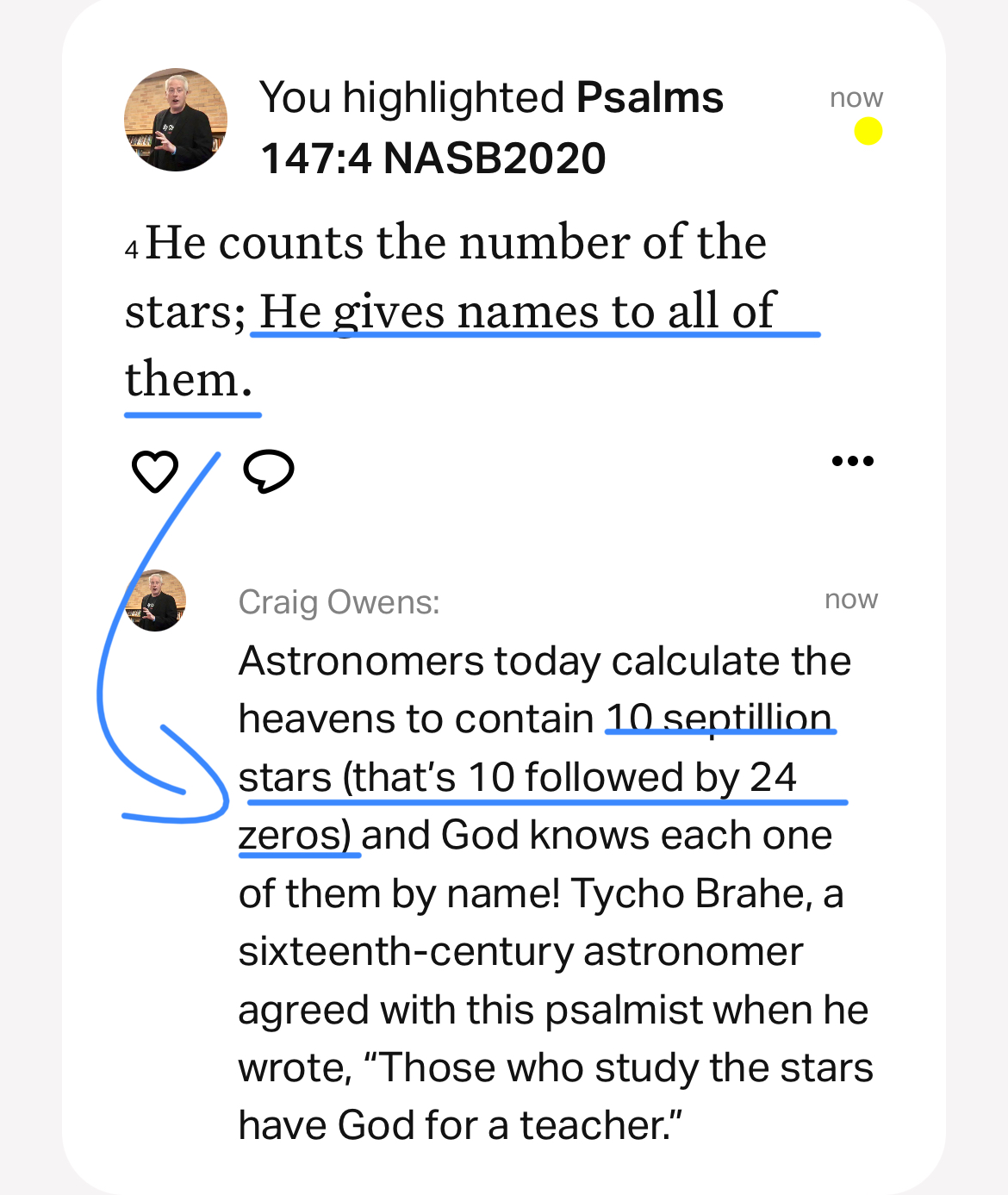
Astronomers admit that they cannot observe the entire universe, because it’s simply too vast for any equipment that has been made. In the Milky Way galaxy alone there are something like 10 trillion stars.

But that’s just one galaxy.

Astronomers used to estimate that there are another 10 trillion galaxies, but they have recently admitted that there are likely three times more stars than they originally thought. Which makes the total number in the observable universe 300 sextillion stars.

300,000,000,000,000,000,000,000 stars

But here’s what is more amazing: God knows each of those stars by name!

Lift your eyes and look to the heavens: Who created all these? He who brings out the starry host one by one, and calls them each by name. Because of His great power and mighty strength, not one of them is missing. (Isaiah 40:26)

As awesome as the stars are, here’s what God thinks about you

When I look at the night sky and see the work of Your fingers—the moon and the stars You set in place—what are mere mortals that You should think about them, human beings that You should care for them? Yet You made them only a little lower than God and crowned them with glory and honor. (Psalm 8:3-5)

And most amazingly of all, God not only knows the 300 sextillion stars by name, but He knows you by name too (Exodus 33:17)!

Friend, in God’s eyes you shine brighter than a star! He knows you by name. If not one star is missing from His view, how much more does He see you!

If you’re feeling discouraged or alone or forgotten, step outside tonight and look up at the stars. God knows them all by name, but He knows you too—and He thinks the world of you!

You are not alone—God sees you and He loves you!

►► Would you please prayerfully consider supporting this ministry? ◀︎◀︎

Thursdays With Oswald—A Strong Weakness

This is a weekly series with things I’m reading and pondering from Oswald Chambers. You can read the original seed thought here, or type “Thursdays With Oswald” in the search box to read more entries.

A Strong Weakness

Are not my days few? cease then, and let me alone, that I may take comfort a little, before I go whence I shall not return, even to the land of darkness and the shadow of death. (Job 10:20-21)

     “I see no way out,” says Job. He lies down, not in weakness, but in absolute exhaustion. Job is not talking in a petted mood, but saying that unless God will be a Refuge for him, there is no way out, death is the only thing. In every crisis of life, as represented in the Old Testament as well as in the teaching of Our Lord, this aspect of God is emphasized—“God is our Refuge”; yet until we are hit by sorrow, it is the last thing we seek for God to be. There is a difference between the weakness of refusing to think and the weakness that comes from facing facts as they really are. Job is seeing for the first time that God is the only Refuge, the only way out for him; yet he cannot get at Him through his creed, it is all confusion; the only thing to do is to fling himself on God.

From Baffled To Fight Better

“The only thing to do is to fling [myself] on God.”

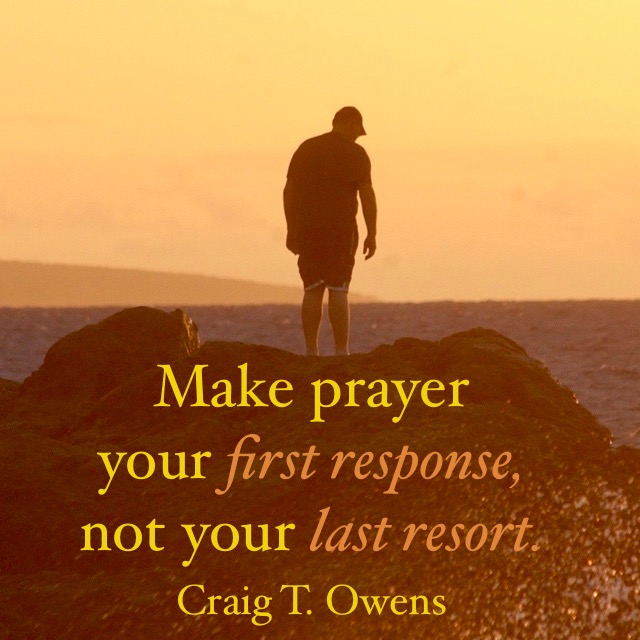
Alas, how many times does this become my last resort! Why don’t I learn to fling myself on God my Refuge as my first resort? I must remember this: For when I am weak, then I am strong. (2 Corinthians 12:10)

Winner Or Whiner?

This morning on John Maxwell’s “Minute With Maxwell” he said: “Winners know they have to do the right thing and then they’ll feel good. Whiners want to feel good before they do the right thing.

I have learned this is true in my life. If I wait until I feel like do something, I’ll make all kinds of excuses to avoid doing it. But if I do what I know I’m supposed to do I’ll feel good that I did it.

Good feelings follow good actions.

Winners do right to feel good.

Whiners wait to feel right before they do anything.

Behavioral psychologist William James wrote: “Action seems to follow feeling, but really action and feeling go together; and by regulating the action, which is under the more direct control of the will, we can indirectly regulate the feeling, which is not. Thus the sovereign voluntary path to cheerfulness, if our cheerfulness be lost, is to sit up cheerfully and to act and speak as if cheerfulness were already there.” (emphasis mine)

So let me ask you: Are you going to be a winner or a whiner today?