Pastoral Insights From “Golden Mouth”

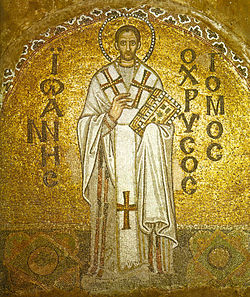
John Chrysostom was a reluctant pastor. It took him a while to surrender to the call of God on his life to serve as a priest. But once he stepped into that role, his God-given talents were used mightily. He was such an incredible speaker that his sermons often moved his audience to tears or applause. Thus, he was given the nickname “Golden Mouth.”


Here are some great pastoral insights from Golden Mouth which are just as applicable today…

“Thus then must the Priest behave towards those in his charge, as a father would behave to his very young children; and as such are not disturbed either by their insults or their blows, or their lamentations, nor even if they laugh and rejoice with us, do we take much account of it; so should we neither be puffed up by the promises of these persons nor cast down at their censure, when it comes from them unseasonably.”

“Let, therefore, the man who undertakes the strain of teaching never give heed to the good opinion of the outside world, nor be dejected in soul on account of such persons; but laboring at his sermons so that he may please God, (For let this alone be his rule and determination, in discharging this best kind of workmanship, not acclamation, nor good opinions,) if, indeed, he be praised by men, let him not repudiate their applause, and when his hearers do not offer this, let him not seek it, let him not be grieved. For a sufficient consolation in his labors, and one greater than all, is when he is able to be conscious of arranging and ordering his teaching with a view to pleasing God.” 

“For the soul of the Priest ought to be purer than the very sunbeams, in order that the Holy Spirit may not leave him desolate, in order that he may be able to say, ‘Now I live; and yet no longer I, but Christ liveth in me….’ For he has need of far greater purity than they; and whoever has need of greater purity, he too is subject to more pressing temptations than they, which are able to defile him, unless by using constant self-denial and much labor, he renders his soul inaccessible to them.”

Thursdays With Oswald—Spiritual Perception

This is a weekly series with things I’m reading and pondering from Oswald Chambers. You can read the original seed thought here, or type “Thursdays With Oswald” in the search box to read more entries.

Spiritual Perception 

     The characteristic of a man without the Spirit of God is that he has no power of perception, he cannot perceive God at work in the ordinary occurrences. The marvelous, uncrushable characteristic of a saint is that he does discern God. You may put a saint in tribulation, amid an onslaught of principalities and powers, in peril, pestilence or under the sword, you may put a saint anywhere you like, and he is “more than a conqueror” [Romans 8:31-39] every time. Why? Because his heart being filled with the love of God, he has the power to perceive and understand that behind all these things is God making them “work together for good.” 

From Biblical Psychology

God says, “For just as the heavens are higher than the earth, so My ways are higher than your ways and My thoughts higher than your thoughts” (Isaiah 55:9). So I cannot understand what God is doing if I only use my own powers of perception.

To truly discern what God is doing, I must rely on the Holy Spirit within me.

That is what the Scriptures mean when they say, “No eye has seen, no ear has heard, and no mind has imagined what God has prepared for those who love Him.” But it was to us that God revealed these things by His Spirit. For His Spirit searches out everything and shows us God’s deep secrets. (1 Corinthians 2:9-10)

Oh, how I need the Holy Spirit’s help!

Conformed To His Image (book review)

Oswald Chambers challenges my thinking about the Christian walk like few other authors can. His insights are always so profound, and yet at the same time awaken me to the realization that I am the one who makes the Christian walk something complex. In Conformed To His Image, I was yet again challenged to simply follow Jesus.

Chambers brilliantly turns secular psychology upside down. He takes what psychology wants to ascribe to our minds and emotions, and brings it back to a Scriptural basis that puts these things where they are supposed to be: in the soul.

The thought of being “conformed” rubs against the human desire to be free and in charge of our own destiny. Somehow being “conformed” feels like being controlled and giving up our unique personality. So Chambers contrasts the natural human tendencies for freedom and calling our own shots with what the Bible says about surrendering to God.

Chambers presents Jesus not as some superhuman, extraordinary Man. But He shows the life of Jesus to be what we should all be able to live out daily. Jesus was perfectly conformed and submitted to the will of His Father. And, he says, if we will submit as well, the Holy Spirit will conform us into the image of Jesus.

Beware: this book is not light reading. This is a heavy-duty, confrontational book that will challenge you to submit to the Holy Spirit as perhaps you never have before in your Christian walk. However, if you are ready to take the plunge into a much deeper, more intimate relationship with your Heavenly Father, Conformed To His Image is the resource for you. 

Miserable

The Apostle Paul asked the Christians in Galatia an important question:

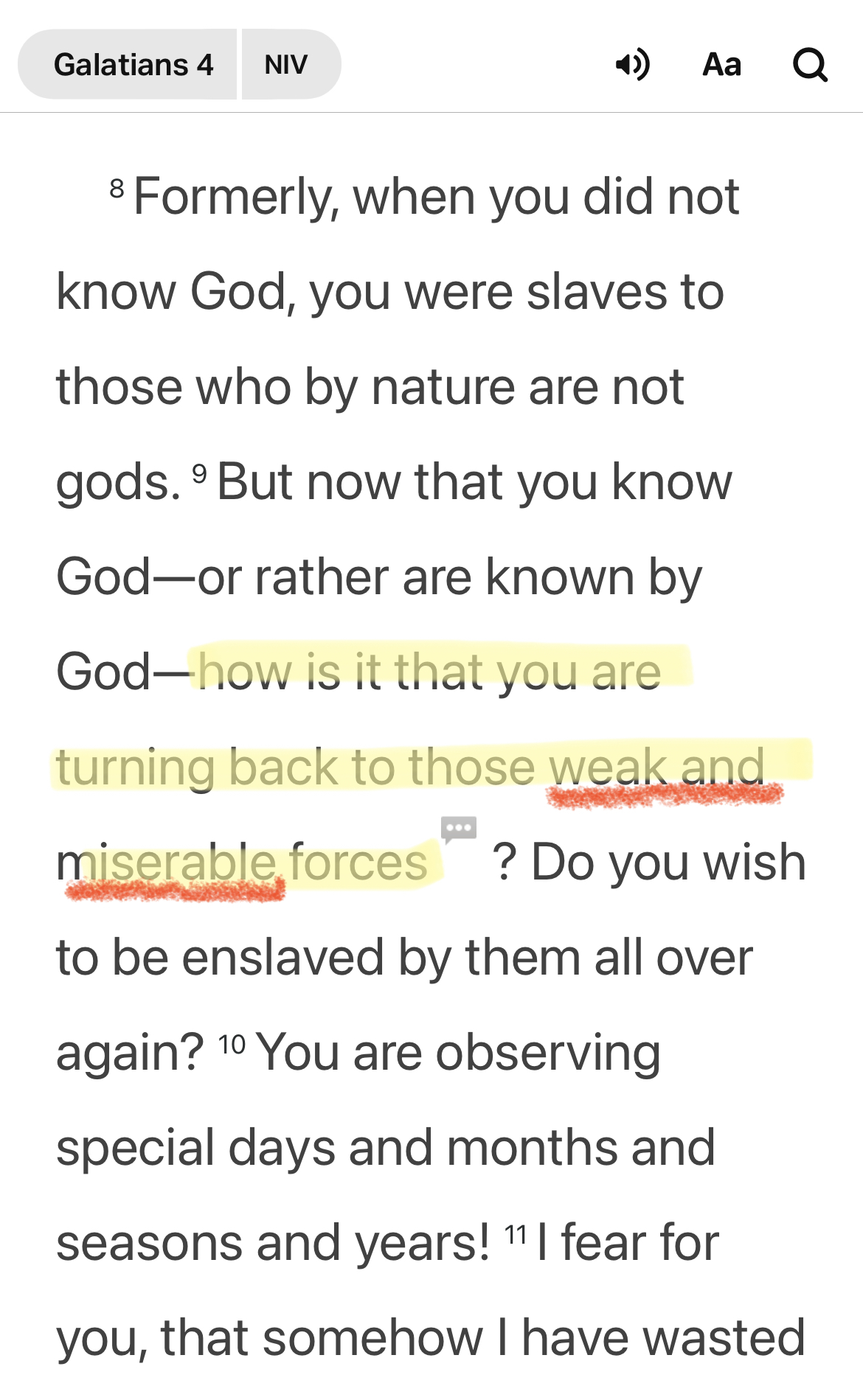
How is it that you are turning back to those weak and miserable principles? (Galatians 4:9)

The two words together in the Greek—weak and miserable—imply things that impoverish us and reduce us to lowly paupers and beggars. That’s not a pretty picture!

Look at the contrast between the princely life and the pauper’s life.

Those who follow Christ:

  • Are called sons of God (Galatians 4:6a)
  • Experience Abba Father’s favor (4:6b)
  • Are heirs to God’s Kingdom (4:7)

Those who don’t follow Christ:

  • Live as slaves (4:7)
  • Are separated from God’s favor (4:1-3)
  • Live as miserable beggars (4:9)

Why would anyone choose the miserable beggar’s life?

Here’s the principle: Everyone serves someone! I will either serve God and be called His son, or I will serve myself (my desires, my passions, my way of doing things) and be called a stranger to God.

Do I want to be in control, or do I want to let God be in control? When I try to control my own life, not only am I not in control, but I actually become a slave to my own passions. Ironic, isn’t it?

The choice is simple, but the choice must be made every day. I must choose to serve God in every moment of every day. It’s the only way to avoid the miserable life, and live the blessed life God has for me.

Stuck In My Head

Ever since our worship team sang this song on Sunday, it has been stuck in my head. But I don’t mind at all, because it’s a great message.

So faithful, so constant

So loving and so true

So powerful in all you do

 You fill me, You see me

You know my every move, You love for me to sing to You

 I know that You are for me 

I know that You are for me 

I know that You will never forsake me in my weaknesses

I know that You have come now, even if to write upon my heart,

to remind me of who You are

So patient, so gracious

So merciful and true

So wonderful in all You do

You fill me, You see me

You know my every move, You love for me to sing to You

Three Amazing Years

This week marks my three-year anniversary of pastoring one of the most amazing churches I have had the privilege of being a part of!

I grew up in some powerful churches, served in others, and have experienced many other churches. And I wouldn’t trade any of them for Calvary Assembly of God. I’m grateful for what I learned and what I experienced at the churches that I have attended in my lifetime. Those prepared me. But Calvary is showing me what a real church looks like.

To my Calvary family:

I so appreciate the love and acceptance everyone in our congregation has for all. Whether it’s a first-time visitor or a lifelong member, all are loved (and hugged) the same.

I love your willingness to reach out to our community. You are always looking for tangible ways to show the love of Jesus to those in and around Cedar Springs.

But most of all I love the hunger for more of God’s presence. Each and every time we gather together, God does amazing things in people’s lives, and yet no one is content to “bottle it up.” Instead you are always seeking an increasingly intimate relationship with Jesus Christ, and you allow the Holy Spirit to move freely in our midst.

More and more I say…

I My Church!

7 Quotes On The Spiritual Life From “The Book Of Man”

I really enjoyed reading The Book Of Man by William J. Bennett (you can read my book review here). The topics were very broad, so I’ll be sharing some of my favorite quotes on the different sections in this book over the next few days.

Here are seven quotes on man’s spiritual life…

I asked God for strength, that I might achieve;

I was made weak, that I might learn to humbly obey.

I asked for health, that I might do greater things;

I was given infirmity, that I might do better things.

I asked for riches, that I might be happy;

I was given poverty, that I might be wise.

I asked for power, that I might have the praise of men;

I was given weakness, that I might feel the need of God.

I asked for all things that I might enjoy life;

I was given life, that I might enjoy all things.

I got nothing I asked for but everything I had hoped for.

Almost despite myself, my unspoken prayers were answered.

I am, among men, most richly blessed. —Anonymous

“The time has come to turn to God and reassert our trust in Him for the healing of America. … Our country is in need of and ready for a spiritual renewal.” —Ronald Reagan

“What can be more excellent than prayer; what is more profitable to our life; what sweeter to our souls; what more sublime, in the course of our whole life, than the practice of prayer!” —Augustine

“Thou awakest us to delight in Thy praise; for Thou madest us for Thyself, and our heart is restless, until it repose in Thee.” —Augustine

“O gracious and Holy Father, give us wisdom to perceive Thee, intelligence to understand Thee, diligence to seek Thee, patience to wait for Thee, eyes to behold Thee, a heart to meditate upon Thee, and a life to proclaim Thee; through the power of the Spirit of Jesus Christ our Lord, amen.” —Saint Benedict of Nursia

“No human creature can believe, how powerful prayer is, and what it is able to effect, but only those that have learned it by experience.” —Martin Luther

“There are some men, who know a thousand other people, but who do not know their own selves; the greatest stranger to them, in the whole world, is their own heart. They have never looked into it, never talked with it, never examined it, never questioned it. They follow its evil devices, but they scarcely know that they have a heart, they so seldom look into it.” —Charles Spurgeon

Getting Back Up When Life Has Knocked You Down

The Bible never presents life as some sort of pie-in-the-sky, walk-in-the-park, everyday-is-always-rosy picture. If it did, we would reject the Bible because our experiences would immediately tell us otherwise. Instead, the Bible realistically portrays the challenges, and the pain, and the heartache, and the disappointments of life. But as it does so it also shows us that God’s way is the only way out of our sorrow and into His joy!

In our P119 Spiritual Workout series, we saw the bookends of the section daleth (Psalm 119:25-32) are:

I am laid low in the dust (v. 25) → You have set my heart free (v. 32).

How do we get this freedom when we are knocked down and laid low in the dust?

The Jews saw the Hebrew letter daleth as a door. Specifically, a door through which humble people stepped into a greater realization that He is God, and I’m not … that He has the answers, and I don’t … that He is in control, and I’m not. So part of going from down in the dust to a free heart is humbly acknowledging that you need God’s help!

In verses 26 and 27, the psalmist recalls his past history, and in so doing he is reminded that God has always been there. God has never left him nor forsaken him, so here’s what the psalmist resolves to do:

  • Teach me = I learned something before, so let me learn again.
  • Let me understand = help me to discern, distinguish; tell things apart. This word is used for things that are divinely disclosed; in other words, they’re things you and I cannot figure out on our own.
  • Meditate = talk with my soul about these new things the Holy Spirit has disclosed to me.

In verse 28, the psalmist says that his soul is weary with sorrow (or as the King James Version states it: my soul melteth for heaviness). The only way to overcome this is to ask for God’s help to energize us to go forward.

In the final four verses of this section you can sense the psalmist’s strength returning as he makes these bold statements:

  • keep me from deceitful ways (v. 29a) = keep me from lying to myself (NLT).
  • be gracious to me (v. 29b) = give me the privilege of knowing Your instructions (NLT).
  • I have chosen (v. 30a) = I have determined (NLT).
  • I have set (v. 30b) = I am long-sighted (on God), not short-sighted (on my problems).
  • I hold fast (v. 31) = the KJV says I have stuck to it!
  • I run (v. 32) = I will [not merely walk, but] run the way of Your commandments (AMP).

So when you are sad/disappointed/injured, run TO God. Don’t cling to your own (old) ways of thinking. Let Him take you from I am laid lowYou have set my heart free.

If you have missed any of the messages in our P119 series, you can access them all by clicking here.

6 Quotes On Marriage & Family From “The Book Of Man”

I really enjoyed reading The Book Of Man by William J. Bennett (you can read my book review here). The topics were very broad, so I’ll be sharing some of my favorite quotes on the different sections in this book over the next few days.

Here are six quotes about marriage and family…

“The family is the association established by nature for the supply of men’s every day wants.” —Aristotle 

“All great change starts at the dinner table.” —Ronald Reagan

General Robert E. Lee was on his way to Richmond, and was seated in the extreme end of a railroad car, every seat of which was occupied. At one of the stations, an aged woman of humble appearance entered the car, carrying a large basket. She walked the length of the aisle and not a man offered her a seat. When she was opposite General Lee’s seat, he arose promptly and said, “Madam, take this seat.” Instantly a score of men were on their feet, and a chorus of voices said, “General, have my seat.” “No, gentlemen,” he replied, “if there was no seat for this old lady, there is no seat for me.” 

“You must not encourage, but rather give yourself to what is kind and pure, chaste, true, loving, elevating, ennobling, and by all means learn to distinguish between love and lust. This is the switch at which so many are side-tracked to ruin. …Lust will degrade you; love will elevate you. Lust will make you vile, selfish, sordid, low; love will make you pure, chaste; lovable, manly. Lust will make you earthly, sensual, devilish; love will make you godlike, continent, noble.” —Rev. Lewis Johnson

“Fatherhood can sometimes be walking the floor at midnight with a baby that can’t sleep. More likely, fatherhood is repairing a bicycle wheel for the umpteenth time, knowing that it won’t last the afternoon. Fatherhood is guiding a youth through the wilderness of adolescence toward adulthood. Fatherhood is holding tight when all seems to be falling apart; and it’s letting go when it is time to part. Fatherhood is long hours at the blast furnace or in the fields, behind the wheel or in front of a computer screen, working a 12-hour shift or doing a 6-month tour of duty. It’s giving one’s all, from the break of day to its end, on the job, in the house, but most of all in the heart.” —Ronald Reagan

“And yet there is no relation on this side of the grave, more sacred, more dignified, or more elevated, than that of husband and wife. The parties might be, and should be, to each other, perpetual sources of consolation and pleasure. There should be no distrust, no suspicion, no equivocation between beings so circumstanced. They should live as much as possible as if animated by one soul and aiming at one destiny. Neither should look for perfection in the other, and yet each should endeavor to excel the other in generous efforts of gentleness, kindness, and affection.” —Robert Morris

9 Quotes On Political Activity From “The Book Of Man”

I really enjoyed reading The Book Of Man by William J. Bennett (you can read my book review here). The topics were very broad, so I’ll be sharing some of my favorite quotes on the different sections in this book over the next few days.

Here are nine quotes about political activity…

“Every right implies a responsibility; every opportunity, an obligation; every possession, a duty.” —John D. Rockefeller

Not gold but only men can make

A people great and strong;

Men who for truth and honor’s sake

Stand fast and suffer long.

Brave men who work while others sleep,

Who dare while others fly . . .

They build a nation’s pillars deep

And lift them to the sky. —Ralph Waldo Emerson

“This nation—where the people rule—is governed by the people, for the people, and so long as it is, then the office-holder is but the servant of the people, and the Bible says the servant cannot be greater than the master. The Bible says, ‘He that is sent cannot be greater than Him who sent Him.’ … Greatness consists not in the holding of some future office, but in doing great deeds with little means and the accomplishment of vast purposes from the private ranks of life. To be great at all one must be great here, now….” —Russell Conwell

“Nothing worth gaining is ever gained without effort. You can no more have freedom without striving and suffering for it than you can win success as a banker or a lawyer without labor and effort, without self-denial in youth and the display of a ready and alert intelligence in middle age. The people who say that they have not time to attend to politics are simply saying that they are unfit to live in a free community. …In facing the future and in striving, each according to the measure of his individual capacity, to work out the salvation of our land, we should be neither timid pessimists nor foolish optimists. We should recognize the dangers that exist and that threaten us: we should neither overestimate them nor shrink from them, but steadily fronting them should set to work to overcome and beat them down.” —Theodore Roosevelt

“There can be no government, or nothing worthy of the name, where there is no religion. …What is the value of a well-worded law if there be not virtue enough in the community to enforce it? It is not worth the paper upon which it is written. …Then let us not be afraid, my brethren, to mix a little more religion with politics. …Let us earnestly exhort and entreat them to respect the law of God; and let us try their actions by that law, as revealed in His holy word. And, as in the presence of Jehovah, let us solemnly ‘protest’ against all their wrong doings. …We are profoundly interested in the prosperity and permanency of this government, and all her virtuous institutions; but we know that any government, and especially a Republic, must stand on virtue, if it stands at all.” —Rev. J.S. Smart

“Our government was made by patriotic, unselfish, sober-minded men for the control or protection of a patriotic, unselfish and sober-minded people. It is suited to such a people; but for those who are selfish, corrupt and unpatriotic it is the worst government on earth. It is so constructed that it needs for its successful operation the constant care and guiding hand of the people’s abiding faith and love, and not only is this unremitting guidance necessary to keep our national mechanism true to its work, but the faith and love which prompt it are the best safeguards against selfish citizenship.” —Grover Cleveland

“What then are the qualities in men which can make them able and willing to achieve greatness by way of citizenship? I name first, without the slightest hesitancy, imagination, the power to see beyond, or even through, wickedness into righteousness. No great cause ever moved far until it had taken possession of the imagination of men.” —William Jewett Tucker

“When you become entitled to exercise the right of voting for public officers, let it be impressed on your mind that God commands you to choose for rulers, ‘just men who will rule in the fear of God.’ The preservation of government depends on the faithful discharge of this duty; if the citizens neglect their duty and place unprincipled men in office, the government will soon be corrupted; laws will be made, not for the public good so much as for selfish or local purposes; corrupt or incompetent men will be appointed to execute the laws; the public revenues will be squandered on unworthy men; and the rights of the citizens will be violated or disregarded. If a republican government fails to secure public prosperity and happiness, it must be because the citizens neglect the divine commands, and elect bad men to make and administer the laws.” —Noah Webster

“And yet the same revolutionary beliefs for which our forebears fought are still at issue around the globe—the belief that the rights of man come not from the generosity of the state, but from the hand of God.” —John F. Kennedy