That first Christmas was supposedly a silent night and a holy night. Maybe there was some singing angels involved, but at least their message was about “peace on earth.”
Sometimes that idea of “peace” at Christmas time can make us feel like hypocrites. Sometimes it seems as if there is more turmoil than peace, and more ill-will than goodwill.
Even Henry Wadsworth Longfellow’s poem called I Heard The Bells On Christmas Day starts out in celebration, but then shifts to the dark words, “And in despair I bowed my head: ‘There is no peace on earth,’ I said, ‘for hate is strong and mocks the song of peace on earth, goodwill to men.’”
If you have had a hard time finding peace this Christmas, this short message will bring you hope and encouragement, so that you can truly say, “Merry Christmas!”
Reader’s of my blog will know that I seldom read fiction books, but Max Lucado tricked me into reading this one! I read the introduction to An Angel’s Story and thought, “Wow, this is going to be an interesting take on the Christmas story,” and I began reading. But before I realized I was reading a fictional account, I was hooked and had to keep on reading.
I’m so glad I did!
We often think of the night of Christ’s birth being—as the Christmas carols tell us—a silent night of wonder, a holy night of rejoicing, a festive night of an angel choir singing in the skies above Bethlehem. Indeed this is the picture we get in the Gospels of Matthew and Luke.
In Revelation, we see the lengths to which the devil and his hoard went to prevent the Advent of Jesus. And we also read about the angels who remain loyal to God battling against the dark forces in the heavens. Max Lucado imagines what this might of have looked like in the unseen spiritual world around Mary, Joseph, and Jesus.
If you’ve ever read anything from Max Lucado, you know that he is a first-class storyteller, and An Angel’s Story is no exception. Believe me: this book will grab your attention, keep you riveted until the very end, and give you a perspective of the night of Christ’s birth like you’ve probably never seen before.
This is a weekly series with things I’m reading and pondering from Oswald Chambers. You can read the original seed thought here, or type “Thursdays With Oswald” in the search box to read more entries.
Cynical Or Satisfied
It is no use trying to find true joy in being either a fool or a wise man. Solomon drives us back every time to the one thing, that a man’s chief end is to glorify God and enjoy Him for ever. …
The only way we can enjoy our “tree of life” is by fulfilling the purpose of our creation. Jesus Christ prayed “that they may have My joy fulfilled in themselves.” The thing that kept Jesus Christ all through was not that He held aloof from actual things, but that He had a kingdom within. … Our Lord’s whole life was rooted and grounded in God, consequently He was never wearied or cynical.
From Shade Of His Hand
In this book, Oswald Chambers is commenting on Solomon’s words in Ecclesiastes. Solomon tried everything he could think of to try to make sense of life and to try to find lasting joy. But everything he tried left him flat.
That’s because we weren’t created to find ultimate fulfillment or purpose in the things of earth, but to find purpose, joy and contentment in a personal relationship to our Creator. Jesus lived His life on earth as a blazing example of a what a joy-filled, purpose-centered, God-glorifying life looks like. The wonder of the Incarnation is that He shows us the kind of eternal life we were meant to have.
So here’s the choice Solomon presents to us: Try to find fulfillment under the sun and end up cynical, or find fulfillment in the Son of God and know truly satisfying, eternal joy. Which will you choose this Advent season?
The Dawning Of Indestructible Joy is a wonderful book from John Piper to prepare your heart for celebrating Christ’s First Advent! It’s arranged as a 25-day countdown until Christmas morning. Check out my review of this book here, and then enjoy a few quotes that caught my attention.
“The coming of Jesus was a search-and-save mission. ‘The Son of Man came to seek and save the lost’ [Luke 19:10]. So Advent is a season for thinking about the mission of God to seek and to save lost people from the wrath to come. … ‘As the Father has sent Me, even so I am sending you’ (John 20:21). It’s the story of how the vertical advent of God in the mission of Jesus bends out and becomes the horizontal advent of Jesus in the mission of the church. In us.”
“If there is a longing in your heart this Advent for something that the world has not been able to satisfy, might not this longing be God’s Christmas gift preparing you to see Christ as consolation and redemption and to receive Him for who He really is?”
“Christmas is about the coming of the Son of Man who ‘came not to be served but to serve, and to give His life as a ransom for many.’ These words in Mark 10:45, as a brief expression of Christmas, are what I hope God will fix in your mind and heart this Advent. Open your heart to receive the best present imaginable: Jesus giving Himself to die for you and to serve you all the rest of eternity.”
“Take the very personal words of the Apostle Paul and make them your own. ‘The life I now live in the flesh I live by faith in the Son of God, who loved me and gave Himself for me’ (Galatians 2:20). This is how Jesus destroyed the works of the devil and rescued us from our sin. Don’t leave Christmas in the abstract. Your sin. Your conflict with the devil. Your victory. He came for this.”
“The point is that when Jesus comes, He confirms the truth of all God’s promises. He shows that God is trustworthy; He keeps His word. … Christ came to prove that God tells the truth, that God keeps His promises. Christmas means that God can be trusted.”
“It is God’s message of hope this Advent that what is good need never be lost and what is bad can be changed. The devil works to take the good and bring the bad. And Jesus came to destroy the works of the devil [1 John 3:8].”
“This is what God does again and again. He may be doing it for you this Advent season—graciously and tenderly frustrating you with life that is not centered on Christ and filling you with longings and desires that can’t find their satisfaction in what this world offers, but only in the God-man. What a Christmas gift that might be! Let all your frustrations with this world throw you onto the Word of God. It will become sweet—like walking into paradise.”
Sometimes I am concerned that even those who know the story of the Incarnation of Jesus miss out on the stunningly powerful miracle that took place in Bethlehem. Instead of being awed by the majesty of Christ’s First Advent, we merely give lip service to His birth. John Piper’s book The Dawning Of Indestructible Joy will give you a fresh perspective of the miracle of Christ’s birth and all that it means.
The Dawning Of Indestructible Joy is written in 25 chapters, building an exciting countdown from December 1 until Christmas morning. Each day John Piper will awaken your heart and mind again to the unimaginable gifts that Jesus Christ made available to us through His incarnation. Gifts such as freedom from sin, intimacy with God, eternal life, and soul-lifting joy.
Each chapter is short enough to serve as an ideal family reading time, perhaps each evening around the dinner table in December. The Scripture passage for each day is short enough, too, for everyone to memorize so that they are prepared to share with anyone else the joy that comes with the miracle of the Advent.
Make this book a part of your family Christmas tradition.
“I call you by name and lead you. I know you—I know every detail about you. You are never a number or statistic to Me; My involvement in your life is far more personal and intimate than you can comprehend. So follow Me with a glad heart. After My resurrection, when Mary Magdalene mistook Me for the gardener, I spoke one word: ‘Mary.’ Hearing Me say her name, she recognized Me and cried out in Aramaic, ‘Rabboni!’ (which means teacher). Beloved, I also speak your name in the depths of your spirit.When you read your Bible, try inserting your name into appropriate passages. … Take time to ‘hear’ Me speaking to you personally in Scripture, reassuring you of My love.” —Jesus (in Sarah Young’s book Jesus Always)
A couple of years ago as we were setting up for our Living Nativity, I was wrapping a towel around the doll we were going to use for the infant Jesus. A young boy from the community was carefully watching me and he asked, “Is that baby Santa?”
“No, it’s not Santa,” I said. “See this manger? We’re getting things setup to tell the story about the very first Christmas, long before St. Nick came on the scene. Maybe you’ve heard about Mary and Joseph?”
The young lad’s eyes lit up as he seem to get the answer. “Oh! Is that baby Moses?!”
Clearly, people don’t know all the facts surrounding the first Advent of Jesus. Sometimes things in culture and church get jumbled—what belongs to which? Is Christmas a pagan holiday? Where do Christmas trees come in? Was the birth of Jesus actually on December 25? What does it all matter anyway?
Instead of running from these questions, Christians should use them to point people in the right direction.
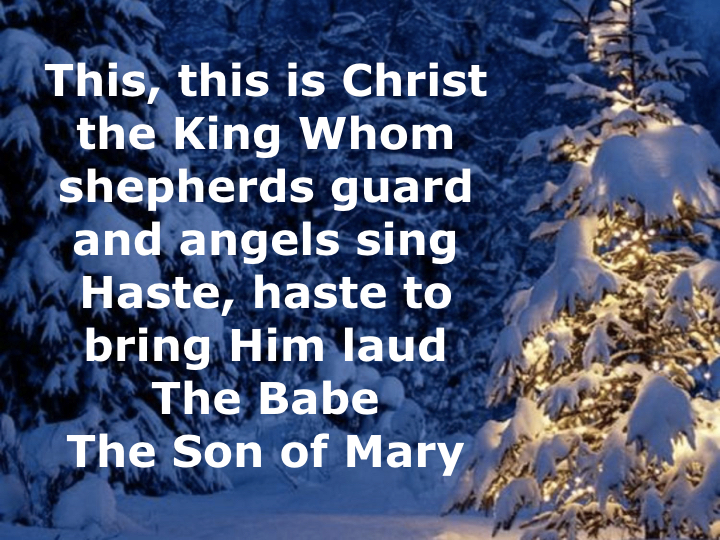
Have you heard the tune called Greensleeves? It’s been around longer than anyone knows. William Shakespeare referenced it in two of his plays and didn’t feel the need to explain it to his audience. The tune has been set to some pretty bawdy words about New Year’s Eve parties, and even as a mocking song to some folks about to go to the gallows. And then in the mid-1800s William Chatterton Dix used this tune to write words about Christ’s birth in What Child Is This?
What an excellent question! Who exactly is this Child? Is Jesus merely a line on the pages of history? Or is His birth something more? Oswald Chambers noted, “The tremendous revelation of Christianity is not the Fatherhood of God, but the Babyhood of God—God became the weakest thing in His own creation, and in flesh and blood He levered it back to where it was intended to be. No one helped Him; it was done absolutely by God manifest in human flesh.”
The first-century historian Luke simply records that Mary is pregnant with “a child.” That is, until Jesus is taken to the temple in Jerusalem eight days later, and we see that a man named Simeon didn’t just see this Child as any baby, but as a fulfillment of prophecy (see Luke 2:25-32; Isaiah 7:14 and 9:6).
This Child is much more than just a historic person. He not only split history into BC and AD, but He has changed my life, and countless others’ lives as well! That’s why the chorus of this Christmas carol joyfully announces, “This, THIS is Christ the King!”
People may be confused about what tradition belongs to culture or Christendom. You may even be confused about what belongs to which. But none of that should stop us from knowing the Child we celebrate this Christmas. None of that should stop us from helping seekers to find Jesus as their own Savior. None of that should stop us from enthroning Jesus Christ as King and giving Him the highest praise He deserves!
Jesus used common, everyday things—farmers, fish, trees, weather, children’s songs—to tell people about a Heaven that was prepared for them. Paul used the cultural idols and poets to point his community to Jesus. Philip used the Scripture a governmental official was reading to point him to Jesus.
So we, too, can use whatever is around us to point people to Jesus this Christmas! What Child is this? This, THIS is Christ MY King! Merry Christmas!!
This is a weekly series with things I’m reading and pondering from Oswald Chambers. You can read the original seed thought here, or type “Thursdays With Oswald” in the search box to read more entries.
A New Look At Some Old Bible Studies
It is important to notice the difference between the Wisdom of the Hebrews and the Wisdom of the Greeks. The Wisdom of the Hebrews is based on an accepted belief in God; that is, it does not try to find out whether or not God exists, all its beliefs are based on God, and in the actual world of things as they are, all its mental energy is bent on practical living. The Wisdom of the Greeks, which is the wisdom of our day, is speculative; that is, it is concerned with the origin of things, with the riddle of the universe, etc., consequently the best of our wits is not given it to practical living.
The value of the Book of Job is not in what it teaches, but that it expresses suffering, and the inscrutability of suffering. In the Book of Psalms, Wisdom is applied to things as they are and to prayer. The Book of Proverbs applies Wisdom to the practical relationships of life, and Ecclesiastes applies Wisdom to the enjoyment of things as they actually are; there is no phase of life missed out, and it is shown that enjoyment is only possible by being related to God.
The record of the whirl of things as they are is marvelously stated in these books of Wisdom: Job—how to suffer; Psalms—how to pray; Proverbs—how to act; Ecclesiastes—how to enjoy; Song of Solomon—how to love. …
Solomon sums up the whole thing as follows: If you try to find enjoyment in this order of things, you will end in vexation and disaster. If you try to find enjoyment in knowledge, you only increase your capacity for sorrow and agony and distress. The only way you can find relief and the right interpretation of things as they are it is by basing your faith in God, and by remembering that man’s chief end is to glorify God and enjoy Him forever. Jesus Christ is the One Who can transmute everything we come across.
From Shade Of His Hand
Sometimes the “wisdom” books of the Bible can be difficult to understand in our modern day, Western culture. But perhaps you may be able to read them differently with these insights that Oswald Chambers shares.
Why not try giving a new look at some old Bible studies, and then comment below on how it worked for you.



 That first Christmas was supposedly a silent night and a holy night. Maybe there was some singing angels involved, but at least their message was about “peace on earth.”







 Craig T. Owens