Thursdays With Oswald—Getting The Order Right

Oswald ChambersThis is a weekly series with things I’m reading and pondering from Oswald Chambers. You can read the original seed thought here, or type “Thursdays With Oswald” in the search box to read more entries.

Getting The Order Right

     Beware of walking in the spiritual life according to your natural affinities. We all have natural affinities—some people we like and others we do not; some people we get on well with and others we do not. Never let those likes and dislikes be the rule of your Christian life. “If we walk in the light, as He is in the light, we have fellowship one with another” [1 John 1:7], i.e., God gives us fellowship with people for whom we have no natural affinity. …  

     Our example is not a good man, not even a Christian man, but God Himself. We do not allow the big surprise of this to lay hold of us sufficiently. Jesus nowhere says, “Follow your Father which is in heaven—that you may be good men? that you may be lovable to all men?” No, “that you may be the children of your Father which is in heaven” [Matthew 5:44-45], and that implies a strong family likeness to Jesus Christ. …  

     It takes a long time to get the full force of our Lord’s statements. “I say unto you, love your enemies”—an easy thing to do when you have no enemies; an impossible thing when you have. “Bless them that curse you”—easy when no one is cursing you, but impossible when someone is. “Do good to them that hate you, and pray for them that despitefully use you.” It seems easy to do all this when we have no enemies, when no one is cursing or persecuting us; but if we have an enemy who slanders and annoys and systematically vexes us, and we read Jesus Christ’s statement “I say to you, Love your enemies”—how are we going to do it? Unless Jesus Christ can remake us within, His teaching is the biggest mockery human ears ever listened to. …

     “I say unto you, love your enemies.” Jesus does not say, “Love every one.” The Bible never speaks vaguely, it always speaks definitely. People speak about loving “mankind,” and loving “the heathen”; Jesus says, “Love your enemies.” Our Lord does not say, “Bless your enemies,” He says, “Love your enemies.” He does not say, “Love them that curse you”; He says, “Bless them that curse you.” “Do good to them that hate you”—not bless them. He does not say, “Do good to them that despitefully use you”; He says, “Pray for them that despitefully use you.” Each one of these commands is stamped with sheer impossibility to the natural man. If we reverse the order Jesus has given it can be done with strain, but in His order I defy any man on earth to be able to do it unless he has been regenerated by God the Holy Ghost. When a man does love his enemies, he knows that God has done a tremendous work in him, and everyone else knows it too. 

From Studies In The Sermon On The Mount

It’s impossible to do what Jesus commands if we’re trying to do it solely in our own strength. But when we allow the Holy Spirit to remake us from within, we can do what Jesus says:

  • If someone is your enemy—love them.
  • If someone persecutes you—pray for them. 
  • If someone curses you—bless them.
  • If someone hates you—do good to them. 

When we operate this way, we know that God has made this possible in us—and everyone else knows it too!

Jesus Is Immanuel

I am Immanuel—God with you—and I am enough! When things in your life are flowing smoothly, it is easy to trust in My sufficiency. However, when you encounter rough patches—one after another after another—you may sometimes feel that My provision is inadequate. This is when your mind tends to go into high gear: obsessing about ways to make things better. There is nothing wrong with seeking solutions, but problem-solving can turn into an addiction: your mind spinning with so many plans and possibilities that you become confused and exhausted.

“To protect yourself from this mental exhaustion, you need to remind yourself that I am with you always, taking care of you. It is possible to rejoice in Me—to proclaim My sufficiency—even during the most difficult times. This is a supernatural work, empowered by My Spirit who lives in you. It is also a decision that you make—day by day and moment by moment. Choose to be joyful in Me, your Savior, for I am indeed enough!” —Jesus Christ (in Sarah Young’s Jesus Calling For Christmas)

(You can check out some more quotes from Sarah Young’s book by clicking here.)

Get Up And Get Moving

When Joseph woke up, he did what the angel of the Lord had commanded him… (Matthew 1:24). 

I was reading an article posted on WebMD about how much damage we can do to our hearts by spending more time in front of the TV or computer than we do exercising. You’re probably thinking, “Well, duh! isn’t that obvious?!” It should be, and yet all of us still have a natural tendency to just sit there.

One quote especially stood out to me —

“It’s not even about the exercise. It’s about not sitting,” says Suzanne Steinbaum, DO, a preventive cardiologist at Lenox Hill Hospital in New York City. “I think that sort of points us in a little different direction. In order for you not to cause harm to yourself, you really need to focus on getting up and moving.”

This reminds me of Joseph (Mary’s husband) in the Bible. God spoke to him three times in dreams. After Joseph woke up, instead of just sitting there contemplating the vision, there’s a phrase that shows up after every single vision—“Joseph got up and did.” 

A mark of a godly leader is one who obeys God quickly.

I’m convinced that if Joseph had not obeyed the first God-given vision, he wouldn’t have been given anymore. 

Has God given you a vision for your life? If so, just sitting there may do damage to your heart and limit any other visions from God. So follow Joseph’s example and get up and get moving!

This is part 32 in my series on godly leadership. You can check out all of my posts in this series by clicking here.

How Is Your Heart Hearing?

Therefore take heed how you hear… (Luke 8:18).

Therefore—when I see this word, I need to ask, “What came before?” Jesus has just shared the parable of the sower and given its fuller explanation to His disciples. Now Jesus is speaking privately to His disciples and telling them, “Be very attentive to how you are hearing My words.”  

Why would Jesus tell them that? He says that the way we pay attention to His words can either bring more blessing to our lives, or cause us to miss out on His blessings: “For whoever has, to him more will be given; and whoever does not have, even what he seems to have will be taken away from him” (v. 18). 

In other words, every single one of us has the capacity to have hearts like all four types of soil Jesus talked about in His parable: hard, rocky, thorny, productive. 

I must be attentive to how I’m listening to Christ’s words…

  • …with a prepared (plowed) heart 
  • …not preoccupied with worldly things
  • …ready to obey what He says
  • …ready to share the blessings of what I hear with others

Lord, my heart is ready. Speak to me. I am ready to hear, ready to obey, and ready to share. Give me more insight into what You are saying to me.

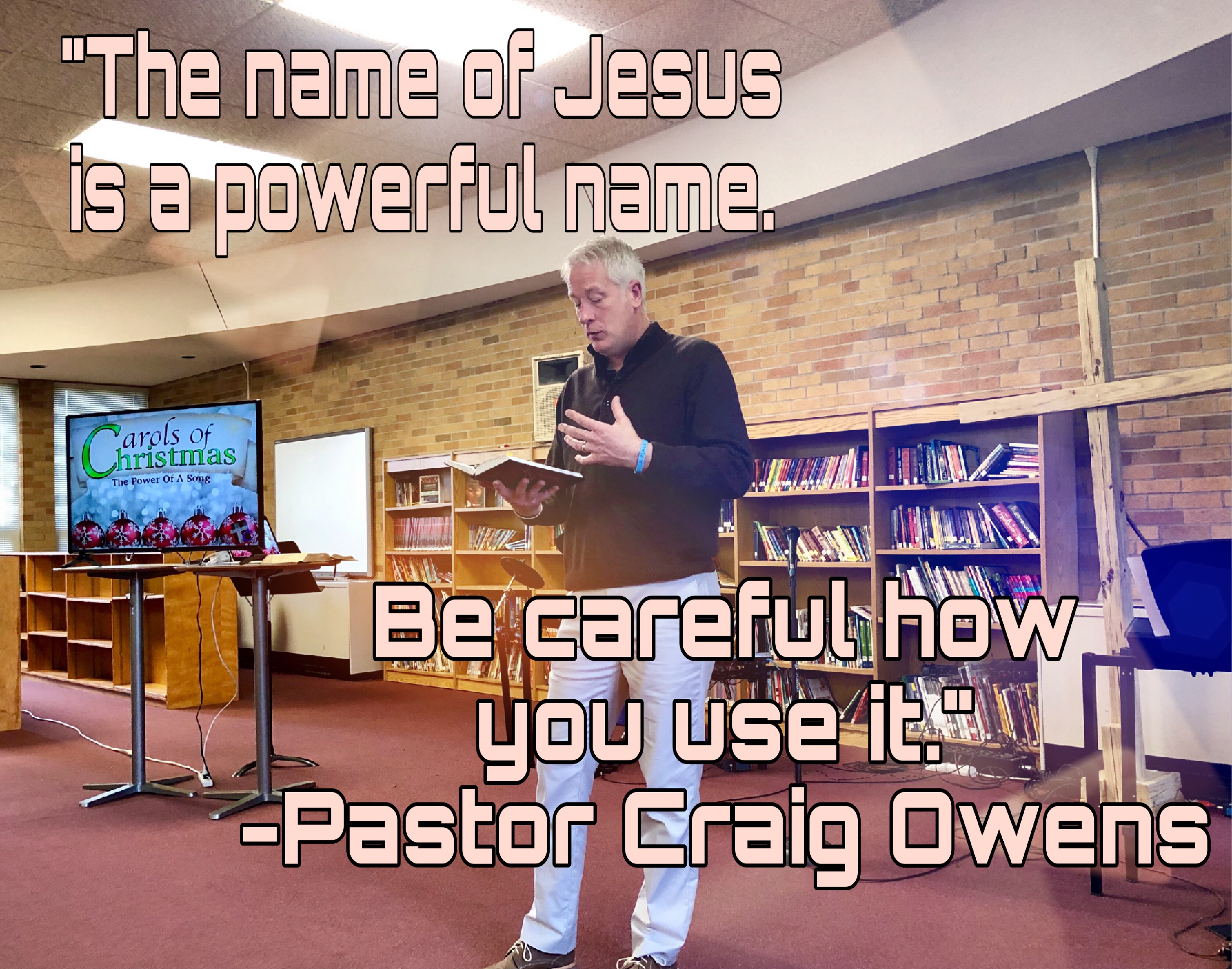
The Powerful Name Of Jesus

As we approach Christmas Day and we think about the First Advent, many times our thoughts go to the scene of a lowly manger, tired parents, and a newborn baby wrapped in cloths. We tend to focus on the Baby. 

And rightly so! 

It is fascinating to think that before He was even born an angel appeared to both Joseph and Mary to tell them that this Baby should be named Jesus (Matthew 1:21 and Luke 1:31). But have you also noticed all of the other names and titles given to the Baby at His birth? 

  • a Savior who is Christ the Lord
  • Immanuel which means “God with us” 
  • Son of the Most High 
  • King of the Jews
  • Ruler of God’s people
  • Son of the Most High God
  • God Himself

What do we do with the name of the Lord? 

When I say “the name of the Lord” I’m not talking about the five letters that spell J-E-S-U-S or even C-H-R-I-S-T. The name of the Lord means all of God’s character, His majesty, His personality, His magnificence, everything that makes God God. 

The Bible clearly tells us how to use God’s name properly. We are to use the name of the Lord for

  • salvation
  • protection
  • batting the enemy
  • preaching
  • praying
  • casting out demons
  • healing the sick

The use of the name of the Lord should distinguish us. CHRISTians bear the name of Christ, so they should represent the character of God accurately, and in a way that causes others to glorify Him and want to approach Him. 

If there is a proper way of using the name of the Lord, that also means there are ways we can misuse the name of the Lord, something God expressly forbids in the third of the Ten Commandments (Exodus 20:7). 

We misuse the name of the Lord when we… 

There is a holy balance—Jesus is both King of kings and a Friend of sinners. God paid an incredibly high price so that we could be reconciled to Him, but not so that you could treat Him ignorantly or carelessly. This calls for some serious searching by the Holy Spirit! Perhaps you could pray a prayer that David penned: Search me, God, and know my heart; test me and know my anxious thoughts. See if there is any offensive way in me, and lead me in the way everlasting.

To take a look at the other stanzas of this Christmas carol, please click here.

Poetry Saturday—Jesus, The Very Thought Of Thee

Jesus, the very thought of Thee
With sweetness fills the breast;
But sweeter far Thy face to see,
And in Thy presence rest.

Nor voice can sing, nor heart can frame,
Nor can the memory find
A sweeter sound than Thy blest Name,
O Savior of mankind!

O hope of every contrite heart,
O joy of all the meek,
To those who fall, how kind Thou art!
How good to those who seek!

But what to those who find? Ah, this
Nor tongue nor pen can show;
The love of Jesus, what it is,
None but His loved ones know.

Jesus, our only joy be Thou,
As Thou our prize will be;
Jesus be Thou our glory now,
And through eternity.

O Jesus, King most wonderful
Thou Conqueror renowned,
Thou sweetness most ineffable
In Whom all joys are found!

When once Thou visitest the heart,
Then truth begins to shine,
Then earthly vanities depart,
Then kindles love divine.

O Jesus, light of all below,
Thou fount of living fire,
Surpassing all the joys we know,
And all we can desire.

Jesus, may all confess Thy Name,
Thy wondrous love adore,
And, seeking Thee, themselves inflame
To seek Thee more and more.

Thee, Jesus, may our voices bless,
Thee may we love alone,
And ever in our lives express
The image of Thine own.

O Jesus, Thou the beauty art
Of angel worlds above;
Thy Name is music to the heart,
Inflaming it with love.

Celestial Sweetness unalloyed,
Who eat Thee hunger still;
Who drink of Thee still feel a void
Which only Thou canst fill.

O most sweet Jesus, hear the sighs
Which unto Thee we send;
To Thee our inmost spirit cries;
To Thee our prayers ascend.

Abide with us, and let Thy light
Shine, Lord, on every heart;
Dispel the darkness of our night;
And joy to all impart.

Jesus, our love and joy to Thee,
The virgin’s holy Son,
All might and praise and glory be,
While endless ages run. —Bernard of Clairvaux

Thursdays With Oswald—Dealing With Persecution

Oswald ChambersThis is a weekly series with things I’m reading and pondering from Oswald Chambers. You can read the original seed thought here, or type “Thursdays With Oswald” in the search box to read more entries.

Dealing With Persecution

     If a disciple is going to follow Jesus Christ, he must lay his account not only with purity and with practice, but also with persecution [Matthew 5:38-42]. … 

     When we are on Jesus Christ’s errands, no time is to be taken in standing up for ourselves. Personal insult will be an occasion in the saint for revealing the incredible sweetness of the Lord Jesus. … Naturally, if a man does not hit back it is because he is a coward; supernaturally, it is the manifestation of the Son of God in him: both have the same appearance outwardly. … 

     Our strength has to be the strength of the Son of God, and “He was crucified through weakness.” Do the impossible, and immediately you do, you know that God alone has made it possible. … 

     The miracle of regeneration is necessary before we can live the Sermon on the Mount. The Son of God alone can live it, and if God can form in us the life of the Son of God as He introduced Him into human history, then we can see how we can live it too. …  

     The Sermon on the Mount is not, “Do your duty”; but, “Do what is not your duty.” … You will go the second mile, not for their sakes, but for Jesus Christ’s sake. … The first thing God requires of a man is to be born from above, then when he goes the second mile for men it is the Son of God in him Who does it. …  

     We always say we do not know what Jesus Christ means when we know perfectly well He means something which is a blunt impossibility unless He can remake us and make it possible. … We can always find a hundred and one reasons for not obeying our Lord’s commands, because we will trust our reasoning rather than His reason, and our reason does not take God into calculation. 

From Studies In The Sermon On The Mount 

If the teachings of Jesus in the Sermon on the Mount sound humanly impossible, that’s because they are! 

I cannot turn the other cheek, give to everyone who asks me, or go the second mile; but Jesus in me CAN. I have to allow the Holy Spirit to transform me, to mold the character of Jesus into me. When this happens, it is no longer I who are trying to do these things, but the Spirit of Christ in me that is actually doing these things.

God Bless Christmas

I just finished my annual re-reading of Charles Dickens’ The Christmas Carol. What a masterful author he was! This year I was especially struck by the argument between Ebenezer Scrooge and his nephew Fred—

“A merry Christmas, uncle! God save you!” cried a cheerful voice. It was the voice of Scrooge’s nephew, who came upon him so quickly that this was the first intimation he had of his approach.

“Bah!” said Scrooge, “Humbug!”

He had so heated himself with rapid walking in the fog and frost, this nephew of Scrooge’s, that he was all in a glow; his face was ruddy and handsome; his eyes sparkled, and his breath smoked again.

“Christmas a humbug, uncle!” said Scrooge’s nephew. “You don’t mean that, I am sure?”

“I do,” said Scrooge. “Merry Christmas! What right have you to be merry? What reason have you to be merry? You’re poor enough.”

“Come, then,” returned the nephew gaily. “What right have you to be dismal? What reason have you to be morose? You’re rich enough.”

Scrooge having no better answer ready on the spur of the moment, said, “Bah!” again; and followed it up with “Humbug.”

“Don’t be cross, uncle!” said the nephew.

“What else can I be,” returned the uncle, “when I live in such a world of fools as this? Merry Christmas! Out upon merry Christmas! What’s Christmas time to you but a time for paying bills without money; a time for finding yourself a year older, but not an hour richer; a time for balancing your books and having every item in ’em through a round dozen of months presented dead against you? If I could work my will,” said Scrooge indignantly, “every idiot who goes about with ‘Merry Christmas’ on his lips, should be boiled with his own pudding, and buried with a stake of holly through his heart. He should!”

“Uncle!” pleaded the nephew.

“Nephew!” returned the uncle sternly, “keep Christmas in your own way, and let me keep it in mine.”
“Keep it!” repeated Scrooge’s nephew. “But you don’t keep it.”

“Let me leave it alone, then,” said Scrooge. “Much good may it do you! Much good it has ever done you!”

There are many things from which I might have derived good, by which I have not profited, I dare say,” returned the nephew. “Christmas among the rest. But I am sure I have always thought of Christmas time, when it has come round—apart from the veneration due to its sacred name and origin, if anything belonging to it can be apart from that—as a good time; a kind, forgiving, charitable, pleasant time; the only time I know of, in the long calendar of the year, when men and women seem by one consent to open their shut-up hearts freely, and to think of people below them as if they really were fellow-passengers to the grave, and not another race of creatures bound on other journeys. And therefore, uncle, though it has never put a scrap of gold or silver in my pocket, I believe that it has done me good, and will do me good; and I say, God bless it!”

There is something “special” about the Advent season. You can palpably sense it in the way people talk and act differently. Could it be that the celebration of Christmas—despite all the tinsel and consumerism that has sought to overwhelm it—sounds a familiar chord in people’s heart because the Story is true? God bless it!

Here are a few Christmas Carol observations I shared last year.

More Trust With Each Birthday

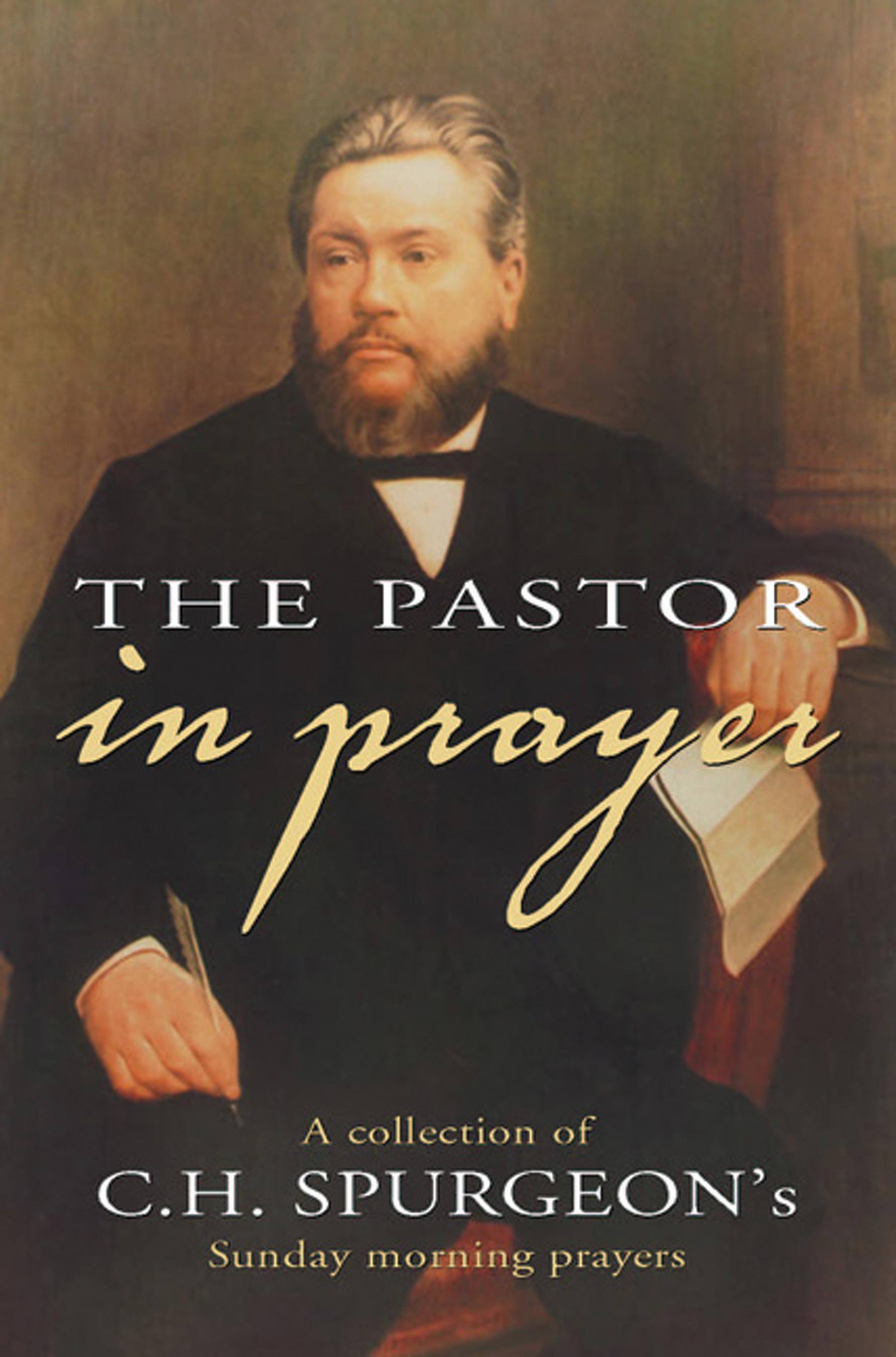
“Peradventure it is written in the tablets of Thine eternal purpose that we shall soon end this mortal life and die. Well, be it so, we shall the sooner see Thy face, the sooner drink eternal draughts of bliss. But if Thou hast appointed for us grey hairs and a long and weary time of the taking down of the tabernacle, only grant us grace that by infirmity our faith may never fail us, but when the windows are darkened may we still look out to see the hope that is to be revealed; and when the grasshopper becometh a burden still let our strength be as our days, even to the last day. … O God, we can trust Thee, and we do. Our faith has gathered strength by the lapse of years. Each following birthday, we trust, confirms us in the fact that to rely upon God is our happiness and our strength.” —Charles Spurgeon, from The Pastor In Prayer

I shared other quotes from this book here.

Blessings And Woes

… blessed are you … woe to you … (Luke 6:20-27). 

Blessings and woes: the positives and negatives of the Christian life. Jesus listed these back-to-back to remind us that we need to keep both of them in mind, sort of like two rails that keep us on track. 

It’s interesting to note how many of these blessings and woes are opposites of each other. It comes down to this—

there are blessings for seeking the Kingdom of God, AND there are woes for seeking our own immediate pleasure.

Notice the contrasts Jesus lists:

  • You are blessed when you seek heavenly rewards; you experience woe when your focus is earthly treasure (vv. 20, 24). 
  • You are blessed when you are driven by a hunger for God; you experience woe when your god becomes your selfish appetites (vv. 21, 25). 
  • You are blessed when you acknowledge your sin, weep over it, and repent from it; you experience woe when sin is laughed at (vv. 21, 25). 
  • You are blessed when you are hated by the world for loving God; you experience woe when you are loved by the world for loving sinful pleasures (vv. 22, 26). 

I think C.S. Lewis captured these thoughts well when he wrote in Mere Christianity, “Give yourself up and you will find your real self. Lose your life and you will save it. … Look for Christ and you will find Him, and with Him everything else thrown in.” 

Blessings for seeking Jesus and His kingdom; woes for seeking only your own kingdom. 

So how do we live blessed? Here’s what Jesus taught us (vv. 27-49)—

Love your enemies
Always do good, even (especially!) to your haters
Bless those who curse you 
Don’t fight for your rights
Be an impartial, liberal giver
Treat others the way you want to be treated 
Love and give to others without expecting a return
Be merciful
Don’t be judgmental
Give, give, and give some more
Look in the mirror at yourself first before looking out the window at others
Serve others
Check what sort of fruit your life is bearing
Build everything in your life on God’s Word

Avoid the woes AND enjoy the blessings of God!