Thursdays With Oswald—In Christ I Can

This is a weekly series with things I’m reading and pondering from Oswald Chambers. You can read the original seed thought here, or type “Thursdays With Oswald” in the search box to read more entries.

In Christ I Can

     We are made sons and daughters of God through the Atonement and we have a tremendous dignity to maintain; we have no business to bow our necks to any yoke saving the yoke of the Lord Jesus Christ [Matthew 11:28-30]. …

     Every detail of our physical life is to be absolutely under the control of the new disposition which God planted in us by means of identification with Jesus Christ, and we shall no longer be allowed to murmur ‘can’t.’ There is no such word as ‘can’t’ in a Christian’s vocabulary if he is rightly related to God; there is only one word and that is ‘can.’

From Biblical Psychology

Sometimes Christians are known more for what we’re against than what we’re for. I think Oswald Chambers would say that is because we don’t really understand the full power of the Atonement.

We can better understand that word by saying it “at one-ment.” We have been made one with Christ. You hear this in Jesus’ prayer for us in John 17, I in them and You in Me, in order that they may become one and perfectly united, that the world may know and definitely recognize that You sent Me and that You have loved them even as You have loved Me.”

When we are in this sort of relationship, we don’t even say can’t to sin. Instead, we say I can live a holy life because of Christ in me!

As Paul said, we can say:

I CAN do everything through Christ Who gives me strength. (Philippians 4:13)
Immersed

What happens when we truly let the Holy Spirit have His way in our lives?

Could we experience today the things that are recorded in the Book of Acts?

Is it possible that God wants to do so much more through our lives than we are allowing Him to do now?

That last question, I believe is the most important one. One of the apostle Paul’s prayers went like this:

And I pray that you, being rooted and established in love, may have power, together with all the saints, to grasp how wide and long and high and deep is the love of Christ, and to know this love that surpasses knowledge — that you may be filled to the measure of all the fullness of God. Now to Him who is able to do immeasurably more than all we ask or imagine, according to His power that is at work within us, to Him be glory in the church and in Christ Jesus throughout all generations, for ever and ever! Amen. (Ephesians 3:17-21)

This is an expansive prayer … a mind-blowing prayer … a prayer that is asking God to go beyond our ability to contain all that He has for us.

The only way we can get to this place (and I want all of us to get to this place) is if we let go. In other words, if we will let the Holy Spirit totally immerse us in His presence, if we will not try to box Him up, or shut Him out of any area of our lives.

We’ll be learning more about Immersed this Sunday at Calvary Assembly of God. If you’ve missed any of the messages in this series, you can check them out here:

Thoughts From C.S. Lewis

I’ve been re-reading some of my notes that I made on a collection of essays from C.S. Lewis. He is one of my favorite authors, always helping me to see the spiritual realm in a whole new light.

These are just a few quotes that have me thinking…

“A live body is not one that never gets hurt, but one that can to some extent repair itself. In the same way a Christian is not a man who never goes wrong, but a man who is enabled to repent and pick himself up and begin over again after each stumble—because the Christ-life is inside him, repairing him all the time, enabling him to repeat (in some degree) the kind of voluntary death which Christ Himself carried out.”

“There are two ways in which the human machine goes wrong. One is when human individuals drift apart from one another, or else collide with one another and do one another damage. The other is when things go wrong inside the individual—when the different parts of him either drift apart or interfere with one another.”

“Those cautions which the tempter whispers in our ears are all plausible…. That is the truth in the temptation. The lie consists in the suggestion that our best protection is a prudent regard for the safety of our pocket, our habitual indulgences, and our ambitions.”

“When a man is getting better he understands more and more clearly the evil that is still left in him. When a man is getting worse he understands his own badness less and less. … Good people know about both good and evil: bad people do not know about either.”

If you haven’t read C.S. Lewis for yourself, he writes in so many different genres that you can find something for almost any taste: science fiction, children’s fairy tales, theology, apologetics, and on and on. He was truly gifted by God to see our world in a different light, and you will be greatly enriched by reading as much as you can from this master author.

Fearless (book review)

I recently read Fearless by Eric Blehm, the story about Adam Brown, who was a SEAL Team 6 operator. It was an amazing story!

The publisher was concerned that since a Navy SEAL was on the front cover, perhaps some church folks (especially pastors) might pass by this book. But let me assure you, this is a completely Christ-centered, God-honoring story. Check out the video review I did for Waterbrook Multnomah —

I am a Multnomah book reviewer.

Getting A Checkup

Probably almost everyone has heard the so-called Golden Rule that Jesus gave us:

So in everything, do to others what you would have them do to you, for this sums up the Law and the Prophets. (Matthew 7:12)

Most of the time we apply this verse from an I-perspective. That is, we ask, “How would I want to be treated in this situation,” and then we treat others like that.

What about if we switch it? What if we took the time to find out how the other person wanted to be treated?

In Romans 12, Paul says we are all interdependent on one another (v. 6). And he gives us some ways to live out the Golden Rule from an others-perspective. So from his teaching, here’s a checkup I’m giving myself:

  • Am I truly devoted to others, like I would be to my own family members (v. 10a)?
  • Do I honor others’ wishes ahead of my own (v. 10b)?
  • Do I work to find harmony (v. 16)?
  • Am I willing to do what others think is right (v. 17)?
  • Do I work hard to find a peaceful solution for everyone involved (v. 18)?

Now here’s the real test:

  • How would others answer the above questions about me?
  • How would someone who doesn’t like me answer those questions about me (v. 20)?

This checkup is making me think. How about you?

I Am A Follower (book review)

About a decade ago I was moved into a position of leadership that seemed way too big for me. So to prepare myself, I began to read all of the leadership materials I could find: Bible-based leadership, marketplace leadership, anything I could find that would help me grow as a leader. I thought I was progressing as a leader, until I read I Am A Follower by Leonard Sweet.

Just a few pages into I Am A Follower I read this: “Following is the most underrated form of leadership in existence.” And thus I was confronted by a message that seemed 180-degrees out-of-phase with what I’ve been learning for the past decade.

In pointing time and time and time again to the life of Jesus, Len Sweet makes the case that Jesus is the only Leader, and the rest of us are followers. Jesus showed us perfect leadership by being a perfect Follower. In fact, He is the perfect Follower, as no one has ever followed God as He did. Some of us may follow Christ a little sooner, or a little closer, or a little more persuasively. Those, Dr. Sweet would say, are better called “first followers.”

Dr. Sweet uses phrases like the dance of life, and the transformation of viewpoint. These are not phrases that a leader uses, but they are the paradigm of followers. Check out this quote:

“The cry for leadership is deafening amid our social disintegration, our moral disorientation. We have come to believe that we have a leadership crisis while all along we have been in a drought of discipleship. The Jesus paradox is that only Christians lead by following.” (Leonard Sweet)

This book is a prophetic word: it is calling us back to true biblical-centeredness, true Christ-likeness, true discipleship. This is a book that took me a while to read, and will take me even longer to process. It’s a paradigm-busting game-changer…

…and it’s right on target.

Go get this book today!

I am a Thomas Nelson book reviewer.

My Amazingly Loving Church

If you’ve followed my blog for even a short period of time, you have see this phrase often:  My Church!

Here’s just one more reason why…

If you live in West Michigan and you are looking for a church home, you couldn’t find a more loving church that Calvary Assembly of God! I hope to see you soon.

A Warning To Shepherds

If you are a pastor, God sees you as a shepherd (see John 21:15-17; 1 Peter 5:1-4).

If you are a shepherd, there is a heavy responsibility on you to lovingly, attentively care for God’s precious sheep. We cannot shirk this responsibility for even a moment.

God loves His sheep so much that He gave His sheep YOU!

God loves His sheep so much that He will remove you, if He has to.

Consider this:

“What sorrow awaits the leaders of My people—the shepherds of My sheep—for they have destroyed and scattered the very ones they were expected to care for,” says the Lord. Therefore, this is what the Lord, the God of Israel, says to these shepherds: “Instead of caring for My flock and leading them to safety, you have deserted them and driven them to destruction. Now I will pour out judgment on you for the evil you have done to them. …Then I will appoint responsible shepherds who will care for them, and they will never be afraid again. Not a single one will be lost or missing. I, the Lord have spoken!” (Jeremiah 23:1, 2, 4)

This is a HEAVY word, and should not be taken lightly.

Pastor, never assume you are leading God’s sheep in the right paths. Ask the Holy Spirit to tell you if you are leading God’s sheep in the right paths!

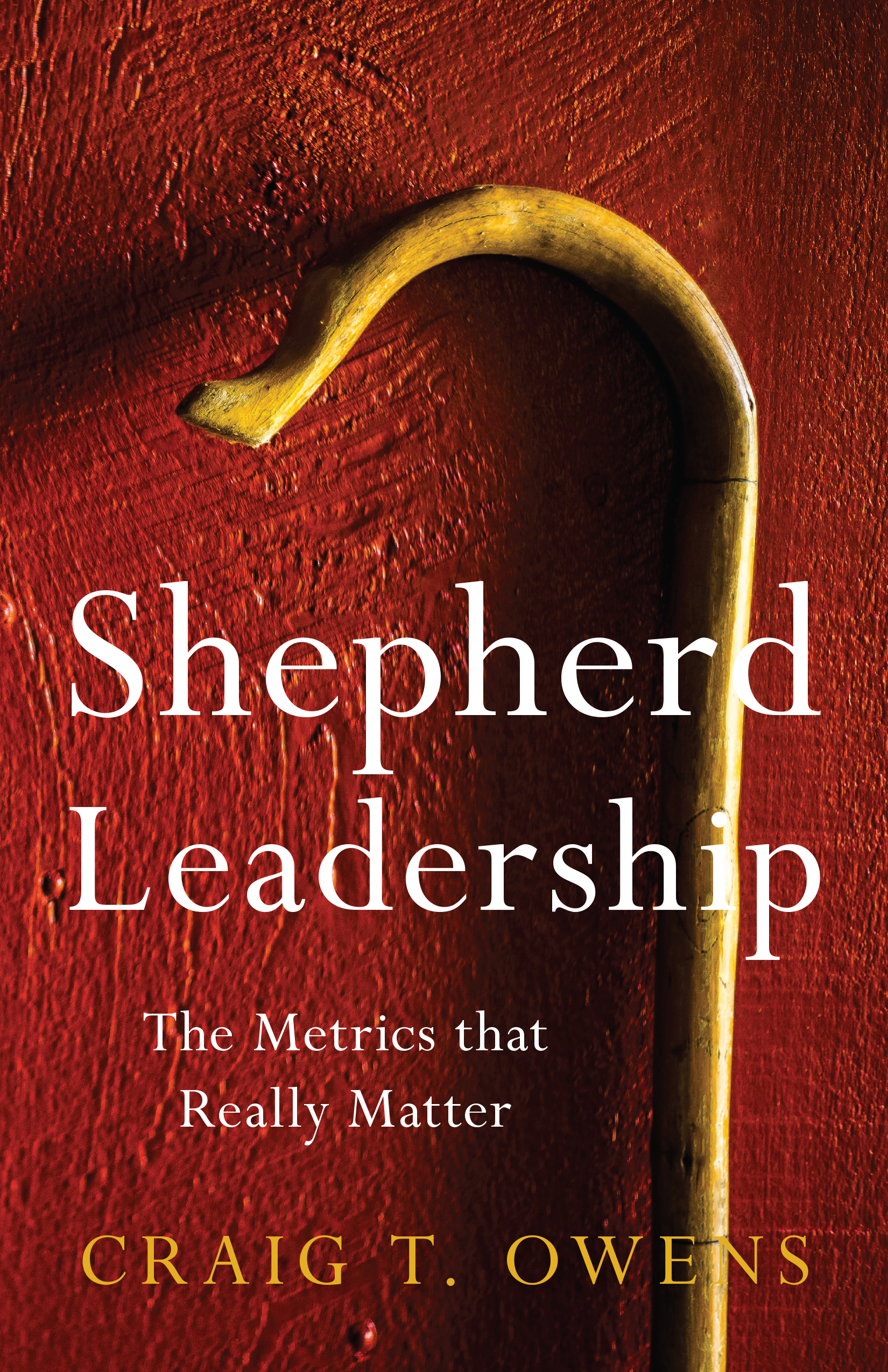
UPDATE: This post was one of the seed thoughts that went into fashioning my book Shepherd Leadership: The Metrics That Really Matter.

What Is “Success” For A Church?

“How’s it going,” a fellow pastor asked me. “How’s your church doing?”

If you’re a pastor, you probably get asked this often. How do you answer this question? Do you tell them what your attendance was on Sunday morning? Or about the newest program you’ve started?

When you look in the mirror and ask yourself, “How’s it going,” is your answer related to nickels and noses (offerings and attendance)? Is it how many people complimented your last sermon?

Listen to these sobering words:

Worldliness is not the trap that most endangers us as Christian workers; nor is it sin. The trap we fall into is extravagantly desiring spiritual success; that is, success measured by, and patterned after, the form set by this religious age in which we now live. 

We have a commercialized view—we count how many souls have been saved and sanctified, we thank God, and then we think everything is all right. (Oswald Chambers)

We need to be very careful about how we define “success” in a church setting. Let’s use Jesus as our example:

  • How big was His congregation? Twelve men. One betrayed Him, nine ran away when the going got tough, and one denied he even knew Him. Even after being raised from the dead (!) there were only 120 people in the upper room.
  • How much money did His church have? Not even enough to buy a gravesite for the Messiah.
  • What did people think of His sermons? Some of His sermons made people so mad they wanted to stone Him. And after one sermon the Bible says: From this time many of His disciples turned back and no longer followed Him (John 6:66).

Maybe “success” in the church is more like…

  • …people being reconciled to God. Remembering that “our work is not to save souls, but to disciple them” (Chambers).
  • …seeing disengaged people becoming actively involved in engaging others with the Gospel.
  • …“Never seek[ing] after anything other than the approval of God” (Chambers).
  • …to say with Jesus, “The Spirit of the Lord is on Me, because He has anointed Me to preach good news to the poor. He has sent Me to proclaim freedom for the prisoners and recovery of sight for the blind, to release the oppressed, to proclaim the year of the Lord’s favor” (Luke 4:18-19).

These are just some of my thoughts. What else should be on this list? How would you define “success” in the church?

I have also shared some questions that can help pastors and ministry leaders better gauge the level of effectiveness in their ministry.

UPDATE: This post was one of the seed thoughts that went into fashioning my book Shepherd Leadership: The Metrics That Really Matter.

Thursdays With Oswald—Me, Me, Me

This is a weekly series with things I’m reading and pondering from Oswald Chambers. You can read the original seed thought here, or type “Thursdays With Oswald” in the search box to read more entries.

Me, Me, Me

     The greatest peril is the peril within, which men never think of as a peril. My right to myself, self-pity, self-conceit, consideration for my progress, my ways of looking at things, those things are the satanic perils which will keep us in perfect sympathy with satan…. 

     In all probability satan is as much upset as the Holy Spirit is when men fall in external sin, but for a different reason. When men go into external sin and upset their lives, satan knows perfectly well that they will want another Ruler, a Savior and Deliverer; as long as satan can keep men in peace and unity and harmony apart from God, he will do so (see Luke 11:21-22). Remember, then, satan’s sin is dethroning God. 

From Biblical Psychology

My natural bent is to internalize. In other words, I want to ponder my circumstances, think about solutions myself, and reach my own conclusion. This, Oswald Chambers says, is dangerous.

When I’m thinking subjectively, everything runs through the filter of me, me, me. But when I verbalize—when I get my thoughts out in the open—the Holy Spirit can use God’s Word to help me think objectively.

I need an objective, external standard to keep me on the right path. If I keep it all inside, my natural subjective bent (that all of us humans have) will lead me down the path of quietly dethroning God and enthroning myself.