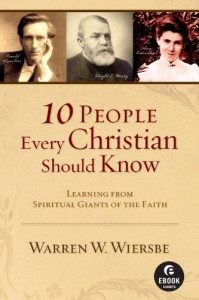
10 People Every Christian Should Know is a quick survey of notable Christian movers and shakers from the 1600s through the 1960s. Warren Wiersbe gives us a quick overview of their lives, attempting to whet our appetites to learn more about them.
By no means are these in-depth biographies, but rather short biographical sketches of their lives. Rev. Wiersbe quotes from other biographies and works written by the person being studied to give us insight into why they belong on this “Top 10” list. Each chapter contains Rev. Wiersbe’s recommendations about which books to read by or about that person to go deeper in your study of their life and beliefs.
I don’t have any arguments with the list of distinguished people who made this list, and I found the book recommendations in each chapter helpful, as well as the extensive list of reference books and biographies at the end of the book. The only thing I found slightly off-putting was Rev. Wiersbe’s commentaries into why the spiritual experiences of some of the subjects weren’t what they were portrayed to be. It would have been far better for him to simply say, “Here’s what happened, and here’s where you can read more.” Other than that, I would recommend this book as a great starting point for anyone who loves studying history as much as I do.
By the way, the Top 10 people covered in this book are:
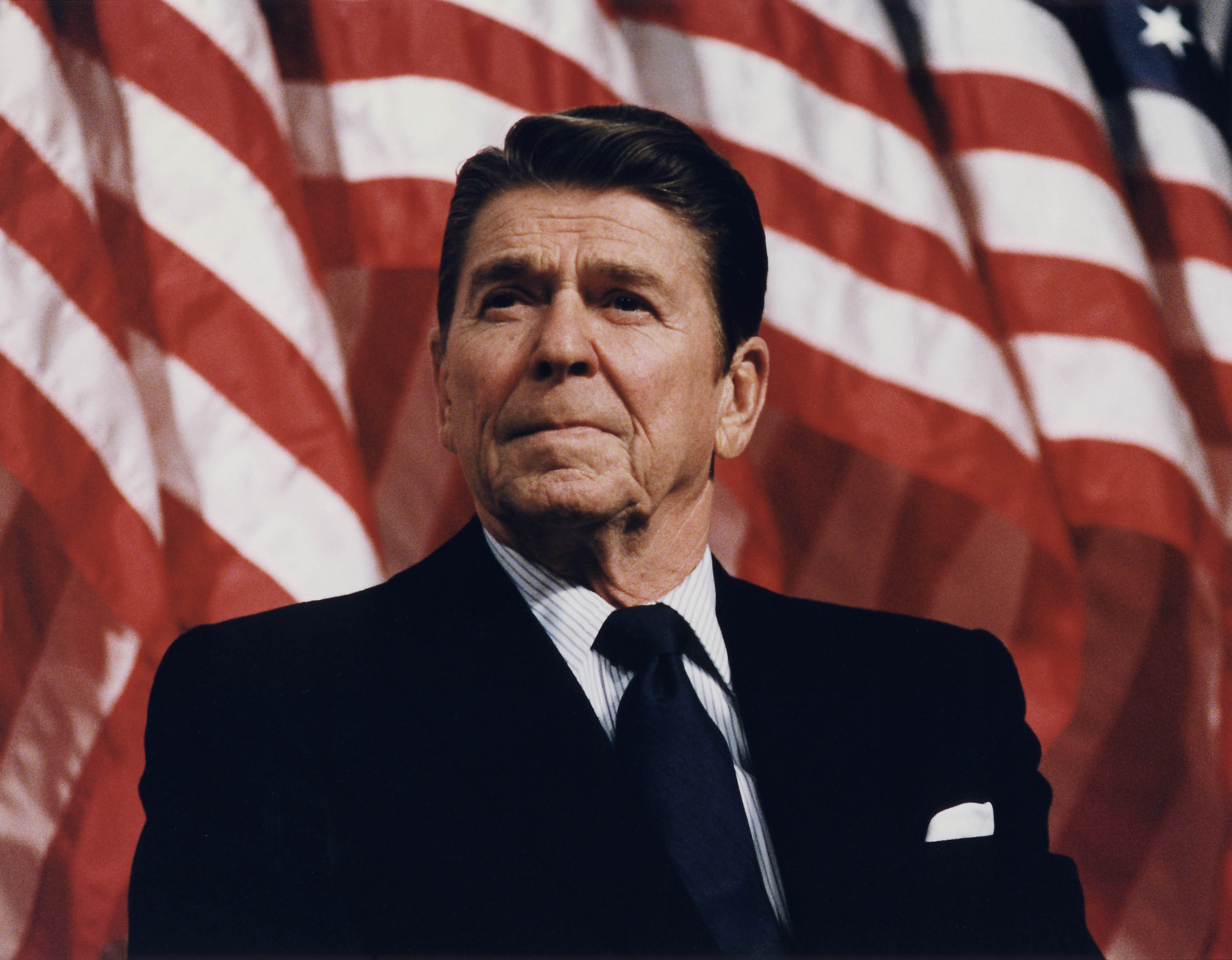
“In our hearts you will always be young, full of the love that is youth, love of life, love of joy, love of country—you fought for your country and for its safety and for the freedom of others with strength and courage. We love you for it. We honor you. And we have faith that, as He does all His sacred children, the Lord will bless you and keep you, the Lord will make His face to shine upon you and give you peace, now and forevermore.” —Ronald Reagan, in his 1988 Veterans Day address
This is a weekly series with things I’m reading and pondering from Oswald Chambers. You can read the original seed thought here, or type “Thursdays With Oswald” in the search box to read more entries.
Our Broken Treasures
It is a revelation of pure joyousness in which the child of God pours into the Father’s bosom the cares which give pain and anxiety that He may solve the difficulties. Too often we imagine that God lives in a place where He only repairs our broken treasures, but Jesus reveals that it is quite otherwise; He discerns all our difficulties and solves them before us.
We are not beggars on the one hand or spiritual customers on the other; we are God’s children, and we just stay before Him with our broken treasures or our pain and watch Him mend or heal in such a way that we understand Him better.
From Christian Disciplines
I think we sometimes forget the infinite capacity of our Heavenly Father. He is All-Loving: no one has ever—or can ever—love more completely and deeply than He does. He is also All-Powerful: there isn’t anything that limits His potency. What an amazing combination! If God were only loving but not powerful, we couldn’t be sure He was able to answer our prayer. If God were only powerful but not loving, we wouldn’t be comfortable about bringing our concerns to Him.
But He is Both! And as such, we should have such rock-solid confidence that He not only can answer prayer, but that He wants to answer prayer. He answers, as Oswald Chambers says, in ways that reveal more of His nature to us, so that we can understand Him better and better through each answered prayer.
“Oh, what peace we often forfeit. Oh, what needless pain we bear, all because we do not carry everything to God in prayer.”
Would you like God to bless your work? Would you like Him to bless all of your work?
He said it pretty simply. There are two actions / attitudes (because the actions must be done with the right attitude) that will bring God’s blessings:
‘Nuff said!
Sadly, that’s the attitude of far too many people in the United States of America. And it’s flat-out wrong!
If America is to stay true to the designs of our brilliant Founding Fathers, we must vote intelligently. In this age of easy internet access, there is no excuse for you not to find out where each candidate stands. So get informed and go vote!
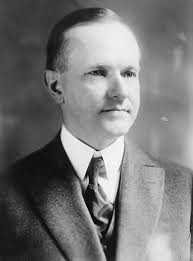
Almost 90 years ago President Calvin Coolidge had some challenging words for Americans which should still grab our attention today—
“All the opportunity for self-government through the rule of the people depends upon one single factor. That is the ballot box…. The people of our country are sovereign. If they do not vote they abdicate that sovereignty, and they may be entirely sure that if they relinquish it other forces will seize it, and if they fail to govern themselves some other power will rise up to govern them. The choice is always before them, whether they will be slaves or whether they will be free. The only way to be free is to exercise actively and energetically the privileges, and discharge faithfully the duties which make freedom. It is not to be secured by passive resistance. It is the result of energy and action. … Persons who have the right to vote are trustees for the benefit of their country and their countrymen. They have no right to say they do not care. They must care! They have no right to say that whatever the result of the election they can get along. They must remember that their country and their countrymen cannot get along, cannot remain sound, cannot preserve its institutions, cannot protect its citizens, cannot maintain its place in the world, unless those who have the right to vote do sustain and do guide the course of public affairs by the thoughtful exercise of that right on election day.” (emphasis added)
Philadelphia, as most people know is “The City of Brotherly Love.” The original Philadelphia in Asia Minor was founded in the second century BC by a man named Attalus who, quite the contrary to cultural norms, kept his brother in a position of power and influence alongside him.
Where many leaders were suspicious of anyone who could make a claim on the throne, Attalus loved (the Greek word is phileo) his brother (Greek adelphos meaning “from the same womb”), so the city took on this name and attitude as well. After the city was leveled by an earthquake in 17 AD, Emperor Tiberius sent the funds needed to rebuild. Out of gratitude to the emperor’s generosity there was a movement to rename the city Neocaesarea in his honor. But the people liked being known for their brotherly kindness, so the name Philadelphia stuck.
At least it stuck in name only. As the first century progressed, Philadelphians bowed more and more to Rome’s influence and this city once known for kindness to all began to persecute Christians.
This reminds me of the United States of America today. Our pledge of allegiance still includes “one nation under God,” and “in God we trust” is still on our currency, and we haven’t repealed the First Amendment which gives us freedom of religion. It appears that we are a “Christian nation,” but in name only.
Many cast the blame far and wide, but as Jesus addressed the people in the first city of Philadelphia (see Revelation 3:7-13), we see the blame is on those self-professing Christians who didn’t live Christ-like lives. They were Christians in name only.
For those who “have kept My Word and not denied My name” Jesus promises a list of rewards longer than the list for any of the other seven churches addressed in the book of Revelation! Those promises are still in effect for those who will not deny Christ. More specifically for those who by their words and their lifestyle hold true to Jesus Christ.
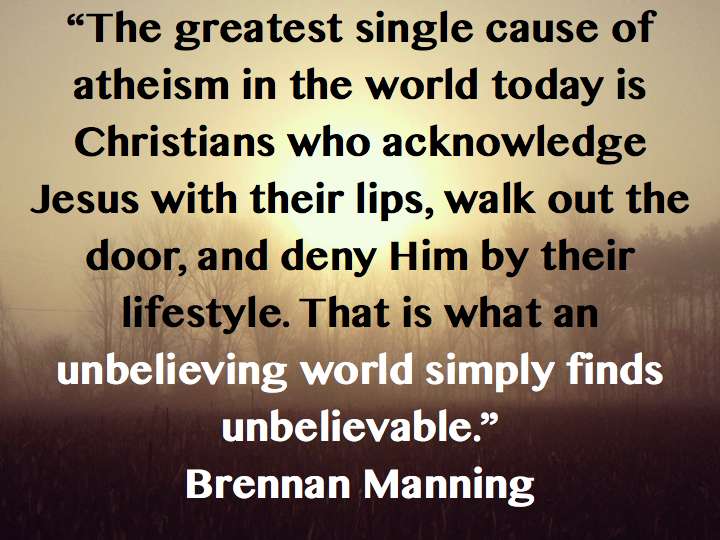
Brennan Manning was exactly right when he said, “The greatest single cause of atheism in the world today is Christians: who acknowledge Jesus with their lips, walk out the door, and deny Him by their lifestyle. That is what an unbelieving world simply finds unbelievable.”
My prayer is that Christians everywhere would be known not just by the name Christian, but by the way they hold true to Christ and His Word!
Please join me next Sunday as we look at the last of the churches in our series The 7-Star Church.
Listen to the podcast of this post by clicking on the player below, and you can also subscribe on Apple, Spotify, or Audible.
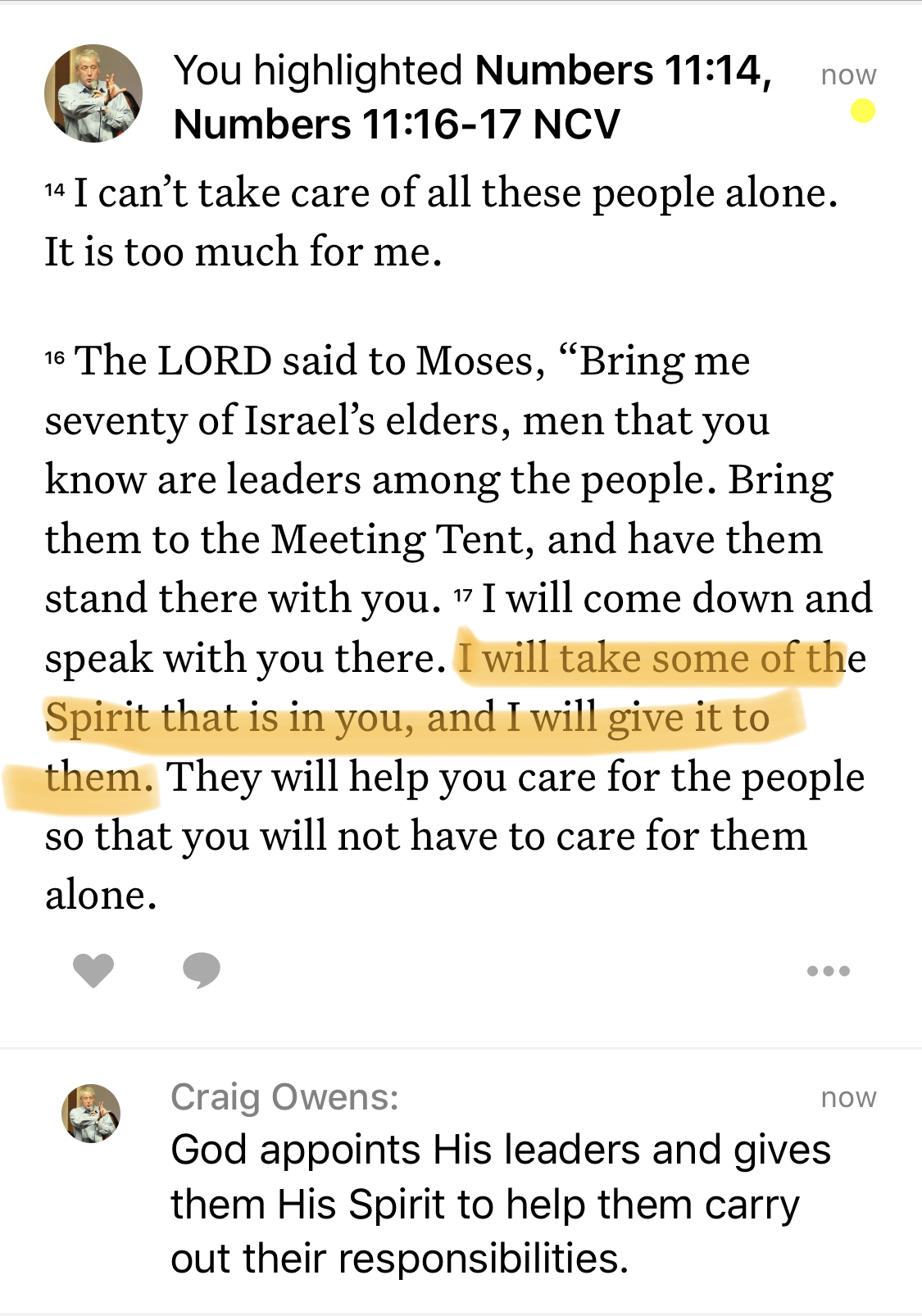
Moses was so right on the mark when he cried out, “I cannot carry all these people by myself; the burden is too heavy for me!” (Numbers 11:14)
It takes a confidently humble man to ask for help (Numbers 12:3). But God gives more grace to that humble person, while He stands aloof from those know-it-alls and those I-can-do-it-all-by-myselfs.
God anointed leaders to assist Moses. He took the same Spirit that was on Moses and imparted it to those 70 leaders. But—note this carefully—the Spirit on Moses was not at all diminished!
Moses’ responsibility was to pick the 70 “who are known to you as leaders” and then the Lord placed His Spirit on them. There were 70 who prophesied but Moses correctly desired “that all the Lord’s people were prophets and that the Lord would put His Spirit on them” (Numbers 11:16-17, 25, 29).
Leadership is necessary, and it is meant to be shared. From the senior leader, this requires:
►► Would you please prayerfully consider supporting this ministry? My Patreon supporters get behind-the-scenes access to exclusive materials. ◀︎◀︎
This is a weekly series with things I’m reading and pondering from Oswald Chambers. You can read the original seed thought here, or type “Thursdays With Oswald” in the search box to read more entries.
Strength For Others
The real reason for prayer is intimacy of relationship with our Father.
From Christian Disciplines
It’s a pretty simple principle: I cannot give to others what I do not possess.
Jesus rose early in the morning to find a place of private prayer (see Mark 1:35) so that He would be filled with His Father’s presence and able to meet the pressing needs of people that day. Why, oh why, don’t I follow my Lord’s example more?
People all around me need encouragement, light, hope, love. I cannot give what I do not possess. But I can possess these things in abundance if I will make use of prayer to tap into that intimate relationship with my Heavenly Father.
Prayer provides the strength I need for the day, so that I can provide the strength that others need for the day. Without prayer, I not only rob myself of God’s help, I rob others as well.