This is a weekly series with things I’m reading and pondering from Charles Spurgeon. You can read the original seed thought here, or type “Thursdays With Spurgeon” in the search box to read more entries.
Born A King
A very singular thing is this, that Jesus Christ was said to have been ‘born King of the Jews’ (Matthew 2:2). … The moment that He came on earth, He was a king. He did not wait till His majority that He might take His empire—but as soon as His eye greeted the sunshine, He was a King. From the moment that His little hands grasped anything, they grasped a scepter. As soon as His pulse beat and His blood begin to flow, His heart beat royally and His pulse beat an imperial measure and His blood flowed in a kingly current. He was born a King. He came ‘to be ruler in Israel.’ …
His goings forth as our Surety were from everlasting [Micah 5:2]. Pause, my soul, and wonder! You had goings forth in the person of Jesus from everlasting. Not only when you were born into the world did Christ love you, but His delights were with the sons of men before there were any sons of men! Often did He think of them; from everlasting to everlasting He had set His affection upon them. …
If He had not loved me with a love as deep as hell and as unutterable as the grave, if He had not given His whole heart to me, I am sure He would have turned from me long ago. He knew what I would be and He had time enough to consider it—but I am His choice and that is the end of it. … He knew me before I knew myself—yes, He knew me before I was myself. …
Sweet Lord Jesus! You whose going forth were of old, even from everlasting, You have not left Your goings forth yet. Oh, that You would go forth this day to cheer the faint, to help the weary, to bind up our wounds, to comfort our distresses! Go forth, we beseech You, to conquer sinners, to subdue hard hearts, to break the iron gates of sinners’ lusts and cut the iron bars of their sins in pieces! O Jesus! Go forth, and when You go forth, come to me!
From The Incarnation And Birth Of Christ
Think about that for a moment—Jesus had all of eternity to think about you, to see your whole life, and still, He loved you enough to die on a Cross for you!
…acceptable to the Lord … an aroma pleasing to the Lord… (Leviticus 1:3, 9).
Whether it’s a sacrifice or a lifestyle, these two phrases sum up the goal of obeying all of God’s directives: acceptable and pleasing.
“But,” you might say, “there is a lot of law to obey—a lot!”
And I would agree with you. Beginning with the Ten Commandments in Exodus 20 and going all the way through Numbers 9, there are 56(!) chapters of regulations.
“And I’m supposed to follow all of those?!”
Yes! Every single one of them. And not just those, but also the innumerable man-made rules that were added on top of all of those laws.
In the opening words of Leviticus, two key words emerge:
“How can I ever get there?”
YOU can’t!
For EVERYONE has sinned; we ALL fall short of God’s righteous standard (Romans 3:23 NLT).
For NO PERSON will be justified—made righteous, acquitted, and judged acceptable—in God’s sight by observing the works prescribed by the Law… (Romans 3:20 AMP).
But here is our hope—Blessed be the God and Father of our Lord Jesus Christ, Who has blessed us with every spiritual blessing the heavenly places in Christ…to the praise and of the glory of His grace, by which HE MADE US ACCEPTABLE in the Beloved (Ephesians 1:3, 6 NKJV).
And when we are in Christ, we also become an aroma pleasing to God—Our lives are a Christ-like FRAGRANCE rising up to God (2 Corinthians 2:14-17 NLT).
On our own, we cannot accomplish any of this. But in Christ we are both ACCEPTABLE to the Lord … and an aroma PLEASING to the Lord….
I am so active every day that I need to eat about 2700 calories just to maintain my weight. Eating that often, if I’m not careful, I can just simply put food in my mouth and really not taste it.
I think most people realize that there is a difference between eating and enjoying their food. Not only is gulping not very pleasurable, but doctors have even found some negative impacts on habitual food-gulpers. Things like:
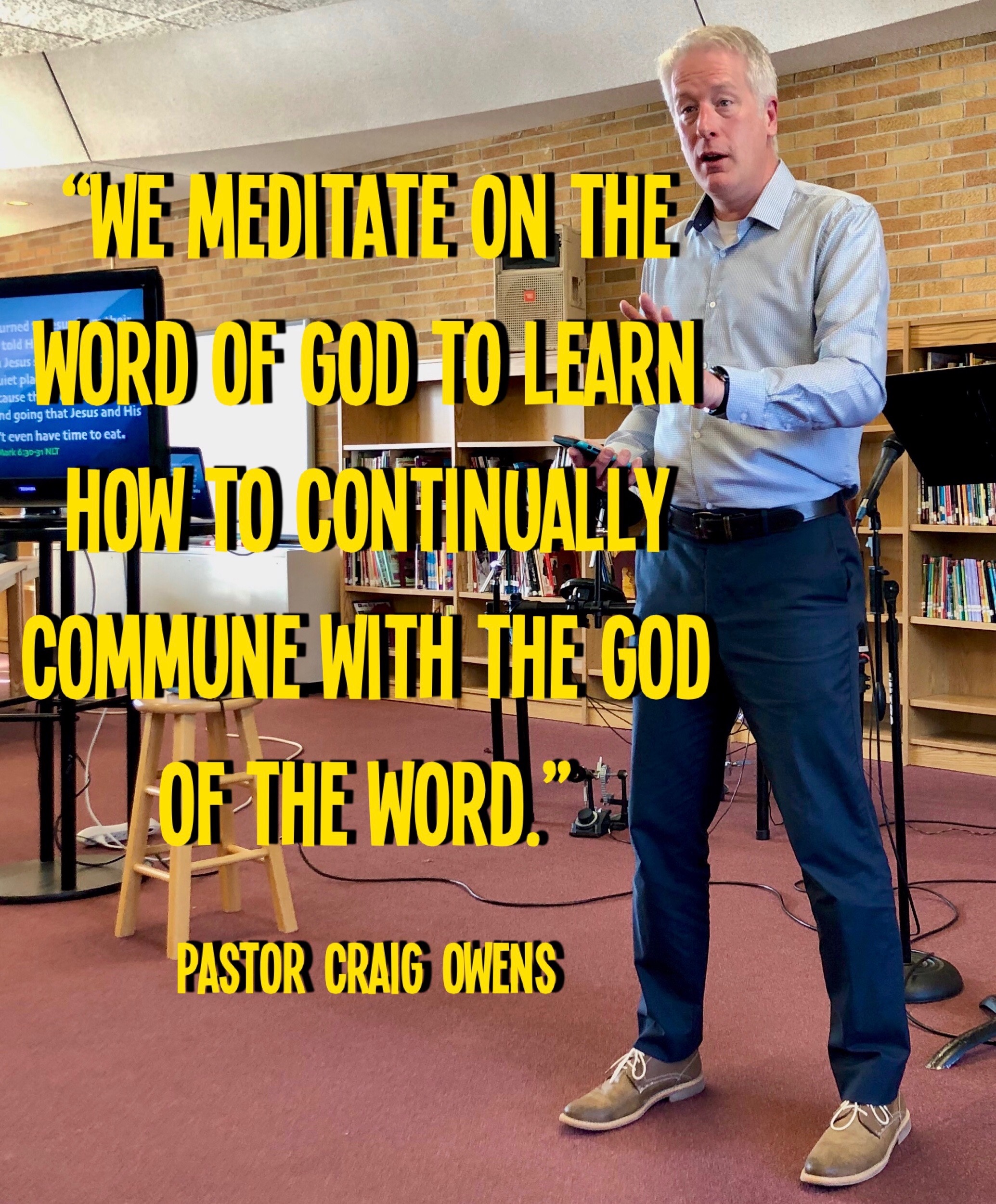
In the same way, there’s a difference between praying and enjoying our time with God (see Mark 6:30-31 and Revelation 3:20).
Just as there are many physical benefits to enjoying healthy food, there are also many spiritual benefits to enjoying our time in God’s Word and God’s presence. This spiritual eating and digestion process is called meditation.
Allow me to put a couple of thoughts together to show you the value of this spiritual discipline:
So the way we pray continually is to have something healthy to digest. We can feast on God’s Word and then allow the Holy Spirit to extract all of the healthy spiritual nutrients that will allow us to grow and mature.
David said, “Taste and see that the Lord is good” (Psalm 34:8). Don’t gulp down your meal of the Scripture—taste it. Don’t rush through your prayer time—enjoy it. Keep mulling over what you have read. Keep chewing on it to help the digestion of the good stuff you need to be healthy.
Meditating on God’s Word with the Holy Spirit’s help means you will never lack material for praying continually.
This is a weekly series with things I’m reading and pondering from Charles Spurgeon. You can read the original seed thought here, or type “Thursdays With Spurgeon” in the search box to read more entries.
Why Bethlehem?
There [in Bethlehem] cleaved to [Naomi] Ruth the Moabitess, whose Gentile blood should unite with the pure untainted stream of the Jew and should thus bring forth the Lord our Savior, the great King both of Jews and Gentiles. … And in the streets of Bethlehem did Boaz and Ruth receive a blessing that made them fruitful, so that Boaz became the father of Obed and Obed the father of Jesse—and Jesse the father of David. …
There is something in the name of the place. Bethlehem Ephrathah. The word Bethlehem has a double meeting. It signifies ‘the house of bread’ and ‘the house of war.’ …
Bethlehem, you house of bread, rightly were you called, for there the Bread of life was first handed down for man to eat.
And it is called ‘the house of war,’ because Christ is to a man either ‘the house of bread’ or else ‘the house of war.’ While He is food to the righteous, He causes war to the wicked, according to His own words: ‘Do not think that I came to bring peace on earth. I did not come to bring peace but a sword…’ (Matthew 10:34–36).
Sinner, if you do not know Bethlehem as ‘the house of bread,’ it will be to you a ‘house of war.’ If from the lips of Jesus you never drink sweet honey—if you were not like the bee, which sips sweet luscious liquor from the Rose of Sharon, then out of the selfsame mouth there will go forth against you a two-edged sword! And that mouth from which the righteous draw their bread will be to you the mouth of destruction and the cause of your ill. …
Ephrathah … the meaning of it is ‘fruitfulness’ or ‘abundance.’ …
If we are like trees planted by the rivers of water, bringing forth our fruit in our season, it is not because we were naturally fruitful, but because of the rivers of water by which we were planted. It is Jesus who makes us fruitful. ‘If you abide in Me, and My words abide in you, you will ask what you desire, and it shall be done for you’ (John 15:7). Glorious Bethlehem Ephrathah! Rightly named! Fruitful house of bread—the house of abundant provision for the people of God!
From The Incarnation And Birth Of Christ
Bethlehem wasn’t just a random place for Jesus Christ to be born. God doesn’t do anything randomly. Everything He does has a plan and a purpose. We may have difficulty seeing what the purpose is. As Martin Tupper noted in one of his poems—
Not only was the birthplace of Jesus purposely chosen by God, so was your birthplace. And your birth parents. And, indeed, everything about you. You are not an accident or some chance encounter. You have been created by God on purpose and for a purpose.
Let the birthplace of Jesus—all the rich meaning of Bethlehem Ephrathah—be an encouragement to you that God knows and loves you dearly. Your life has meaning and purpose, which you can discover through a personal relationship with your Heavenly Father through Jesus Christ.
“I saw more clearly than ever, that the first great and primary business to which I ought to attend every day was, to have my soul happy in the Lord. The first thing to be concerned about was not, how much I might serve the Lord, how I might glorify the Lord; but how I might get my soul into a happy state, and how my inner man may be nourished…. I saw that the most important thing I had to do was to give myself to the reading of the Word of God and to meditation on it. The first thing I did, after having asked in a few words for the Lord’s blessing upon His precious Word, was to begin to meditate on the Word of God, searching, as it were, into every verse to get blessing out of it; not for the sake of the public ministry of the Word, not for the sake of preaching on what I had meditated on, but for the sake of obtaining food for my own soul. … So that, though I did not, as it were, give myself to prayer, but to meditation, yet it turned almost immediately more or less into prayer.” —George Mueller, in his Autobiography (emphasis mine)
In great fear and distress Jacob divided the people who were with him into two groups… (Genesis 32:7).
Jacob’s brother Esau is approaching with 400 men!
Esau is the man who sold his birthright to Jacob, and then had his father’s blessing swindled away from him by Jacob. And now he is rapidly approaching Jacob and his entourage.
Jacob’s natural response is, well, natural: great fear and distress grip his heart (v. 7). In his agitated state of mind “he thought” of a strategy to try to appease his brother and save as many of his family members and possessions as he could.
And then another strategy popped into Jacob’s agitated mind: Then he prayed (v. 9). He concocted his own plans first and then he prayed. Prayer should have been his first response, but at least he finally did get around to praying!
In his prayer, Jacob twice reminds God, “You said” (vv. 9, 12), and in-between those reminders he confesses to Him, “I am afraid” (v. 11).
As he speaks to God, reminds God of His promises, and confesses his own heart-quaking, knee-knocking fear, God says: [crickets chirping in the warm evening].
So Jacob returns to his own strategizing—once again we read “for he thought” (v.20)—until he is utterly out of options. All he can do now is wrestle with God (vv. 22-30). All out of his own options, Jacob now tenaciously clings to God and will not let Him go!
In the Hebrew language, the name Jacob means a man who struggles, thinks, and strategizes using his own abilities*.
After finally submitting to God, Jacob’s name is changed to Israel**. Now Israel lets God do the strategizing and the fighting. Jacob tried to figure things out on his own; Israel lets God’s plan prevail. When Israel bought his first plot of ground after his name had been changed, he built an altar there and named it El Elohe Israel—The Almighty God is my God (33:20).
Israel now says, “I’m done striving with men on my own. I’m done fighting people and trying to figure out how to make things happen for me. From now on I will only wrestle with God, and I’ll let Him fight the battles for me!”
How often do I strategize on my own first, and only after I have run out of options do I run to God in prayer? This is a Jacob spirit in me! I don’t want to live this way. I want to be like Israel—clinging to God as my first and only Source of help.
How about you?
* In the Faithlife Illustrated Study Bible, there is an interesting note on Jacob’s name. For instance, when Esau says, “Isn’t he rightly named Jacob?” (Genesis 27:36), the FSB editors offer this commentary: “Esau uses the Hebrew word ‘aqab here, which is a wordplay on Jacob’s name in Hebrew, ya-aqov. … Esau suggests that Jacob’s name actually has to do with him being a person who supplants or cheats other people.”
** Your name will no longer be Jacob, but Israel (Genesis 32:28). The FSB commentary points out, “Jacob’s name must be changed due to its association with his misdeeds. Here, the reasoning for the name Israel (yisra’el in Hebrew) is the verbal phrase ‘you have striven with (or struggled with) God.’ This suggests the name derives from the Hebrew verb sarah, meaning ‘to struggle,’ ‘to strive’ or ‘to fight.’ The name yisra’el itself could mean ‘God will struggle,’ ‘May God struggle’ or ‘God fights’….”
I was visiting in my wife’s 3rd-grade classroom and I was asked by her class what my favorite movie was. Without hesitating, I said, “The Princess Bride.” Not surprisingly, several of these young children knew this movie! For a movie that is over 30 years old, that would meet the definition of a “classic movie.” Cary Elwes famously portrays a pivotal character—the man in black—in this wonderful movie, so he is the perfect person to give us a behind-the-scenes tour of this film in his book As You Wish.
I chose to get the audiobook version, and I’m so glad I did. This is a delightful remembrance of how this movie came to the big screen, but hearing Cary reading these remembrances in his own voice (and sometimes hearing him impersonate some of the people he is quoting) was an added dimension that I had not expected. In addition to Cary’s voice, you will also be treated to the voices of Princess Buttercup, Count Rugen, Prince Humperdinck, Miracle Max and his wife Valerie, and Vezzini, as well as director Rob Reiner and producer Andy Scheinman.
In As You Wish, you will hear about the cast selection, the struggles of getting a studio to agree to make this movie, the lengthy training that went into the amazing sword duel between Westley and Inigo, the injuries, the ad-libs, the faux pas, and so much more!
Whether you have seen this movie or not, As You Wish is an excellent primer before watching this movie (again)!