The Importance Of Good Theology

Brandon D. Smith“Theology is about love—of God and neighbor. We worship rightly so we can share the gospel rightly. We want to know God rightly, and we want to tell others about him rightly. … It’s not loving to lead people into a false relationship with a false god, so we shouldn’t take our theology lightly.

“Good theology is the system of roots that keeps our tree of faith vibrant and alive. It keeps us grounded and centered, yet growing. When we are rooted, we won’t remain stagnant. And neither will those around us.

“Forging and sharpening a good theology is valuable, for the worship of God and the mission to others.” —Brandon D. Smith

10 More Quotes From “Answering Jihad”

Answering JihadNabeel Qureshi has given us a very timely book in Answering Jihad. He cuts through the confusion and misinformation to give us an informed, clear look at the teachings of Islam in regard to jihad.

I already shared one set of quotes from this book (which you can read here). Here is the next set of quotes I found eye-opening.

“At the risk of over-generalizing, this common understanding of Islam boils down to this: True obedience to Allah will result in Muslim dominance.”

“I have heard many people, frustrated by the increasing frequency and scale of Islamist terrorism, suggest that Islam needs a reformation. What they may not realize is that radical Islam is the Islamic reformation. This might sound shocking, but consider: Just as the Protestant Reformation was an attempt to raze centuries of Catholic tradition and return to the canonical texts, so radical Islam is an attempt to raze centuries of traditions of various schools of Islamic thought and return to the canonical texts of the Quran and Muhammad’s life.”

“Violent expressions of Islam adhere more consistently and more literally to the foundational texts of the Islamic faith, the Quran and the hadith. Peaceful versions of Islam must reinvent traditions from Muhammad’s life in order to be internally consistent, or they must ignore them outright.”

“Instead of fearing Muslim immigrants, we should embrace them and be the element of change we wish to see. … I suggest friendship rather than fear has a better way forward.”

“Christians believe Jesus is God, but the Quran is so opposed to this belief that it condemns Jesus worshipers to hell (5:72).”

“According to Jesus, God is our Father, yet the Quran very specifically denies that God is a father (112:1-4).”

“Islam roundly condemns worship of the Trinity (5:73), establishing in contrast its own core principle of Tawhid, the absolute oneness of God. Tawhid emphatically denies the Trinity, so much so that it is safe to say the doctrine of God in Islam is antithetical to the doctrine of God and Christianity. … The Trinity teaches that God is not a person, but three Persons: Father, Son, and Spirit. To assert that the God of Islam is the same person as the God of Christianity becomes almost nonsensical at this point, as the Christian God is tripersonal, two persons of Islam specifically denies in the Quran.”

“One can both love Muslims and insist that the God they worship is not the same as the Christian God.”

“In the Christian worldview, the exemplar for followers of God is no mere man but God Himself. Since God cares for those who are His enemies, even blessing them with rain, Christians ought to love their enemies and pray for those who persecute them, so that they can follow God’s example. This contrasts with the teaching of the Quran, where Allah tells Muslims, ‘O you who believe! Do not take my enemies or your enemies as allies, offering them your friendship when they do not believe’ (60:1). Of course, that is not to condemn the Quran, as it is counterintuitive to love one’s enemy. The Christian command may make little earthly sense, but it is the explicit teaching of Jesus.” 

“Even though Muslims are often raised with the teaching that ‘Islam is the religion of peace,’ when they study the texts for themselves, they are faced with the reality that Muhammad in the Quran calls for jihad. They will stand at the crossroads for only so long before they choose what path they will take—apostasy, apathy, or radicalization. As Muslims make that choice, it would benefit the whole world if they did not make it alone, or worse, with radical recruiters. We need to show compassion for Muslims and befriend them.”

Be sure to check out my review of Answering Jihad, and then pick up a copy for yourself.

The Safe Walk Of Faith

David Wilkerson“We sometimes think that when God commands us to do something and we obey, everything will be smooth sailing. We think He’ll be grateful for our obedience so He will place us on a four-lane freeway to blessing. Abraham obeyed God’s Word, but the fact is, one act of obedience doesn’t add up to a walk of obedience.

“Abraham had a promise from God, but along the way he had to go through the Negev desert, over snow-covered mountains, through another desert, and past the warring people of Canaan. Then he ended up in the midst of a famine in Egypt. I’m glad God didn’t tell Abraham about the path he would be walking!

“This particular path was like no other Abraham had walked. Yet, through it all, he was never in any danger. Nobody could touch him. God was his shield and protector every day. And because of his faith, Abraham was becoming a friend to God.” —David Wilkerson

Praying For Your Congregation

I heart my churchPastors often ask for their congregation to pray for them. This is a good thing! But the Apostle Paul gives pastors a model for praying for their congregation.

In his letter to the Church at Philippi, Paul says, “And this is my prayer…” (Philippians 1:9).

First, notice the motivation for Paul’s prayer: thankfulness. He’s not skeptical nor cynical. He doesn’t browbeat them for any shortcomings. He doesn’t think, “Ministry would be great if it weren’t for these people.” No! He was full of thanks that bubbled up in joyful prayer for these precious people (vv. 3, 4).

Paul also had an attitude of confidence for this congregation. He believed they could carry out ministry responsibilities, and that in the process they could continue to mature in Christ (vv. 5, 6).

Paul had affection for this church: he really liked these people! It’s one thing to love someone (after all, Jesus commanded us to do that), but something entirely different when we like being around people. The King James Version says Paul greatly longed after these folks. The Greek is even better—it says he doted on them (v. 8).

With this in mind, look how Paul prayed for these precious folks on whom he doted. He prayed that…

  • …their love might abound
  • …they would increase in knowledge and insight
  • …their level of spiritual discernment would help them always see the best
  • …their purity and blamelessness would remain intact all the days of their life
  • …they would be filled with God’s righteousness
  • …they would bring glory to God

Pastor, this is a great prayer to pray over the precious people on whom you dote!

Mom, Your Prayers ARE Making A Difference

Mother's loveOne day a little girl was sitting and watching her mother do the dishes at the kitchen sink. She suddenly noticed that her mother has several strands of white hair sticking out in contrast on her brunette head. She looked at her mother and inquisitively asked, “Momma, why are some of your hairs white?” Spotting a teachable moment, her mother replied, “Well, every time that you do something wrong and make me cry or unhappy, one of my hairs turns white.” The little girl thought about this revelation for while and then asked, “Momma, how come all of grandma’s hairs are white?”

Mom, you have earned every one of those gray hairs or wrinkles through your loving care for us!

Gray hair is a mark of distinction, the award for a God-loyal life. (Proverbs 16:3)

The glory of the young is their strength; the gray hair of experience is the splendor of the old. (Proverbs 20:29)

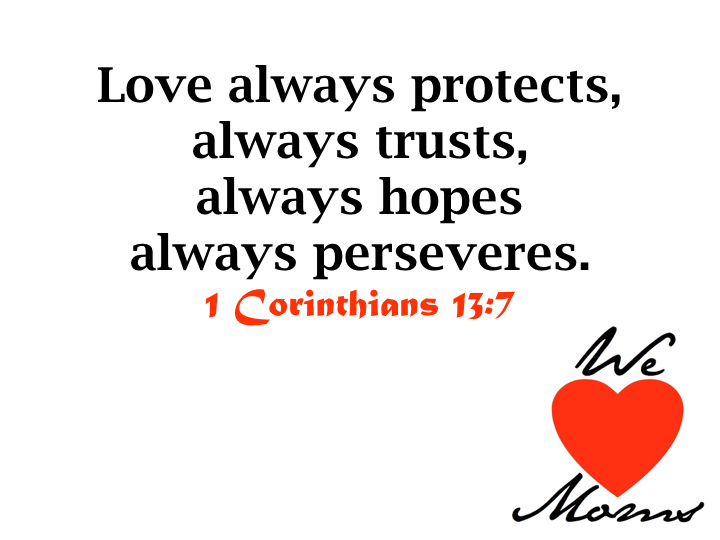
Mom, your love for us can be summed up in one verse—Love always protects, always trusts, always hopes, always perseveres. (1 Corinthians 13:7)

And the Apostle Paul’s words to a young preacher are just as true for Moms as they were for Timothy: Keep a close watch on how you live and on your teaching. Stay true to what is right for the sake of your own salvation and the salvation of those who hear you. (1 Timothy 4:16)

Don’t give up, Mom! You need to persevere so that when you have done the will of God, you will receive what He has promised. (Hebrews 10:36)

What has God promised you about your family? Has He said your whole family will call on Jesus as their Savior? Then persevere in that. Has He said that your prodigal child will come home? Then persevere in that. Despite the odds, despite the obstacles, despite the setbacks, keep on loving them and praying for them. It IS making a difference!

Here’s an encouraging biblical example of a little-known Mom’s prayerful influence on a son that is listed in the genealogy of Jesus Christ…

Keep persevering in prayer, Mom. Your prayers ARE making a difference!

Mom, We Remember You

I shared this with my congregation this morning…

MomsTo those who gave birth this year to their first child—we celebrate with you.

To those who lost a child this year—we mourn with you.

To those who are in the trenches with little ones every day and wear the badge of food stains—we appreciate you.

To those who experienced loss through miscarriage, failed adoptions, or running away—we mourn with you.

To those who walk the hard path of infertility, fraught with pokes, prods, tears, and disappointment—we walk with you. …

To those who are foster moms, mentor moms, and spiritual moms—we need you.

To those who have warm and close relationships with your children—we celebrate with you.

To those who have disappointment, heart ache, and distance with your children—we sit with you.

To those who lost their mothers this year—we grieve with you.

To those who experienced abuse at the hands of your own mother—we acknowledge your experience.

To those who lived through driving tests, medical tests, and the overall testing of motherhood—we are better for having you in our midst.

To those who are single and long to be married and mothering your own children—we mourn that life has not turned out the way you longed for it to be.

To those who step-parent—we walk with you on these complex paths.

To those who envisioned lavishing love on grandchildren, yet that dream is not to be—we grieve with you.

To those who will have emptier nests in the upcoming year—we grieve and we rejoice with you.

To those who placed children up for adoption—we commend you for your selflessness and remember how you hold that child in your heart.

To those who are pregnant with new life, both expected and surprising—we anticipate with you.

This Mother’s Day, we walk with you.

Mothering is not for the faint of heart and we have real warriors in our midst.

We remember you. —Amy Young

Poetry Saturday—The Loom Of Time

FullSizeRender 3Man’s life is laid in the loom of time
To a pattern he does not see,
While the Weaver’s work and the shuttles fly
Till the dawn of eternity.

Some shuttles are filled with silver threads
And some with threads of gold,
While often but the darker hues
Are all that they may hold.

But the Weaver watches with skillful eye
Each shuttle fly to and fro,
And sees the pattern so deftly wrought
As the loom moves sure and slow.

God surely planned the pattern:
Each thread, the dark and fair,
Is chosen by His master skill
And placed in the web with care.

He only knows its beauty,
And guides the shuttles which hold
The threads so unattractive,
As well as the threads of gold.

Not till each loom is silent,
And the shuttles cease to fly,
Shall God reveal the pattern
And explain the reason why.

The dark threads were as needful
In the Weaver’s skillful hand
As the threads of gold and silver
For the pattern which He planned. —Anonymous

We ♥︎ Moms


We Love MomsThis Sunday is Mothers Day, and I cannot wait to celebrate the special ladies in our church. Both the biological Moms and the spiritual Moms have definitely earned my respect and admiration!

I’m going to share a special message about the power that comes when Moms persevere in prayer and a godly example. These prayers with the feminine touch not only change our present, but have a lasting impact for generations to come. In fact, we owe much of our spiritual heritage to those Moms who faithfully prayed.

Please bring Mom with you to Calvary Assembly of God this Sunday!

Thursdays With Oswald—Stretched Like A Bow

Oswald ChambersThis is a weekly series with things I’m reading and pondering from Oswald Chambers. You can read the original seed thought here, or type “Thursdays With Oswald” in the search box to read more entries.

Stretched Like A Bow

     God takes the saints like a bow which He stretches and at a certain point the saint says, “I can’t stand any more,” but God does not heed, He goes on stretching because He is aiming at His mark, not ours, and the patience of the saints is that they “hang in” until God lets the arrow fly. … Remain spiritually tenacious.

From God’s Workmanship 

Endure hardship as discipline; God is treating you as His children. For what children are not disciplined by their father? If you are not disciplined—and everyone undergoes discipline—then you are not legitimate, not true sons and daughters at all. Moreover, we have all had human fathers who disciplined us and we respected them for it. How much more should we submit to the Father of spirits and live! They disciplined us for a little while as they thought best; but God disciplines us for our good, in order that we may share in His holiness. No discipline seems pleasant at the time, but painful. Later on, however, it produces a harvest of righteousness and peace for those who have been trained by it. (Hebrews 12:7-11)

My prayer is that we all remain spiritually tenacious until God lets the arrow of our life fly!

11 Quotes From “Answering Jihad”

Answering JihadAnswering Jihad by Nabeel Qureshi is an excellent resource to get clarity on all of the terms floating around about Islam, Muslims, and the use of jihad. You can read my full book review by clicking here.

Below are the first set of quotes from this book that I’d like to share with you. Unless otherwise noted, all the quotes are from Nabeel Qureshi.

“There is a great deal of violence in Islam, even in the very foundations of the faith, and it is not all defensive. Quite to the contrary, if the traditions about the prophet of Islam are in any way reliable, then Islam glorifies violent jihad arguably more than any other action a Muslim can take.”

“As Islam is practiced in a way that calls Muslims to return to its foundations, violence will follow.”

“Islam is not Muslims, and Muslims are not Islam. Though Muslims are adherents of Islam, and Islam is the worldview of Muslims, the two are not the same, as many uncritically believe. … Islam is not Muslims, and one can criticize Islam while affirming and loving Muslims.” 

“Islam was first called ‘the religion of peace’ as late as 1930, and the title of a book published In India. … The phrase was slow to take off, but by the 1970s it was appearing more and more frequently in the writings of Muslims for western audiences.” —Mark Durie, a research scholar of linguistics and Islam at Melbourne School of Theology, in an article for the Independent Journal

“The Quran never says, ‘Islam is the religion of peace,’ nor do the traditions of Muhammad.”

“To contend that the word Islam signifies peace in the absence of violence is incorrect. Islam signifies a peace after violence, or under the threat of it. According to Islamic tradition, that is how Muhammad himself used the word. His warning to neighboring tribes is famous: Aslim taslam, ‘If you surrender, you will have peace.’ It was a play on words, as aslim also connotes becoming Muslim: ‘If you convert, you will have safety through surrender.’”

“The vast majority of Muslims inherit their understanding of Islam and have not investigated the foundations of Islam for themselves. If they were raised in the West and taught that Islam is the religion of peace, as I was, then their first foray into the foundations might be somewhat of a shock, and they will probably soon find themselves either in a defensive position or grappling with significant cognitive dissonance.”

“Since there are thousands of verses in the Quran and hundreds of thousands of hadith, it is expected that only trained Muslim jurists can engage in determining what sharia teachers. The jurist must give primacy to the Quran, then consider the actions (sunnah) and sayings (hadith) of Muhammad, followed by reviewing the consensus of Islamic scholars, or ijma, before using his own reasoning (qiyas). By following these four steps, a Muslim jurist can make a decision, or fatwa, about what sharia teaches on a given matter. The ultimate goal is to apply the teachings of sharia to Muslim life, and that is called fiqh.”

“As is probably clear by now, at no point was the average Muslim expected to read the Quran to decide upon correct Islamic practices by himself or herself. Not only is Islam not a faith that upholds the sufficiency of scripture alone, the complexity of its foundations virtually necessitates a reliance on jurists and scholars for proper practice.”

“Islam was not in fact ‘spread by the sword’—conversion was not forced on the occupants of conquered territories—but the conquests created the necessary preconditions for the spread of Islam. With only a few exceptions… Islam has become the majority faith only in territories that were conquered by force. Thus, the conquests and the doctrine that motivated these conquests—jihad—were crucial to the development of Islam.” —David Cook

“I ask your pardon, but I really do feel that the Christian teaching of loving one’s enemies, even in the face of death, might perhaps be the most powerful answer to jihad at our disposal today. Not only does it allow us to counter jihad, it also enables us to treat Muslims with the utmost dignity: as image bearers of God.” 

Stay tuned for more quotes from Answering Jihad