Our Musical Testimony

Listen to the podcast of this post by clicking on the player below, and you can also subscribe on AppleSpotify, or Audible.  

As these songs of ascent are reminding us, we’re trying to ascend into God’s presence. But it seems like the forces pulling us back downward are so strong! The lyrics in the most popular songs are getting more and more raunchy, the blockbuster movies routinely celebrate sin, TV shows increasingly push a decidedly unbiblical agenda, government leaders are caught in scandals, and church leaders are “de-transitioning” from their Christian testimony. 

It doesn’t seem like there is much to celebrate. 

Just like the Jews who found themselves defeated and living in a foreign land, or fighting opposition to rebuild their way of life, or contending with occupying forces that were hostile to their religion, we, too, find ourselves in a very similar place—even in a country that was supposedly built on godly principles. 

The worldly-minded and irreligious have always tried to pull down the godly. When they do, it makes it hard to even worship God (Psalm 137:1-4). 

I’ve been reminding you that in Hebrew literature we can usually get our perspective from the middle of the story. So before we look at this next song of ascent, let’s look at the middle of the Jewish story—the middle of their time of exile, when things seemed darkest. 

Jeremiah wrote a book of Lamentations which was in the middle of the exile. In the middle of his tears and gall and bitterness he wrote this—

I remember my affliction and my wandering, the bitterness and the gall. I well remember them, and my soul is downcast within me. Yet this I call to mind and therefore I have hope: Because of the Lord’s great love we are not consumed, for His compassions never fail. They are new every morning; great is Your faithfulness. I say to myself, “The Lord is my portion; therefore I will wait for Him.” … I called on Your name, Lord, from the depths of the pit. You heard my plea: “Do not close your ears to my cry for relief.” You came near when I called You, and You said, “Do not fear.” (Lamentations 3:19-24, 55-57) 

Jeremiah said when he called God, He came near. He’s not saying that God had left him, but instead, Jeremiah is saying that he got his eyes off the ever-present God. As soon as he put his eyes back on God, he could feel His nearness. 

Our next song of ascent (Psalm 126) opens with the word “when.” This is a celebration of how God kept His word that the exiles would be released from Babylon and return to Jerusalem. As the Jews praised God for keeping His Word, then the surrounding nations saw and heard the testimony in the songs of joy that were being sung. 

God’s people were both singing for joy for God’s deliverance AND they were singing in joyful anticipation of what was still to come. 

They make a request in prayer for God to “restore our fortunes” (v. 4). This phrase always means that God is going to bring back everything that was taken away and then some. 

We have a promise two times in the next two verses that God will (not might) bring in these restored fortunes. In the midst of darkness or drought, it may seem hopeless to keep sowing seed. God sees your tears, and He will use your tears to water that seed and He will bring a harvest. 

The New Testament assures us of the same promise: “Let us not become weary in doing good, for at the proper time we will reap a harvest if we do not give up” (Galatians 6:9). 

We show our faith in God’s eternal victory by lifting up our voices in song today. That song is a testimony to the nations around us and an encouragement to other saints who may be struggling with weariness (see Ephesians 5:18-20). We keep on singing these songs of joy in anticipation of the final and eternal song we will sing in Heaven. 

God is near. He hears your sighs. He sees your tears. He is watering the seeds you are sowing, and He will bring a harvest. As you sow in tears, sow also with songs of joy! 

If you’ve missed any of the other messages in our Ascending series, you can find them all here. 

►► Would you please prayerfully consider supporting this ministry? My Patreon supporters get behind-the-scenes access to exclusive materials. ◀︎◀︎

His Love Endures Forever

Listen to the podcast of this post by clicking on the player below, and you can also subscribe on AppleSpotify, or Audible.

Psalm 136 calls on us to season absolutely every circumstance and every thought with a reminder to be thankful to God for His everlasting love for us. In the 28 verses of this psalm, we are reminded twenty-eight times that “His love endures forever.” 

At every instance we are reminded of God’s eternal attributes: His goodness and His kindness. And at every instance we are reminded to praise God for who He is. 

In creation, He reveals His goodness.

In difficult places, He reveals His goodness. 

In deliverance, He reveals His goodness.

In His miracles, He reveals His goodness.

In our celebration of His strength, He reveals His goodness.

In our confession of our weaknesses, He reveals His goodness.

In His daily provision, He reveals His goodness.

In keeping us close to Himself, He reveals His goodness.

In His eternal nature, He reveals His goodness.

In our thanks giving, we reveal His goodness to a searching world. 

Never, ever miss an opportunity to give God thanks for His ever-enduring love! 

►► Would you please prayerfully consider supporting this ministry? My Patreon supporters get behind-the-scenes access to exclusive materials. ◀︎◀︎

Ascending

Every year, Jews from around the world made four pilgrimages up to Jerusalem for various feasts and sacrifices. These journeys reminded them of God’s goodness as they went to the Temple to worship, and they helped refocus on God’s ways as they returned to their regular routines.

Jerusalem is over 2500 feet above sea level, so the pilgrimage there was a physical workout as well as a spiritual workout. These workouts were beneficial for God’s people, preparing them to minister in their cities in the following months.

The Book of Psalms contains 15 songs that these pilgrims would sing to and with each other as they traveled up to Jerusalem. These Psalms of Ascent are still instructive for Christians today.

Please join me for this look at the life-changing truths these pilgrimage songs can still teach today to all of God’s people. We would love to have you join us in person, but if you are unable to do so you can watch the videos of these messages on my YouTube channel.

Here’s what we have covered so far:

A Preview Of Heaven

Listen to the podcast of this post by clicking on the player below, and you can also subscribe on AppleSpotify, or Audible. 

When Mary visits Elizabeth, she discovers that Elizabeth is pregnant, just as the angel Gabriel told her. This confirms for Mary that everything Gabriel told her about her own pregnancy would be fulfilled too. 

At this, Mary bursts into a song that we now call the Magnificat: My soul glorifies the Lord and my spirit rejoices in God my Savior (Luke 1:46-47). 

Mary’s rejoicing was prompted by her deeper realization of who her Savior is. The more she knows her Lord, the more she can praise Him; the more she praises Him, the more He is glorified; the more He is glorified, the more she knows Him. 

So could we say it this way? As my spirit rejoices in God my Savior my soul glorifies Him. Yes, indeed we can! There seems to be an interconnectedness: As I focus on God to rejoice in Him, that rejoicing cannot help but glorify Him. 

So we could also say it this way: God is glorified in my rejoicing of Him. 

Or: As I express my delight in my Savior, His glory is seen more clearly. 

However we put it, when I rejoice in who God is, He is glorified. As He is glorified, my joy in rejoicing in Him is increased. As my joy in Him increases, I cannot help but rejoice in Him even more. 

This, I believe, is a picture of Heaven. Just as the angels encircle the throne and call out to one another, “Holy! Holy! Holy!” as they perpetually rejoice in a new realization of God’s glory, so will we. There are an infinite number of beauties in our Savior which will prompt us to rejoice in Him and glorify Him, so we need an infinite amount of time to fully appreciate His majestic beauty. 

Let’s not wait until we arrive in Heaven to begin this loving worship. Let’s follow the example of Mary and sing out our praise at every possible moment. As we do, a desperate world cannot help but be drawn to gaze upon the beauty which is celebrated in our rejoicing. 

►► Would you please prayerfully consider supporting this ministry? My Patreon supporters get behind-the-scenes access to exclusive materials. ◀︎◀︎

How To Honor Our King

Listen to the podcast of this post by clicking on the player below, and you can also subscribe on AppleSpotify, or Audible. 

Merry Christmas! 

When the Magi came to Jesus at His first advent they brought gifts. Isaiah also prophesies all peoples bringing gifts at the second advent of Jesus. Have you ever wondered what gift is appropriate for the King of kings? Fortunately, the Bible tells us the gift He is happy to receive from you! 

Check out the Bible verses I mention: 

If you’ve missed any of the messages in this Advent series, you can find a list of all of those messages by clicking here. 

►► Would you please prayerfully consider supporting this ministry? My Patreon supporters get behind-the-scenes access to exclusive materials. ◀︎◀︎

Links & Quotes

“But friendship is precious; not only in the shade, but in the sunshine of life.” —Thomas Jefferson

“People are just about as happy as they make up their minds to be.” —Abraham Lincoln

“Humility is the foundation of all the other virtues hence, in the soul in which this virtue does not exist there cannot be any other virtue.” —Augustine

When you praise God, despite your surroundings, you magnify Him. And when you magnify God, you invite others to magnify Him with you!

“Manhood first and then gentleness.” —Ralph Waldo Emerson

I have blogged quite a bit about the historicity of the Bible. The Bible Archeology Report has a very informative post of the top 10 historical references to Jesus outside the Bible. These sources are from the first or second century AD, and specifically mention Jesus of Nazareth, not just Christians.

Dan Reiland wrote, “Church leadership always carries with it seasons of success and setbacks, momentum and grind, joy and discouragement. Yet, we all do better through those seasons when we have learned the rhythms of resilience—the lifelines we need.” Check out the 6 sustaining lifelines for leaders that he shared.

The Institute for Creation Research reported, “Two separate studies claim massive tsunamis and earthquakes from an asteroid impact profoundly affected the rock record. … [Yet] these global phenomena are better explained by the global Flood described in Genesis.”

“Anger makes dull men witty, but it keeps them poor.” —Francis Bacon

Grateful For What You Have

Listen to the podcast of this post by clicking on the player below, and you can also subscribe on AppleSpotify, or Audible. 

We said last week that nobody likes to be around a complainer, although many complainers would say they’re not complaining but just sharing facts. In their mind, they have a legitimate right to let everyone know how they’ve been short-changed, gotten a bad deal, or experienced something that no one else has gone through.    

Have you ever heard your kids say, “I’m starving”? And perhaps you think, “Do you really know what starving is?” Or what about people waving their very expensive phones around as they complain, “Isn’t there any WiFi here?!” 

This isn’t a glass half-full or half-empty thing. This is really closing your eyes to the fact that many people don’t even have a glass, or if they do have a glass, they don’t have access to the water that they need. 

I was delivering some Christmas toys to a family and I discovered they had lost everything they owned. When I came to their house their furniture was mismatched, their food and clothes were donated, and their kids only had a couple of simple toys to play with. And yet this family was happy to be together! 

That sort of puts things in perspective, doesn’t it? 

We have to choose grumbling or gratefulness, but as E.M. Bounds noted, “Gratitude and murmuring never abide in the same heart at the same time.” So if you are complaining about what you don’t have, you cannot be grateful for what you do have. 

There is a fascinating story told in all four Gospels of a woman named Mary. She was an uninvited guest at a house where Jesus and His disciples had been invited to dinner. Jesus was not there because someone was grateful to have Him in his home, but because Simon the Pharisee and his cronies were trying to find a reason to accuse Jesus of wrongdoing. 

Simon was so focused on his “gotcha” moment that he completely overlooked his host duties. He didn’t wash Jesus’ feet, nor greet Him with a kiss, nor anoint Him with perfume, as the custom of the day demanded. But Mary, standing behind Jesus at the dinner table, washed Jesus’ feet with her tears, kissed His feet, and anointed Him with an entire bottle of costly perfume! She did all of this out of gratitude for what she had received from Jesus. 

First, I would like you to consider what Mary didn’t have:

  • a seat at the table—even though the dinner was in her hometown of Bethany, her brother Lazarus was invited to the meal, and her sister Martha was serving the meal 
  • a good reputation—twice Simon the Pharisee said, “Does Jesus even know what kind of woman she is? Does He know she is a sinner?” 
  • the acceptance or approval of others—even the disciples thought her gesture of anointing Jesus with so much perfume was a wasted extravagance 

Next, let’s look at what Simon did have:

  • an elevated position as a Pharisee 
  • considerable wealth—he had servants and a home large enough for a big dinner party 
  • healing from leprosy—the Gospels refer to him as “Simon the leper” which tells us that he had been healed of his leprosy 

Now, let’s consider what the disciples did have:

  • an enviable position as disciples of Jesus
  • a dinner invitation to Simon’s house
  • access to the financial resources that people gave to Christ’s ministry
  • and let us never overlook the fact that they had access to Jesus Himself like no one else had

Finally, let’s look at what Mary did have:

  • forgiveness—Luke says this about her, “A woman who HAD lived a sinful life” 

Gratitude is truly a great attitude. Grateful people stand out because they don’t grumble about what they don’t have, but they are focused on what they do have.  

Mary knew that she didn’t have the outward marks of success or favor or approval, but she did have the assurance that she had been forgiven. For that, she was more than willing to give everything she had to Jesus in thankful worship! 

And as a result, look what Mary now has:

  • the kind words of Jesus—He assured her that she was forgiven (Luke 7:47)
  • Jesus as her defender—He told His disciples, “Leave her alone” (John 12:7)
  • an eternal testimony—Jesus said that wherever the Gospel was preached, people would tell Mary’s story (Matthew 26:13) 

I think a good way to sum up the distinguishing way grateful people live is like this: They don’t grumble about what they don’t have, but they are extremely grateful for what they do have. 

When you find grumbling slipping out of your mouth, remind yourself of just how much you have been given. Even if you think to yourself, “I don’t have much,” you can be assured that you have Jesus, and He is more than enough! And with that assurance, let your gratitude be lifted up in extravagant, fragrant praise to God. 

If you’ve missed any of the messages in our series The Great Attitude of Gratitude, you can find the full list by clicking here. 

►► Would you please prayerfully consider supporting this ministry? My Patreon supporters get behind-the-scenes access to exclusive materials. ◀︎◀︎

Magnifying God

Listen to the podcast of this post by clicking on the player below, and you can also subscribe on AppleSpotify, or Audible.

No one likes to be around a complainer! 

Complainers, ironically, find things wrong everywhere else but with themselves. Complainers know how everyone else should raise their kids, run their businesses, operate their government, lead their sports teams to victory, but they seldom apply their so-called wisdom to their own lives. Complainers find the one thing that’s wrong in an otherwise perfect situation.   

Complaining is easy because it comes so naturally. What do I mean by that? Take a look at the magazine covers at your grocery store—do they have good news or complaints? Take a look at the lead news stories—are they celebrations or complaints? Those magazines want to sell copies. Those news stations want viewers. Those websites want clicks. They wouldn’t promote the complaints if they didn’t get them the attention (and the advertising revenue) they desire! 

Let me see a show of hands on this: How many of you want to be around complainers? 

I noticed no one raised their hand, so I need to ask a follow-up question: Why do you complain? If you don’t like to be around a complainer, why do you do what others obviously don’t like either? 

I think we complain because we think our situation is unique—no one has experienced anything quite like what we’re going through. We often make a list to “prove” to everyone that we have earned the right to complain. This is what Job did. Check out his list in Job 7:1-11, and then notice his conclusion where he says, “Therefore I will not keep silent; I will speak out in the anguish of my spirit, I will complain in the bitterness of my soul.” 

But we need to be careful because the Bible makes it clear that complainers make God angry (see Numbers 11:1; 1 Corinthians 10:10-11). Why? I think there are two reasons. 

First, I think God gets angry about complaints because of how quickly they spread to everyone around them—like cancer cells they destroy the whole body. 

Second, complainers take everyone’s eyes off God and point their attention to the lousy situation about which they are complaining. 

On the other hand, grateful people stand out because they can find the one thing worthwhile in an otherwise lousy situation. Being a grateful person takes discipline to overcome the downward pull of everyone else’s complaints. 

Paul wrote a letter to the church at Philippi that is bursting with thankfulness! We only have to get three verses in when he says, “I thank my God every time I remember you” (Philippians 1:3). 

Paul stood out because of his great attitude of gratitude. Consider what happened the very first time he visited the city of Philippi. He and Silas were wrongly accused, beaten, and locked in prison. Paul didn’t start a petition, he didn’t give the jailer a bad review on Yelp, he didn’t organize a rally, he didn’t call the Roman governor. Instead, Paul and Silas were praying and singing hymns to God while the other prisoners listened in (Acts 16:16-25). 

In a lousy, unfair, dark situation, Gratitude says, “God is still God, and He is still worthy of abundant praise!” 

So in the middle of his letter to the Philippians, Paul instructs these Christians to: Do all things without murmurings and disputings (Philippians 2:14 KJV). Murmurings are the vocalizing of the faults we have found. Disputings, though, are internal. In the Greek, this word almost always refers to complaining and grumbling thoughts, and many times it’s translated as “evil thoughts.” 

When the complaining comes out of our mouths, that is just the ugly weed. The root of that complaint is in our hearts. We don’t need a vocabulary change, we need a heart change. 

When we praise God, we magnify Him. That doesn’t make God bigger because He is infinite. But it does put a “telescope” on Him. Telescopes bypass everything that is close by and focus on something majestic. Our praise—like Paul and Silas’ song from prison—invites others to look through our telescope to see the God we are magnifying. 

Gratitude can start with one person, and then it can spread. Gratitude can counteract the cancerous complaints. Will you be that one grateful person at this Thanksgiving season and beyond? Will you be the one that says, “No matter what, God is still God, and He is still worthy of abundant praise”? Will you be that one that sings praise at the exact moment everyone else expects complaints? If you do, your gratitude will entice others to want to worship this all-good God too! 

Follow along with all of the messages in our series called The Great Attitude Of Gratitude by clicking here. 

►► Would you please prayerfully consider supporting this ministry? My Patreon supporters get behind-the-scenes access to exclusive materials. ◀︎◀︎

Thursdays With Spurgeon—Bragging About God

This is a weekly series with things I’m reading and pondering from Charles Spurgeon. You can read the original seed thought here, or type “Thursdays With Spurgeon” in the search box to read more entries.

Listen to the podcast of this post by clicking on the player below, and you can also subscribe on AppleSpotify, or Audible. 

Bragging About God

I will extol the Lord at all times; His praise will always be on my lips. I will glory in the Lord; let the afflicted hear and rejoice. Glorify the Lord with me; let us exalt His name together. (Psalm 34:1-3)

     Boasting is a very natural propensity, and if it were used as in this case, the more it were indulged the better. The exultation of this verse is no mere tongue bragging; the soul is in it, and the boasting is meant and felt before it is expressed. 

     What scope there is for holy boasting in Jehovah! His Person, attributes, covenant, promises, works, and a thousand things besides are all incomparable, unparalleled, matchless; we may cry them up as we please, but we shall never be convicted of vain and empty speech in so doing.

From Spurgeon And The Psalms

What is even more remarkable about the praise David offers up in this psalm is the setting. The introduction to the psalm tells us it is while David is running from Saul and trapped in a Philistine stronghold. 

And yet David still chooses to praise God.

It is a choice of his will. David didn’t wait until he felt like praising God, or until his circumstances were improved. We are more likely to act ourselves into feeling than we are to feel ourselves into action. So David says, “I will extol the Lord … His praise will be on my lips.” 

This bragging about God—when from a human standpoint there appears to be nothing to brag about—becomes a testimony. David’s personal pronouns “I” and “my” quickly turn into the plural pronoun “us” as David invites others to ponder the beauty of Jehovah! “Glorify the Lord with me; let us exalt His name together. 

Our bragging about God, especially in the face of difficult circumstances, is a powerful testimony that will draw others to Him. You may start out praising Him on your own, but it won’t be long until others join your worship chorus. 

Friends, your praising and bragging about God is more powerful than you may realize. When God is worshipped, He is lifted up for all to see, so keep on bragging about Him!

►► Would you please prayerfully consider supporting this ministry? My Patreon supporters get behind-the-scenes access to exclusive materials. ◀︎◀︎

Thursdays With Spurgeon—New Songs Everyday

This is a weekly series with things I’m reading and pondering from Charles Spurgeon. You can read the original seed thought here, or type “Thursdays With Spurgeon” in the search box to read more entries.

Listen to the podcast of this post by clicking on the player below, and you can also subscribe on AppleSpotify, or Audible. 

New Songs Everyday

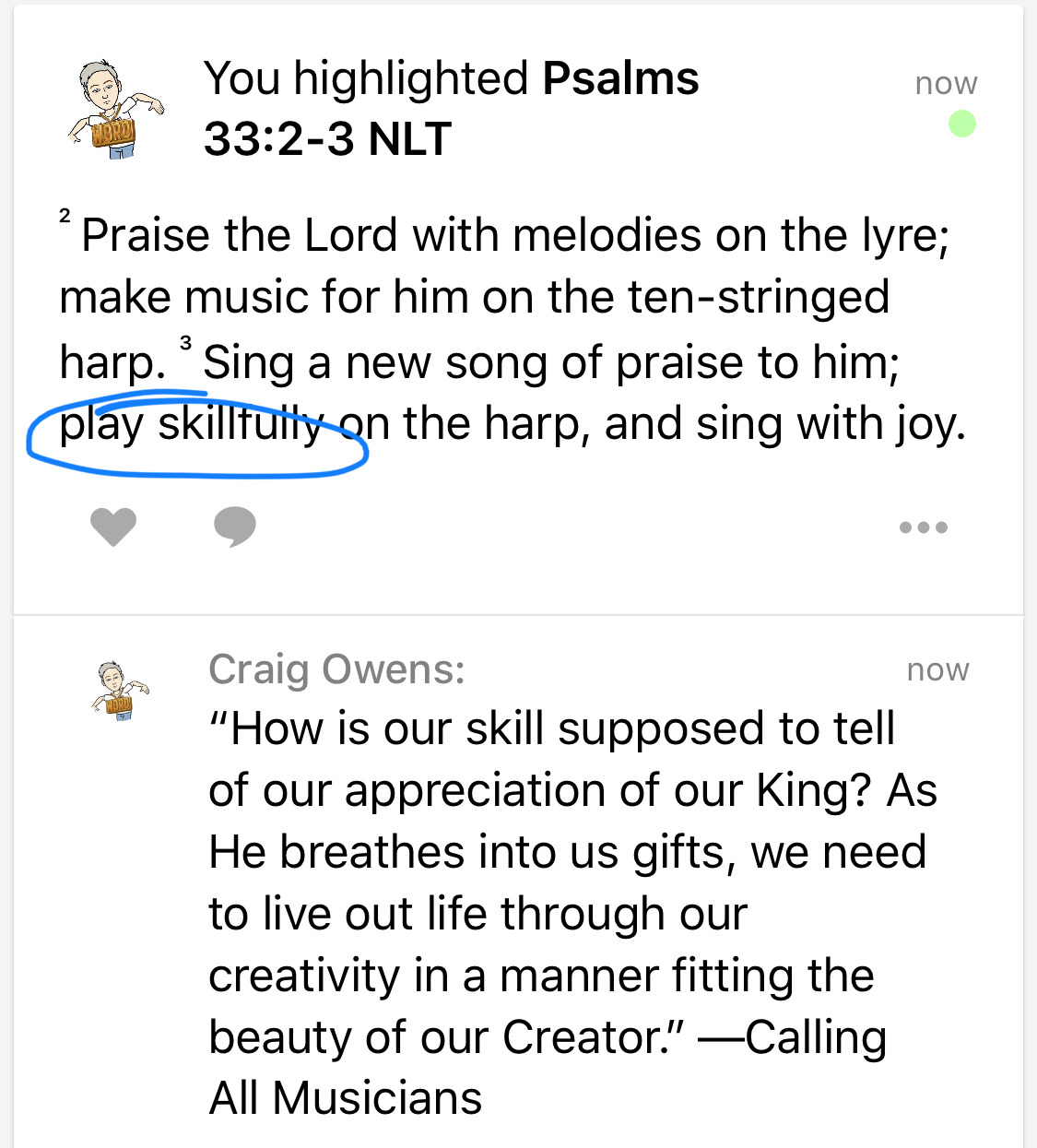
Sing joyfully to the Lord, you righteous; it is fitting for the upright to praise Him. Praise the Lord with the harp; make music to Him on the ten-stringed lyre. Sing to Him a new song; play skillfully, and shout for joy. (Psalm 33:1-3)

     To keep up the freshness of worship is a great thing, and in private, it is indispensable. Let us not present old, worn-out praise but put life and soul and heart into every song, since we have new mercies everyday and see new beauties in the work and Word of our Lord. 

     It is wretched to hear God praised in a slovenly manner. He deserves the best we have. All Christians should endeavor to sing according to the rules of the art so that they may keep time in tune with the congregation. The sweetest tunes, and the sweetest voices, with the sweetest words, are all too little for the Lord our God; let us not offer Him limping rhymes, set to harsh tunes, and growled out by discordant voices.

From Spurgeon And The Psalms

Imagine if I told my wife something like this—

Every Thursday night is going to be our date night. I’m going to plan something special, dress up in some nice clothes, and be totally tuned in to your needs. I’m going to listen to everything you have to say to me, express my unending love to you, ask forgiveness for areas I may have messed up that week, and then endeavor to put into practice everything you tell me that you would like. 

I promise I’ll be there every Thursday. 

The other days of the week, I’ll think about you every once in a while—especially if I need something—but other than that I’ll be doing my own thing. 

How rich and meaningful would you expect that relationship to be? 

Sadly, this is how many people who call themselves Christians view their relationship with Jesus. They put on nice clothes every Sunday, show up at church, sing some songs, listen to a sermon, repent of sins, and promise to live a better life in this new week. But after they leave their church service, they seldom give their Savior another thought—unless they get themselves into trouble where they really need a Savior’s immediate help. 

In Psalm 33, the psalmist is calling us to—as Spurgeon puts it—“freshness in worship” not just in a public worship service, but in private worship at every moment of every day. Our God is continually revealing Himself to us in new and fresh ways, so our worship should be equally as fresh, vibrant, and passionate—both planned times of worship and spontaneous songs of praise. 

Both our relationship with God and with our loved ones will go to new levels of intimacy when we seek to know the other one more deeply. Our God is worthy of the very best praise we can give Him, which means we will always be finding new ways to sing our worship to Him every single day.

►► Would you please prayerfully consider supporting this ministry? My Patreon supporters get behind-the-scenes access to exclusive materials. ◀︎◀︎