The Role Of Prophecy

Micah may be classified as a minor prophet, but the prophecies in his book are fulfilled in a major way in as little as 20 years and as far out as 2700+ years! 

Here’s a question for us to consider: What exactly is the role of prophecy in the life of a Christian? 

Micah introduces himself in the opening verse. He was ministering in the country while Isaiah was in the city of Jerusalem at the same time. Micah’s ministry spans three kings of Judah in the south, and he overlaps the defeat of Israel in the north.  

Check out some of Micah’s most notable prophecies: 

  1. Judgment is coming to Samaria/Israel (1:6-7). This was fulfilled about 20 years later when the Assyrians defeated Samaria and took the Israelites into exile. 
  2. Judgment is coming on southern Judah (1:9-16). This was fulfilled about 30 years later when Sennacherib attacked Philistia and southern Judah, coming “even to the gate of Jerusalem” (v. 12). At the gate of Jerusalem was the miraculous deliverance God gave during Hezekiah’s reign (see 2 Kings 18-19; Isaiah 37). 
  3. Judgment is coming on Jerusalem (3:12). Micah even prophesied the Babylonians would defeat them (4:10). This is noteworthy because Assyria was the dominant world power at this time; it would be another 100 years before Babylon would even begin to rise to power. This prophecy was fulfilled about 160 years later, and this prophecy actually saved Jeremiah’s life around that same time (Jeremiah 26:7-19). 
  4. The Messiah will be born in Bethlehem (5:2). This prophecy was fulfilled about 700 years later when Jesus was born (Matthew 2:5-6). 
  5. How people will respond to the Messiah’s Advent (7:4-6). This prophecy was partially fulfilled 700 years later in a direct quotation from Jesus (Matthew 10:34-36). 
  6. The coming of the final Kingdom of God (4:1-3). This prophecy will be fulfilled at Christ’s second Advent. 

[you can read all of these prophecies yourself by clicking here] 

So what is the role of prophecy? 

First of all, fulfilled prophecy reminds us that God is sovereignly in control of everything (Isaiah 46:10). But right on the heels of that, fulfilled prophecy reminds us that there is still more prophecy left to be fulfilled (2 Peter 1:20-2:3). 

The Bible tells me that when I sin, God’s first response is not anger toward me but broken-hearted grief. In a similar fashion, the prophecies of coming judgment on sinners are intended to show us the incredible mercy of God in the forgiveness of sin that He made available (Micah 7:18-20). 

Prophecy is never, never to be used as a club to beat people into submission to God. When Micah prophesied the destruction of Israel and Judah, he wept (Micah 1:8). 

So did Jesus (Matthew 23:37). 

And so should we! 

We live in an age today—as Micah experienced and as the apostle Peter said would be coming—where people won’t want to hear the news that unforgiven sin brings God’s judgment. Our response to this should be brokenhearted grief, tears, and a steadfast commitment to speak the truth in love that Jesus has provided the only means to be rescued from that judgment. 

If you’ve missed any of the other posts in this series on the major lessons from the minor prophets, you can access the full list by clicking here.

Assyrian Kings Involved With Israel

A helpful Bible study tool—

Assyrian Kings Involved With Israel

  • Shalmaneser III (858-824 BC)—2 Kings 17:3-4
  • Adad-Nirari III (810-782 BC)—took tribute from Israel; king during Jonah’s visit (Jonah 3) 
  • Tiglath-Pileser III (745-727 BC)—deported most of the northern part of Israel 
  • Shalmaneser V (727-722 BC)—besieged Samaria (2 Kings 18:9) 
  • Sargon II (721-705 BC)—deported the rest of Israel (Isaiah 20) 
  • Sennacherib (704-681 BC)—invaded Judah (Isaiah 36) 
  • Esar-Haddon (681-669 BC)—very powerful king 
  • Ashurbanipal (668-626 BC)—most powerful and brutal Assyrian king 

Two weak kings followed (626-607 BC), and Assyria fell in 605 BC. 

Source: Halley’s Study Bible 

You may also want to check out my chart of the kings and prophets of the divided kingdom of Judah and Israel.

History Matters

The minor prophets cover a span of about 300 years, from 760-450 BC, and Jonah appears right in the middle of that. Jonah overlaps Amos and Hosea in northern Israel, and he finishes his ministry just before Isaiah’s ministry begins in southern Judah. 

Jonah is the only narrative in the minor prophets. He was a prophet during the reign of Jeroboam II when Israel was temporarily growing in strength. He is the first of Israel’s prophets to be sent to a non-Jewish population. 

Critics have raised questions about this book. Questions like: Did Jonah write this book himself or is it just a story about him? Is this book historical or allegorical? 

The five biggest objections that are raised to Jonah’s historicity are: 

  1. The hyper-nationalistic feel is more like when Ezra and Nehemiah led people back to Jerusalem after their captivity in Babylon, and not during the time of Jeroboam II. 
  2. Parts of Jonah appear copied from the prophet Joel. 
  3. There are no (or incorrect) details about the major city of Nineveh that Jonah visited. 
  4. There are no extra-biblical historical records of a revival in Nineveh. 
  5. Jonah was swallowed by a fish?! 

I think there are very good reasons to believe that Jonah was both autobiographical and historically accurate. 

First, there was a revival of sorts (although not religiously) in Israel during the time of Jeroboam II. This was a time that Israel felt like it could flex its muscles again, so Jonah would not be acting out of character to be so pro-Israel. 

Second, Jonah 3:9 and Joel 2:14 sound similar, but scholars cannot tell which was written first. Couldn’t God amplify a message? Consider how many parts of the Gospel of Mark are used in the Gospels of Matthew and Luke. And it’s a regular practice for authors even today to directly quote other sources. 

Third, regarding the lack of details about Nineveh, the biblical writers give very few details of any places outside of Israel or Judah. The only “incorrect” detail skeptics point to is Jonah 3:3 stating that the city was so big that it would take three days to walk around it. Nineveh was a city of about 120,000 inhabitants, so it could easily take three days of walking and preaching in order to get the message to everyone. 

Fourth, the revival in Nineveh was clearly short-lived. Jonah was probably in Nineveh around 760 BC. Assyria was rising politically and militarily during that time and defeated Israel just 40 years after Jonah’s preaching. Assyria itself was then defeated in 605 BC. 

Finally, Jonah was swallowed by a fish?! The root word for fish in Hebrew means something that has grown to such an enormous size that it overshadows everything else. But notice that what caused the sailors to be in awe of God was not the whale/fish swallowing Jonah, but the immediate calming of the ocean when Jonah was thrown overboard (Jonah 1:15-16). Miracles appear throughout this book. And throughout the entire Bible! 

Why should the appearance of miracles surprise us? Some people have a bias against the supernatural, where they wrongly believe that we can know everything through naturalistic means. C.S. Lewis pointed out, “I use the word Miracle to mean an interference with Nature by supernatural power. … Nature as a whole is herself one huge result of the Supernatural: God created her.” 

I don’t think this story is a parable or an allegory because nowhere else in the Bible are such details given in the form of a parable. 

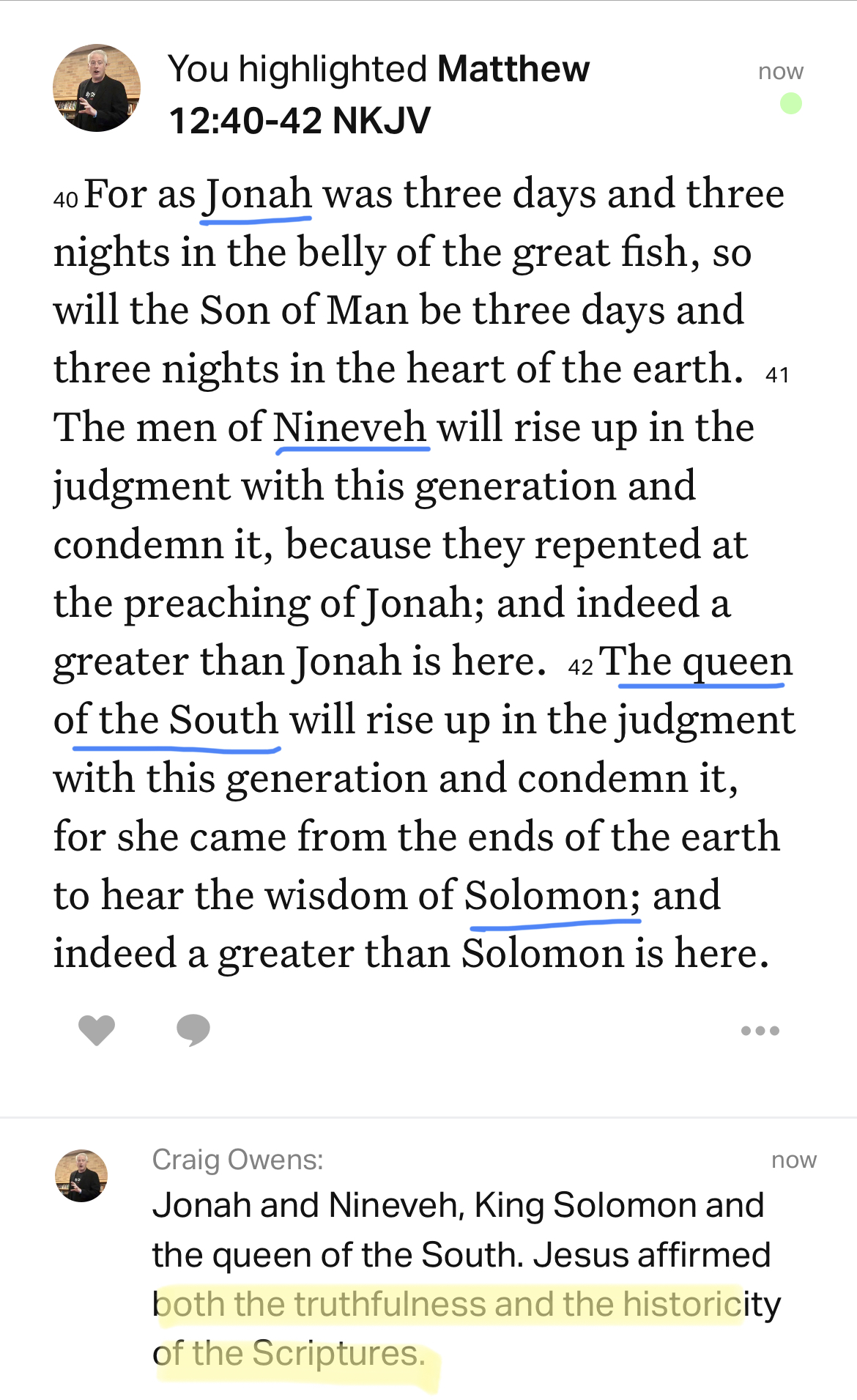
I believe this story is historical because Jesus talked about the historicity of Jonah in the same breath as He talked about other historical people: the Queen of the South and Solomon (Matthew 12:38-42). Jesus clearly viewed Jonah as historically reliable and accurate. To call Jonah into question is to call into question the truthfulness of Jesus Himself! 

History matters because all of History is God’s story! 

Our belief in the message of the Bible is not based upon “once upon a time” or “a long time ago in a galaxy far, far away.” It’s based upon real people in real places, especially the historicity of Jesus (notice all of the historical details Luke lists in the birth account of Jesus). 

Jonah was clearly one of those historical people, in an historic place, and at a precise moment in world history that tells the story of Jesus and our redemption which He purchased! 

If you want to check out all of the messages in our series on the major lessons from the minor prophets, you can find that list by clicking here.

Halley’s Study Bible (book review)

I believe Halley’s Bible Handbook may have been the first Bible study resource I got my hands on when I was a pre-teen. It was a slender book but packed with insights that even this third-generation Pentecostal boy hadn’t heard before. So I was quite intrigued when I heard about Halley’s Study Bible. 

Let me get something out of the way right upfront. I’m a blogger for the BibleGateway Blogger Grid (sometimes called #bgbg2 on Twitter), so I’m occasionally offered a free book in exchange for my honest book review. However, there are more books that I pass on than books I agree to review. Since I am already working my way through the Faithlife Illustrated Study Bible, I wasn’t too eager to dive into another study Bible just yet. But I’m so glad I did! 

Reading Henry Halley’s concise overview of each book of the Bible was nostalgic for me, reminding me of what initially intrigued about his handbook: taking voluminous information and giving such a clear, concise overview. 

The study notes on each page offer fascinating insights, and the unique perspective Halley offers of the people, places, and practices chronicled in the pages of Scripture are unparalleled. And what I especially appreciate is Halley’s whole-Bible approach. By that, I mean his ability to show you a theme that originates in the Old Testament and finds its fulfillment in the New Testament, showing how all of the Bible is interconnected. 

If you are looking for a new way to study your Bible, I highly recommend Halley’s Study Bible to you. 

I am a HarperCollins book reviewer. 

How Long Will This Last?

Chaos is all around us! There’s infighting both politically and religiously. Government officials are imposing new laws and regulations and restrictions. Lots of rival voices are clamoring to be heard. Loss of personal freedoms, civil liberties, and even the freedom of worship. Uncertainty about the future. Fear in the present. 

Although this may sound like current conditions in the USA, I’m actually describing life in Israel around 31 BC. 

The people of Israel were frustrated beyond words with the restrictions they faced. They thought they were living in their land and that they should be able to govern themselves as they saw best. 

Have you ever been in that place of utter frustration? Are you there now? “What’s happening? Why is this not going according to plan? Isn’t there anything I can do? How long is this going to last? God, where are You in all of this?!” 

We humans like to think we are in control. Or at least we like to think that we know God’s timetable. Throughout the Bible—and still today—the questions persist: 

  • How long will this last? 
  • When will this take place? 
  • What about him? 
  • Is this the right time? 

(see Psalm 13:1-2; Matthew 24:3; John 21:21; Acts 1:6; Revelation 6:9-10) 

When we ask God, “How long?” He never answers us by pointing to the calendar or the clock, but He points us to principles in His Word.

Here are four principles that we need to ask the Holy Spirit to help us grasp: 

  1. God’s timing was determined before Time even started. 
  2. God is using this “How long?” time to perfect us for His service.
  3. God is using this “How long?” time to empower us to point others to Him.
  4. God is calling us to trust Him alone during our “How long?” times. 

(see Psalm 90:2; Isaiah 46:10; Psalm 13:5-6; Romans 5:3-4; Matthew 24:13-14; Acts 1:7-8; John 21:21) 

Those Israelites I described earlier were so frustrated with asking “How long?” and apparently getting no answer, that they frequently took matters into their own hands. This never turned out well for them. But God’s perfect timing was heading toward His perfect fulfillment.  

We may not perceive it, but God IS doing more than we will ever know during our “How long?” times. 

God’s perfect timing for His people couldn’t be until Caesar Augustus came on the scene and brought an end to the political uncertainty that kept everything in chaos. Nearly 30 years before Jesus was to be born in Bethlehem, Augustus was launching the pax Romana—the peace of Rome—all over the world. Pax Romana was creating the perfect environment in which Jesus could be born and minister, as well in which His followers could then take the Good News all over the world. 

Jesus was born “in the fullness of time” (Galatians 4:4), around 5 BC, in a land where a Jordanian king (Herod the Great) served an Italian emperor (Caesar Augustus) to a people frustrated with waiting. But God knew exactly when and where and how to send His Son to be our Savior!

So, my friends—Trust God in the “How long?” times! 

God’s perfect plan includes YOU, so guard against any anxious thoughts that would make you bail out of His perfectly-timed plan early. (see Psalm 139:16, 23-24)

Join me this Sunday as we continue our series called Where’s God? 

All Of HIStory Is His Story

There were the kings who reigned in Edom before any Israelite king reigned (Genesis 36:31). 

When Rebecca was pregnant with twins, they jostled each other in her womb. God said this was an indication of what was to come of the two nations that would arise from her sons. God also said that the older son would serve the younger son (25:23).

The nation of Edom was a fierce but unstable people. Just take a look at the succession of their kings to see the power struggles at every transition. But eventually, King Saul would war against Edom, and King David would subjugate them—making the prophecy true that the older son served the younger son.

What went into the fulfillment of this prophecy?

  • Esau (also known as Edom) short-sightedly sold his birthright
  • Jacob and Rebecca conspired to get Isaac to bless Jacob instead of Esau
  • Esau married Canaanite wives, which disappointed his parents and strained relations with them
  • God blessed both Esau and Jacob so that Esau had to move to the region that would eventually bear his name: Edom

Along the way, Esau had a son with his Canaanite wife named Eliphaz. Eliphaz had a child with a concubine named Timna—a son that grew into one of Israel’s most deadly foes: the Amalekites!

Yet all of this was foreseen by God and fulfilled His pre-ordained plan. Once again: All of History is His story. There is never any need for us to worry about turmoil—political or otherwise—because God is in sovereign control… always! 

(By the way, this is not an isolated incident. There are countless examples in the Bible of how God’s sovereign plan is fulfilled, despite man’s best efforts to derail it. Check out another example here.) 

What Is The Church Supposed To Look Like?

If someone asked you what a church is supposed to look like, do you describe steeples and crosses, stained glass windows and big wooden pulpits?

Guess what? The first Church in Jerusalem had none of those things!

Luke the historian describes the church this way: “They studied and prayed together, they ate with each other, they fed the hungry, and they took care of the poor. God performed miracles through them, everyone thought well of them, and people were getting saved every single day” (see Acts 2:42-47). Other historians of the day noted that Christians started the first orphanages, the first feeding programs, the first homes/schools for the blind, and the first medical dispensaries. They described how the Christians changed the cultural understanding of marriage and family, and how they gave dignity to women, children, the elderly, and the sick. 

They did this by putting their faith into action, just as Jesus described (see Matthew 25:31-40). James reminds us that this required a deeply personal faith and a roll-up-your-sleeves attitude. In fact, James went so far as to say that faith in Jesus wasn’t enough. 

Faith without works is dead. Works without faith is useless. We must believe it and live it. We need both faith and works.

Everyone can do this… 

  • if a young kid is hungry, get involved with feeding them
  • if an elderly lady in your neighborhood needs a friend, stop by for coffee
  • if a neighbor is sick and can’t cover their usual tasks, mow their lawn 
  • if a high school student can’t go to homecoming because she can’t afford the dress, take her shopping and buy the dress for her
  • if someone has an extended hospital stay, collect their mail and water their plants
  • if no one is visiting them in the hospital, go sit with them for a while

Jesus said, “When you do this for others, you are really doing it for Me.” 

Luke didn’t say, “Every day the Christians were preaching.” He says, “Every day the Christians were serving. And then every day God was adding to their number people who were being saved.” 

Your faith in action speaks a sermon louder and more convincingly than any sermon ever could. 

How will you show your neighbors the love of Jesus this week?

What Are You Doing With God’s Story?

…You could have no power at all against Me unless it had been given you from above… (John 19:11)

As Daniel says, “The Most High is sovereign over all the kingdoms of the earth, and He gives them to whom He pleases.” 

God is sovereign. All of History is His story!

Pilate tried to change the story—twice he said, “I find no fault in Him” (vv. 4, 6). But still his caving in to the chief priests fulfilled His story.

The soldiers were looking for personal gain (v. 24), and yet their greed unwittingly fulfilled His story.

Jesus knew what was happening, and purposely let people treat Him a certain way to fulfill His story (vv. 28-30, 36-37). 

God is still telling His story today.

The question is—am I willfully fighting against it (like Pilate), or ignorantly fulfilling it (like the soldiers), or obediently submitting to it (like Jesus)?

Passion Timeline

As we approach Christ’s Passion Week, I think it’s a good time to slow down and remember all of the events that took place during a very short time. 

The Faithlife Illustrated Study Bible has an excellent infographic on the timeline of these events. You can click on the image above to access a larger view, or you can check it out on the website. 

I also invite you to join me at Calvary Assembly of God as we are taking a slow walk on Christ’s Passionate Journey toward the Cross and the empty tomb. We’re spending one week looking at each of the 8 days of His Passion Week. If you cannot join us in person, please check out our Facebook Live broadcast.

Jesus Through Middle Eastern Eyes (book review)

Taking a journey with a tour guide who knows the terrain and the customs is always so much more rewarding than simply following the directions of some far-removed travel agent. In journeying through the four Gospels of the New Testament, a premier tour guide is close by in Kenneth Bailey and his book Jesus Through Middle Eastern Eyes. 

All of us bring our own paradigms with us wherever we go. There is a certain way we see the world, and everything gets processed through those lenses. My natural bias, when I pick up the New Testament is to read it through my lenses of a 21st-century American. But Jesus lived in a specific time and place in world history. He lived as a Jewish man in Israel during the time the Roman Empire held sway over world affairs. 

If I try to read about a 1st-century Eastern world through 21st-century Western eyes, I will be missing so much of the richness. Kenneth Bailey lived and taught and was immersed in the middle eastern culture for decades. So with his western understandings and middle-eastern insights, he treats us to vistas of Scripture that I hadn’t seen before. 

Bailey is a first-rate scholar, but by no means is this book an academic study. On the contrary, Bailey’s scholarship will make the accounts of the life of Jesus come to life before your eyes! You will be noticing nuances and insights that you probably missed in all your previous readings. 

If you want to experience the Gospels in a new, exciting way, I cannot recommend strongly enough that you take Jesus Through Middle Eastern Eyes along with you for the journey!