The Change From “Why?” To Worship

Listen to the podcast of this post by clicking on the player below, and you can also subscribe on AppleSpotify, or Audible.

On this episode of The Podcast, let’s talk about seeing something brighter in the darkest of times. 

Check out all of the Scriptures I reference in this video here. 

You may seem some glimmers of light in your dark place—like Paul did in the Roman prison—but even if you don’t see anything but darkness, make the choice to worship. I need to remind myself that God has a plan for my life and that He is working out all the details for my good and to bring glory to Himself. 

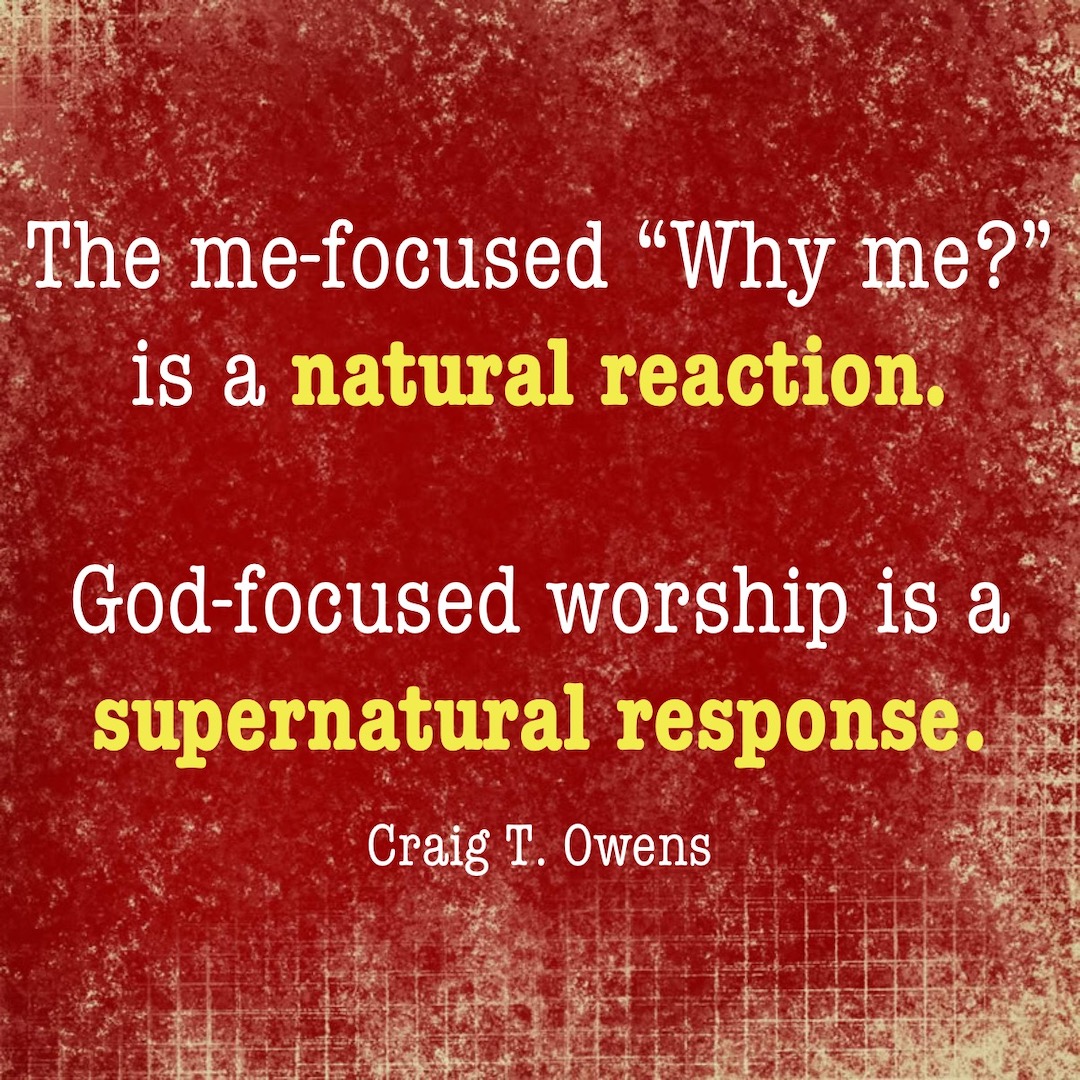
Let’s change our self-focused “Why me?” to God-focused worship as we say, “Thank You, Jesus, that You are using me to build Your kingdom!” 

You may also be interested in:

►► Would you please prayerfully consider supporting this ministry? My Patreon supporters get behind-the-scenes access to exclusive materials. ◀︎◀︎

Tried And Tested

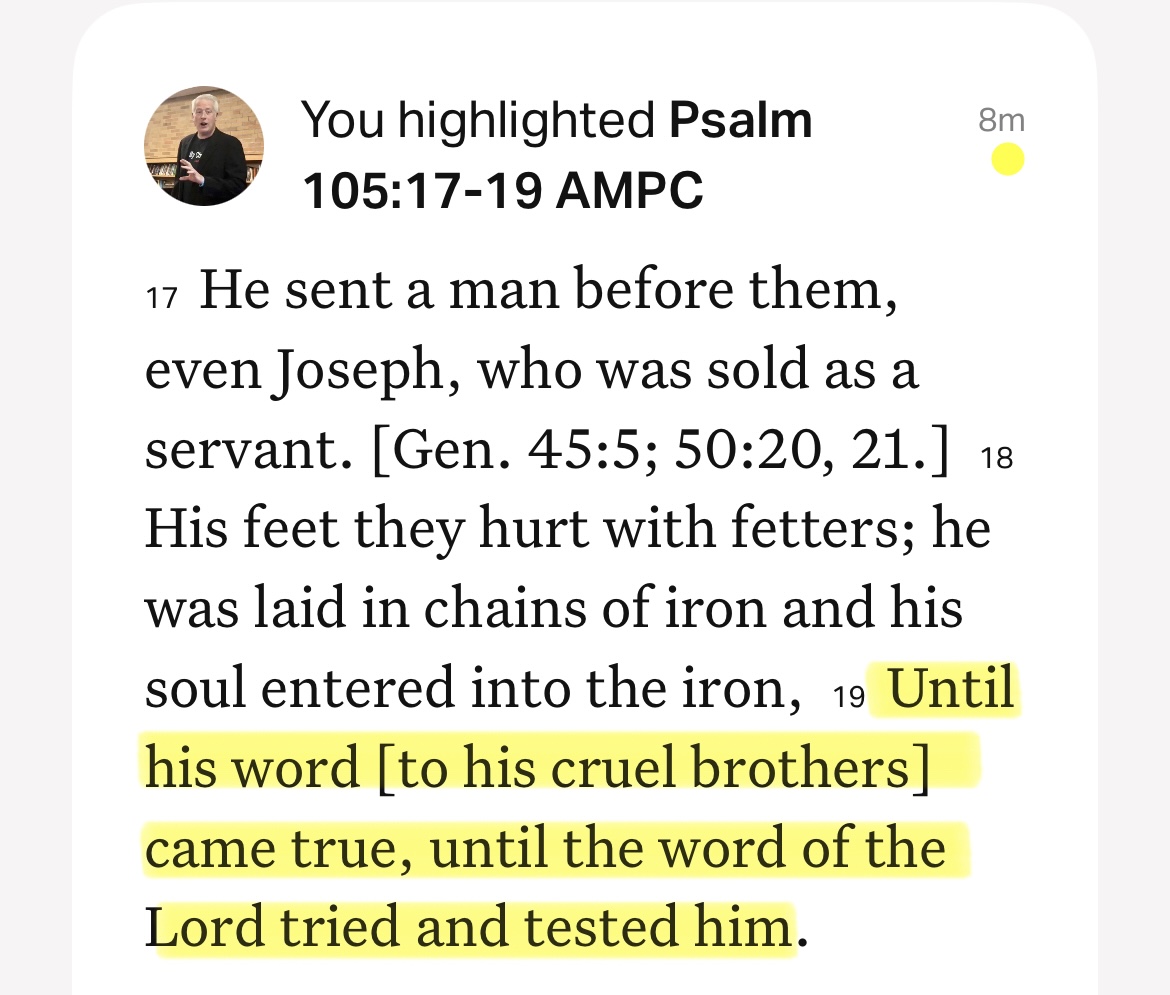
Moreover, [God] called for a famine upon the land of Egypt; He cut off every source of bread [Genesis 41:54]. He sent a man before them, even Joseph, who was sold as a servant [Genesis 45:5; 50:20, 21]. His feet they hurt with fetters; he was laid in chains of iron and his soul entered into the iron, until his word to his cruel brothers came true, until the word of the Lord tried and tested him. The king sent and loosed him, even the ruler of the peoples, and let him go free. He made Joseph Lord of his house and ruler of all his substance [Genesis 41:40]. To bind his princes at his pleasure and teach his elders wisdom. (Psalm 105:16-22 AMPC) 

“The word of the Lord tried and tested him.” When we cling to God’s promises despite the seemingly impossible circumstances we are in, that faithful clinging matures us. It both softens our heart and strengthens our trust in God. 

Before going through the difficulties, Joseph wasn’t ready to operate effectively in such a lofty leadership position. God uses all things to mold us and shape us for His purpose (Romans 8:28). We certainly see a more mature Joseph standing before Pharaoh than we saw interacting with his brothers earlier in his life. 

God called Joseph and he prepared Joseph. All that was lacking was Joseph’s faithful clinging to God and yielding to God’s maturing process. The end result was one of the most impactful leaders that history has ever known! 

I blogged more about Joseph:

What Fills Me?

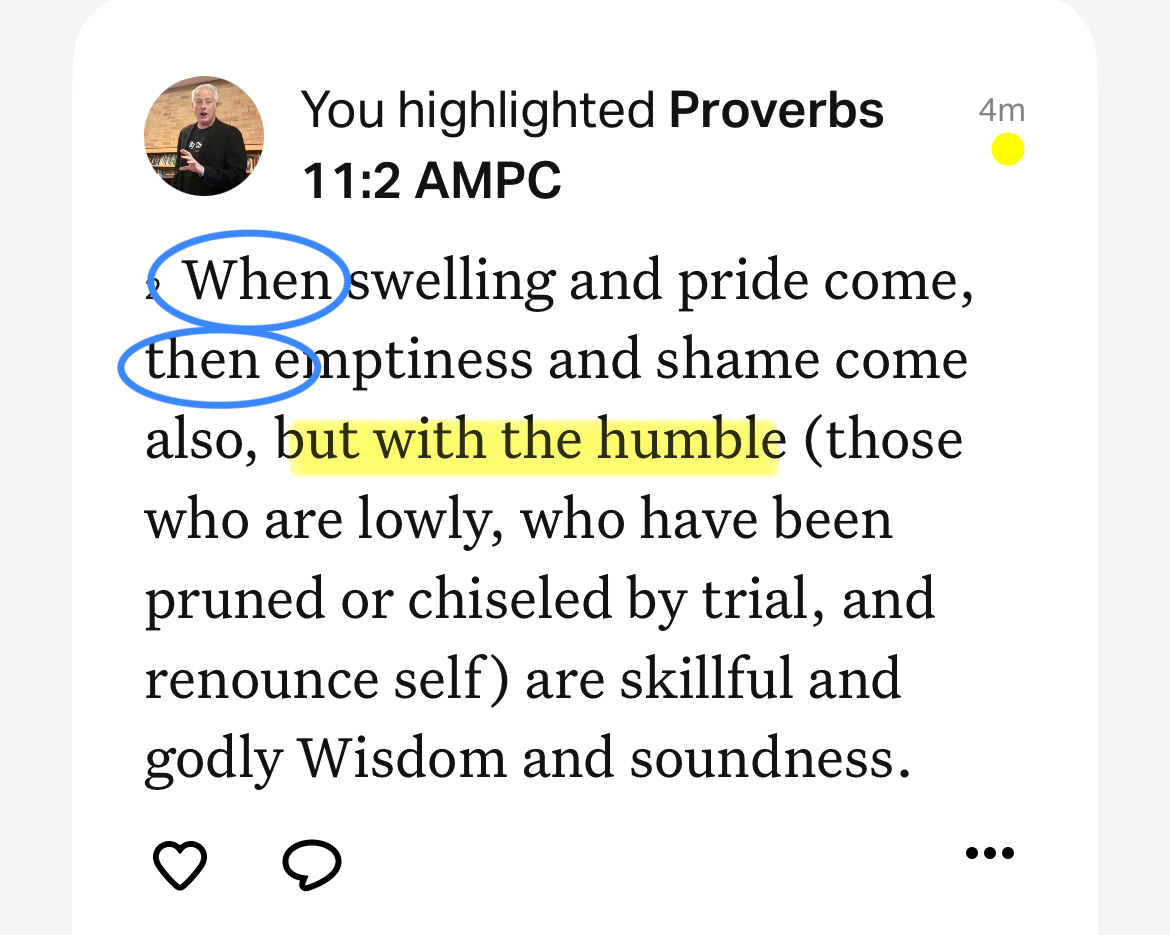
When swelling and pride come, then emptiness and shame come also, but with the humble (those who are lowly, who have been pruned or chiseled by trial, and renounce self) are skillful and godly Wisdom and soundness. (Proverbs 11:2 AMPC) 

The pruning, trials, and discipline the Lord allows us to experience are for an important purpose: To allow ourselves to be emptied of ourselves. This humility that empties us of ourselves makes room for us to be full of the presence of God. 

On the other hand, remaining full of yourself—also called “pride”—will also bring an emptiness. But this emptiness comes with shame and is absent of God’s fulfilling presence. 

You and I must choose one or the other: humility before God or pride in ourselves.

Encouraging Others In The Storm

Listen to the podcast of this post by clicking on the player below, and you can also subscribe on AppleSpotify, or Audible. 

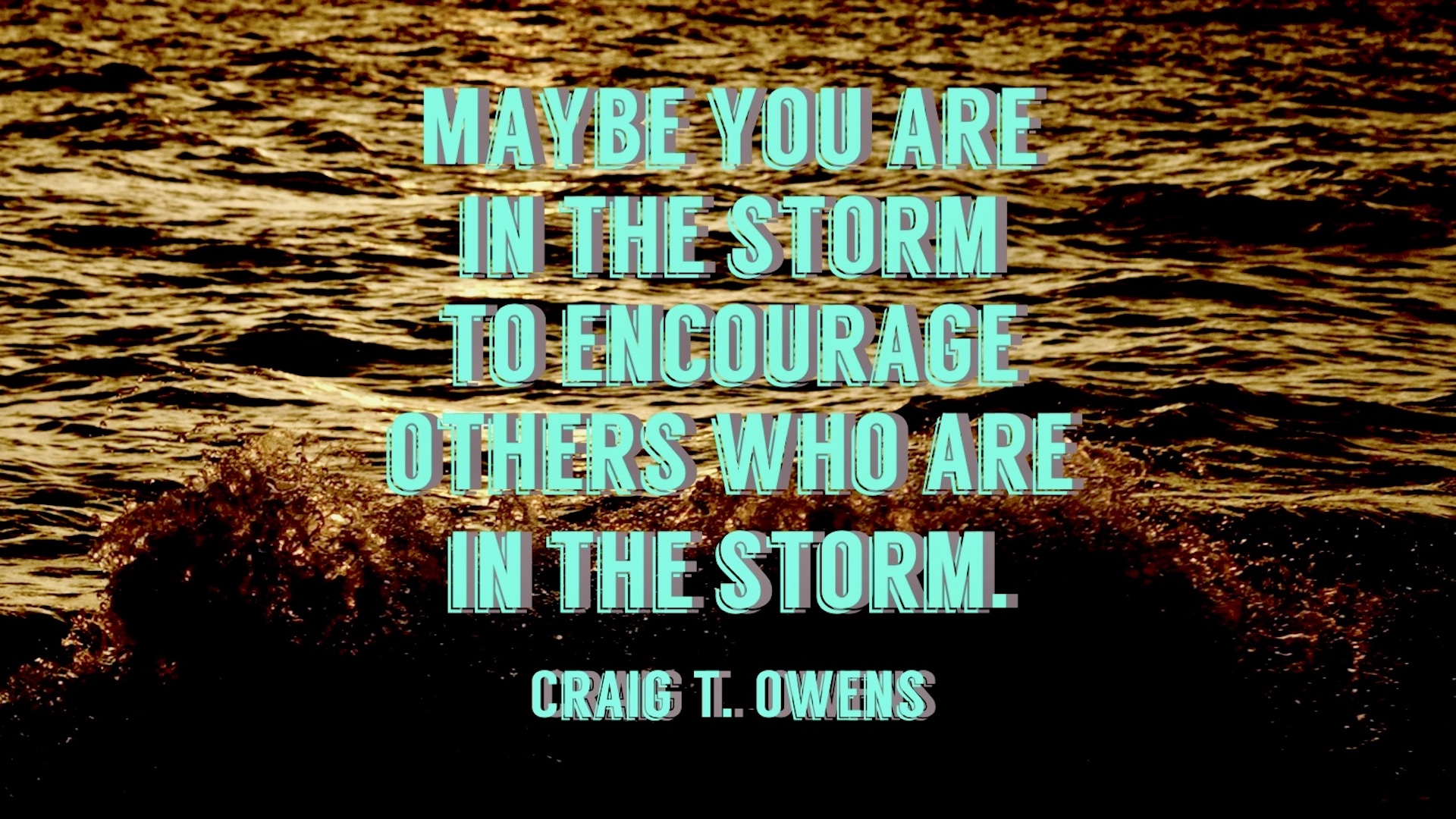
Have you ever been going through a storm in your life and wondered, “God, why are You allowing me to go through this?” 

The Scriptures I reference in this episode are Acts 27; Jonah 1; Acts 23:11.

I talk more about encouragement in the storms of life in my posts Hope in the Storms and Hard Times. And I talk more about Jonah’s storm in the post Not the Answer I was Expecting. 

My book When Sheep Bite is available here. 

►► Would you please prayerfully consider supporting this ministry? My Patreon supporters get behind-the-scenes access to exclusive materials. ◀︎◀︎

No Room For Grumbling

Listen to the podcast of this post by clicking on the player below, and you can also subscribe on AppleSpotify, or Audible. 

Paul’s first visit to Philippi didn’t go so well! 

It started off with some success—Lydia and her household accepted Jesus as their Messiah, and a demon-possessed girl was set free—but then things turned sour very quickly! Paul and Silas were falsely accused of subverting Roman law, and without any sort of trial they were beaten and thrown into prison. 

Even after the local magistrates realized their mistake in mistreating Roman citizens in this way, they simply asked Paul and Silas to leave town. You can read this story in Acts 16:11-40. 

But there were seeds planted in this city. Not just Lydia’s family, but the jailer’s family as well, became followers of Jesus. And what about the girl set free from demonic oppression? I have a hunch she joined with the Christians in praising God too! This group of believers then became the first financial supporters of Paul’s missionary work. 

Paul knew that his brief imprisonment in Philippi had resulted in a thriving group of believers. And now as he writes a letter to these saints from a Roman jail, he is once again starting to see what God is going to do through this hardship—

Now I want you to know, brothers and sisters, that my circumstances have turned out for the greater progress of the gospel, so that my imprisonment in the cause of Christ has become well known throughout the praetorian guard and to everyone else, and that most of the brothers and sisters, trusting in the Lord because of my imprisonment, have far more courage to speak the word of God without fear. (Philippians 1:12-14) 

Paul was not embittered by his imprisonment, but he was rejoicing in all of the good things God was accomplishing because of his imprisonment. 

✅ An attitude of thankfulness allows our eyes to stay open to God’s blessings even in hardships. 

❌ A grumbling attitude prevents us from acknowledging what God is doing. 

Paul’s trust in God’s provision gave him an attitude of gratitude in a difficult place, and he now encourages his friends to adopt this same mindset. In the next chapter, he writes—

Finally, my brothers and sisters, rejoice in the Lord. To write the same things again is no trouble for me, and it is a safeguard for you. (Philippians 3:1)

Paul knew that in a heart full of gratitude there is no room for grumbling. That’s why always rejoicing in the Lord is “a safeguard” for Christians. Rejoicing in God’s character and God’s blessings keeps our mind on Him, making it very difficult for any temptation to ambush us. 

Let’s proactively keep a heart full of gratitude so that no grumbling can seep in. But if we do find ourselves in a dark place that may prompt us to grumble, let’s react quickly to turn any complaints into praying and singing hymns to God, just as Paul and Silas had done in the Philippian jail, and undoubtedly as they were also doing now in their Roman jail. 

►► Would you please prayerfully consider supporting this ministry? My Patreon supporters get behind-the-scenes access to exclusive materials. ◀︎◀︎

Different Thinking In Difficult Places 

Listen to the podcast of this post by clicking on the player below, and you can also subscribe on AppleSpotify, or Audible. 

The Israelites had just been released from the slavery in Egypt when they faced one of the most difficult places they would know. God taught them how to thinking differently in this hard place. 

The Scriptures I reference in this video—1 Corinthians 10:11; Exodus 14:1-3, 10-14. 

You can watch the full sermon from which I took this clip here. 

You may also be interested in my blog post Between a Rock and a Hard Place, and a whole series of messages about difficult settings called Where’s God? 

►► Would you please prayerfully consider supporting this ministry? My Patreon supporters get behind-the-scenes access to exclusive materials. ◀︎◀︎

Great Hardships Can Be Great Opportunities

Listen to the podcast of this post by clicking on the player below, and you can also subscribe on AppleSpotify, or Audible.

The Christians could have used the “great persecution” that broke out against them (Acts 8:1) as a great excuse to hide or to remain quiet. After all, Saul and his hoard were specifically targeting those who were known to be Christians, so keeping quiet or out of sight might have saved their lives. 

Instead, these fearless Christians used this great persecution as a messenger from God to keep them on-mission in fulfilling the Great Commission (Matthew 28:18-20; Acts 1:8), taking the Gospel to even the despised Samaritans (Acts 8:4)! 

Would they have taken this message to these folks without this “nudge” of persecution? Maybe, but then again, maybe they would have stayed in Jerusalem and delayed too long in sharing with those who lived in the capital city. It’s a really good bet that without this persecution they wouldn’t have come up with the idea of going to Samaria on their own!

I think we can learn some good lessons from this incident. When unexpected difficulties crash into our lives, let’s re-frame our thinking. Instead of using this hardship as an excuse to do less, let’s ask:

  • Do I need to re-evaluate what I have (or haven’t) been doing? Do I need to repent of anything? 
  • Am I on-mission as a Christian witness? Am I consistently using my God-given gifts in God-glorifying ways to point others to Jesus? 
  • How can I live out and proclaim the Word of God even in this unexpected place? 

Let’s be like those Christians who didn’t grumble, who didn’t hide, who didn’t make excuses. But they said, “This is just another opportunity for us to invite people to meet Jesus as their Lord and Savior,” and then they joyfully moved forward. 

►► Would you please prayerfully consider supporting this ministry? My Patreon supporters get behind-the-scenes access to exclusive materials. ◀︎◀︎

Links & Quotes

Even if the world’s legal system seems unjust, Jesus says by continuing to press our case with the public servants He has put in place, we are really trusting God to bring us His perfect justice. Check out my full sermon on how the Bible from Moses to Jesus explains how to define the legal term, “An eye for an eye, a tooth for a tooth.”

I have lots of new content every week, which you can check out on my YouTube channel.

“A significant amount of research and scholarship (both scientific and theological) indicates that a young Earth is the most straightforward, conservative way to interpret God’s Word. … The most unambiguous way to interpret the Bible is according to its grammatical-historical sense, or the intended meaning of the authors. A literal interpretation accounts for all figures of speech in the text, providing the most straightforward method of exegeting Scripture. To this point, when Jesus quoted the Old Testament, it was always clear that He considered its passages as factual and true.”  Check out the post Long Ages and the Bible—What’s the Problem? 

“Your brain is made up of neurons that communicate with each other through synapses. Delta-FosB is one of the chemicals that creates neural circuits—i.e., ‘pathways’—to help those neurons communicate more quickly and efficiently. … Basically, what you experience as getting better and better at something is your brain ‘rewiring’ itself to become faster and more efficient at sending the same messages between the same neurons.” This works for both healthy and unhealthy activities. In this article from Fight The New Drug, research shows how regular consumption of pornography is hampering your brain’s ability to have normal, healthy relationships.

Dr. Henry Halley, in his Halley’s Study Bible, observed, “Note, too, the unceasing emphasis on the resurrection throughout this book. It was the pivotal point in Peter’s sermon on Pentecost (2:24, 31-32), in his second sermon (3:15), and in his defense before the Sanhedrin (4:2, 10), It was the burden of the apostles’ preaching (4:33). It was Peter’s defense in his second arraignment (5:30). A vision of the risen Christ converted Paul (9:3-6). Peter preached the resurrection to Cornelius (10:40). Paul preached it in Antioch (13:30-37), Thessalonica (17:3), Athens (17:18, 31), and Jerusalem (22:6-11), to Felix (24:15, 21), and to Festus and Agrippa (26:8, 23).” You can check out all of the Scriptures he mentions in this quote here.

Stephen Witmer asks an important question: “Which is closer to the center of your life as a Christian: what you’re doing for God, or what God has already done for you through Jesus Christ? Which one grounds your identity more deeply, affects your mood more frequently, rouses your passions more highly? Your answer to these questions will deeply shape the stability, tenacity, happiness, boldness, and humility of your Christian experience. Jesus wants to provide you grounds for unshakable joy.” Check out this example Witmer shares from an exchange between Jesus and His followers. 

“Informing your opinion of the comparative merits of Christian men, never forget the old rule: ‘distinguish between times.’ Place yourself in each man’s position. Do not judge what was a right course of action in other times, by what seems a right course of action in your own.” —J.C. Ryle

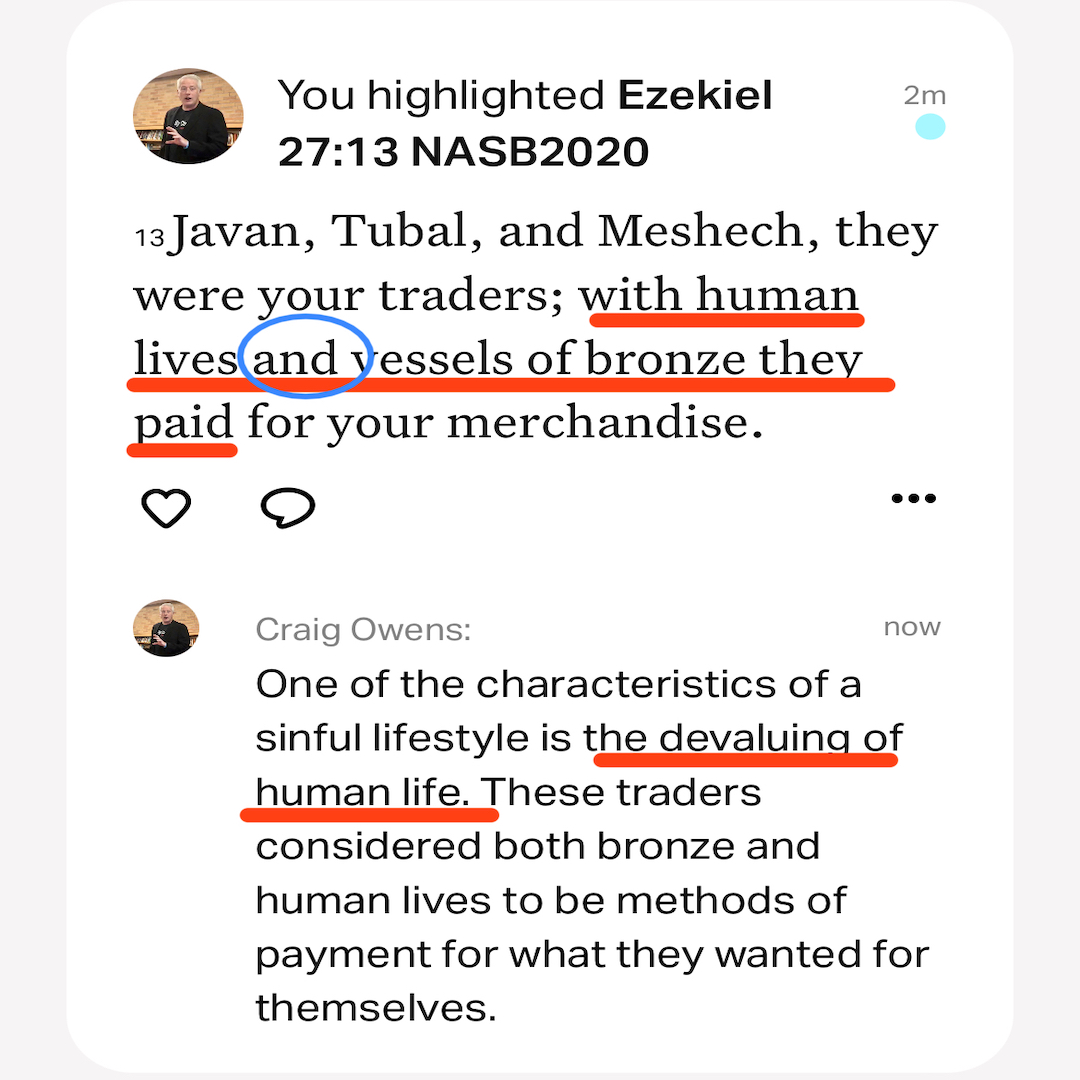
God holds human life as precious in His sight. Whenever anyone asks me why I support the sanctity of human life, my answer is simple, “Because God holds it sacred.” Consequently, God punishes those who devalue human life.

My friend, Pastor Tim Dilena, shares a thought about how God often uses people as the answer to our prayers.

The Hour, The Power, And The Procedure

Listen to the podcast of this post by clicking on the player below, and you can also subscribe on AppleSpotify, or Audible. 

If you’re going through a dark time in your life right now, I’ve got a word of encouragement for you. Well, actually three words of encouragement!

Check out this episode of The Podcast. 

Here are the Scriptures I reference in this video—John 13:1-5, 18:4-11; Matthew 26:51-54; John 17:11-12; Psalm 23:4 

You may also want to check out a couple of related blog posts:

My book When Sheep Bite is for pastors who are going through challenging times in their ministries.

►► Would you please prayerfully consider supporting this ministry? My Patreon supporters get behind-the-scenes access to exclusive materials. ◀︎◀︎

Links & Quotes

A.W. Tozer said, “There’s an awesomeness about God which is missing in our day altogether; there’s little sense of admiring awe in the Church of Christ these days.” May we repent of little prayers and boldly pray to an awesome God who wants to do awesome things that will bring Him glory!

I have lots of new content every week, which you can check out on my YouTube channel.

I always smile at the archeological discoveries which confirm the historicity of the Bible! Discovery after discovery keeps reinforcing that the Bible is a reliable historical document—which is exactly what one would expect from the inspired Word of God. Here are two recent article: (1) An archeological biography of the Assyrian king Ashurbanipal, and (2) The excavation of a rare Roman prison in Corinth that “likely gives us a picture of those that held the apostles as recorded in the New Testament (e.g. Acts 5:18, 12:5, 16:23).”

This is a very informative Q&A session with cold case detective and Christian apologist J. Warner Wallace. But I especially like his answer to the first question: Do Christians have to investigate every other religion to be convinced that the Bible is true?

“Faith untried may be true faith, but it is sure to be little faith, and it is likely to remain dwarfish so long as it is without trials. Faith never prospers so well as when all things are against her: tempests are her trainers, and lightnings are her illuminators. … No flowers wear so lovely a blue as those which grow at the foot of the frozen glacier; no stars gleam so brightly as those which glisten in the polar sky; no water tastes so sweet as that which springs amid the desert sand; and no faith is so precious as that which lives and triumphs in adversity. … Faith increases in solidity, assurance, and intensity, the more it is exercised with tribulation. Faith is precious, and its trial is precious too.” —Charles Spurgeon 

“Mature Christians can be recognized by a variety of indicators. They feast on the Word of God (Hebrews 5:14), persevere in love and good works (Hebrews 6:9-10), bear the fruit of the Spirit rather than the marks of the flesh (Galatians 6:16-23), use their gifts to help build the church (1 Corinthians 12:7-11; Ephesians 4:12-16), teach the things of Jesus to others (Hebrews 5:12: Acts 1:8), and more. This, the New Testament insists, is the condition toward which every Christian strives.” —T.M. Moore (check out all of the Scriptures T.M. references here

“Now is the accepted time, not tomorrow, not some more convenient season. It is today that our best work can be done.” —W.E.B. Du Bois 

Jesus shows us that only secure people can serve others. Insecure people won’t ever make themselves vulnerable, and so they miss out on God’s blessing. I address this in more depth in my book Shepherd Leadership.