I Am Doulos

Listen to the podcast of this post by clicking on the player below, and you can also subscribe on AppleSpotify, or Audible.

In this era of LinkedIn, Facebook, X, Instagram, and the like, we are so concerned about connections, friends, followers, and likes that it consumes our thoughts.

We self-promote and pray for popularity.

Well, I don’t think anyone is actually brazen enough to pray, “God, make me popular.” But we often live as if popularity was the answer to a prayer.

We gain our status by who we know, what we’ve done, what we are doing, the places we’ve worked, and the number of “friends,” “followers” and “connections” we have accumulated.

James wrote a book of the Bible. As he opened the letter he introduced himself. He could have said:

  • I am the half-brother of Jesus
  • I am the leader of the Christian Church
  • I chaired the Jerusalem Council

Instead he simply said, “James, a servant of God and of the Lord Jesus Christ.”

Not even the servant, as if he were distinguished among others, but the indefinite article a servant. The Greek word here (doulos) means:

  • A slave
  • “One who gives himself up to another’s will for Christ to use his service to advance His cause among men” (Strong’s Greek Dictionary)
  • Devoted to another to the disregard of one’s own interests

Any connections, friends, followers, skills, talents, or opportunities I have are wholly God’s. He gave them to me so I could serve Him and serve others. I am merely a steward of what He’s given me—I AM DOULOS.

(To see a negative example of this, check out my post Trading Truth for Popularity.)

My desire for my eulogy and my tombstone is for it to simply say: “He was a servant.”

I am living to hear my Master say, “Well done, good and faithful servant.”

►► Would you please prayerfully consider supporting this ministry? My Patreon supporters get behind-the-scenes access to exclusive materials. ◀︎◀︎

What Is Successful Church Ministry?

I like to keep asking myself and my leadership team this question: How do we know if our church is successful? 

The apostle Paul uses two words to help answer these questions: Quality and Faithfulness.

But each one’s work will be shown for what it is; the Day will disclose it, because it will be revealed by fire—the fire will test the quality of each one’s work. (1 Corinthians 3:13)

Now it is required that those who have been given a trust must prove faithful. (1 Corinthians 4:2)

So here are two important questions we need to ask ourselves:

  • Am I doing quality work?
  • Am I faithfully doing my work?

To help answer those questions, I like this thought from Leonard Sweet’s book I Am A Follower:

“The most important metrics we must rely on, the crucial ‘deliverables’ we can present, must focus on the newly formed lives of the disciples we are making, the followers who are following Christ into a place of serving Him by serving others. The most important measure of our faithfulness to Christ must be the extent of transformation into the living image of Christ Himself. …

The quantifiable fruit of our church is not found in the number of people we can gather on a weekly basis. What counts is what is happening in the lives of those who have gathered. …It is quite possible to have a ‘successful’ life—and a ‘successful’ church—without God. But it is absolutely impossible to have a truly fruitful one.”

Again, Paul’s advice here is invaluable:

My conscience is clear, but that does not make me innocent. It is the Lord who judges me. Therefore judge nothing before the appointed time; wait till the Lord comes…. (1 Corinthians 4:4, 5)

Pastor, you need to think about these questions about “success.” But they should be questions framed around your quality and faithfulness of work as revealed to you by the Holy Spirit, not by some “expert” or anyone else.

(By the way, if you’re interested in exploring this further, I framed this question a different way in this post.)

UPDATE: This post was one of the seed thoughts that went into fashioning my book Shepherd Leadership: The Metrics That Really Matter.

Thursdays With Oswald—In Christ I Can

This is a weekly series with things I’m reading and pondering from Oswald Chambers. You can read the original seed thought here, or type “Thursdays With Oswald” in the search box to read more entries.

In Christ I Can

     We are made sons and daughters of God through the Atonement and we have a tremendous dignity to maintain; we have no business to bow our necks to any yoke saving the yoke of the Lord Jesus Christ [Matthew 11:28-30]. …

     Every detail of our physical life is to be absolutely under the control of the new disposition which God planted in us by means of identification with Jesus Christ, and we shall no longer be allowed to murmur ‘can’t.’ There is no such word as ‘can’t’ in a Christian’s vocabulary if he is rightly related to God; there is only one word and that is ‘can.’

From Biblical Psychology

Sometimes Christians are known more for what we’re against than what we’re for. I think Oswald Chambers would say that is because we don’t really understand the full power of the Atonement.

We can better understand that word by saying it “at one-ment.” We have been made one with Christ. You hear this in Jesus’ prayer for us in John 17, I in them and You in Me, in order that they may become one and perfectly united, that the world may know and definitely recognize that You sent Me and that You have loved them even as You have loved Me.”

When we are in this sort of relationship, we don’t even say can’t to sin. Instead, we say I can live a holy life because of Christ in me!

As Paul said, we can say:

I CAN do everything through Christ Who gives me strength. (Philippians 4:13)

What Is “Success” For A Church?

“How’s it going,” a fellow pastor asked me. “How’s your church doing?”

If you’re a pastor, you probably get asked this often. How do you answer this question? Do you tell them what your attendance was on Sunday morning? Or about the newest program you’ve started?

When you look in the mirror and ask yourself, “How’s it going,” is your answer related to nickels and noses (offerings and attendance)? Is it how many people complimented your last sermon?

Listen to these sobering words:

Worldliness is not the trap that most endangers us as Christian workers; nor is it sin. The trap we fall into is extravagantly desiring spiritual success; that is, success measured by, and patterned after, the form set by this religious age in which we now live. 

We have a commercialized view—we count how many souls have been saved and sanctified, we thank God, and then we think everything is all right. (Oswald Chambers)

We need to be very careful about how we define “success” in a church setting. Let’s use Jesus as our example:

  • How big was His congregation? Twelve men. One betrayed Him, nine ran away when the going got tough, and one denied he even knew Him. Even after being raised from the dead (!) there were only 120 people in the upper room.
  • How much money did His church have? Not even enough to buy a gravesite for the Messiah.
  • What did people think of His sermons? Some of His sermons made people so mad they wanted to stone Him. And after one sermon the Bible says: From this time many of His disciples turned back and no longer followed Him (John 6:66).

Maybe “success” in the church is more like…

  • …people being reconciled to God. Remembering that “our work is not to save souls, but to disciple them” (Chambers).
  • …seeing disengaged people becoming actively involved in engaging others with the Gospel.
  • …“Never seek[ing] after anything other than the approval of God” (Chambers).
  • …to say with Jesus, “The Spirit of the Lord is on Me, because He has anointed Me to preach good news to the poor. He has sent Me to proclaim freedom for the prisoners and recovery of sight for the blind, to release the oppressed, to proclaim the year of the Lord’s favor” (Luke 4:18-19).

These are just some of my thoughts. What else should be on this list? How would you define “success” in the church?

I have also shared some questions that can help pastors and ministry leaders better gauge the level of effectiveness in their ministry.

UPDATE: This post was one of the seed thoughts that went into fashioning my book Shepherd Leadership: The Metrics That Really Matter.

Was Your Church Successful?

These thoughts are especially for my fellow pastors (although I think they pertain to anyone who attended a church service recently).

So… how successful was your church gathering this weekend?

Was it successful because lots of people were there? Or because the pastor preached a good sermon? Or maybe the offering was better than usual? Or because you could feel something special as the worship team sang and played their instruments?

How about these measurements:

“The great business of the church is not our number by addition, but by grace, by growing up in Christ.” (John Owen)

“The perfect church service would be one we were almost unaware of. Our attention would have been on God.” (C.S. Lewis)

“Revival is the church getting back to ‘normal.’” (A.W. Tozer)

I hope these quotes have you thinking about church “success” as much as they are working on me!

UPDATE: This post was one of the seed thoughts that went into fashioning my book Shepherd Leadership: The Metrics That Really Matter.

Me, Myself & Bob (book review)

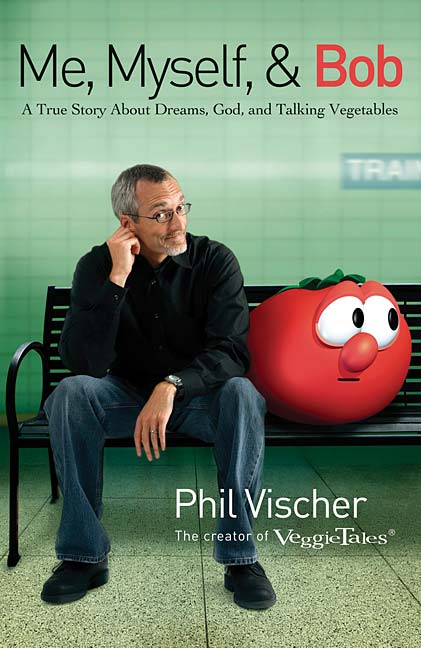
As a parent of young children, I really appreciated the biblical values delivered in a fun way through so many VeggieTales videos. Now I’m really appreciating the wisdom of VeggieTales creator Phil Vischer in his book Me, Myself & Bob.

Written in the same witty style that made the VeggieTales videos so engaging, Me, Myself & Bob leads us through the meteoric rise and sudden collapse of Big Idea Productions. We read about the passion that drove the start of this incredible vision, and how—as the Bible says—zeal without a foundation of wisdom is a  dangerous thing.

With such candor, Phil shares about the vision and talents God gave him to do something so groundbreaking, how others caught that vision and jumped on board to help, and then how the company sort of took on a life of its own and how corporate executives took this highly successful business in a direction Phil never imagined.

This book is more like a business strategy book told as Phil Vischer’s autobiography. From the business board room to the family living room, there are valuable lessons to be learned from the rise and fall of VeggieTales. So whether you’re a fan of Bob the Tomato & Larry the Cucumber, an entrepreneur, or a parent, you will find something to love about Me, Myself & Bob.

How The Mighty Fall (book review)

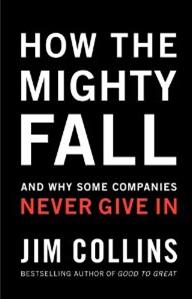
This is the third in the series of books from Dr. Jim Collins: Built To Last, Good To Great, and now How The Mighty Fall. This is a book that Dr. Collins wished he didn’t have to write, as he uncovers the markers that contributed to the failure of once-great companies.

If you are a frequent reader of my blog, you’re probably wondering why I’m reading/reviewing a business book. The answer is simple: the principles Jim Collins uncovers in his books are rock-solid principles of success and failure, regardless of the organization in which they are practiced or ignored. In all three of his books, I have mined so many great truths to apply to my personal life, as well as the organizations I lead.

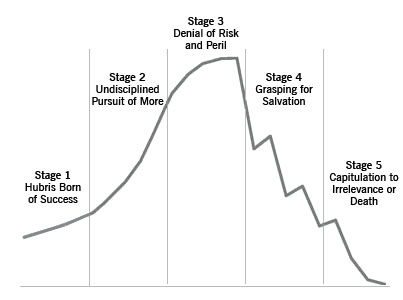
In How The Mighty Fall we learn about the five stages of decline for once-great organizations. Working backward from his evidence, Dr. Collins then gives us “markers” to look for in our own organizations that would tip us off to the stages of decline.

Why study this? Because I want to lead a great church! This quote from the book especially resonates with me:

“The point of struggle is not just to survive, but to build an enterprise that makes such a distinctive impact on the world it touches, and does so with such superior performance, that it would leave a gaping hole — a hole that could not be easily filled by any other institution—if it ceased to exist.” (emphasis added)

If you are involved in the leadership of any organization (whether for-profit or non-profit), I would encourage you to devour all three of Jim Collins’ books.

What’s Your Excuse?

It’s so easy to make excuses, isn’t it?

  • I wasn’t feeling well
  • I don’t have enough training
  • The sun was in my eye
  • The other guy was supposed to….
  • I don’t have the right tools
  • If only….
  • I can’t because….

John Maxwell has started a new teaching series where he presents a one-minute lesson on one word every day. Today’s lesson was on excuses. Watch the clip here.

Here are some other quotes on excuses:

“Ninety-nine percent of failures come from people who have the habit of making excuses.” —George Washington Carver

“There’s a difference between interest and commitment. When you are interested in doing something, you do it only when it is convenient. When you are committed to something, you accept no excuses only results.” —Kenneth Blanchard

“Obstacles are not excuses for failure, they are opportunities for growth.” —Craig T. Owens

“People who are good at making excuses are seldom good at anything else.” —Benjamin Franklin

Let’s stop making excuses and start taking responsibility! 

No Such Thing As Overnight Success

Although to the outsider it sometimes appears that way, success does not happen overnight. So much of the work and preparation and study that are done are simply unnoticed by others.

On the flip side, there is no such thing as an overnight failure either. So much of the work and preparation and study that was left undone is also usually unnoticed by others.

Both public success and public failure are the culmination of years of private decisions. Every single day I am either preparing for success or preparing for failure.

The battles are being won or lost before I even take the field. It’s the everyday private practice that determines the game day public performance.

I have to pay careful attention to the “little things” in private every day if I hope to successfully handle the “big things” in public someday.

The heights of great men reached and kept,
Were not attained by sudden flight,
But they, while their companions slept,
Were toiling upwards in the night. —Henry W. Longfellow


What are you doing to prepare today?

Little By Little

I’ve found a great group of guys to play basketball with in Cedar Springs. I love early morning basketball because I feel like it gets my day started right.

I have been playing with this group for a little over two months. Prior to this, I hadn’t played full-court basketball in quite a while, so when I started up again, it was amazing how quickly I was out of breath … and how many turnovers I had … and how off my shot was. Just a few months of not playing, and everything deteriorated.

But I hung in there. And yesterday it dawned on me, “Hey, I can run a little longer before I get winded. And my shot is getting a little better too.”

I didn’t see a dramatic overnight improvement. In fact, I only see real improvement if I compare my game in mid-November with my game in mid-September.

This is an important concept to remember in anything we do: little by little keeps you moving forward. The little steps you take every day add up.

  • Start with just 5 minutes of exercise, and slowly increase it.
  • Read a book for just a few minutes each day, then a few minutes more.
  • Pray for a couple of minutes before you go to bed tonight, then a couple minutes more.
  • Quit smoking for just an afternoon, then try an hour or two more.

Little by little you are increasing your capacity to do greater things. Don’t try for cold turkey or overnight success or immediate results. Little by little will help you get there.

Ready? What little thing can you do today?