Links & Quotes

link quote

Some interesting reading from this weekend…

Assemblies of God missionaries were addressing the issue of sex slaves and sex trafficking as far back as 1917.

Chilly Chilton challenges us to view worship as serving: Serving Up Some Worship!

This infuriates me … a Planned Parenthood staffer recommends abusive sex to a 15-year-old! And guess what? Our tax dollars are paying for this garbage.

More medical evidence that stress is bad for your heart.

“It will take an infinite number of ages for God to be done glorifying the wealth of His grace to us—which is to say He will never be done. And our joy will increase forever and ever. Boredom is absolutely excluded in the presence of an infinitely glorious God.” —John Piper

Don’t just study; study well. Here are some important questions to ask yourself.

The Overview Bible Project has a cool look at the Psalms.

How can we ever hope that our kids will become moral, ethical, committed people when we can’t keep our word, can’t keep our pants on, and can’t seem to hold our tongue or liquor? To all three groups of leaders, I simply say: We don’t expect you to be perfect, but we do expect you to embody integrity.” Read more from Tim Elmore’s post The Only Way To Turn Students Into Ethical Leaders.

“As Christians we are called upon to exhibit the character of God, and this means the simultaneous exhibition of His holiness and His love.” —Francis Schaeffer


Links & Quotes

link quote

Some great reading from today.

Why do we take a railway guide and arrange for a particular journey? … Well, one has confidence in the reliability of these official publications. As a rule we are not put to shame! Now, just as we use a railway guide we must use our Bible. We must depend on God’s Word just as we depend on man’s word, only remembering that though man may not be able to carry out his promise, God will always fulfill what He has said.” —Hudson Taylor

More archeological finds in Israel confirm the historicity of the Bible: Canaanite Fortress Discovered.

Explain to me again how this is legal (or humane!): Nurse tells grisly tale of partial-birth abortions.

The New York Post finds that tanning salons are inspected more than abortion clinics.

Medical science shows stress in the home adversely effects chromosomes in kids.

“Distractions must be conquered or they will conquer us. So let us cultivate simplicity; let us want fewer things; let us walk in the Spirit; let us fill our minds with the Word of God and our hearts with praise. In that way we can live in peace even in such a distraught world as this.” —A.W. Tozer

“If indeed the name of the eternal God is named upon us, we are secure; for, as of old, a Roman had but to say Romanus sum, I am a Roman, and he could claim the protection of all the legions of the vast empire; so everyone who is a man of God has omnipotence as his guardian, and God will sooner empty heaven of angels then leave a saint without defense. Be braver than lions for the right, for God is with you.” —Charles Spurgeon

“How one learns to be thankful for each day on which one can still do something.” —Karl Barth

Do You Like That Feeling?

How do you feel this morning? Are you still feeling good from your day yesterday? I sure hope you are!

Did you know those good feelings are more from your thoughts than they are from anything else? Check out this insight from Jon Gordon—

“Research shows that grateful people are happier and more likely to maintain good friendships. A state of gratitude, according to research by the Institute of HeartMath, also improves the heart’s rhythmic functioning, which helps us to reduce stress, think more clearly under pressure and heal physically. It’s actually physiologically impossible to be stressed and thankful at the same time. When you are grateful you flood your body and brain with emotions and endorphins that uplift and energize you rather than the stress hormones that drain you.”

Let’s see…

  • Happier
  • Better friendships
  • Less stress
  • More creativity
  • Better health
  • More energy

Those sound like great reasons to make every day a day of givingthanksgiving!

What God Do You Tru$t?

Listen to the podcast of this post by clicking on the player below, and you can also subscribe on AppleSpotify, or Audible.

Things seem to be going very, very well for Israel! Check out what Isaiah wrote:

Their land is full of silver and gold; there is no end to their treasures. Their land is full of horses; there is no end to their chariots.

Sounds like a success story to me!

But wait: the next verse sounds a bit ominous:

Their land is full of idols; the people worship things they have made with their own hands.

Money? Yes.

Influence? Lots.

Prosperity? For everyone.

Idolatry? Widespread.

They were no longer looking to God, but they were looking to what they had made with their own hands. In other words, they made Money their god.

Money can save us!

Money can fix all our problems!

Without Money we are lost!

Only those with Money can be saved!

Sadly, I believe what was said of Israel 2500 years ago could be said of the United States of America today. In God We Trust is printed on all our currency, but it really has become In Money We Trust. We have made Money our god.

Don’t believe me? How do you think most people would answer these fill-in-the-blanks:

  • I need _____________ to get clothes.
  • Without _____________ I cannot feed my family.
  • If I lost _____________ today I would be devastated.
  • I frequently think about how more _____________ in my life would make my life better.

But check out what Jesus says about clothes, food, and our means of survival.

What should go in the blank: Money or God? Again, let’s let Jesus have the final word: “No one can serve two masters. Either you will hate the one and love the other, or you will be devoted to the one and despise the other. You cannot serve both God and money” (Luke 16:13).

►► Would you please prayerfully consider supporting this ministry? ◀︎◀︎

Overloaded Recap

We all have times that life feels overwhelming. Like there is too much to do, but not enough of us (or our time, or our money, or our willpower, or…) to accomplish what we need to. In a word: we are overloaded.

I just finished a 4-part series about God’s ways for finding relief for our overloaded lives, and I thought this quick recap might be helpful.

If you’re feeling OVERLOADED, remember…

Less Is More

When the “less” is stuff, the “more” is relationships.

Off Makes On Better

A day OFF (a Sabbath) helps you appreciate ON more.

Study To Be Quiet

Tune out all the noise so you can tune in to God’s voice.

Trust God First

Give God the first 10% of your income and enjoy His blessing.

Overloaded?!?

I’m starting a new series this Sunday which I wish I didn’t have to start. But the reality is that far too many of us (and I do mean us because I’m including myself) have bought into the cultural idea that we need to add more and more and more to our lives.

As a result, our lives are overloaded. Physically, emotionally, financially, relationally … if life throws us just one curveball in any area, we’re toast!

And the biggest victim in our overloaded lives? Our relationships. It’s hard to have rich, meaningful, intimate, vibrant relationships when we’re so concerned about our own overloaded lives. It doesn’t have to be this way!

I hope you can join me at Calvary Assembly of God over the next four Sundays as we talk about the relief that God shows us in the Bible. There is relief from overload, and God wants us to find it.

Spread It Out

What do you do when you get bad news? Scientists know that when we hear bad news, our stress hormone cortisol immediately surges into our bloodstream. This hormone unleashes a bunch of other things in our bodies: blood pressure goes up, heart rate increases, pupils dilate, sugar stores are released. In other words, your body prepares for action.

What about your brain? What does it do? Immediately your brain starts searching for a way to cope with the stress of the bad news. And the typical response is to return to well-worn pathways. In other words, do what I’ve always done before.

So perhaps the question is better stated: What have you done before when you got bad news?

  • Did you sulk?
  • Did you cry or get angry?
  • Did you get paralyzed, not knowing what to do?
  • Did you call a friend?
  • Did you just shake your head and try to ignore it?
  • Did you spread it out before God?

Huh? Judah’s King Hezekiah got some very bad news from a very mean general named Sennacherib. What did he do? He did what he had done before…

Hezekiah received the letter from the messengers and read it. Then he went up to the temple of the LORD and spread it out before the LORD…. “Give ear, LORD, and hear; open Your eyes, LORD, and see; listen to the words Sennacherib has sent to ridicule the living God.”

Hezekiah had the same physiological and psychological responses that you and I would have when facing such a huge threat. But his first response was his well-worn response. He did what he had always done before with bad news: he spread it out before the Lord.

We can start making a new pathway for our brain to follow. Instead of fight-or-flight, or ignoring, or paralysis, or calling a friend—take it to God and spread it out there. He knows your situation better than anyone else and He wants to help you.

Start making new neural pathways in your brain today by taking everything to God—even the so-called “little” things—so that when the really bad news comes, your brain will tell you to do what you always do: spread it out before the Lord.

The Doctor & The Pastor—Part II

Friends, I recently reviewed the manuscript for a new book Living Free In An Anxious World. This is an essential book for pastors, Christian counselors, psychologists, and medical doctors which deals with a problem that is only expanding: worry, stress, anxiety. Stay tuned to this blog for a chance to win a free copy in just a couple of weeks.

In the meantime, I am absolutely thrilled that the co-authors of Living Free In An Anxious World have agreed to write to my blog readers! Today is the second installment from Dr. Lanny Hunter. (If you missed Part I from Victor Hunter, you can check it out here.)

Guest Author: Dr. R. Lanny Hunter

In my profession as a dermatologist, it’s fair to say that most of my patients come to see me because they are worried. Patients may have developed a rash that worries them. What is it? Is it contagious? Is it serious? Will it scar? What will people think? Can I get rid of it?

Patients may have developed a skin growth, a lump, a sore that won’t heal, a place that is changing color, causing pain, or bleeding. Again, they are worried. Is it cancer? Is it life-threatening? Can it be cured? If I do make a diagnosis of cancer, their anxiety escalates. Will I die? How long do I have to live? How will it be treated? What should I tell my spouse? My family?

Beyond questions of diagnosis, treatment, and questions of severity of illness, many worry about medical costs. How much will it cost? Will my insurance pay for it? They may confide that their insurance has a very high deductible, or that they have no insurance at all, or that they live only on Social Security and Medicare. Will treatment bankrupt them?

In the course of consultation, medical care, and surgery, patients reveal more than their medical worries. They confide their life disappointments—marriage problems, work conflicts, children in trouble, personal and vocational failures, criminal escapades.

Patients with worry and anxiety are my life’s work. To that end, I use all of the interpersonal skills, psychological insights, religious convictions, and medical skills that I have acquired through training and experience. I must listen compassionately and constructively, and be armed with the latest medical techniques in treating disease. I must be cognizant of my limitations in skill and time. I may need to refer a patient to a psychologist, psychiatrist, pastor, priest, social worker, or another physician. I must always remember that I’m not treating the skin. I’m treating the whole person.

With that holistic approach in mind, my brother (a pastor) and I (a physician) have authored a book, Living Free in an Anxious World, which combines the insights of our two vocations to help people manage worry and anxiety in order to free them for more productive living. 

The Doctor & The Pastor—Part I

Friends, I recently reviewed the manuscript for a new book Living Free In An Anxious World. This is an essential book for pastors, Christian counselors, psychologists, and medical doctors which deals with a problem that is only expanding: worry, stress, anxiety. Stay tuned to this blog for a chance to win a free copy of this book later this month.

In the meantime, I am absolutely thrilled that the co-authors of Living Free In An Anxious World have agreed to write to my blog readers! Today is the first installment from Rev. Victor Hunter.

Guest Author: Rev. Victor L. Hunter

Whether it was the Carter family’s version in the 1930s, Woody Guthrie’s in the 40s, the Kingston Trio’s in the 50’s, Ramblin’ Jack Elliott’s in the 60s, or Devo’s in the 70s and 80s, “Worried Man Blues” has been a ubiquitous presence in the bluegrass/folk song genre of cultural music throughout the “century of anxiety.” Its words and tune have provided a common background theme playing in our minds for decades:  “It takes a worried man to sing a worried song.” Most of us, men and women, have hummed along, literally and/or figuratively, with its sentiments.

During these decades, my brother and I have listened to the song’s lyrics and contemplated the reality of worry and anxiety both personally and professionally. He’s a physician. I’m a pastor. I can say without hyperbole that there hasn’t been a week go by in nearly a half-century of preaching, pastoral care and counseling, and teaching that worry and anxiety haven’t been at the forefront of conversations with people, young and old, men and women, who have said to me, “I need to talk with you about something.”

This is so because anxiety is part of what it means to be human beings. It’s part of our biological makeup and spiritual reality. It is essential to our survival, as well as being a core theological question. It can also be devastatingly paralyzing, keeping people from living free, living life fully alive.

During the past four decades, the doctor and the pastor, the brothers, have been in conversation about our disciplines of science and theology and our professions in medicine and religion. We have become increasingly sensitive to the many issues that meet at the intersection of biology and theology. It’s about being human before God. We share in Living Free in an Anxious World this conversation and our passion for a holistic understanding of our humanity in light of faith and science . . . as well as our hope for the healing and redemption of our lives. We affirm that while anxiety and worry are unavoidable, they can be our teachers rather than our masters. Our goal is to provide realistic, practical, and helpful guidance in understanding worry and facing our fears that we might travel the road of freedom and grace.

Check out the guest post from Dr. R. Lanny Hunter by clicking here

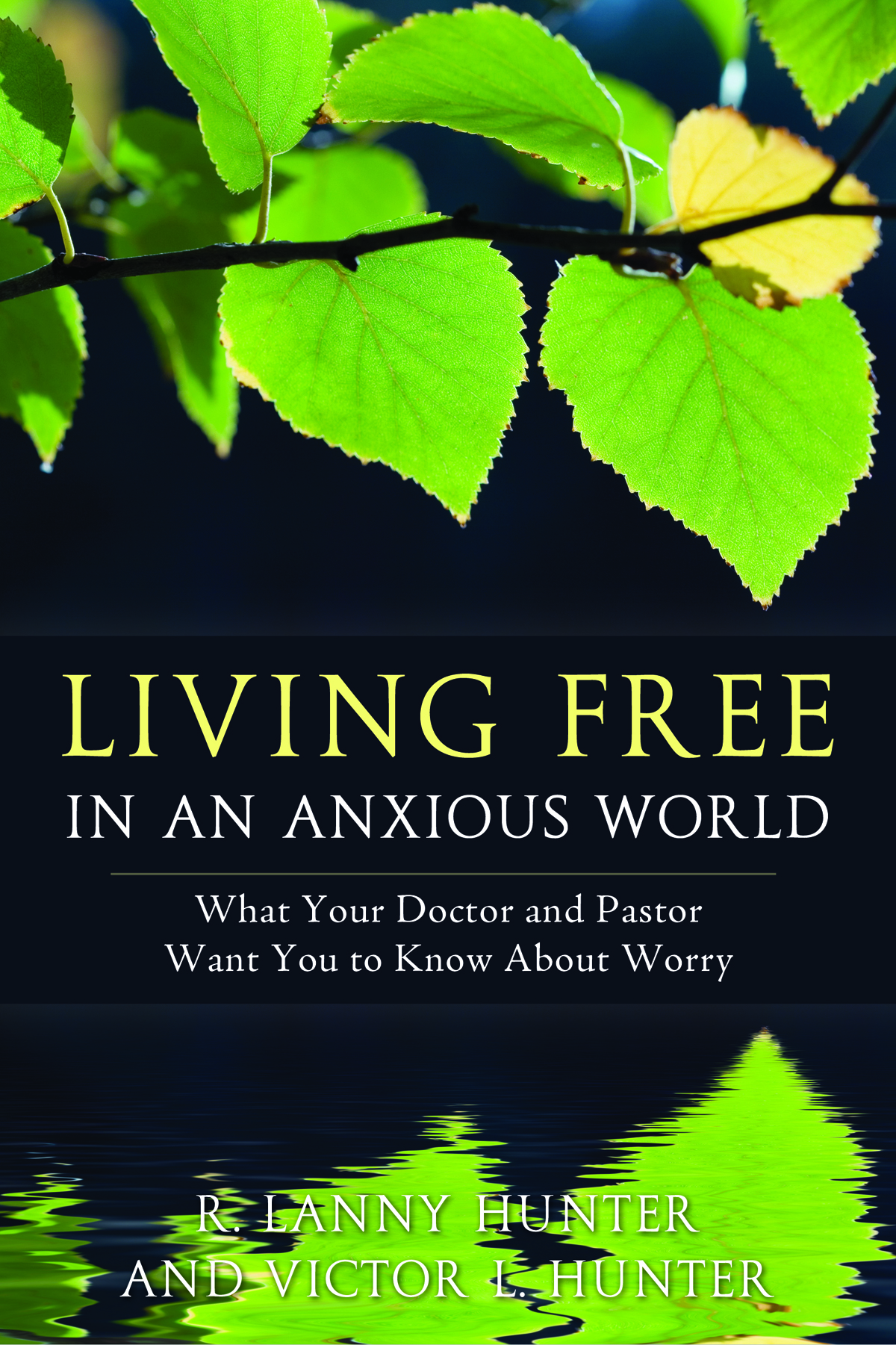
Living Free In An Anxious World (book review)

When I say that more people today are worried, or stressed-out, or suffering from anxiety attacks, I’m not saying anything that you don’t already know. But in Living Free In An Anxious World authors R. Lanny Hunter and Victor L. Hunter give us a whole new way of looking at worry and anxiety.

Many times I’m frustrated by some author’s one-size-fits-all approach to dealing with worry and anxiety. The fact is, we are complicated and we are individuals. But more than that, many authors tend to focus on just one part of the human, when in fact we are a three-part being. There is a physical component, an emotional/mental component, and a spiritual component.

The Hunter brothers are well trained to address the effects of worry in all its forms, as one brother is a medical doctor and the other is a pastor who received specialized training in both religion and psychiatry. They both bring their specialties to this book in a way that I found both informative and comforting.

One of the first concepts they address is that the key is to not eliminate worry from our lives. That, they say, is impossible. The goal is to not worry in a self-destructive way. Right from the first chapter, I found myself buying into their insights which were so real and applicable.

The Hunter brothers explore the biblical, scientific, and even philosophic origins of worry, and provide very real solutions for even a layman like me. This book wasn’t “over my head” nor did it over-simply the very real and challenging task of dealing with worry the right way.

Since 6.5 million Americans suffer from general anxiety disorder every year, chances are good that you are going to have to confront worry in your life or in the life of a loved one. So I highly recommend this book to you.

I am an Abilene Christian University Press book reviewer.