Oh, The Silliness!

Listen to the podcast of this post by clicking on the player below, and you can also subscribe on AppleSpotify, or Audible. 

Jesus had just been taken from the high priest Caiaphas to the praetorium where the Roman governor Pontius Pilate presided. And then I read one of the most ridiculous statements in this whole crucifixion scenario. 

In order for you to grasp the full impact of this outrageous request, let me take you back in time a few hours. 

Jesus was arrested by the temple guards without there being any formal charges filed against Him. He was taken to the home of the former high priest for an off-the-record interview to attempt to get Jesus to stumble in something He said so that they would have official charges to lodge against Him. 

The Sanhedrin was then convened in the middle of the night. Witnesses were brought in not really to testify as to what they saw or heard, but because the Sanhedrin was “looking for evidence” (Mark 14:55). In the meantime, the Sanhedrin asked Jesus to answer non-existent charges without having any legal representation of His own. They even resorted to physical violence to try to coerce Him to say something incriminating. 

The Sanhedrin eventually reached a non-unanimous decision, without any corroborating testimony, to ask Pilate for the death sentence. 

Now here comes the silly statement—“Then the Jewish leaders took Jesus from Caiaphas to the palace of the Roman governor. By now it was early morning, and to avoid ceremonial uncleanness they did not enter the palace, because they wanted to be able to eat the Passover” (John 18:28). 

To avoid ceremonial uncleanness?! 

In their blind fury and rabid self-righteousness, these men broke both mosaic law and their own rules of order. Doing things like: 

  • not securing charges first before arresting Jesus 
  • physically abusing Jesus without a conviction or even a proper trial 
  • meeting at night instead of during the day 
  • not calling in witnesses one at a time 
  • not getting corroborating testimony from two or three witnesses 
  • not allowing Jesus to have a legal advocate 
  • not getting a unanimous guilty decision before asking for the death sentence 

(Check out these passages to read all about the actions of the Sanhedrin on this night.)

After all that, they’re concerned about being ceremonially clean for the Passover? Oh, the silliness! 

Then I began to wonder: Am I guilty of this same folly? 

Do I keep my own set of rules? Do I justify bending God’s rules because of what I think are special circumstances? Am I self-righteous? Do I really think that I can do things the way that I want to do them and that God will put His stamp of approval on that?  

Isn’t it far better to simply follow God’s ways, to listen to the Holy Spirit speaking to my conscience, and then to repent if I begin to deviate from the truth? 

I need to always deal with my own self-righteousness first—to take care of the plank in my own eye before I point out the speck in someone else’s eye. Or else, I am being just as silly as those religious leaders were! 

You may also be interested in these related blog posts: 

►► Would you please prayerfully consider supporting this ministry? My Patreon supporters get behind-the-scenes access to exclusive materials. ◀︎◀︎

Winning Souls, Not Arguments

Listen to the podcast of this post by clicking on the player below, and you can also subscribe on AppleSpotify, or Audible. 

The men who were guarding Jesus mocked Him and beat Him. They blindfolded Him and hit Him again and then demanded, “Prophesy! Who hit You?” And it wasn’t just the physical abuse, but they heaped mocking insult upon mocking insult upon Jesus (Luke 22:64-65). 

All four of the Gospel writers recount how Jesus responded to both the physical and verbal abuse: 

  • To the false charges before the Sanhedrin, Jesus remained silent (Matthew 26:57-63) 
  • To the spitting and hitting by the members of the Sanhedrin, Jesus remained silent (Matthew 26:67-68) 
  • To the physical abuse of the guards, along with their mocking insults, Jesus remained silent (Mark 14:65; Luke 22:64-65) 
  • To the mocking He endured before King Herod, Jesus remained silent (Luke 23:9-11) 
  • To the false charges announced to Governor Pilate, Jesus remained silent (Matthew 27:12-14) 
  • To the insults and mocking thrown His way as He hung on the Cross, Jesus remained silent (Matthew 27:38-44; Mark 15:29-32; Luke 23:35-36) 

His only verbal response was after being slapped in the face by one of the officials in the Sanhedrin. Jesus said, “If I said something wrong, testify as to what is wrong. But if I spoke the truth, why did you strike Me?” (John 18:22-23). 

These are what we call an ad hominem attack. That is attacking the person, instead of confronting the ideas or arguments the person is presenting. 

The self-control of Jesus here is absolutely astounding! Peter records, “When they held their insults [and their fists and their spit] at Him, He did not retaliate; when He suffered, He made no threats. Instead, He entrusted Himself to Him who judges justly” (1 Peter 2:23). 

Even as His trial got underway, Luke records, “the council of the elders of the people…met together, and Jesus was led before them” (Luke 22:66).

Dr. Henry Halley points out that extra-biblical sources have told us that this trial violated at least four of the Sanhedrin’s own rules:

  1. Meeting on the morning of a festival 
  2. Meeting in Caiaphas’ personal residence 
  3. Trying a defendant without defense 
  4. Passing the verdict of a death sentence in one day instead of two days 

I would add a fifth rule which is found in Scripture: At least two witnesses need to be in agreement with their testimony for there to be a death sentence (Deuteronomy 17:6, 19:5; Mark 14:55-59). 

When the Sanhedrin then hauled Jesus before Pontius Pilate, even their charges made before the governor in Luke 23:1-2 were flimsy at best: 

  1. Subversion—there is no proof for this 
  2. Opposing taxes to Rome—this was false (see Luke 20:20-25) 
  3. Jesus was a rival to the Roman throne—not true 

And still Jesus remained almost completely silent! He only spoke when asked a direct question, but He remained silent throughout the false accusations, the verbal taunts, and the physical abuse. 

When I am treated unfairly, when the rules are bent against me, when false charges are lodged against me, I get angry! I want to defend myself! I want to put my accusers or abusers in their place! 

Could Jesus have prevented His arrest? Yes (Matthew 26:53)! 

Could Jesus have defended Himself before the Sanhedrin, Pilate, and King Herod? Yes! 

Could Jesus have come down from the Cross to prove His power? Yes! 

But Jesus wasn’t trying to win a momentary argument; He was winning souls for eternity! 

Jesus came not to be served, but to serve, and to give His life as a ransom for many (Mark 10:45). So, “for the joy set before Him He endured the Cross, scorning its shame, and sat down at the right hand of the throne of God.” 

When anger boils up because of the mistreatment we are enduring, we must “consider Him who endured such opposition from sinners, so that you will not grow weary and lose heart” (Hebrews 12:2-3). 

Like Jesus, let’s not try to win just a momentary argument that may result in the loss of a soul for all of eternity. There is a time to speak and there is a time for silence. As we keep our eyes on Jesus, we will know what time it is. 

(You can check out all of the Scriptures I referenced in this post by clicking here.)

P.S. You may also be interested in a previous blog post Winning the Argument or the Battle or my short video How Should Leaders Handle Pushback. 

►► Would you please prayerfully consider supporting this ministry? My Patreon supporters get behind-the-scenes access to exclusive materials. ◀︎◀︎
Helping Skeptics See The King

Listen to the podcast of this post by clicking on the player below, and you can also subscribe on AppleSpotify, or Audible. 

I once worked with a guy that was the epitome of “all talk and no action.” After a while people just stopped listening to him or believing anything he said. But something worse is someone who says he will do something but doesn’t have the power to finish what he started. In that case, you may have believed him and not taken any steps of your own, so when he finally admits defeat, you are totally unprepared to step in to help finish the task. 

I think that comes close to the two attitudes people had prior to the First Advent of Jesus in Bethlehem. Some people thought all of God’s promises had just become “all talk and no action.” 

But after Jesus began His public ministry, His skeptics may have originally thought He was also “all talk and no action,” but when they saw how the people responded to Him, they realized He at least had the power to sway a crowd. But they certainty didn’t think He could finish what He started. 

The religious elite—the Sanhedrin—had their own plans in the works, and it appeared to them that Jesus was just going to get in the way. So they hatched a plan to have Pontius Pilate, the Roman governor, have Jesus crucified. As Jesus is hanging on the Cross, you can hear the skepticism and derision in the voices of these religious elite—

In the same way the chief priests, the teachers of the law and the elders mocked Him. “He saved others,” they said, “but He can’t save Himself! He’s the King of Israel! Let Him come down now from the Cross, and we will believe in Him. He trusts in God. Let God rescue Him now if He wants Him, for He said, ‘I am the Son of God.’” (Matthew 27:41-43)

After all, they had experienced “messiahs” before (Acts 5:35-37) so they thought this Jesus from Nazareth was just the next in a long line of pretenders. “King of Israel, indeed! Ha!” 

But when someone tells you what they are going to do, and then they actually do it, skeptics are turned into believers. We see this happen in people like Nathaniel, a whole village of Samaritans, and one of the thieves that was crucified alongside Jesus (John 1:43-51; John 4:9-42; Luke 23:39-42)

Even though Jesus told His disciples exactly what was going to happen to Him in Jerusalem—and then it did!—they were still skeptical of the claims of His resurrection until they saw it for themselves (Matthew 20:18-19; John 20:3-8). 

Just like the prophets told us how Jesus would come from a virgin and be born in Bethlehem—and then it happened!—so Jesus foretold His death and resurrection. 

There is a common theme here that turned all these skeptics into believers:

  • Philip said to Nathaniel, Come and see Jesus” 
  • The Samaritan woman said to her fellow townsfolk, “Come and see Jesus”  
  • The criminal saw and heard Jesus’ loving words when He forgave His crucifers 
  • And the doubting disciples ran to the tomb and “saw and believed” 

(See John 1:46; John 4:29; Luke 23:34; John 20:8) 

Skeptics need to see and hear for themselves that Jesus has the power to do what He says He will do. We are the ones that preach this Good News to them by the way we live. 

We have to live as good citizens of the King of kings so that people will “come and see” what a good and loving King He is. For those who are skeptical of the claims of Jesus the King, we have to live in a way that makes it real. We have to help them see the King of kings! 

Advent isn’t just a long-ago event that we fondly remember. The First Advent is proof that God has the power to keep His word. And just as we have seen the First Advent, so we will see the Second Advent. 

If you’ve missed any of the messages in this Advent series, you can check them all out here. 

►► Would you please prayerfully consider supporting this ministry? My Patreon supporters get behind-the-scenes access to exclusive materials. Like this video where I explain what the Bible means when we “examine” our lives. ◀︎◀︎

Reason To Hope And To Proclaim

Listen to the podcast of this post by clicking on the player below, and you can also subscribe on AppleSpotify, or Audible. 

On Resurrection Sunday, Christians celebrate an event that is the foundational truth for all of the Bible and for the Christian faith which springs from the Scriptures: The resurrection of Jesus. 

If Jesus wasn’t resurrected, this is a terrible, cruel lie we are perpetuating. If Jesus was resurrected, we have been given the key to eternal life. No one has ever made the bold claims that Jesus made about His own death and resurrection and then backed them up! 

On the Sunday morning after Jesus was crucified, some women arrived at His tomb to finish preparing His body for burial, but Luke records something fascinating: “They did not find the body of the Lord Jesus” (Luke 24:1-8). 

Think about this in a modern-day setting. If you were at the bedside of your loved one when they took their last breath, if you heard the doctor pronounce them dead, if you were at the funeral and saw their body in a casket, and if you saw that casket closed, sealed, and lowered into the ground, you would have every reason to find a body if that casket were re-opened. 

These women were on Golgotha when Jesus died, they saw the Roman soldiers verify His death, they witnessed Joseph and Nicodemus wrap His body in linen strips, and they saw His body placed in a sealed tomb. 

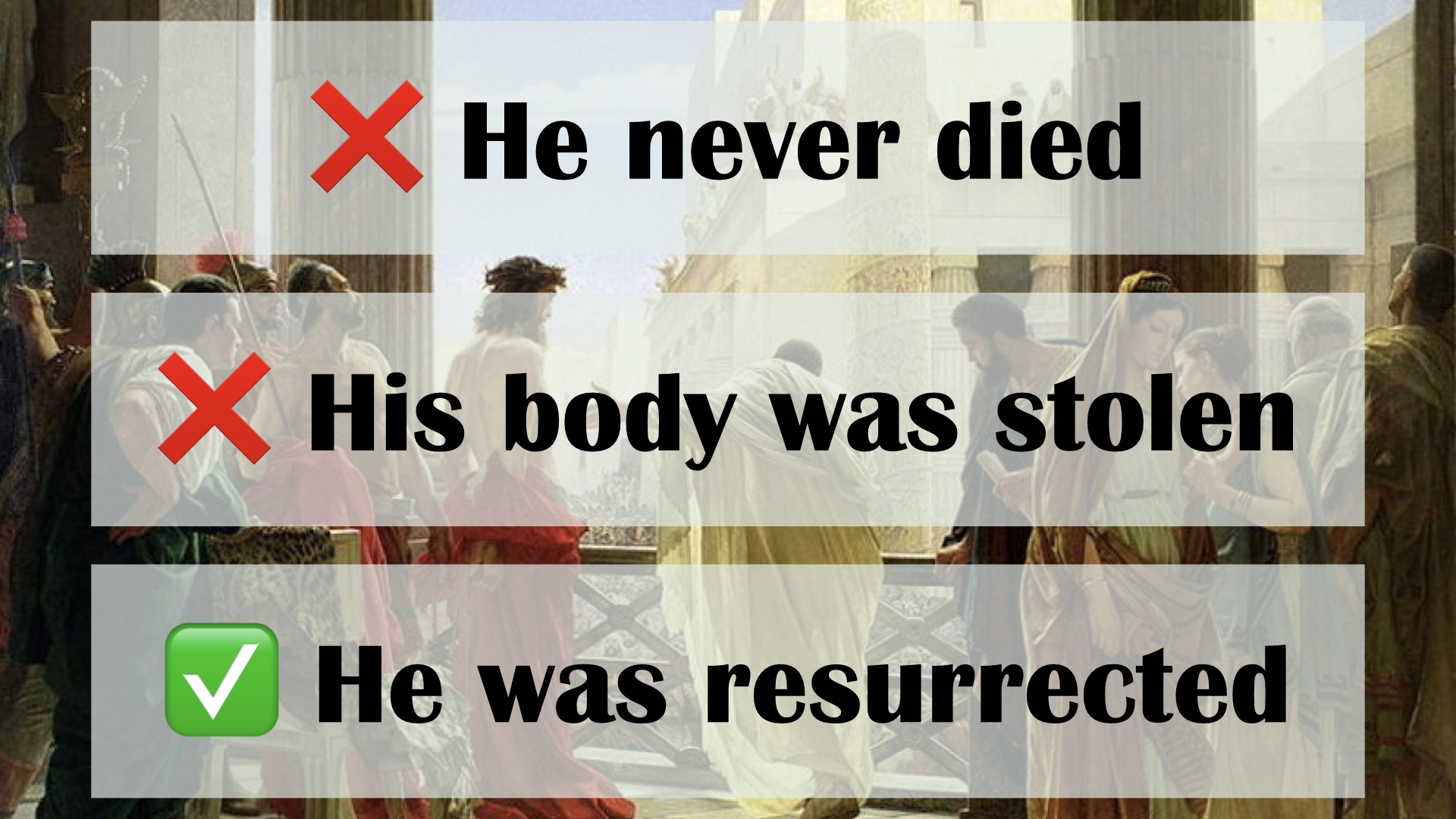
Then when there is no body where the dead body of Jesus is expected, there are only three possibilities: 

(1) He never died

Medical experts have concluded that the horrific torture that Jesus endured prior to even being crucified resulted in significant blood loss, and would have put His body in shock. Then the strain on His weakened body during crucifixion would have resulted in His body experiencing either pleural effusion or cardiac effusion, which is attested to by the flow of “blood and water” from Jesus’ dead body when His side was pierced by a Roman spear (John 19:34). 

The dead body of Jesus was thoroughly examined by both the Romans who conducted the crucifixion and His friends who prepared His body for burial (Mark 15:43-45; John 19:38-40). And two contemporary historians—Tacitus and Josephus—who were unfriendly to the cause of Christianity both attested to Christ’s death by crucifixion. 

(2) His body was stolen

The Sanhedrin was so insistent on Jesus being crucified, they wouldn’t have left the “conspiracy” option open. So they convinced Governor Pontius Pilate to allow them to both seal the tomb and place a group of soldiers outside the tomb to guard it (Matthew 27:62-66). It is highly unlikely that the disciples who fled before the temple guard and who were now locked in a room because they were quaking with fear would somehow gain the courage to undertake a mission to steal Jesus’ body. Nor is it likely that they could have escaped the notice of the highly-trained Roman soldiers guarding the tomb. 

(3) He was resurrected 

The angels at the empty tomb reminded the women that Jesus had foretold both the manner of His death and the assurance of His resurrection. Jesus described His death in detail multiple times, including such key details as His death would be in Jerusalem, the religious leaders would pronounce a death sentence but the Romans would crucify Him, and that He would be resurrected three days later (Matthew 20:18-19; Luke 18:31-33). In addition, Paul tells us that there were hundreds of eyewitnesses to the resurrected Jesus (1 Corinthians 15:3-8). 

Jesus said, “The reason my Father loves Me is that I lay down My life—only to take it up again. No one takes it from Me, but I lay it down of My own accord. I have authority to lay it down and authority to take it up again. This command I received from My Father” (John 10:17-18). 

If Jesus foretold this and fulfilled this, we can also trust His other promises. Assurances such as:

  • He is preparing an eternal home for us and He will come back to take His followers there 
  • That He alone holds the keys to Death and Hades
  • And that only those who have been cleansed from their sins will be able to enter Heaven

(see John 14:1-3; Revelation 1:18, 22:12-14)

The bold claim that Jesus would be resurrected back to life is adequately backed up by the events on Resurrection Sunday! So now we can say that believing the bold claim of Christ’s resurrection gives us hope for the future and reason to tell others about Him! 

If you’ve missed any of the other bold claims that we have discussed, you can find them all by clicking here. 

►► Would you please prayerfully consider supporting this ministry? My Patreon supporters get behind-the-scenes access to exclusive materials. ◀︎◀︎
Respectful Boldness

Listen to the podcast of this post by clicking on the player below, and you can also subscribe on AppleSpotify, or Audible. 

As we near the crucifixion of Jesus, we begin to see how politics plays a role in so many decisions. The Sanhedrin is trying to balance their popularity with the Jewish people and their standing with powerful leaders in the Roman government. Pontius Pilate is trying to balance how the Sanhedrin portrays him to the Jewish people and what those in Rome are telling Caesar Tiberius about him. King Herod Antipas also has issues with balancing the pressure from the Sanhedrin with the popularity of Jesus. 

Luke gives us a very telling statement about the politics of the day when he writes, “That day Herod and Pilate became friends—before this they had been enemies” (Luke 23:12). How did they become friends over this issue of what to do with Jesus? Remember that the Sanhedrin is a common thorn-in-the-side for both of them, and the political axiom that still holds to this day says, “The enemy of my enemy is my friend.” 

I point out all of the political maneuverings during this pivotal time because these political balancing acts are still being played out today and Christians will end up in the crosshairs. 

Pilate was trying to appease the Sanhedrin but there was no Roman law that Jesus had broken that was deserving of the death penalty they were demanding. So twice Pilate tells these religious leaders, “I will punish Him and then release Him.” In fact, without waiting for their approval, Pilate subjects Jesus to the tortuous punishment known as flagellation (Luke 23:13-22; John 19:1-11). 

I think Pilate believed that if they saw Jesus so humiliated and beaten down they would back off from their desire for His death. But Pilate miscalculated their commitment to seeing Jesus eliminated from the scene. 

Pilate finally gives in and says, “You take Him and crucify Him. As for me, I find no basis for a charge against Him.” But the Jewish religious leaders insisted, “We have a law, and according to that law He must die, because He claimed to be the Son of God.” 

If you have ever watched a movie about the gladiatorial games in the Roman Colosseum, you’ve probably viewed the scene where one combatant is disarmed and helpless. Before the victor strikes his deathblow he will look to Caesar in the stands. The Roman Caesar will either give a thumbs-up signal to pardon the victim or he will give a thumbs-down signal to send the defeated one to their death. 

Pilate has this same authority here in the region of Judea. The Sanhedrin knew Pilate had the power of life and death, so did the convicted prisoner Barabbas, and so did Jesus. 

Pilate asks Jesus, “Don’t You realize I have power either to free You or to crucify You?” 

There was another king who called himself “king of kings” but God called him “My servant.” He was King Nebuchadnezzar of Babylon. Daniel, an exile from Israel who was Nebuchadnezzar’s prime minister, reminded him where his authority originated, “The Most High is sovereign over all kingdoms on earth and gives them to anyone He wishes” (Daniel 4:17). 

In the same way, Jesus addressed Pilate, “You would have no power over Me if it were not given to you from above.” 

John Piper wrote: “This does not intimidate Jesus because Pilate’s authority over Jesus is subordinate to God’s authority over Pilate. Jesus gets His comfort at this moment not because Pilate’s will is powerless, but because Pilate’s will is guided. Not because Jesus isn’t in the hands of Pilate’s fear, but because Pilate is in the hands of Jesus’s Father.” 

Jesus shows us an important principle: Should we respect our leaders (even the ungodly ones)? Yes! Should we fear them? No! 

We don’t fear them because their power is limited to just this life and is under the control of the Most High God (Luke 12:4). Peter and John learned this lesson well, as we see in their interaction with the same Sanhedrin that turned Jesus over to Pilate (see Acts 4:1-10). What Jesus and these apostles demonstrate for us is respectful boldness.

In light of this, here are five things Christians should keep in mind. When persecution comes against us, we should respond like this: 

  1. Be prepared—Matthew 5:11-12; John 15:20
  2. Be respectful—1 Peter 2:17 
  3. Be loving—Matthew 5:44
  4. Be prayerful—Acts 4:27-30
  5. Be bold—Acts 4:18-20

(Check out all of the above Scriptures by clicking here.)

Jesus taught us there is a time for eloquent silence, but when the Holy Spirit needs us to speak, He will give us the respectfully bold words to share. Jesus said, 

On My account you will be brought before governors and kings as witnesses to them and to the Gentiles. But when they arrest you, do not worry about what to say or how to say it. At that time you will be given what to say, for it will not be you speaking, but the Spirit of your Father speaking through you. (Matthew 10:18-20)

Respectful? Yes. Fearful? No. Respectful, loving, prayerful boldness is how we will glorify the Most High God in the face of persecution. 

If you’ve missed any of the other messages in our series of Bold Claims, you can find them all here. 

►► Would you please prayerfully consider supporting this ministry? My Patreon supporters get behind-the-scenes access to exclusive materials. ◀︎◀︎
Eloquent Silence

Listen to the podcast of this post by clicking on the player below, and you can also subscribe on AppleSpotify, or Audible. 

We’ve just looked at two back-to-back bold statements of Jesus. To the Sanhedrin, He said, “I am the I AM,”  and to Pontius Pilate, He said, “I am a king.” Christ’s third bold claim essentially amounts to, “And I don’t have to prove either of these to you; I don’t have to argue with you about it.” 

After He was arrested, there was a back-and-forth shuttling of Jesus from the Sanhedrin to Pilate, then from Pilate to King Herod, and then back to Pilate again. Pilate told the Sanhedrin, “I find no basis for a charge against Him.” But the Sanhedrin countered, “But He is stirring up trouble all the way from Galilee to here in Jerusalem!” (see Luke 22:67-23:11).

Pilate was looking for “an out”—a way he could safely discharge or punish Jesus that would keep both the Sanhedrin and his Roman superiors happy. So when Pilate heard that Jesus was from Galilee, he was more than happy to pass this “hot potato” to King Herod. When Jesus was hauled before Herod, we read that he was greatly pleased to see Jesus. 

Why was that? To answer that question, we need to understand who Herod was. His name is Herod Antipas, and he was the son of Herod the Great. Herod the Great was king when Jesus was born, and he was the one who attempted to kill Jesus. 

Herod Antipas was infamous for having seduced his sister-in-law Herodias, whom he married after divorcing his wife. Shortly after this, Herod arrested John the Baptist for calling out this marriage as sinful. Herodias especially was embarrassed by this and wanted John killed, but Herod feared the backlash from the people if he did this. Eventually Herodias got her way and Herod was forced to have John beheaded (Matthew 14:5; Mark 6:17-28).

When news about Jesus began to reach his ears, Herod thought that Jesus was John reincarnated and he wanted to see him (Luke 9:9). So now when Jesus is brought before him, Herod is looking for a magic trick—Jesus remains silent. Then the religious leaders resume their accusations against Jesus, and still He remains silent. Then Herod and his soldiers began mocking and ridiculing Jesus, and amazingly, He still doesn’t say a word. 

Jesus knew the Scriptures that make it clear that there is nothing to be gained by bantering with fools. For instance, Solomon wrote, 

Do not answer a fool according to his folly, or you yourself will be just like him. … Don’t waste your breath on fools, for they will despise the wisest advice. (Proverbs 26:4, 23:9). 

So here is the next bold claim from Jesus: {Eloquent silence.}

Even in the face of accusation, ridicule, and mocking, Jesus refused to engage in meaningless arguing with Herod or the Sanhedrin’s false witnesses. His silence was so eloquent that it got the attention of Governor Pilate:  

“Then Pilate asked [Jesus], ‘Don’t You hear the testimony they are bringing against You?’ But Jesus made no reply, not even to a single charge—to the great amazement of the governor.” (Matthew 27:13-14) 

Let’s learn from Jesus: Sometimes the best thing to say is NO thing! 

Peter pointed Christians to this example of Jesus when he wrote—

To this you were called, because Christ suffered for you, leaving you an example, that you should follow in His steps. “He committed no sin, and no deceit was found in His mouth.” When they hurled their insults at Him, He did not retaliate; when He suffered, He made no threats. Instead, He entrusted Himself to Him who judges justly. (1 Peter 2:21-23)

Jesus called us to let our good deeds shine brightly to bring glory to God. Fools will ridicule and mock and accuse us, just as the religious crowd did to Jesus. Let’s not let our bantering with fools put out the light of our testimony. 

When I was a little kid in Sunday School, we used to sing a song called This Little Light Of Mine. We would hold up our pointer finger like a candle as we sang. But holding up our pointer finger across our lips is also a way to let our light shine too. Your silence in the face of foolish ridicule will speak so eloquently!

Let’s learn this lesson from Jesus. Instead of bantering with fools, entrust yourself to the perfect Judge who is perfectly keeping track of every word. He is the One who can add eloquence to your silence as you shine brightly for Him. 

If you’ve missed any of the other messages in our series of Bold Claims, you can find them all by clicking here. 

►► Would you please prayerfully consider supporting this ministry? My Patreon supporters get behind-the-scenes access to exclusive materials. ◀︎◀︎

Our Perfect King

Listen to the podcast of this post by clicking on the player below, and you can also subscribe on AppleSpotify, or Audible. 

Our country has a policy of separation of church and state, and that appears to be a good thing. When the head of the government starts telling the church how to worship, or when the head of the church starts telling the government how to run its affairs, strife typically results. 

There have been some notable examples of wise kings who were God-fearing rulers, and some examples of religious leaders who had the wisdom to make just laws. But history has most often shown us that when a king imposes on the church a mode of worship or a pastor imposes on the king religious ways of governing, clashes result. Some of them have been bloody civil wars and some have spread into international conflicts. 

That being said, wouldn’t it be better for everyone if there was a way that one person could hold both of those offices simultaneously? If only there was some way to bring those different offices together. Very few people could ever accomplish this because it would require a perfect person with both absolute wisdom and complete God-honoring selflessness, someone so confident in both their wisdom and their relationship with God that they would never be swayed unfairly one way or the other. 

Last week we saw the first bold claim from Jesus: “I am the I AM.” With this title and authority, Jesus claimed to be the Head of the Church. This is a title Paul uses several times in his letter to the church at Ephesus (Ephesians 1:22, 5:23). Paul goes on to remind us that our aim as the Church body is to grow into maturity under the Headship of Jesus (Ephesians 4:15). 

Consider two other notable rulers during this same time period. As the high priest, Caiaphas would have laid claim to the title of “head of the church.” As the Roman governor, Pilate would have laid claim to the title of “head of the government in Judea.” Yet both of them clearly demonstrated that they had “become the symbol of those who make religious decisions based on political expediency rather than truth and justice,” as Dr. Donald Stamps noted. 

Paul goes father than calling Jesus simply the Head of the Church—

And He [Jesus] is the head of the body, the church; He is the beginning and the firstborn from among the dead, so that in everything He might have the supremacy. (Colossians 1:18) 

Not just Headship over the Church, but Headship over “everything.” 

After the bold claim of Jesus that He was the I AM, the Sanhedrin wanted to have Him put to death, so they took Jesus to Pontius Pilate (Luke 22:71—23:2; Matthew 27:1-2; John 18:28-37). 

Pilate “knew it was out of self-interest that they had handed Jesus over to him” (Matthew 27:18), but he still asked Jesus, “Are You the king of the Jews?” Just as Caiaphas was trying to save his position of power by keeping a delicate balance between the Jews and the Romans, Pilate was also trying to save his skin. Pilate was trying to appease both the Sanhedrin and Tiberius Caesar. 

Jesus answers Pilate’s question in a way Pilate never expected. Twice Jesus says “My kingdom,” noting that His kingdom is other-worldly. His kingdom comes from outside this world and therefore supersedes any government of this world. Pilate clearly has never heard anything like this, so after hearing this statement he announces, “You are a king, then!” 

Just as Jesus had answered the Sanhedrin with, “You are right in saying I am the Messiah,” now He answers Pilate, “You are right in saying I am a king.” 

Combining those two bold claims—“I am God” and “I am a King”—Jesus is the only One who can perfectly hold both offices without any conflict. This is what the prophecy in Isaiah 9:1-7 foretold, and this is the fulfillment that John shows us at the end of time (Revelation 17:14, 19:11-16). 

What does this mean for us? How are we now supposed to live knowing Jesus as our God and as our King? We should live confidently before our King and humbled before our God. We don’t fear earthly kings, but neither do we fight them. We don’t have to try to convince earthly kings to rule a certain way because they are God’s servants to accomplish God’s plan. We don’t have to get caught up in the politics of the day because this day will come to an end. 

We are subjects of a kingdom not of this world, so the kings of this world don’t get to decide our final destiny!

(If you would like to explore this topic further, check out my series of messages from 1 Peter called Aliens and Strangers.)

If you’ve missed any of the messages in our series called Bold Claims, you can find the full list of messages by clicking here. 

►► Would you please prayerfully consider supporting this ministry? My Patreon supporters get behind-the-scenes access to exclusive materials. ◀︎◀︎

Is My Boldness Clearly Visible?

Listen to the podcast of this post by clicking on the player below, and you can also subscribe on AppleSpotify, or Audible. 

Some people are either afraid to say what they really think, or else they aren’t entirely confident in what they believe. As a result, they tend to take an indirect approach to communicate what they want someone else to hear. 

Some try to imply what they’re really trying to say: “Do you get what I’m saying? Can you read between the lines?” Others hope the other person will infer the right meaning. But bold claims are something completely different—there’s no implying, no hoping the other person will infer the right thing, but just a clear statement. Like Caiaphas’ statement that we looked at last week: “Jesus must die so that the rest of us can keep our cushy positions.” 

You can always tell if the message got through by how the recipients respond. Usually the stronger the reaction, the more clearly the message was received! 

Remember that I talked about the clout that Annas still held, even though he wasn’t officially the high priest anymore? We see it right after the arrest of Jesus. Instead of taking Him directly to the Sanhedrin, He was first taken to Annas. There Jesus was questioned about His followers and His teaching, and He simply replied, “Everything I taught is public knowledge. I’ve boldly and clearly proclaimed Who I am” (John 18:12-14, 19-24). 

All throughout His public ministry, Jesus did make it clear who He was. There are so many places we could read about this in the Gospels, but let me just show you three examples from the Gospel of Luke:

    1. He forgives sins and heals a paralytic to prove that He has the power of God to forgive—Luke 5:20-25 
    2. Demons recognize Him and submit to His power—Luke 8:28-35 
    3. His disciples recognize that Jesus is the Son of God—Luke 9:18-22

(Check out all of the above references by clicking here.) 

Finally, Jesus was asked directly by the Sanhedrin and He made His bold claim that He was indeed the Son of God (Luke 22:66-71). Remember I said earlier that you can tell how clearly the message got through by the response of the people? Well, check out this response—

Then the high priest tore his clothes and said, “He has spoken blasphemy! Why do we need any more witnesses? Look, now you have heard the blasphemy. What do you think?”

“He is worthy of death,” they answered. (Matthew 26:65-66)

What about you and me? Do we have to imply that we believe Jesus is the Son of God? Do we have to hope the other person will infer that we are His disciples? Or can it be said that our verbal and lifestyle testimony is a bold claim of what we believe and Whose we are? 

The Book of Acts records the response of the Sanhedrin to the first Christians, and it appears to be identical to their response when they heard Jesus say, “I am the Son of God.” For instance: 

  • After Peter and John healed a lame man, the Sanhedrin could see “that these men had been with Jesus” but they ordered them not to talk about Jesus anymore. These men said they could not obey that directive (Acts 4:13-14). 
  • When they were called back in for a second appearance, Luke tells us the Sanhedrin “were furious and wanted to put them to death.” But they persisted in boldly proclaiming Jesus to everyone (Acts 5:30-39). 
  • Then there was an early church leader named Stephen. His bold preaching brought him before the Sanhedrin as well, who ended up stoning him to death (Acts 6:8-10, 15; 7:55-56).

(Check out all of the above references by clicking here.)

So let me repeat the question: Can it be said that our verbal and lifestyle testimony is a bold claim of what we believe and Whose we are? Or do we simply speak empty words? 

Jesus made His bold claim and He backed it up. What about us? Do we make the bold claim that we will stand for Jesus even if that means we will be ridiculed, persecuted, or killed? Is our bold claim backed up by a lifestyle of complete trust in our Savior? These are questions every Christian should ask and allow the Holy Spirit to help them answer honestly. 

If you’ve missed any of the messages in our series called Bold Claims, you can find them all by clicking here. 

►► Would you please prayerfully consider supporting this ministry? My Patreon supporters get behind-the-scenes access to exclusive materials. ◀︎◀︎

When “The End” Is Just The Beginning

Listen to the podcast of this post by clicking on the player below, and you can also subscribe on AppleSpotify, or Audible. 

We’ve all heard people make some audacious claims. But the real power is in being able to back up those claims. Without any proof, it’s all talk! As things were coming to a conclusion for Christ’s ministry—at least in the world’s eyes—there were some bold claims being made. Some were made by Jesus Himself, some by His rivals, and some by His supporters. 

The first bold claim we’re going to consider was made by the high priest: a man named Joseph Caiaphas. 

The Sanhedrin was the highest court in the land and was made up of 70 + 1 men. This comes from Numbers 11:16-17 (seventy leaders) plus Moses. After Moses, another person was always appointed to serve as the leader, which was usually the high priest. 

By the time of Jesus, this ruling body had become more political than religious. Very frequently, leadership would change because of the whims of the Romans or their puppet leaders (someone like a King Herod). The high priest in Christ’s early years was a man named Annas, who served from AD 6-15. During all of the public ministry of Jesus, the high priesthood had transferred to Caiaphas (AD 18-36), who was Annas’ son-in-law. Yet both of them still shared considerable influence (see Luke 3:2; John 18:13, 24; Acts 4:6). 

Caiaphas and his family were Sadducees. They didn’t hold to any beliefs of the supernatural—no angels or demons, no resurrection, no afterlife. Partly because of these unscriptural beliefs, the Jewish Qumran, who safeguarded the careful copying of the Scriptures, called Caiaphas “the wicked priest.”

Annas, Caiaphas, and their family member were the ruling party that wanted to stay in power. So their activities were always a balancing act: Trying to keep the Jewish community happy on one hand, while not offending the Romans or other political leaders on the other hand. 

It’s with this backdrop that we read the story of Lazarus’ resurrection in John 11. Jesus knew this miracle would validate His ministry, and sure enough, after the resurrection of Lazarus, more and more people put their faith in Jesus. So much so that the religious leaders wanted to kill both Jesus and Lazarus (11:53; 12:9-11). 

Ironically, these same religious leaders had previously asked Jesus for a sign to prove He was who He made the bold claim to be. To this demand, Jesus said that He would give them “the sign of Jonah” who was considered dead in the belly of the fish before he was “resurrected” to complete his mission (Matthew 12:38-40, 16:1-4). 

Since the religious leaders viewed everything through a political lens, they thought Jesus was also going to instigate a political or military uprising. The following that Jesus would gather would challenge the Sanhedrin’s hold on power, so Caiaphas proposed a political solution disguised as a prophecy (John 11:49-53). 

Caiaphas meant it like this: “We’re trying to keep the balance between the Jewish people and the powerful Romans. If we kill one Man (Jesus) in time, we may be a little out of favor with the Jews but we will save our position with the Romans. Later on, we’ll make things right with the common people.” 

Even to this day, people are trying to balance, juggle, control, appease, and bargain their way to get or keep the life they want to live. They will use religious dressing to do political things, thinking they will “make it right” later on. 

Caiaphas made this bold claim: “If Jesus dies, our position will be saved for us and our children.” But he had no power to back up his bold claim, so it was just talk. 

But Jesus made this bold claim: “I will die so that your souls can be saved for eternity.” He, on the other hand, had the power to back up His bold claim (John 10:17-18). 

God’s plan always prevails! 

Caiaphas’ plan sounded like it would be the end of Jesus and His mission, but “the end” was really just another step in fulfilling what God had already planned! 

Let me say it again: God’s plan always prevails. The bold claims of powerful evil people may make it seem like the end is near, but don’t fret because their “end” is only fulfilling God’s plan! 

If you’ve missed any of the messages in this series of Bold Claims, you can check them all out by clicking here. 

►► Would you please prayerfully consider supporting this ministry? My Patreon supporters get behind-the-scenes access to exclusive materials. ◀︎◀︎

All Talk But No Action

Listen to the podcast of this post by clicking on the player below, and you can also subscribe on AppleSpotify, or Audible. 

What people were saying about Jesus from His birth—before He preached a sermon, performed a miracle, or stepped on the toes of religious or political leaders—was revealing the truth. I’ve already discussed the words of the Magi and King Herod the Great, but all of these men also interact with another group (Matthew 2:1-6). Matthew calls them “all the people’s chief priests and teachers of the law.” 

This group was commonly called the Sanhedrin. It was an influential body of 70 + 1 leaders (Numbers 11:16), whose influence was felt in the temple in Jerusalem, in the synagogues in small villages, in King Herod’s throne room, and in the palace of the Roman governors. 

Notice that Matthew says “chief priests” in the plural. At the time of the birth of Jesus, Caiaphas was high priest and Annas his father-in-law was the former high priest. In the time of the early church, Annas is again called the high priest (Luke 3:2; John 18:13; Acts 4:6) 

Even under the Roman government the Sanhedrin held tremendous power…

  • they were experts in the Mosaic law and its application (Matthew 22:35) 
  • Jesus said, “the teachers of religious law and the Pharisees are the official interpreters of the law of Moses” (Matthew 23:2 NLT) 
  • Jesus also said they had storehouses of helpful knowledge (Matthew 13:52) 
  • they decided who would get to use their authority (Mark 11:27-28; 1:22) 
  • they were keepers of the traditions and became “indignant” when those traditions weren’t followed (Mark 7:5; Matthew 21:15) 
  • they were exorcists (Mark 9:14-17; Acts 19:13-14) 
  • Jesus said these leaders would be instrumental in His death (Matthew 16:21) 
  • they had their own armed guards and prisons (Mark 14:43; Acts 4:1; 5:18) 
  • yet they were afraid of the opinions of the people (Luke 22:1-2; Mark 11:31-32) 

(check out all of the above Scriptures by clicking here)

Jesus said they were “the official interpreters of the law,” yet they oftentimes interpreted the law to benefit themselves. 

When Herod asks them where the Messiah is to be born, they quote Micah 5:2 as saying, “a Ruler who will be the Shepherd of My people Israel.” But the word they use for “Ruler” means a leader with authority, or a governor (the same word is used for Joseph in Acts 7:10). Remember Herod’s violent temper and his insane suspicion? The word these religious leaders used gave them an “out.” They were almost saying to Herod, “When the Messiah does come, He will be a governor, which means there’s a good chance that He would report to you.” This “tame” interpretation was an attempt to keep them in the good graces of King Herod the Great 

But Micah himself uses the word for “Ruler” that means one with absolute dominion. Jesus will be THE Sovereign King. 

After hearing that this long awaited Messiah had finally been born in fulfillment of the prophecies, take a look at their response—

  • they said   . 
  • they did   . (even though Bethlehem was only 6 miles away!) 

How sad! 

But I think this is because they believed themselves to be “in” with Jehovah because they so carefully kept the rules. They didn’t need a Messiah to save them because—in their minds—they believed they were already saved from God’s punishment. 

Keeping religious rules doesn’t save anyone. 

Honoring age-old traditions doesn’t save anyone. 

Only coming to Jesus saves anyone! 

A key prophecy about Jesus in Isaiah 9:2 says that the Messiah will save us from darkness and shadows. What exactly are these? 

The writer of Hebrews tells us that the law and rules are merely shadows of the True Substance. God said through Isaiah that relying on the rules keeps us trapped in meaningless religious traditions. But Jesus came as the Light and as the Substance that set us free. His death and resurrection made it possible for our sins to be forgiven (see Hebrews 10:1-7; Isaiah 1:11-14, 18).

Rules don’t take us into God’s presence, but Jesus does. Not just talking about Jesus, but coming to Jesus as our Savior and Lord. 

People will talk about Jesus—even you may talk about Him. That doesn’t do anything. But when we do more than talk—when we come to Him to follow Him as our Ruler and Shepherd—then we find forgiveness and freedom. 

Let’s not just talk about Jesus, but let’s be actively obedient! 

If you’ve missed any of the messages in our Advent series People Will Talk, you can find those messages by clicking here. 

►► Would you please prayerfully consider supporting this ministry? ◀︎◀︎