No, I’m not repeating myself; I’m just quoting the pattern in the Bible (specifically Leviticus 26).
God’s laws are inviolate. No conditions will be made, nor any exceptions allowed. The conditions in Leviticus 26 apply as much to the Israelites in 1400 BC as they do to us in the United States of America today.
IF we obey God’s Word, He will bless us with His favor (verses 3-13).
BUT IF we disobey, He will set His face against us (verses 14-17).
IF we continue to harden our hearts and remain unrepentant, God’s punishments will grow increasingly more severe (verses 18-39).
BUT IF we repent wholeheartedly, God will again restore us (verses 40-45).
It’s time for us in America to wake up to this reality! If God held His chosen people, the Israelites, to this, how much more so will He not hold us to it.
We in America have violated God’s principles for too long. We have clearly moved through the first IF and BUT IF stages. I believe we are now in the second IF stage. But the hopeful news is that there is still another BUT IF stage for us to obtain, if only we will repent and ask God’s forgiveness.
It starts with me and with you. Will you join me in asking for repentance and praying for God’s favor to visit us once again?
The opening words of Psalm 119 describe the end result of going through what I’m calling the P119 Spiritual Workout. In a word: Blessed.
In fact, this word is so exciting that the Hebrew language uses the emphatic thought here. Bringing that into English means that the first two verses of this chapter both begin…
O!! How blessed!!
That’s a wonderful goal, but the next two verses seem to bring us crashing back to earth. In order to enjoy these heights of blessing we are asked to live like this:
They do nothing wrong as they walk in His ways (v. 3).
God’s precepts are to be fully obeyed (v. 4).
Yikes! Nothing wrong?! Full obedience?! No mistakes?!
Even Jesus said, “Be perfect, therefore, as your Heavenly Father is perfect” (Matthew 5:48).
But pay attention to this: The sign of a maturing Christian is not one who never sins;the sign of a maturing Christian is one who is closing the gap between sin and repentance.
How does that work? Here’s the progression…
Realization of sin → Repentance of sin → Restoration of God’s blessing
The time gap between our repentance and God’s restoration is faster than the blink of an eye—faster than you can even comprehend. What often takes us a while is moving from realization to repentance. Instead, we explain, and justify, and make excuses, and drag our feet.
But a maturing Christian invites the inspection of the Holy Spirit through the reading of God’s Word and then is quick to realize sin and repent from it. When God restores us, do you know how we appear to Him? PERFECT!!
So realizing our sin, repenting of that sin, and experiencing God’s restoration is the fastest way to live as those who do nothing wrong and who are fully obeying God’s precepts.
Don’t wait any longer: realize and repent, and then experience God’s restoration as you stand perfect in His presence!
Listen to the podcast of this post by clicking on the player below, and you can also subscribe on Apple, Spotify, or Audible.
As a pastor, one of your responsibilities is to point out what may be harmful in someone’s life. We have a word for that: confrontation.
Handled correctly, confrontation can lead to restoration and newfound maturity. Handled incorrectly, and, well, let’s just say it can get very ugly!
I just heard the story of a pastor who felt like he needed to confront one of his board members. I don’t really know this pastor, nor do I know the board member; I don’t know what was said in their meeting, but I have heard about the outcome, and it got ugly.
Samuel was going to be sent by God to confront King Saul about the sin he had committed. Look at this passage:
Then the word of the Lord came to Samuel: “I am grieved that I have made Saul king, because he has turned away from Me and has not carried out My instructions.” Samuel was troubled, and he cried out to the Lord all that night. (1 Samuel 15:10-11)
Did you catch how Samuel responded? He cried out to the Lord all that night.
Perhaps if we, as pastors, cried before we confronted the results might be more healthy.
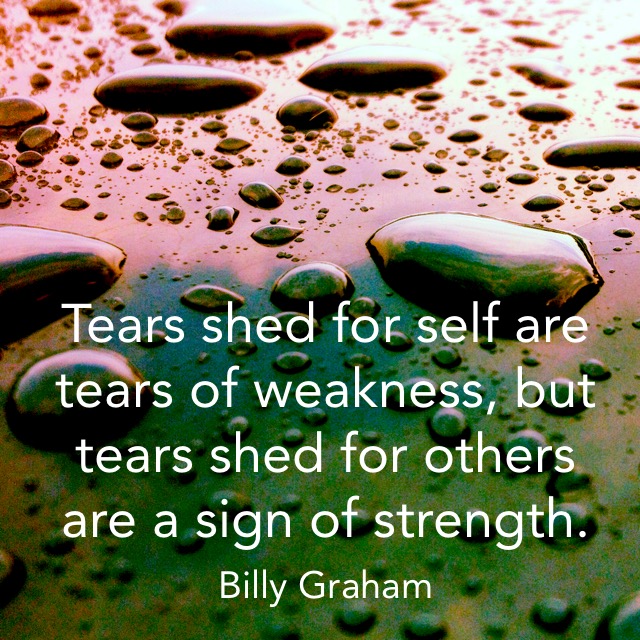
“Tears shed for self are tears of weakness, but tears shed for others are a sign of strength.” —Billy Graham
Nehemiah was another pastoral/prophetic figure that was going to confront the inhabitants of Jerusalem about their sin.
When I heard these things, I sat down and wept. For some days I mourned and fasted and prayed before the God of heaven. Then I said: …I confess the sins we Israelites, including myself and my father’s house, have committed against You. (Nehemiah 1:4-6)
Before Nehemiah confronted the sins of the people, he tearfully took a hard look at himself, and then asked for forgiveness. Jesus shared this same concept with these words:
Why do you look at the speck of sawdust in your brother’s eye and pay no attention to the plank in your own eye? How can you say to your brother, “Let me take the speck out of your eye,” when all the time there is a plank in your own eye? You hypocrite, first take the plank out of your own eye, and then you will see clearly to remove the speck from your brother’s eye. (Matthew 7:3-5)
So before you confront your brother or sister, let the Holy Spirit confront you. Then, if it’s needed, confess your sin and ask God’s forgiveness. Let the Holy Spirit remove things in your life so that you can see clearly how to lovingly confront your brother.
Cry before you confront. Cry over your sin. Cry over the sinful state of your brother or sister. Plead with the Lord for this time of confrontation to lead to restoration and maturity.
I was reading and meditating on Matthew 11:28-30. These are the notes just as a jotted them down in my journal. I pray they will be as helpful for you as they were for me.
Come—without delay
to Me—Jesus is my only Source
all—no one is ever excluded from Christ’s call
you who are weary—I feel like I have been working hard, but gaining little ground
and burdened—and my conscience is bugging me because I feel I’m falling short of what God requires
and I will—only Jesus can do this
give you rest—a quiet, calm, patient expectation of a better future
Take—I need to apply what Jesus says to my life right now
My yoke upon you—Christ’s power to fulfill God’s requirements
and learn from Me—I must get in the habit of doing things His way
for I am gentle—strong enough to help me, but in a way that doesn’t overwhelm me
and humble in heart—He has the perfect attitude toward our Heavenly Father, and He can show me how to live this way too
and you will find rest—an intermission from my struggles
for your souls—the real me
For My yoke is easy—virtuous and pleasant
and my burden is light—relieving my conscience from worry and guilt
Why do I wait until I am wearied and burdened before I come to Christ? Why don’t I just take His yoke upon me daily? It’s my self-imposed burdens, from trying to do things my own way, that wear me out and beat me up! O stubborn pride! that keeps me toiling away, trying to do life my way. Submit and be free, O my soul!
Listen to the podcast of this post by clicking on the player below, and you can also subscribe on Apple, Spotify, or Audible.
How would you define loyalty? All of the dictionary definitions have to do with faithfulness. It’s almost implied that there is a blindness (at worst), or a dogged persistence (at best), to remain loyal to a person or to an idea. The thinking goes, “If I’m loyal to someone, like it or not, I become their Yes-man.”
But I think…
Loyalty is not telling people what they want to hear, but what they need to hear.
For an example, take the prophet Nathan in the Bible. We don’t know how old he is when he steps on the scene, or even where he came from. There isn’t a clue as to his tribal ancestry or even his father’s name.
King David wanted to build a temple for the ark of the covenant of the Lord, and he asked Nathan about this. Nathan immediately said, “Yes!” (kinda reinforces that idea of loyalty = Yes-man, doesn’t it?) But wait! That night, God speaks to Nathan and says, “Tell David he’s not the one to build the temple for Me.” So Nathan returns to David and loyally tells him no.
Later on, David steals another man’s wife and contrives a plan to have that man murdered on the battlefield. David thinks he’s gotten away with it until Nathan, the loyal friend, shows up to confront David with his sin. Nathan didn’t want to see David fail, but he wanted to give him a chance to confess and repent.
Near the end of David’s life, one of David’s sons, Adonijah, wanted to take the throne for himself. Many of the officials in David’s palace jumped on the bandwagon, but loyal Nathan did not. In fact, Nathan even got word to the King about Adonijah’s plans. As a result, David asked Nathan to anoint his son Solomon as king.
During David’s life, Nathan wrote David’s biography. If Nathan was just a mindless Yes-man, he could have easily left out the messy parts of David’s life. But the loyal friend wanted to show future readers that we all mess up, but God forgives and restores us when we repent.
Nathan’s name means the gift God gave or a giver. Both meanings fit this loyal man.
Loyal friends give their friends the gift of life. They don’t let friends go down a destructive path. They don’t join with others when they attack. They remain constant, always-there, friends.
What a blessing to be called a loyal friend! And what an even greater blessing to have “Nathans” in our own lives!
Imagine: You and your wife are the only people on the face of the earth. No bills, no employer, no economic downturn, no kids, no school, no traffic. Just you and God. That was Adam and Eve in the Garden of Eden. The Bible gives this commentary, “Now the man and his wife were both naked, but they felt no shame.”
Nothing to hide from God. Nothing to hide from each other. A perfect relationship with God. A perfect relationship with each other.
Then the temptation, and the bite of the forbidden fruit. Sin enters. Now, something changes when God comes to talk with His favorite couple: “Then the man and his wife heard the sound of God as He was walking in the garden in the cool of the day, and they hid from God among the trees.”
“Why are you hiding from Me?” God asks.
“Uh,” Adam stammers, “because we’re naked.”
Sin made mankind uncomfortable in God’s presence. Sin made them want to hide from God. They knew He was there, but they tried to pretend He wasn’t. This is why I think many of us don’t come into God’s presence in prayer: we’re uncomfortable because of our sin.
We should not run away from God, instead, we should run to Him. “If we confess our sins to Him, He is faithful and just to forgive us our sins and to cleanse us from all wickedness” (1 John 1:9).
What happens when we’re forgiven? We’re re-clothed. God Himself clothes us. He made clothes for Adam and Eve, and He clothes us, too, in the righteous robes of Jesus. “And all who have been united with Christ in baptism have put on Christ, like putting on new clothes” (Galatians 3:27).
And when we’re clothed in Christ, we no longer have to hide from God, nor feel uncomfortable in His presence. Instead, we can “come boldly to the throne of our gracious God. There we will receive His mercy, and we will find grace to help us when we need it most” (see Ephesians 3:12 and Hebrews 4:16).
Perhaps the reason we don’t spend enough time in prayer is that we feel self-conscious, sinful, uncomfortable… naked.
You don’t have to be naked. You can be clothed in Christ. You can enter into God’s presence without shame and find the mercy and grace and help that you need.
I’m struggling with this one. I have a dear friend who is perplexed by an ongoing drug addiction. He appeared to have it under control until things in his life started spiraling out of his control, and he gave in to his old habit again.
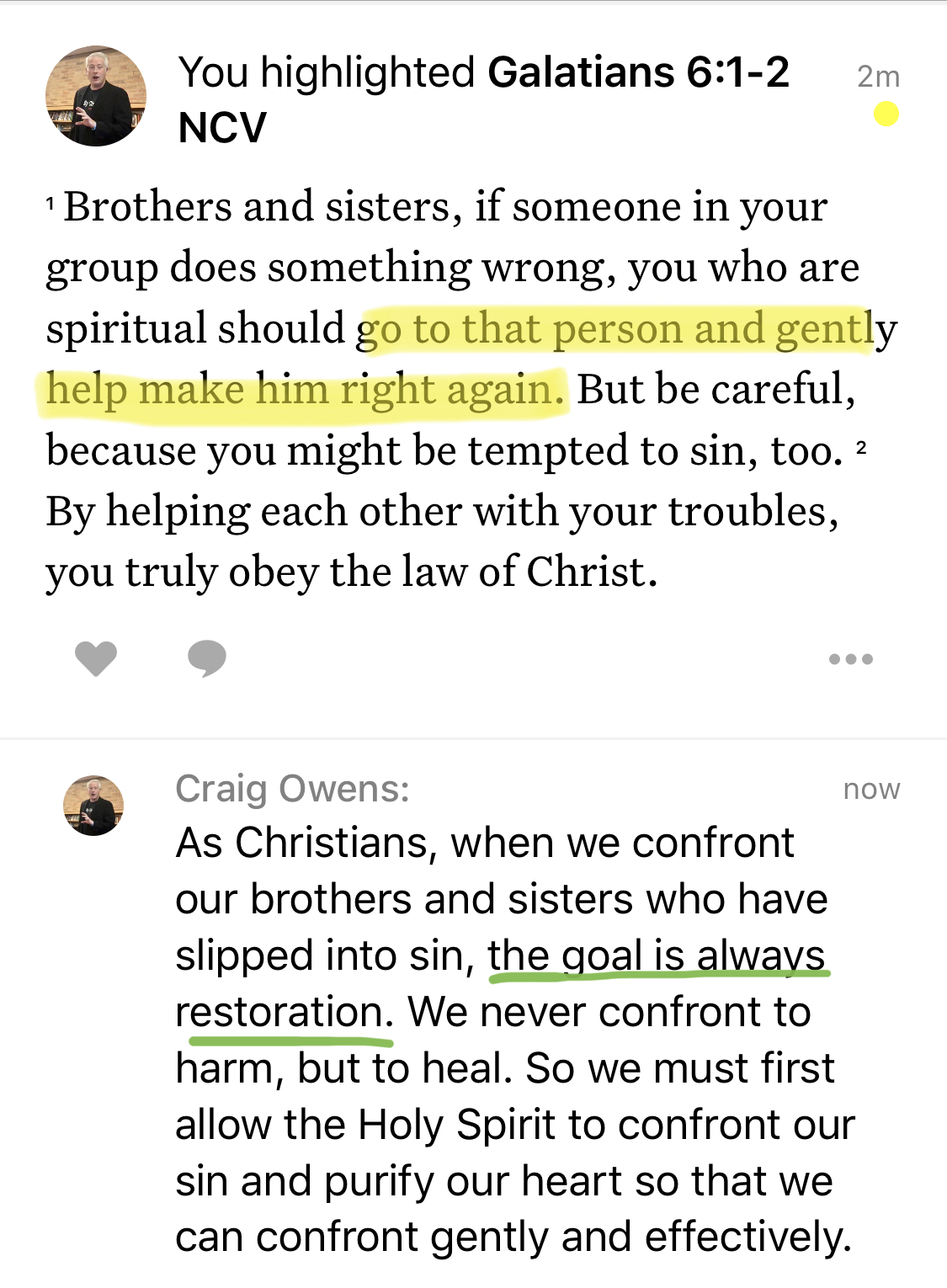
So the Bible says that if one of my brothers slips up I’m supposed to restore him gently. How exactly does one do that? I bounced between so many emotions during the last 48 hours: anger at this addiction, sorrow for what my friend is going through, heaviness at what he’s doing to himself and his family, hatred at the devil for his evil tricks, and a passion to see him whole and healthy and free again. Then my own thoughts have baffled me: “How do I gently restore my brother? What does restoration look like?”
Restoration is an interesting Greek word. It can mean setting a broken bone; mending torn fishing nets; manning a fleet of ships; or supplying an army with its provisions.
Restoration is NOT canceling a debt or removing the consequence for someone’s actions. I like what Dave Anderson wrote, “One of the best lessons you can teach your people is that when they choose a behavior they choose the consequences for that behavior.”
Restoration is feeling the pain of what’s been broken or defeated, learning the lesson from that, and then repairing the break or deficiency in such a way that it won’t break or be defeated again. I have the responsibility and the privilege of doing some mending for my friend.
What about gentle? Over time this word has come to mean something like wishy-washy, no backbone, no guts. Gentle originates from the Latin word gentilis which means belonging to the same family or clan. To be gentle is to be strong enough to respond in a controlled manner to someone who is just like me. Gentleness is strength under control.
I hope I’m gentle enough to restore my friend, to mend what is broken in him so he never has to be defeated by this addiction again. He has some consequences to face. But I am committed to helping him carry this heavy load all the way to the finish line.
Check it out—
Brothers, if someone is caught in a sin, you who are spiritual should restore him gently. But watch yourself, or you also may be tempted. Carry each other’s burdens, and in this way you will fulfill the law of Christ. (Galatians 6:1-2)
Gentle restoration is hard work. But it’s so worth the effort!
If you have any thoughts on how to gently restore a friend, I’d love to have you share them with me in the comments section.



 No, I’m not repeating myself; I’m just quoting the pattern in the Bible (specifically Leviticus 26).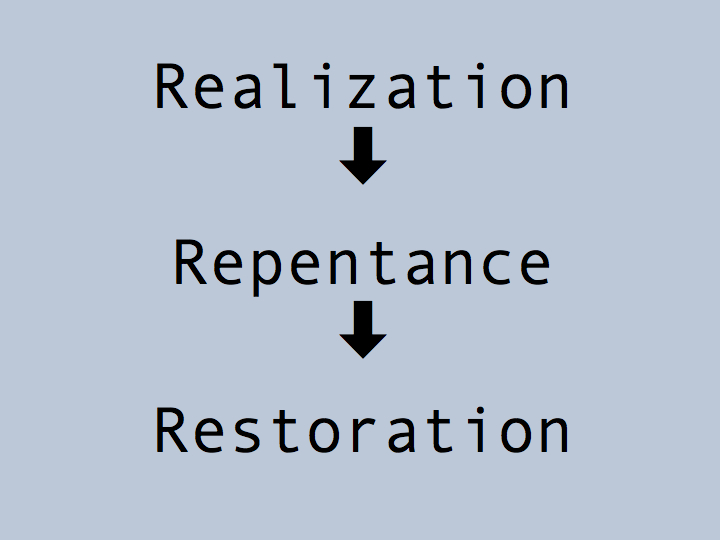





 Craig T. Owens