5 Quotes From “The Truth About Forgiveness”

Yesterday I reviewed John MacArthur’s book The Truth About Forgiveness. Here are five of my favorite quotes from this book.

“These days everything wrong with humanity is likely to be explained as an illness. What we used to call sin is more easily diagnosed as a whole array of disabilities. All kinds of immorality and evil conduct are now identified as symptoms of this or that psychological illness. Criminal behavior, various perverse passions, and every imaginable addiction have all been made excusable by the crusade to label them medical afflictions. Even commonplace problems, such as emotional weakness, depression, and anxiety, are also almost universally defined as quasi-medical, rather than spiritual, afflictions. …In place of evil, therapeutic society has substituted ‘illness’; in place of consequences, it urges therapy and understanding; in place of responsibility, it argues for a personality driven by impulses. The illness excuse has become almost routine in cases of public misconduct.”

“The world’s wisdom: Guilt is a virtual mental defect. Don’t let it ruin your self-image. …Guilt functions in the spiritual realm like pain in the material realm. Pain tells us there is a physical problem that must be dealt with or the body will suffer harm. Guilt is a spiritual pain in the soul that tells us something is evil and needs to be confronted and cleansed.” 

“God does not love us ‘for what we are.’ He loves us in spite of what we are. … God loves us because He is love; love is essential to who He is. Rather than viewing His love as proof of something worthy in us, we ought to be humbled by it.”

“There can be no salvation for those who aren’t convinced of the seriousness of their sin. There can be no word of reconciliation for sinners who remain oblivious to their estrangement from God. True fear of God cannot grip those who are blind to the depth of their sinfulness. And no mercy is available for those who do not tremble at God’s holy threats. In other words, to attempt to eradicate the human conscience is one of the most spiritually destructive pursuits any individual or society can engage in.”

“You need to forsake your sin regularly, seeking not the pardon of an angry Judge but the forgiveness of your loving Father—displeased and grieved, yet loving all the same.”
God’s Truth, Not Your Comfort

Some time ago I was asked to speak in a church setting outside of my church. The audience was a blend of people from all different church backgrounds, and perhaps even some without any church background. I talked about the hopelessness of trying to pay-off our sin debt on our own, and the amazing love that Jesus showed when He paid our debt in full.

After the service, a couple of pastors in the audience wanted to speak with me about my message. They were moved by what they called “the impact” of the message, and especially about the way I called sin “sin.” As I spoke with them further, I discovered that they were somewhat hesitant to speak so openly and plainly about sin, because it unsettled some people in their congregations.

But here is the sober reality—

The Word of God IS unsettling because we cannot read it or hear it and remain unchanged.

Our job as pastors or preachers is to speak the Word. When we do, the Holy Spirit will bring the necessary conviction and pull hearts toward repentance. Here’s what Oswald Chambers wrote about this:

“When we preach, we are not simply proclaiming how people can be saved from Hell and be made moral and pure; we are conveying good news about God.

“In the teachings of Jesus Christ the element of judgment is always brought out—it is the sign of the love of God. Never sympathize with someone who finds it difficult to get to God; God is not to blame. It is not for us to figure out the reason for the difficulty, but only to present the truth of God so that the Spirit of God will reveal what is wrong. The greatest test of the quality of our preaching is whether or not it brings everyone to judgment. When the truth is preached, the Spirit of God brings each person face to face with God Himself.”

Pastor, just speak the truth. You’re not trying to win a popularity contest, but to share with people how to step into a deeper relationship with God Almighty!

One final thought from Chambers: “Never water down the truth of God. Let it have its way and never apologize for it.

15 Quotes From “I Am A Follower”

I Am A Follower by Leonard Sweet turned my leadership thoughts upside down (or is that right-side up?). I would strongly encourage you to read this book, especially if you are in church “leadership.”

It wasn’t easy to do, but here are 15 great quotes from I Am A Follower —

“The Greek noun perichoresis was the early church’s favorite word to describe the interrelationship of the holy Trinity. When the prefix peri (around) is linked with the root of the verb choreuein (to dance), a compelling metaphor is formed or  ‘choreographed’ to describe the ‘one nature in three Persons’ of God the Father, Son, and Holy Spirit. Literally they ‘dance around.’ The choreia or dance of God is the choreography of the cosmos, the interrelationship of Creator, creation, and life itself, the holy creativity of the All in All.”

“Following is the most underrated form of leadership in existence.”

“The cry for leadership is deafening amid our social disintegration, our moral disorientation. We have come to believe that we have a leadership crisis while all along we have been in a drought of discipleship. The Jesus paradox is that only Christians lead by following.”

“The church has become what [Dwight] Eisenhower predicted: a place where everyone is trying to get everyone else to do what they want done but don’t want to do themselves.”

“Leadership is a function. Followership is an identity. … Leadership is a functional position of power and authority. Followership is a relational posture of love and trust. … Being a follower is less about showing how much you know than showing humble gratitude for how much there is to be known.”

“Have we made Christianity more a moment of decision than a momentum for life? Both are important, but have we spent more time on how you become a Christian than on what it means to live as a Christian? Both are important, but have we made holiness more about a destination than a direction?” 

“But to think we can capture and tame Truth is a delusional trap. In fact, the desire for command and control above our desire to please God dams up the rivers of Living Water.”

“Christ does not ask of His followers great success or great fame or great distinction. Christ expects of His followers what He expected of Himself: simply ‘to do the will of Him Who sent Me.’”

“Never in the history of humanity has knowledge been more accessible and of such quality. But when our thirst for information, expertise, and control begins to outrun our thirst for Christ, we can easily trade the waters of the Spirit for a soda-pop substitute. When we place our faith in fillers instead of allowing the Spirit to fill us, we end up selling out not only Christ but ourselves.”

“Leadership culture is strength based. Followership culture is weakness based. …We bless others naturally through our strengths. But we bless others supernaturally through our weaknesses.”

“The disciples were instructed to feed the sheep, not lead them. Christ will lead them. Jesus is the Shepherd. We are the sheep. All of us.”

“Near the end of John’s gospel we find Jesus’ poignant words: ‘As You have sent Me into the world, so I have sent them into the world.’ Did you catch that sneaky as? Jesus’ commissioning of His disciples was simply an echo of His own commissioning.”

“The relationship between leader and follower is this: leaders are over, followers are among. We are all Jesus followers.”

“The leadership paradigm creates folk heroes. Followership creates heroes who are folk.”

“Jesus told His disciples that the sheep always know the Master’s voice. To follow Jesus is not to demand road signs but to respond to the Voice of the Spirit along the way.”

Thoughts From C.S. Lewis

I’ve been re-reading some of my notes that I made on a collection of essays from C.S. Lewis. He is one of my favorite authors, always helping me to see the spiritual realm in a whole new light.

These are just a few quotes that have me thinking…

“A live body is not one that never gets hurt, but one that can to some extent repair itself. In the same way a Christian is not a man who never goes wrong, but a man who is enabled to repent and pick himself up and begin over again after each stumble—because the Christ-life is inside him, repairing him all the time, enabling him to repeat (in some degree) the kind of voluntary death which Christ Himself carried out.”

“There are two ways in which the human machine goes wrong. One is when human individuals drift apart from one another, or else collide with one another and do one another damage. The other is when things go wrong inside the individual—when the different parts of him either drift apart or interfere with one another.”

“Those cautions which the tempter whispers in our ears are all plausible…. That is the truth in the temptation. The lie consists in the suggestion that our best protection is a prudent regard for the safety of our pocket, our habitual indulgences, and our ambitions.”

“When a man is getting better he understands more and more clearly the evil that is still left in him. When a man is getting worse he understands his own badness less and less. … Good people know about both good and evil: bad people do not know about either.”

If you haven’t read C.S. Lewis for yourself, he writes in so many different genres that you can find something for almost any taste: science fiction, children’s fairy tales, theology, apologetics, and on and on. He was truly gifted by God to see our world in a different light, and you will be greatly enriched by reading as much as you can from this master author.

Co-Workers

Obvious statement #1: Church ministry is not lone ranger work.

I needed to state that not only as a reminder to myself, but to my other pastor friends too. It seems like we can often lose sight of this fact. We can become so focused on the next sermon, the next appointment, the next Board meeting, the next outreach that we are actually worshiping the ministry instead of worshiping God through our ministry.

Oswald Chambers gave this warning:

“Beware of any work for God that causes or allows you to avoid concentrating on Him. A great number of Christian workers worship their work. The only concern of Christian workers should be their concentration on God. … A worker who lacks this serious controlling emphasis of concentration on God is apt to become overly burdened by his work. … Consequently, he becomes burned out and defeated. There is no freedom and no delight in life at all. His nerves, mind, and heart are so overwhelmed that God’s blessing cannot rest on him.”

When we are more focused on the work than on God, we can easily begin to feel over-worked and under-appreciated. And this usually leads to us either bearing down to work harder or to simply throwing in the towel.

There is a healthy alternative: link arms with The Co-Worker—

Walk with me and work with Me—watch how I do it. Learn the unforced rhythms of grace. I won’t lay anything heavy or ill-fitting on you. Keep company with Me and you’ll learn to live freely and lightly.” (Matthew 11:29, The Message)

Link with The Co-Worker, and then you will do ministry out of the overflow of your personal worship. Remember, you are a co-worker, not a solo-worker.

Obvious statement #2: Church ministry is not just for the pastor.

Church member, you too are a co-worker with Christ. And with your pastor.

The apostle Paul reminded the church at Corinth that “we are God’s fellow workers” (1 Corinthians 3:9). In other words, we’re all in this together. You need your pastor, and your pastor needs you.

Allow me to paraphrase a quote from President Dwight Eisenhower:

“Never let yourself be persuaded that one [pastor] is necessary to the salvation of America. When [the Church] consists of one leader and [a bunch of] followers, it will no longer be [the Church].”

The Church is a beautiful thing! It functions best when:

  • Pastor and church member are both linked with Christ
  • The pastor is not a lone ranger
  • The church members are not spectators

Ready? Go BE the Church of Jesus Christ!

Thursdays With Oswald—A Moral Lavatory

This is a weekly series with things I’m reading and pondering from Oswald Chambers. You can read the original seed thought here, or type “Thursdays With Oswald” in the search box to read more entries.

A Moral Lavatory

     The Bible does not deal with sin as a disease; it does not deal with the outcome of sin, it deals with the disposition of sin itself. … We have cheapened the doctrine of sin and made the Atonement a sort of moral ‘lavatory’ in which men can come and wash themselves from sin, and then go and sin again and come back for another washing. …

     All Heaven is interested in the Cross of Christ, all Hell terribly afraid of it, while men are the only beings who more or less ignore its meaning.

From Biblical Ethics

This hits me in two areas.

First, as a sinner saved by grace. I am so grateful for the gift of grace. I want to treat this gift with all of the gratitude I can. It was purchased for me with such a high price: The blood of the sinless King of kings. May my sin break my heart as much as it breaks my Heavenly Father’s heart. I’m grateful grace is there when I blow it, but I don’t want to blow it ever again.

Dietrich Bonhoeffer described cheap grace like this:

“Cheap grace is the preaching of forgiveness without requiring repentance, baptism without church discipline, Communion without confession, absolution without personal confession. Cheap grace is grace without discipleship, grace without the Cross, grace without Jesus Christ, living and incarnate. … Cheap grace is the grace we bestow on ourselves.”

Second, as a pastor who teaches about the atonement and grace. I know that I will have to give account before God if the people who hear me teach about these gifts are ones who “ignore its meaning.” I want to do everything I can to make sure everyone who listens to me understands the inestimable value of the Cross of Jesus Christ.

In his book Costly Grace, Jon Walker writes:

“Costly grace justifies the sinner: Go and sin no more. Cheap grace justifies the sin: Everything is forgiven, so you can stay as you are.”

Grace is powerful stuff. May we always treat it that way.

How Much Do I Have To Do?

I had a couple of questions along the line of “How much do I have to do” in The Q Series yesterday morning. We all have a tendency to want to know how to fill in the blanks of questions like:

  • How much time do I have to spend with God to make Him happy?
  • How holy do I have to be for God to accept me?
  • What do I have to do for God to love me more?
  • How much do I have to do to make it to Heaven?

But all of these questions start with a wrong premise. These questions all assume I can do something. If the history of mankind shows us anything, it’s that all of our attempts to build a bridge up to God always falls short.

So—wonder of wonders!—God reached down to us! Jesus gave all so that we could be restored to a relationship with God. And what does He want in return? He wants you! I love this thought from C.S. Lewis:

“For it is not so much of our time and so much of our attention that God demands; it is not even all our time and all our attention; it is ourselves.”

Sometimes we look at ourselves and think, “God wants this?! God wants me?!” In fact, I received another question yesterday that simply asked, “Why does God love us?”

God wants you because He made you to be in relationship with Him. He loves you as if you were the only person on earth to love. Again, consider these wise words from C.S. Lewis—

“We were made not primarily that we may love God (though we were made for that too) but that God may love us, that we may become objects in which the Divine love may rest ‘well pleased.’ …Because He already loves us He must labor to make us lovable.”

How much do you have to do to receive that love? Just believe that fact that God loves you, that He sent Jesus to pay the price for your forgiveness, and that the Holy Spirit is right now working to draw you into that ‘Divine love’ relationship.

Let me state it simply: God loves you. Will you let His love fill your life?

Check out other questions in our Q Series by clicking here.

Temptation

Have you ever thought, “Well, of course Jesus could say ‘no’ to temptation! After all, He is God.”

Yes, Jesus is fully God. But He is also fully Man. And it was as a Man that He defeated temptation.

“As a Man, without using any of His divine powers, Jesus defeated temptation in the same areas where Eve failed and where we fail. … By this He condemned sin in sinful man, that is, He showed we sin, not because we have to sin, but because we choose to sin and because we ignore the help available through the Word and the Spirit.” —Stanley Horton

We don’t have to sin, but we choose to sin.

Ouch!

“In His temptation, Jesus did not use His divine power to defeat the devil. Still identifying Himself with us as Spirit-filled human, He defeated satan by the same means that are available to us — the Word, anointed by the Spirit. Eve, tempted in exactly the same areas—the lust of the flesh (appetite), the lust of the eyes (desire), and the pride of life—failed (Genesis 3:6; 1 John 2:16). In these areas, which John says together comprise the things of the world or worldliness (1 John 2:15). Jesus won a complete victory for us. He has truly overcome the world (John 16:33). We can do the same by our faith (1 John 5:4).” —Stanley Horton

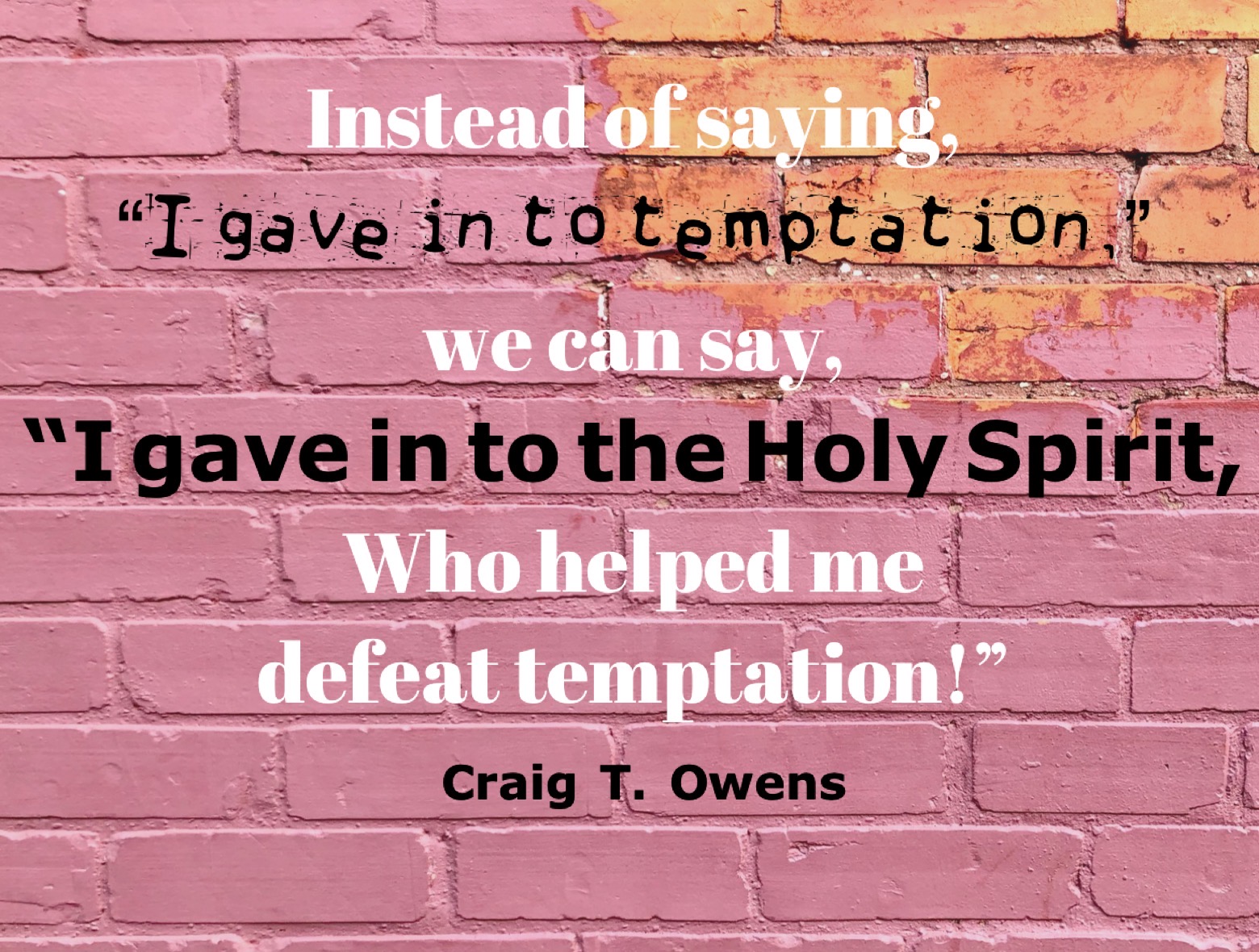
We can do the same thing. Instead of saying, “I gave in to temptation,” we can say, “I gave in to the Holy Spirit, Who helped me defeat temptation!”

Praying, Praying, And Praying Some More

I start each new year teaching a series on prayer at my church. This year I also began by reading Mark Batterson’s excellent new book on prayer called The Circle Maker.

So 2012 has been a more prayerful year for me so far. As a result, I am hearing about and seeing miracles take place in my life, and throughout our church. You know what this is doing in me? Increasing my desire to pray more!

Charles Spurgeon wrote,

“We may be certain that whatever God has made prominent in His Word, He intended to be conspicuous in our lives. If He has said much about prayer, it is because He knows we have much need of it. The motto for this year must be, Continue in prayer.”

But some of the things I am praying for have been on my prayer list for a long time. It appears that an answer hasn’t come… yet. You know what this is doing in me? Increasing my desire to pray more!

Here’s what Mark Batterson said,

“Some prayers go unanswered because they aren’t what’s best for us. Some prayers go unanswered because they don’t glorify God. Some prayers go unanswered because they aren’t part of God’s will. But while God doesn’t always ANSWER our prayers the way we want, we can be confident that He HEARS our prayers! And our Father knows best.”

Have you seen answers to your prayers? Keep on praying!

Are you waiting for answers to your prayers? Keep on praying!

And then pray some more!!

Life In What You Have

Pastors, these two quotes from Charles Spurgeon have really been working on me. This is not intended to be a pastor-bashing message. Instead, it’s more of a wake-up call.

“We too often flog the church when the whip should be laid on our own shoulders. We should always remember that we are a part of the church, and that our own lack of revival is in some measure the cause of the lack of revival in the church at large. I will lay the charge before us; we ministers need a revival of piety in our lives.”

“You don’t need a new preacher, another kind of worship, another type of preaching, new ways of doing things or even new people. You need life in what you have.”

If I’m going to pray, “Start a revival, Lord,” the prayer needs to begin with, “Start it with me!”