I Press On

Not that I have already obtained all this, or have already arrived at my goal, but I press on to take hold of that for which Christ Jesus took hold of me. … I press on toward the goal to win the prize for which God has called me heavenward in Christ Jesus. (Philippians 3:12, 14)

There is no neutral, but always going forward.

There is no complacency, but always striving.

There are no shortcuts, but always straining.

There is no baggage, but always something new.

There is no regression, but always progression.

There is no relaxing, but always gripping tightly.

There is a reward—an eternal reward—which I eagerly long to receive.

The Craig And Greg Show: Blind Spots

Listen to the podcast of this post by clicking on the player below, and you can also subscribe on AppleSpotify, or Audible.

In our last episode, Greg and I discussed how vital it is to focus on your own internal development. If you’ve been doing that, chances are you have identified a few blind spots in yourself. While it might feel more comfortable to simply hide these away and hope nobody notices, we would like to encourage you to be vulnerable: Drag your blind spots into the light, address them, and watch how your leadership improves as a result.

  • [1:30] Leaders have to get comfortable with being vulnerable if they are going to make any meaningful changes in their life.
  • [2:17] Blind spots have to be brought out into the light.
  • [5:44] Paying attention to the feedback from others requires us to slow down to process what we need to change.
  • [7:35] Leaders need to understand the speed of their team in the area of productivity.
  • [8:34] Greg shares a “blind spot” example from one of his kids.
  • [9:53] Why do leaders avoid their blind spots?
  • [11:45] Peripheral vision isn’t good just for athletes, but for leaders too.
  • [13:11] I share how asking good questions has helped my teammates with their blind spots.
  • [14:50] If leaders assume things about their teammates or work with their favorite teammates, they will never improve the morale of the team.
  • [18:17] Greg talks about the movie “Blindside” as a learning point about having the right people watching out for us.
  • [20:10] We need to be thinking about the kind of people we need around us.
  • [25:42] The one word most people are afraid to say.
  • [26:59] Sometimes a fresh set of eyes is necessary to see a blind spot. Maximize coaching would love to be a resource for you in this area.

Check out this episode and subscribe on YouTube so you can watch all of the upcoming episodes. You can also listen to our podcast on Spotify and Apple.

The Craig And Greg Show: The Struggle Is Real (But Necessary)

Listen to the podcast of this post by clicking on the player below, and you can also subscribe on AppleSpotify, or Audible.

Do you enjoy struggling? Odds are the answer to that is a resounding “No!” because struggling is difficult, uncomfortable, and frustrating. However, without struggle it is impossible for us to develop to our full potential in our personal and professional lives. In this episode Greg and I encourage you to embrace struggle, and allow your team to struggle as well so that you all can grow to your very best.

  • [0:20] The struggle is real, but leaders help people know that struggling ≠ failing.  
  • [2:07] Failure is not permanent, and leaders need to help people slow down to see this.
  • [3:38] Here’s how leaders can inspire their teammates to reframe failure.
  • [5:54] Greg shares some reflections from his sports background that can help us see our productive struggle in a positive light.
  • [6:40] I talk about using Six Sigma initiatives in one of my organizations to help them learn each time they missed a benchmark.
  • [8:25] The struggle is what helps us ultimately succeed.
  • [11:42] We rob others of the joy of a breakthrough if we don’t allow them to struggle.
  • [14:19] Leaders need to differentiate failures from mistakes.
  • [16:09] Greg pulls out a movie analogy for us.
  • [18:17] The struggle helps us enjoy the future wins.
  • [21:14] Two leadership lessons we need to keep in mind.
  • [25:26] Greg transformed a couple of organizations by asking people what they learned from mistakes.
  • [27:15] Leaders need to change their own mindset about failing before they can change the mindset of their team. If you need help with this, we would love to help coach you to that next level.

Check out this episode and subscribe on YouTube so you can watch all of the upcoming episodes. You can also listen to our podcast on Spotify and Apple.

The Benefits Of A Little Stress

Listen to the podcast of this post by clicking on the player below, and you can also subscribe on AppleSpotify, or Audible.

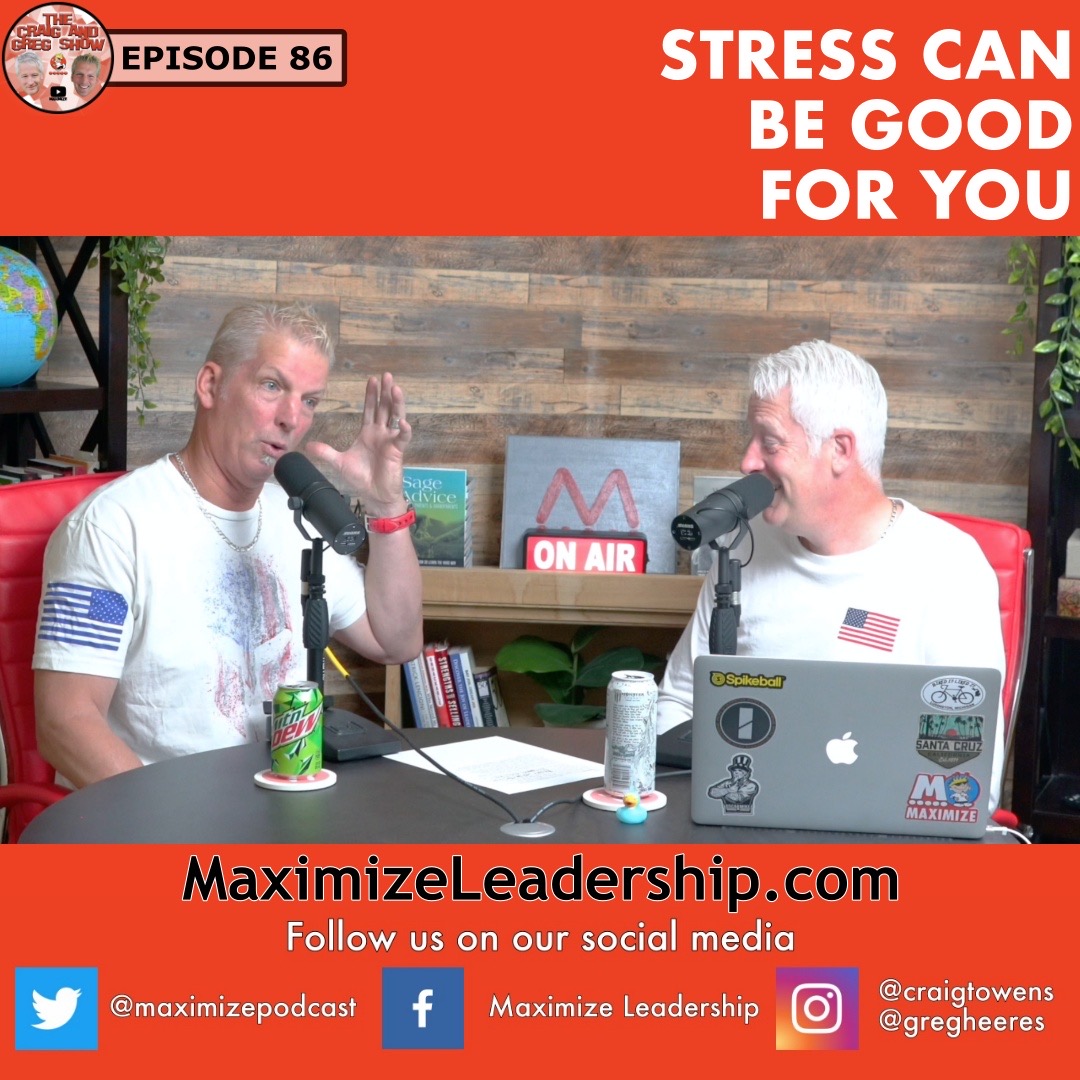
On our most recent leadership podcast, Greg and I were talking about the idea of not trying to eliminate stress from our workplaces. I know that may initially sound counterintuitive, but it actually makes a lot of sense when you really think about it. 

You can check out the full conversation we had on the Craig And Greg Show, but I’d especially like to direct your attention to this clip. The quote Greg is referencing right at the beginning of the clip is from Andrew Murray: 

“A great team begins to happen when you have the right people on the bus in the right seats and the bus breaks down…. They work through the crisis, they get back on the bus, they’re sweating and tired. All of the sudden something magical happens: They begin to talk to each other. Culture happens through crisis. Unfortunately, many team environments have structured the crisis out.”  

Here’s a couple of other quotes for you to ponder: 

“Crisis is a powerful motivator. It enables you to do things you should have been doing all along. Whoever said that nothing focuses the mind like the sight of the gallows had it right.” —Anne Mulcahy, CEO of Xerox 

“If you really want to see innovation happen, find a crisis. It’s in the middle of a crisis when we come to the realization that either the end is near or a new future is being born. On the verge of a crisis, we are also on the verge of our greatest moment. It’s at that moment that we must decide: innovate or die.” —Dave Ferguson, in his book On The Verge 

You may also want to check out my blog post Moderate stress is healthy. 

►► Would you please prayerfully consider supporting this ministry? My Patreon supporters get behind-the-scenes access to exclusive materials. ◀︎◀︎
Links & Quotes

Guys, you don’t have to “live down” to the poor male role models that Hollywood portrays, but you can create a beautiful culture in your marriage, your home, and your workplace. Check out the full sermon this clip came from.

I have lots of new content every week, which you can check out on my YouTube channel.

“Challenge yourself; it’s the only path which leads to growth.” —Morgan Freeman

Michael R. Emlet writes, “There are no easy answers here. In thinking about the juxtaposition of mental-health issues and church discipline, we want to be wary of two extremes. First, we don’t want to avoid corrective pastoral care out of fear that we will ‘add insult to injury’ for those struggling with mental affliction. Second, we don’t want to care for someone with mental illness exactly as we would care for someone without such a struggle. We want biblical truth and love to guide us.” This is a thoughtful post about how pastors should think about mental illness in church disciple. I shared a year-long series of messages on a Christian’s mental health, which you can find here.

Why does Paul call satan “the prince of the power of the air” (Ephesians 2:2)? Pastor John Piper gives us some excellent thoughts on Bible study in general and this verse in particular. 

Give Yourself Grace

Listen to the podcast of this post by clicking on the player below, and you can also subscribe on AppleSpotify, or Audible. 

If you are going to keep growing in a heathy way, you’re going to have to give yourself some more grace.

Check out this episode of The Podcast.

Resources mentioned in this video:

►► Would you please prayerfully consider supporting this ministry? My Patreon supporters get behind-the-scenes access to exclusive materials. ◀︎◀︎

Micro-Adjustments

Listen to the podcast of this post by clicking on the player below, and you can also subscribe on AppleSpotify, or Audible. 

I had a great time on the Leading From Alignment podcast with Jim Wiegand and John Opalewski. 

One of the loudest, most persistent advertising messages is about speed: Take action now, get immediate results as soon as you sign up, don’t miss out, act today! Because of this sentiment that appears all around us, many people often think that any life changes they make should bring about immediate and lasting results. 

I’ve often joked that I wish I had the superpower to zap myself or a friend—“<Poof!> There, you’ve got it now. You’re all set!” Unfortunately, that’s usually not how it works. 

Instead, we need to be ready for a lengthy process—possibly even a lifelong process—of the Holy Spirit helping us to make the micro-adjustments that are necessary. 

Check out this part of my conversation with Jim and John as we discussed this idea. 

 I like this line from Henry Wadsworth Longfellow:

The heights of great men reached and kept,
Were not attained by sudden flight,
But they, while their companions slept,
Were toiling upwards in the night.

The Holy Spirit knows exactly where we need to change and how much we need to change. Let’s trust Him in this process. Then take some time to look back and celebrate how far the Holy Spirit has matured us so that we can be re-energized to stay in this lifelong process.  

If you would like to watch this full interview on the Leading From Alignment podcast, please go here.

I’ll be sharing more clips from this interview soon, so please stay tuned. My book Shepherd Leadership: The Metrics That Really Matter is available in print or ebook, and in audiobook through either Audible or Apple. 

►► Would you please prayerfully consider supporting this ministry? My Patreon supporters get behind-the-scenes access to exclusive materials. ◀︎◀︎

“So That…”

Listen to the podcast of this post by clicking on the player below, and you can also subscribe on AppleSpotify, or Audible. 

There are so many things a leader can do to develop themselves and develop the people around them. In fact, at times there may be too many things from which we could choose! 

So how do we narrow it down? How do we know which things to guard in our schedule, which things to drop, and which things to add? 

One thing that has been immensely helpful for me is asking the question, “Why do I want to do this, or learn this, or make a commitment to this?” And then answer the question with these two words, “So that…. 

What is the “so that” I am aiming for? How will that thing enhance my leadership or develop me personally? I need to keep asking that question again and again until I hit upon the key factor that needs to be added to my schedule and then guarded in my schedule. 

I co-host a leadership podcast called The Craig And Greg Show with my lifelong friend Greg Heeres. On a recent episode, we were discussing the value of personal development and we got into this “so that” topic.

A mark of a godly leader is one who is regularly asking the question, “Why am I doing this?” and then continually drilling down to a solid “so that” reason. 

If I can help coach you through this process in your leadership journey, please reach out to me. 

This is part 68 in my series on godly leadership. You can check out all of my posts in this series by clicking here.

►► Would you please prayerfully consider supporting this ministry? My Patreon supporters get behind-the-scenes access to exclusive materials. ◀︎◀︎

Thursdays With Spurgeon—Keep Moving Forward

This is a weekly series with things I’m reading and pondering from Charles Spurgeon. You can read the original seed thought here, or type “Thursdays With Spurgeon” in the search box to read more entries.

Listen to the podcast of this post by clicking on the player below, and you can also subscribe on iTunes or Spotify.

Keep Moving Forward  

For we walk by faith, not by sight. (2 Corinthians 5:7) 

     God does not say to us, ‘This is the way,’ and then stop. He says, ‘This is the way, walk in it.’ We are always to be making advances. We are to be going from faith in its beginnings to faith in its perfections, from faith to assurance, from assurance to full assurance. And from there, we are to go to the full assurance of hope to the full assurance of understanding, always forward, waxing stronger and stronger. …  

     The Christian’s motto is ‘Upward and onward.’ Not as though he has already obtained, either is already perfect, he presses forward to the mark for the prize of his high calling in Christ Jesus. …  

     Can you perform the common activities of the household and the daily duties that fall to your lot in the spirit of faith? This is what the apostle means. He does not speak about running or jumping or fighting, but about walking—and he means to tell you that the ordinary life of a Christian is different from the life of another man—that he has learned to introduce faith into everything he does. 

From Faith Versus Sight

I have a t-shirt that says on the front, “Keep moving forward.” But the back of the t-shirt has the real-life challenge: “Crawling is acceptable. Falling is acceptable. Puking is acceptable. Crying is acceptable. Pain is acceptable. Quitting is not!” 

How true! 

I think the problem for many Christians is that they have an unrealistic expectation of growth. Somehow we’ve come to believe that our Christian growth is a constant upward trajectory to maturity, and that if there are ever any stumbles along the way, that means we’ve blown it. (By the way, Oswald Chambers has some helpful thoughts on our stair-step growth.)

But Paul tells us, “We walk”: We keep moving forward. That doesn’t mean there aren’t times of stumbling, or a plateau, or even a pause to catch our breath. Paul tells us that an important aspect of our walk is that we forget what’s behind us and we keep moving forward—keep walking—keep going. 

Every single day, let us say along with Paul, “I don’t mean to say that I have already achieved these things or that I have already reached perfection. But I press on to possess that perfection for which Christ Jesus first possessed me. No, dear brothers and sisters, I have not achieved it, but I focus on this one thing: Forgetting the past and looking forward to what lies ahead, I press on to reach the end of the race and receive the heavenly prize for which God, through Christ Jesus, is calling us” (Philippians 3:12-14 NLT). 

My friend, keep moving forward in faith, believing that the Holy Spirit is with you—maturing you, strengthening you—on every single step on your Christian walk.

►► Would you please prayerfully consider supporting this ministry? ◀︎◀︎


The Craig And Greg Show: Helping Leaders Blossom

On this episode of “The Craig And Greg Show” we talk about: 

  • leaders need to grow themselves because we cannot give to others what we do not possess
  • leaders who aren’t refreshed can blow up what should have been a pretty simple situation  
  • Greg and I discuss a great leadership development example from the Bible
  • I drop a little hint about my forthcoming book
  • leaders need healthy self-esteem if they are going to encourage others
  • leaders aren’t developed in a cookie-cutter way
  • be careful of measuring success by things you can count—people growth is more qualitative than it is quantitative
  • it is important that a leader and his/her teammates have the same definition of key words
  • how leaders can turn unexpected “rainy days” into something positive
  • leaders need to learn how to modify plans without totally changing plans
  • Greg shares some key strategies for leaders to grow themselves, as well as a word of caution
  • if you would like more information on our leadership coaching services, please check out this link

Check out this episode and subscribe on YouTube so you can watch all of the upcoming episodes. You can also listen to our podcast on Spotify and Apple.