Counting Down 2012: #5 Pet (Pastoral) Peeve

I am counting down the top 5 posts that I wrote in 2012, as determined by the number of views during this year. The 5th most read post is: Pet (Pastoral) Peeve.

One of my biggest pet peeves: hearing pastors say, “Ministry would be great if it weren’t for the people.”

Pastor: People ARE your ministry!

After Christ’s resurrection, He wanted to help restore Peter. Jesus asked Peter a simple question, “Do you love Me?” When Peter acknowledged that he did, Jesus gave Peter a way to show it: “Feed My sheep.” I believe this exchange is what Peter had in mind when he penned the words,

Be shepherds of God’s flock that is under your care, serving as overseers—not because you must, but because you are willing, as God wants you to be; not greedy for money, but eager to serve; not lording it over those entrusted to you, but being examples to the flock. (1 Peter 5:2,3)

Is it hard to be a shepherd? Yes.

Are some sheep difficult to shepherd? Yes.

Is it worth it to shepherd them? Yes, yesYES!!

I love Oswald Chambers’ insight on this —

Jesus has some extraordinarily peculiar sheep: some that are unkempt and dirty, some that are awkward or pushy, and some that have gone astray! But it is impossible to exhaust God’s love, and it is impossible to exhaust my love if it flows from the Spirit of God within me. The love of God pays no attention to my prejudices caused by my natural individuality. If I love my Lord, I have no business being guided by natural emotions—I have to feed His sheep.

Jesus, increase my capacity to love Your sheep. All of Your sheep—the ones that bite; the ones that are nice; the ones that are untidy; the ones that are clean; the ones that are thankful; the ones that are ungrateful; the ones that “get it”; the ones that don’t. All of YOUR sheep. Thank You, Lord, for the supreme honor and heavy responsibility of serving as Your under-shepherd.


You Need “Grey Heads”

Tim DilenaI know that all of us can benefit from an older, wiser person speaking into our lives, but I am especially concerned about pastors. Too many times pastors are seen by others as the “go-to guy” for anyone who needs help, and we pastors begin to believe that we don’t need to go to anyone else for help.

This is a dangerous attitude of pride!

Check out this short 4-minute teaching from my friend Rev. Tim Dilena about the value of “grey heads” in our lives—

My fellow pastor, humble yourself and accept the help of a wise mentor. It will not only enhance your ministry, it could literally save your ministry from crumbling.

Was That Sermon Successful?

Pastor, ever had one of those times when you delivered what you thought was an amazing sermon, but when it was over people looked completely unmoved?

Or maybe you sat down with someone to tell them something that would be so beneficial to their lives, and they responded by lashing out at you?

What happened? Did you miss something? Wasn’t God in your sermon or in your  counseling time?

The Apostle Paul has some great insight for us—

Now this is our boast: our conscience testifies that we have conducted ourselves in the world, and especially in our relations with you, in the holiness and sincerity that are from God…. (2 Corinthians 1:12)

Paul didn’t rely on external observations to gauge his success in following God, but he listened for the internal witness of the Holy Spirit. Paul wasn’t living to please an audience of people, but an audience of One. He was listening for either the approval or the reproof of the Spirit.

Those you and I preach to may say, “That was wonderful! Great word, pastor!” and have no change of heart at all.

Others may scowl at us, but only because the Holy Spirit is using our words to bring about a deep heart change in them.

So we cannot use the facial expressions, or the compliments, or the complaints of others to know if we hit the mark or not. We have to let the Holy Spirit testify to our conscience whether or not we have been obedient.

I’m praying for you (and for myself): Holy Spirit, remind us of this. Help us to be tuned into You, and not into the external cues we think we may be observing. You alone can approve or reprove us.

Money And The Church

Unfortunately, far too many financial scandals have tainted the church, and therefore any pastor who mentions tithes or offerings or missions support is usually viewed skeptically.

So sad! Especially because it should NEVER be this way!

The Apostle Paul gives an excellent teaching on financial gifts for church ministry in 2 Corinthians 8-9. I love this example he gives about the Christians in the impoverished area of Macedonia—

Out of the most severe trial, their overflowing joy and their extreme poverty welled up in rich generosity. (2 Corinthians 8:3)

Severe trial … extreme poverty rich generosity…. Want to see this in a modern-day setting? Check out this video:

Wow!! If the homeless can give like that, why can’t we?

Here are some principles Paul lists about giving:

  • Give because God compels you, not because a man compels you (2 Corinthians 8:3-4)
  • Give yourself to God before you give your income (8:5)
  • Give excellently (8:7)
  • Give sincerely (8:8)
  • Give like Jesus gave (8:9)
  • Give what you say you’re going to give, and do it quickly (8:10-15)
  • Give where there is proper accountability and proven credibility (8:16-24)
  • Give generously (9:1-6)
  • Give cheerfully (9:7)
  • Give where God is glorified (9:8-15)

Giving according to these principles removes the taint of anything shady, and puts the focus on God.

A Warning To Shepherds

If you are a pastor, God sees you as a shepherd (see John 21:15-17; 1 Peter 5:1-4).

If you are a shepherd, there is a heavy responsibility on you to lovingly, attentively care for God’s precious sheep. We cannot shirk this responsibility for even a moment.

God loves His sheep so much that He gave His sheep YOU!

God loves His sheep so much that He will remove you, if He has to.

Consider this:

“What sorrow awaits the leaders of My people—the shepherds of My sheep—for they have destroyed and scattered the very ones they were expected to care for,” says the Lord. Therefore, this is what the Lord, the God of Israel, says to these shepherds: “Instead of caring for My flock and leading them to safety, you have deserted them and driven them to destruction. Now I will pour out judgment on you for the evil you have done to them. …Then I will appoint responsible shepherds who will care for them, and they will never be afraid again. Not a single one will be lost or missing. I, the Lord have spoken!” (Jeremiah 23:1, 2, 4)

This is a HEAVY word, and should not be taken lightly.

Pastor, never assume you are leading God’s sheep in the right paths. Ask the Holy Spirit to tell you if you are leading God’s sheep in the right paths!

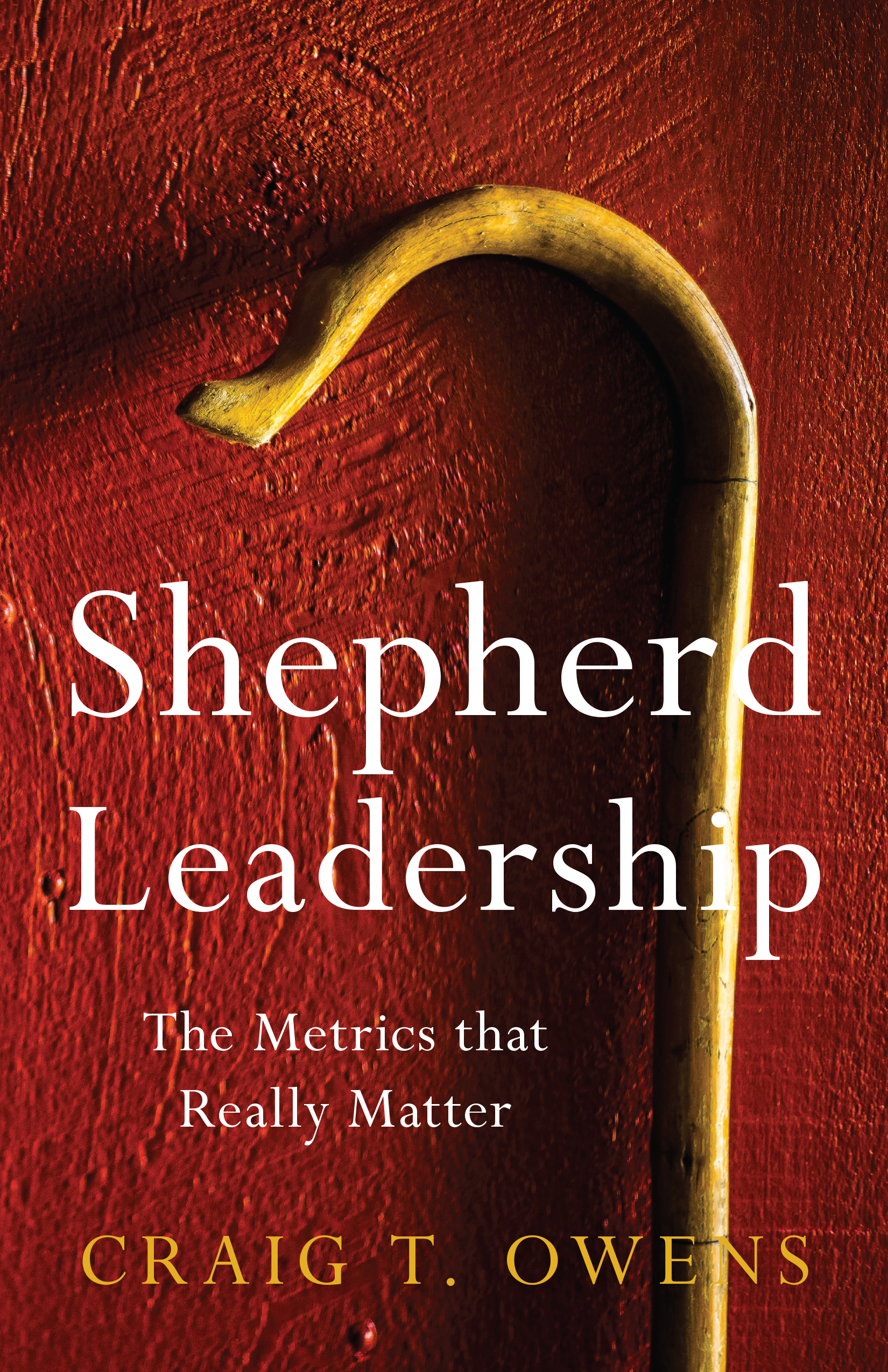
UPDATE: This post was one of the seed thoughts that went into fashioning my book Shepherd Leadership: The Metrics That Really Matter.

Got Hope?

In my position as a pastor, you can probably imagine that many people come to me with pretty desperate situations. One of the common things I hear from these hurting people is something along the lines of, “I really thought God had directed me on this, but it seems like it’s not going to work out.”

In other words, their hope is wavering.

For a Christian, hope is not blind trust. It’s not a feeling that things might work out. It’s not even holding on tighter.

For a Christian, hope is about a promise and a Person.

It’s about what God said and Who God is.

It’s about believing that His Word is true and that He is trustworthy.

Let me stitch together a few phrases about Abraham—

Against all hope, Abraham in hope believed. …Without weakening his faith, he faced the fact that his body was as good as dead… yet he did not waver through unbelief regarding the promise of God, being fully persuaded that God had power to do what He had promised. (Romans 4:18-21)

Abraham didn’t deny the facts, but he trusted the promise and the One Who gave him the promise!

And then there’s this promise for us about hope—

And we boast in the hope of the glory of God. Not only so, but we also glory in our sufferings, because we know that suffering produces perseverance; perseverance, character; and character, hope. And hope does not put us to shame, because God’s love has been poured out into our hearts through the Holy Spirit, who has been given to us. (Romans 5:2-5)

Do you need hope? Get the promise from God’s Word, and then trust the One Who spoke that word. Hang on—God IS doing something great!

Do You Know Your Community?

Jesus called His followers to be salt and light. It’s pretty easy to figure out that the salt cannot season the food if it stays in the saltshaker, and the light cannot illuminate the darkness if it stays covered up. In order to season and shine in your community, you have to know your community.

And, pastor, that starts with you.

What you do is a much more effective sermon that what you say. Pastor, you need to know your community, so that you can be involved in your community, so that you and your church can season and shine in your community together.

So let me ask a couple of questions:

  • Do you know your Mayor / City Manager / Township Supervisor? If you don’t know them, how can you affirm their leadership (Romans 13:1-7)?
  • Do you attend City / Township Council meetings? If you don’t, how will you know what issues they’re wrestling with? If you don’t know those issues, how can you pray effectively for them (1 Timothy 2:1-2)?
  • Are you involved in your community? Don’t just assume people in your community will come to your church to sit among stranger to hear a stranger speak; instead, be so involved in your community that they will come to church to fellowship with friends and hear a friend speak (John 2:1-2).

I opened with the question, “Do you know your community?” But maybe a better way to ask this is, “Does your community know you?”

Does the community come to you to ask for help? This may be the best barometer of your involvement in your community: how often they seek your help or assistance in addressing issues within your community.

If you’re not as involved as you should be, the good news is that it’s never too late to start! Go get involved—go season and shine!

Copartnership

Do you want your church services to be more engaging?

Do you want your pastor to preach more effectively?

Do you want to come away from church more energized?

If so, you need to enter into a partnership. E.M. Bounds, in his fascinating book The Weapon of Prayer, wrote this—

“Prayerlessness, therefore, as it concerns the preacher is a very serious matter. If it exists in the preacher himself, then he ties his own hands and makes the Word as preached by him ineffective and void. If prayerless people be found in the pew, then it hurts the preacher, robs him of an invaluable help, and interferes seriously with the success of his work. How great the need of a praying church to help in the preaching of the Word of the Lord! Both pew and pulpit are jointly concerned in this preaching business. It is a copartnership.”

If you want more engagement, effectiveness, and energy at your church, partner with your pastor in prayer.

If you don’t have a church home, I hope you can partner with me this Sunday at Calvary Assembly of God as I continue a series called The Danger Of Prayerlessness.

Pray More

I love this passage from J.C. Ryle that I read on the J.C. Ryle Quotes blog.

Pray for yourselves—that you may know the Lord Jesus, and cleave to Him—that you may be kept from falling—that you may serve your generation—that you may be sober in prosperity, patient in trial, and humble at all times.

Pray for the congregation to which you belong—that the word of the Lord may have free course in it, and be glorified—that the household of faith may become stronger and stronger, and the household of unbelief weaker and weaker.

Pray for your country—that her ministers may preach the Gospel, and be sound in the faith—that her rulers may value the Bible, and govern according to it—and that so her candlestick may not be taken away.

And pray for your minister—that he may be strong to work, and willing to labor for your good, that all his sicknesses may be sanctified, and all his health given to the Lord—that he may be ever taught of the Spirit, and thus be able to teach others—that he may be kept faithful unto death, and so be ready to depart when he is called.

Let us all pray, one for the other—I for you, and you for me—and we shall be blessed in our deed!

We can never pray too much!

I Didn’t Choose This

Hello, my name is Craig Owens and I’m a pastor. I wasn’t a PK (pastor’s kid). This isn’t the profession I chose for myself. I envisioned myself doing other things, but God had different plans for me.

He called, and I said “yes.” He called me to be a pastor and so He equipped me for the pastorate. I can relate to what the Apostle Paul wrote—

By God’s grace and mighty power, I have been given the privilege of serving Him by spreading this Good News. (Ephesians 3:7)

Paul, too, didn’t choose be a minister telling people about Jesus Christ. But God had different plans for him.

And so, since God has called me to do this, I must do it to the best of my ability. I don’t have the natural ability for it, I simply have God’s grace and mighty power. And to that grace and power I must add my best effort—

Study and be eager and do your utmost to present yourself to God approved (tested by trial), a workman who has no cause to be ashamed, correctly analyzing and accurately dividing [rightly handling and skillfully teaching] the Word of Truth. (2 Timothy 2:15, AMP)

I like the counsel of Charles Spurgeon:

Again, the theme of a minister should be Christ Jesus in opposition to mere doctrine. Some of my good brothers are always preaching doctrine. Well, they are right in so doing, but I would not care myself to have as the characteristic of my preaching doctrine only. I would rather have it said, ‘He dwelled much upon the person of Christ and seemed best pleased when he began to tell about the atonement and sacrifice. He was not ashamed of the doctrines; he was not afraid of threatening. But he seemed as if he preached the threatening with tears in his eyes, and the doctrine solemnly as God’s own Word. But when he preached of Jesus, his tongue was loosened, and his heart was at liberty.’”

I didn’t choose this, but God chose me. And for that I am extremely humbled and grateful.