Thursdays With Oswald—Stir Me, Oh Lord

This is a weekly series with things I’m reading and pondering from Oswald Chambers. You can read the original seed thought here, or type “Thursdays With Oswald” in the search box to read more entries.

Oswald Chambers

Stir me, Oh Lord!

Stir me, oh! stir me, Lord, I care not how, 
   But stir my heart in passion for the world! 
Stir me to give, to go—but most to pray;
   Stir, till the blood-red banner is unfurled 
O’er lands that still in heathen darkness lie, 
O’er deserts where no Cross is lifted high. 
 
Stir me, oh! stir me, Lord, till prayer is pain—
   Till prayer is joy—till prayer turns into praise! 
Stir me, till heart and will and mind—yea, all
   Is wholly Thine to use through all the day. 
Stir, till I learn to pray “exceedingly:” 
Stir, till I learn to wait expectantly.

From Christian Disciplines

Yes, Lord, yes! Stir me!

867-5309

MeditatingI know I’m showing my age with this example: But how many of you remember the song by Tommy Tutone that contained Jenny’s phone number. That song hit #4 on the charts in 1982, and yet after all of these years if you start singing the song, people can tell you that Jenny’s number is 867-5309.

Why do we remember such trivial things?!

The way God designed the human brain is absolutely astounding! Electrical impulses from our five senses filter into the brain and are saved as short-term memories, with the emphasis on short. Short-term memories usually last 20-30 seconds. But we can reset the timer by repeating the information again and again.

If we repeat it enough or think about it more, our brain realizes that it has some significance to us, and begins to “solidify” the information in our intermediate memory banks. These intermediary memories last 5-8 hours.

But in order for the intermediary memories to be stored away in our long-term memory—where they can be stored indefinitely—there needs to be an added component from us. That component is emotion.

The more important the information is to us, the greater the likelihood it will be filed in the “do not delete” section of our brain.

People tell me all the time how difficult it is for them to memorize Scripture, but the keys to memorization are built into the Scripture itself.

First, you have to approach it with a passion. Oh, how I love your law! … Therefore I hate every wrong path (Psalm 119:97, 104). The “bookends” of this section show passionate emotion.

Second, you need to sing the Word. Twice the psalmist said he mediated on God’s Word all day long (vv. 97, 99). At the root of this word is to hum. Singing God’s Word attaches emotion to it, and the emotion tells your brain to move it to long-term storage.

Third, you need to realize just how important it is to have the Scripture stored away in your memory banks. In one section of the 119th Psalm we see benefits like: makes me wiser, gives me more insight, I have greater understanding, I can avoid evil paths (vv. 98-102).

C.S. Lewis commented, “All that is not eternal is eternally useless.” Jenny’s phone number won’t keep us out of trouble, or draw us closer to God, or even give us insight into helping a friend. But God’s Word will do all of those things … and so much more!

These steps will help you store and retrieve eternally useful truths, and not just fictional phone numbers! Try it and let me know how it works for you.

If you have missed any of the messages in our P119 series, you can access them all by clicking here.

Thursdays With Oswald—Redemption

This is a weekly series with things I’m reading and pondering from Oswald Chambers. You can read the original seed thought here, or type “Thursdays With Oswald” in the search box to read more entries.

Redemption

   Redemption is easy to experience because it cost God everything, and if I am going to be regenerated it is going to cost me something. I have to give up my right to myself. I have deliberately to accept into myself something that will fight for all it is worth, something that will war against the desires of the flesh, and that will ask me to go into identification with the death of Jesus Christ, and these things produce a struggle in me. …

   The result of the Redemption in my life must be that I justify God in forgiving me. …In what way are you different in your life? does the reality of the Redemption at work in you justify God in having forgiven you?

From Baffled To Fight Better and Biblical Ethics

I like to think of the death and resurrection of Jesus this way: It cost Him so much, and He wants everything He paid for.

Jesus didn’t coast through, He wasn’t wishy-washy about His decision to go to the Cross, neither was He forced into such a horrific death by crucifixion.

Jesus willingly and lovingly went “all in” to pay the redemption price for our sins. So I’m challenged by Oswald Chambers’ question: Does the reality of the Redemption at work in you justify God in having forgiven you? Does my life show how grateful I am for the price Jesus paid?

Such Wondrous Love

CrossAs I am preparing both a Good Friday message and an Easter message, I am immersed in the details of Christ’s passion for us. There are so many thoughts swirling through my head about the amazing, unequaled, undeserved, overflowing love that Jesus has for us.

See from His head, His hands, His feet / Sorrow and love flow mingled down! / Did e’er such love and sorrow meet, / Or thorns compose so rich a crown? (Isaac Watts, When I Survey The Wondrous Cross)

You see, at just the right time, when we were still powerless, Christ died for the ungodly. Very rarely will anyone die for a righteous person, though for a good person someone might possibly dare to die. But God demonstrates His own love for us in this: While we were still sinners, Christ died for us. (Romans 5:6-8)

That Christ should join so freely in the scheme / Although it meant His death on Calvary / Did ever human tongue find nobler theme / Than love divine that ransomed me?

Such love, such wondrous love / Such love, such wondrous love / That God should love a sinner such as I / How wonderful is love like this!

That for a willful outcast such as I / The Father planned, the Savior bled and died / Redemption for a worthless slave to buy / Who long had law and grace defied (C.Bishop, Such Love)

Because of the joy awaiting Him, Jesus endured the Cross, disregarding its shame. Now He is seated in the place of honor beside God’s throne. (Hebrews 12:2)

I hope this week you will reflect on God’s amazing grace, Christ’s great love, and the Holy Spirit’s persistent drawing of your heart. Jesus died for us so that we could be brought into a loving relationship with our Heavenly Father!

If you are in the Cedar Springs area, please join me in celebrating with our churches our combined Good Friday service, or our Easter morning breakfast drama called Conspiracy!

No!

Do you have a hard time saying “No”?

How about saying “No” to temptations? Perhaps this thought will help.

For the grace of God…teaches us to say “No” to ungodliness and worldly passions, and to live self-controlled, upright and godly lives in this present age. (Titus 2:11-12)

How does grace teach me to say, “No”?

The more I realize how much it cost Jesus to extend grace to me, the more I will realize what I can do to show gratitude for this amazing gift. I show my appreciation for this inestimable gift by saying “No” to ungodliness, AND saying “Yes” to godliness.

Saying “Yes” to my sinful passions is like a slap in the face of God. It’s saying that what I want to indulge in is somehow more valuable than Christ’s death on the Cross.

To live a self-controlled, upright, godly life is the bare minimum I can do to show my gratitude to my Savior! Grace is not a license to live as I want to live. Grace teaches me to say “No” to anything that would offend Jesus Christ.

George Whitefield said, “Think of the love of Jesus and let that love constrain you to keep near unto Him.” Which reminds me of a stanza of an old song—

Turn your thoughts upon Jesus
Think deep of His wonderful love
And the thoughts of sin
And of self and strife
Will be lost in that rapture above

Even Greater Things

I’m a fourth-generational Pentecostal. I’ve grown up in the church. Over many years I’ve seen and heard some incredible things.

And yet I’m so hungry for God to do more!

I’ve had an amazing last three years as the pastor of Calvary Assembly of God. We’ve seen God move in awesome ways!

And yet I’m so hungry for God to do more! 

I feel like the prophet Habakkuk who cried out,

Lord, I have heard of Your fame; I stand in awe of Your deeds, O Lord. Renew them in our day, in our time make them known. (Habakkuk 3:2)

What God has done in my personal history, and in the history of our church, is nothing compared to what I believe is coming!

You won’t find me standing on the sidelines. I’m not dreaming about “the good ol’ days.”

I’m going to live my life like Jesus taught us. He announced that His ministry was anointed by the Holy Spirit to tell everyone the good news of God’s favor (Luke 4:18-19). And then He lived this out by doing good everywhere He went (Acts 10:38).

Jesus instructed us to conduct our lives the same way (Matthew 28:19-20), living in the anointing of His Holy Spirit (Acts 1:8). The same Spirit which anointed Christ Jesus for ministry will anoint your life for ministry!

I am so hungry for God to do more in me … in my church … in Cedar Springs! Like the words of the song say, “Greater things are yet to come!”

I Want To Be Fascinated

If we are going to stick with anything for the long haul, we have to be fascinated by it. As soon as it becomes boring, humdrum, or monotonous, the downward spiral leading to us throwing in the towel is almost inevitable.

It looks like this:

Inattention → Fizzled passion → Lack of discipline → Quitting

This is bad enough for a diet, exercise routine, or any other healthy pursuit. But it becomes even more painful when this downward cycle occurs in our spiritual life. In that case, the “quitting” is called by another name: Sin.

In Psalm 119, the Beth section (verses 9-16) opens with two contrasting thoughts:

  • How can a young man keep his way pure? By LIVING according to Your Word.
  • I seek You with all my heart; do not let me STRAY from Your commands.

Stray is a passive word. No real attention or foresight is required to wander or meander around. On the other hand, living is an active word. In the Hebrew, this word carries the idea of keeping careful watch; protecting; carefully tending.

So the question that leads to my success is this: What fascinates me? What dominates my thoughts? What motivates me?

The answer to these questions will determine my stick-to-itiveness.

The remaining verses in this section show the upward spiral away from sin if we will keep careful watch over how closely we stick to God’s Word.

  • Living = guarding (v. 9)
  • Seek You with all my heart (v. 10) … Yearning (in the Amplified Bible)
  • Hidden Your Word (v. 11) … Treasured (in the Complete Jewish Bible)
  • → Personal praise (v. 12)
  • With my lips… (v. 13) = verbal, public praise
  • Rejoice (v. 14) … as in more than in any kind of wealth (in the CJB)
  • Meditate (v. 15) = constant companion
  • Delight (v. 16)

When we delight in God’s Word, the cycle is started over again—I will not neglect Your Word—but now with a renewed and intensified PASSION!

I want God’s Word to dominate my thoughts, and its principles to captivate me. I want to be fascinated by my relationship with Jesus Christ that comes through the revelation of the Bible to my heart.

There is no other way to live!

If you have missed any of the messages in our P119 series, you can access them all by clicking here.

Strengths Formula

God wants you to be yourself, but not as you can make you. But to be the “you” He created you to be. Part of what He implanted in you was certain gifts, talents, and abilities. To the extent that you allow the Holy Spirit to (1) reveal these gifts to you, and (2) turn these gifts into strengths, you will find more joy in being “you” as your “you” builds up the Body of Christ.

Just before listing some of the innumerable spiritual gifts God reveals in humanity, the apostle Paul says this:

For by the grace given me I say to every one of you: Do not think of yourself more highly than you ought, but rather think of yourself with sober judgment, in accordance with the measure of faith God has given you. (Romans 12:3)

Does that sound contradictory at all: Do not think…but rather think?

The root word is the same in each usage (phroneo in the Greek), but the prefix is what sets them apart from each other.

  • The first has the prefix hyper-. That means it’s overly analyzed, overly concerned = self-focused. 
  • The second time the prefix is soph- (meaning “wise”). This is sound thinking, big-picture thinking = others-focused.

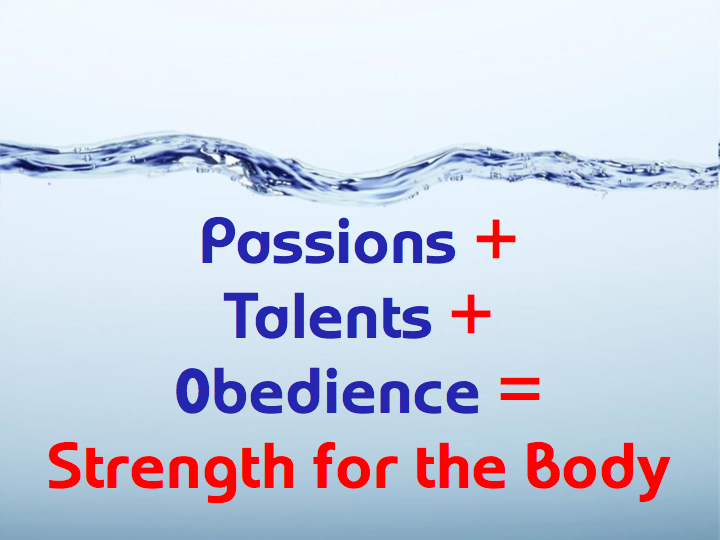
The Holy Spirit gives you sophroneo thinking to reveal your God-implanted gifts and talents to benefit others—to benefit the whole Body of Christ. He helps us turn our talents into strengths by using a formula like this:

Passions + Talents + Your Obedience = Strength for the Body

Pay attention to your passionate responses to situations, as they will reveal to you some of your gifts.

Listen to areas where others say you are talented. This will help you know how God has wired you.

Then you must be obedient to the prompting of the Holy Spirit in how to use your talents. If you let them sit on the shelf, they will never become strengths. Strengths develop when you passionately and obediently use your God-given talents for God’s glory.

The Holy Spirit wants to help you in all of these areas. Will you let Him?

If you’ve missed any of the messages in the Immersed series, you can find them all here.

Christ’s Passion

Listen to the podcast of this post by clicking on the player below, and you can also subscribe on AppleSpotify, or Audible.

Good Friday is almost too heavy for me to comprehend. It’s only “good” as we view it now, after the resurrection of Christ. Looking at Calvary at the moment is so humbling.

See how the patient Jesus stands,
Insulted in His lowest case!
Sinners have bound the Almighty hands,
And spit in their Creator’s face.
 
With thorns His temple gored and gashed
Send streams of blood from every part;
His back with knotted scourges lashed,
But sharper scourges tear His heart.
 
Nailed naked to the accursed wood
Exposed to earth and heaven above,
A spectacle of wounds and blood,
A prodigy of injured love!
 
Hark! how His doleful cries affright
Affected angels, while they view;
His friends forsook Him in the night,
And now His God forsakes Him too!
 
Behold that pale, that languid face,
That drooping head, those languid eyes!
Behold in sorrow and disgrace
Our conquering Hero hangs, and dies!
 
Ye that assume His sacred name,
Now tell me, what can all this mean?
What was it bruised God’s harmless Lamb,
What was it pierced His soul but sin?
 
Blush, Christian, blush: let shame abound:
If sin affects thee not with woe,
Whatever life is in thee found,
The life of Christ thou doest not know.
—Joseph Hart, 1759

“Believer in Jesus, can you gaze upon Him without tears, as He stands before you the mirror of agonizing love? He is at once fair as the lily for innocence, and red as the rose with the crimson of His own blood. As we feel the sure and blessed healing which His stripes have wrought in us, does not our heart melt at once with love and grief? If ever we have loved our Lord Jesus, surely we must feel that affection glowing now within our bosoms.” —Charles Spurgeon

I hope you will join me in soberly and lovingly contemplating the amazing love of our Savior Jesus!

►► Would you please prayerfully consider supporting this ministry? My Patreon supporters get behind-the-scenes access to exclusive materials. ◀︎◀︎

Love For A Traitor

Listen to the podcast of this post by clicking on the player below, and you can also subscribe on AppleSpotify, or Audible.

Just a couple of hours before He would be arrested and so cruelly mistreated, Jesus had one last meal with His disciples. The meal began after Jesus had assumed the lowest of all positions, and washed all of His disciples’ feet.

Then He took the cup, gave thanks and offered it to them, saying, “Drink from it, all of you.” (Matthew 26:27)

Do you realize that this “all of you” included Judas the traitor?

Judas, the betrayer of Jesus, was there. He ate the bread and drank the wine of the first Communion. Jesus washed Judas’ feet. The traitor was right there when Jesus said, “This is My Body broken for you. This is My blood spilled for you.”

But it’s even heavier to think that He also said to me, “Drink of this cup, Craig.”

For Jesus surely saw my sin and my betrayal before He went to the Cross. I was the traitor, and He washed my feet. I betrayed Him by my sin, and He told me to eat and drink the reminders of His suffering for me.

How can I ignore such wondrous love?

How could I ever treat lightly such a sacrifice?

How could I ever hang on to my betraying sins in light of the forgiveness He purchased for me?

Jesus loved me—the traitor, the betrayer—and died for me. What a beautiful Savior!

My friend Dilip has released his debut album The Great Reversal (I hope you will buy this amazing CD), but I love the words of his song Beautiful Jesus:

All my words cannot describe just how beautiful You are
Earthly love cannot compare to the Perfect Love that bled and died
Beautiful Jesus, I stand in awe of You
Beautiful Jesus, I’m captivated by Your wondrous love
So I bow my knee, humbled by this mystery
How can it be? King of Majesty, You rescued me
You gave it all for me
More than I could ask for
All I ever need is You, Jesus, Lover of my soul
 
►► Would you please prayerfully consider supporting this ministry? ◀︎◀︎