Thursdays With Oswald—Jesus Can Satisfy

This is a weekly series with things I’m reading and pondering from Oswald Chambers. You can read the original seed thought here, or type “Thursdays With Oswald” in the search box to read more entries.

Jesus Can Satisfy 

     [There] are indications from innumerable passages in God’s Book which prove that this complex soul which we have been examining can be satisfied and placed in perfect harmony with itself and with God in its present existence. The thought that a human soul can fulfill the predestined purpose of God is a great one. The human soul, however, can also be stagnated by ignorance. In the beginning, we do not know the capabilities of our souls and are content to be ignorant; but when we come under the conviction of sin, we begin to understand the awful, unfathomable depths of our nature and the claim of Jesus Christ that He can satisfy this abyss. Every man who knows what his soul is capable of, knows its possibilities and terrors, but knows also the salvation of God, will bear equal testimony with the written Word of God that Jesus Christ can satisfy the living soul. 

From Biblical Psychology

I think Chambers explains why some people don’t read the Bible regularly. Because when we read the Word, the Holy Spirit does show us the abyss between where we are and where God wants our souls to be. Then we are convicted and restless. And, as Augustine said, “Our souls are restless until they find their rest in You.”

But with that realization of the separation—the abyss—also comes the recognition that Jesus paid the price for our atonement (our at one-ment). Our souls can find their full satisfaction here and now if we will just turn from the thoughts and practices that are separating us from God.

Don’t wait for the “sweet by and by” to find satisfaction with God:

  1. Read the Word
  2. Let the Holy Spirit convict you of the abyss in your soul
  3. Obey the Spirit’s prompting so you can repent
  4. Experience the at one-ment with God that Jesus paid for!
Thursdays With Oswald—Seeing And Hearing “Holy”

This is a weekly series with things I’m reading and pondering from Oswald Chambers. You can read the original seed thought here, or type “Thursdays With Oswald” in the search box to read more entries.

Seeing And Hearing “Holy” 

     The Bible places in the heart everything that the modern psychologist places in the head. … 

     God does alter the desire to look at the things we used to look at; and we find our eyes are guarded because He has altered the disposition of our soul life. …I will always hear what I listen for, and the ruling disposition of the soul determines what I listen for, just as the ruling disposition either keeps the eyes from beholding vanity or makes them behold nothing else. 

From Biblical Psychology

Solomon wrote, “Above all else, guard your heart, for it is the wellspring of life” (Proverbs 4:23). This is where Chambers gets the thought about our hearts doing what psychologists want our heads to do.

The more I fill my heart with God’s Word (Psalm 119:11), the more the Holy Spirit can remind me of that Word (John 14:26). The more I am tuned in to that sanctifying instruction of the Holy Spirit (Ephesians 5:26), the more holy I will live (Romans 8:4; Galatians 5:16; 1 Thessalonians 4:7).

This “tuning in” in the spiritual realm (the heart) absolutely affects the physical realm (the head). I have written before about the reticular activating system (RAS) in our brains (you can read about this here and here). The combination of the Word and the Spirit reprograms our RAS so that our eyes and ears are looking and listening for what pleases and glorifies God.

Do you want to live a holy life? Start by guarding your heart. You do this by filling your heart with the Word of God.

God’s Truth, Not Your Comfort

Some time ago I was asked to speak in a church setting outside of my church. The audience was a blend of people from all different church backgrounds, and perhaps even some without any church background. I talked about the hopelessness of trying to pay-off our sin debt on our own, and the amazing love that Jesus showed when He paid our debt in full.

After the service, a couple of pastors in the audience wanted to speak with me about my message. They were moved by what they called “the impact” of the message, and especially about the way I called sin “sin.” As I spoke with them further, I discovered that they were somewhat hesitant to speak so openly and plainly about sin, because it unsettled some people in their congregations.

But here is the sober reality—

The Word of God IS unsettling because we cannot read it or hear it and remain unchanged.

Our job as pastors or preachers is to speak the Word. When we do, the Holy Spirit will bring the necessary conviction and pull hearts toward repentance. Here’s what Oswald Chambers wrote about this:

“When we preach, we are not simply proclaiming how people can be saved from Hell and be made moral and pure; we are conveying good news about God.

“In the teachings of Jesus Christ the element of judgment is always brought out—it is the sign of the love of God. Never sympathize with someone who finds it difficult to get to God; God is not to blame. It is not for us to figure out the reason for the difficulty, but only to present the truth of God so that the Spirit of God will reveal what is wrong. The greatest test of the quality of our preaching is whether or not it brings everyone to judgment. When the truth is preached, the Spirit of God brings each person face to face with God Himself.”

Pastor, just speak the truth. You’re not trying to win a popularity contest, but to share with people how to step into a deeper relationship with God Almighty!

One final thought from Chambers: “Never water down the truth of God. Let it have its way and never apologize for it.

Thursdays With Oswald—Practice, Practice, Practice

This is a weekly series with things I’m reading and pondering from Oswald Chambers. You can read the original seed thought here, or type “Thursdays With Oswald” in the search box to read more entries.

Practice, Practice, Practice 

     If we do not go on practicing day by day and week by week, working out what God has worked in, when a crisis comes God’s grace is there right enough, but our nature is not. Our nature has not been brought into line by practice and consequently does not stand by us, and down we go and then we blame God. We must bring our bodily life into line by practicing day by day, hour by hour, moment by moment, then when the crisis comes we shall find not only God’s grace but our own nature will stand by us, and the crisis will pass without any disaster at all, but exactly the opposite will happen, the soul will be built up into a stronger attitude towards God. 

From Biblical Psychology

Allen Iverson (in)famously said, “We’re talking practice. Not a game, not a game, not a game. We’re talking practice.”

Guess what? As Christians, we cannot skip practice.

If we want to be victorious in the big things, we have to practice doing the little, moment-by-moment things right. We cannot just flip a switch and win a victory.

Do you want to be successful? You’ve got to practice!

Do you not know that in a race all the runners run, but only one gets the prize? Run in such a way as to get the prize. Everyone who competes in the games goes into strict training. They do it to get a crown that will not last; but we do it to get a crown that will last forever. Therefore I do not run like a man running aimlessly; I do not fight like a man beating the air. No, I beat my body and make it my slave so that after I have preached to others, I myself will not be disqualified for the prize. (1 Corinthians 9:24-27)

Thursdays With Oswald—Knowledge And Innocence

This is a weekly series with things I’m reading and pondering from Oswald Chambers. You can read the original seed thought here, or type “Thursdays With Oswald” in the search box to read more entries.

Knowledge And Innocence 

     Knowledge of evil broadens a man’s mind, makes him tolerant, but paralyzes his action. Knowledge of good broadens a man’s mind, makes him intolerant of all sin, and shows itself in intense action. 

From Biblical Psychology

The Apostle Paul said it this way, “I want you to be wise about what is good, and innocent about what is evil” (Romans 16:19).

I love how Secret Service agents are trained to spot counterfeit money. They don’t study the fake, but they study the real. They learn everything there is to know about genuine, authentic currency so that they are able to spot counterfeit currency easily.

I need to put this into practice in my own life. I don’t need to study evil; I just need to be thoroughly immersed in the truth of Scripture. That will broaden my mind, help me to spot all counterfeit ideas, and prepare me to take intense action.

Be knowledgeable about what is good. Be innocent about what is evil.

Thursdays With Oswald—My Spiritual Personality

This is a weekly series with things I’m reading and pondering from Oswald Chambers. You can read the original seed thought here, or type “Thursdays With Oswald” in the search box to read more entries.

Spiritual Personality

     When we receive the Holy Spirit, He so energizes our spirit that we are able to detect things that are wrong, and we are able to rectify them if we ‘mind’ the Holy Spirit. This is the Scotch use of the term ‘mind,’ and it means ‘remember to obey.’ It carries with it the meaning of another Scotch word, ‘lippen,’ that is, ‘trust.’ Mind the Holy Spirit, mind His light, mind His convictions, mind His guidance, and slowly and surely the sensual personality will be turned into a spiritual personality. 

From Biblical Psychology

It’s not too often that I think of personality in a spiritual light. But God created me as a unique person, complete with my own personality. He gave me the personality He did on purpose: to glorify Him.

Left to myself, my personality is highly self-serving. But when I “mind” the Holy Spirit, He helps me live out my God-given personality in a way that is more and more God-serving and God-glorifying.

I love Chambers’ list:

  • Mind the Holy Spirit
  • Mind His light [illumination]
  • Mind His convictions
  • Mind His guidance

I’m working on “minding” better. How about you?

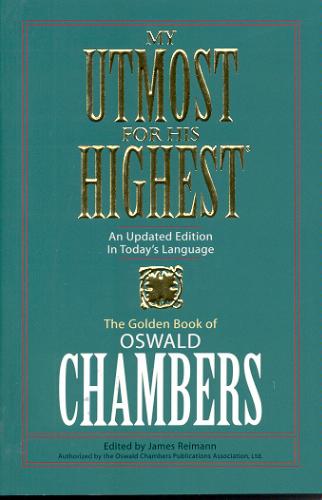
My Utmost For His Highest (book review)

Most people probably think that My Utmost For His Highest is the only book that Oswald Chambers wrote. Although My Utmost is a great devotional book, it should just be a launching pad to read more of his writings.

I am currently in the process of reading through everything Oswald Chamber wrote. And, let me tell you, it’s a lot to take in! This man was so prolific and so anointed, that not only is there much to read, but it has to be read slowly and prayerfully. That’s why I say that My Utmost is such a great starting place.

Each day’s devotional is only a page long. A few of the devotionals appear only in this book, while the remaining come from the thoughts in his many other sermons and writings. So I encourage you to spend a whole year soaking in the thoughts in My Utmost For His Highest, and then allow that to whet your appetite for more of his writings.

This book is definitely on my “must read” list!

Working It Out

Ah, yes, Oswald Chambers always gets me thinking…

“You must ‘work out your own salvation’ which God has worked in you already (Philippians 2:12). Are your speech, your thinking, and your emotions evidence that you are working it ‘out’? If you are still the same miserable, grouchy person, set on having your own way, then it is a lie to say that God has saved and sanctified you.”

Thursdays With Oswald—In Christ I Can

This is a weekly series with things I’m reading and pondering from Oswald Chambers. You can read the original seed thought here, or type “Thursdays With Oswald” in the search box to read more entries.

In Christ I Can

     We are made sons and daughters of God through the Atonement and we have a tremendous dignity to maintain; we have no business to bow our necks to any yoke saving the yoke of the Lord Jesus Christ [Matthew 11:28-30]. …

     Every detail of our physical life is to be absolutely under the control of the new disposition which God planted in us by means of identification with Jesus Christ, and we shall no longer be allowed to murmur ‘can’t.’ There is no such word as ‘can’t’ in a Christian’s vocabulary if he is rightly related to God; there is only one word and that is ‘can.’

From Biblical Psychology

Sometimes Christians are known more for what we’re against than what we’re for. I think Oswald Chambers would say that is because we don’t really understand the full power of the Atonement.

We can better understand that word by saying it “at one-ment.” We have been made one with Christ. You hear this in Jesus’ prayer for us in John 17, I in them and You in Me, in order that they may become one and perfectly united, that the world may know and definitely recognize that You sent Me and that You have loved them even as You have loved Me.”

When we are in this sort of relationship, we don’t even say can’t to sin. Instead, we say I can live a holy life because of Christ in me!

As Paul said, we can say:

I CAN do everything through Christ Who gives me strength. (Philippians 4:13)

What Is “Success” For A Church?

“How’s it going,” a fellow pastor asked me. “How’s your church doing?”

If you’re a pastor, you probably get asked this often. How do you answer this question? Do you tell them what your attendance was on Sunday morning? Or about the newest program you’ve started?

When you look in the mirror and ask yourself, “How’s it going,” is your answer related to nickels and noses (offerings and attendance)? Is it how many people complimented your last sermon?

Listen to these sobering words:

Worldliness is not the trap that most endangers us as Christian workers; nor is it sin. The trap we fall into is extravagantly desiring spiritual success; that is, success measured by, and patterned after, the form set by this religious age in which we now live. 

We have a commercialized view—we count how many souls have been saved and sanctified, we thank God, and then we think everything is all right. (Oswald Chambers)

We need to be very careful about how we define “success” in a church setting. Let’s use Jesus as our example:

  • How big was His congregation? Twelve men. One betrayed Him, nine ran away when the going got tough, and one denied he even knew Him. Even after being raised from the dead (!) there were only 120 people in the upper room.
  • How much money did His church have? Not even enough to buy a gravesite for the Messiah.
  • What did people think of His sermons? Some of His sermons made people so mad they wanted to stone Him. And after one sermon the Bible says: From this time many of His disciples turned back and no longer followed Him (John 6:66).

Maybe “success” in the church is more like…

  • …people being reconciled to God. Remembering that “our work is not to save souls, but to disciple them” (Chambers).
  • …seeing disengaged people becoming actively involved in engaging others with the Gospel.
  • …“Never seek[ing] after anything other than the approval of God” (Chambers).
  • …to say with Jesus, “The Spirit of the Lord is on Me, because He has anointed Me to preach good news to the poor. He has sent Me to proclaim freedom for the prisoners and recovery of sight for the blind, to release the oppressed, to proclaim the year of the Lord’s favor” (Luke 4:18-19).

These are just some of my thoughts. What else should be on this list? How would you define “success” in the church?

I have also shared some questions that can help pastors and ministry leaders better gauge the level of effectiveness in their ministry.

UPDATE: This post was one of the seed thoughts that went into fashioning my book Shepherd Leadership: The Metrics That Really Matter.