Ask & Act

Listen to the podcast of this post by clicking on the player below, and you can also subscribe on AppleSpotify, or Audible.

Do you want to mature as a Christian? I do! So here’s the first step…

…you may be mature and complete not lacking anything. If any of you lacks wisdom, he should ask God… (James 1:4-5).

The dictionary defines mature as “complete in natural growth or development; fully developed in body or mind as a person.” The Bible has a higher definition of maturity. The phrase mature and complete (the King James Version actually says perfect) is just one word in the Greek: teleios. It’s the same word Jesus uses when He sets this standard for maturity:

Be perfect [teleios], therefore, as your Heavenly Father is perfect [teleios]. (Matthew 5:48)

Yikes! Talk about a high standard! I certainly can’t reach that level of perfect maturity on my own! That’s why James says we should pray for wisdom. The kind of wisdom God gives is heavenly knowledge that is perfectly practical on earth. It fits with the prayer Jesus taught us to pray, “Your will be done on earth, even as it is in Heaven.”

But there is more to maturity than just asking for wisdom. I have ASK for wisdom and then I have to ACT on that wisdombut when he asks, he must believe and not doubt (James 1:6).

Growing in maturity is never a passive process; I must be actively engaged. God will not waste knowledge or experience. He won’t give it to me unless I’m going to be obedient enough to mature by its application.

Ask and act. God wants you to be teleios (perfectly mature) because it brings glory to Him. So ask for wisdom, but then be ready to act on it. This is the only path to godly maturity.

►► Would you please prayerfully consider supporting this ministry? My Patreon supporters get behind-the-scenes access to exclusive materials. ◀︎◀︎

More And More

Listen to the podcast of this post by clicking on the player below, and you can also subscribe on AppleSpotify, or Audible.

There’s a popular cliché that many motivators use to challenge people to go beyond where they are. They will cheer them on by saying, “C’mon, let’s raise the bar!” The only problem is, once someone clears the bar’s next height, they usually celebrate and then stop trying to go any higher.

Christians should be especially on guard against this mindset. It’s not a one-time thing. I don’t simply invite Jesus into my life and then set Him on a shelf. If I’m going to live a life that pleases God, I must learn how to do so more and more.

…We instructed you how to live in order to please God, as in fact you are living. Now we ask you and urge you in the Lord Jesus to do this more and more (1 Thessalonians 4:1).

The KJV says, “abound more and more.” This means that there is no set level I’m trying to reach, but that the level is always higher—there’s always more, my capacity is always increasing.

More and more is a single word in the Greek language. It means:

  • More willingly
  • More readily
  • Sooner

When the Holy Spirit speaks to me, do I respond and obey more willingly? more readily? sooner? If I do, then I am truly abounding more and more.

The mark of my maturity is a more willing, faster obedience.

This relentless focus on pleasing God more and more then overflows in the way I cheer on and encourage my brothers and sisters. Paul uses the exact same Greek word for more and more when he says a few verses later: “We urge you, brothers, to [express brotherly love] more and more” (vv. 9-10).

My increasing capacity and willingness to love and obey God more and more overflows into my increasing capacity and willingness to love and serve others more and more.

My prayer for you and for me: Holy Spirit, help us to hear Your voice, to abound more and more in our obedience to Your direction, and to express our love more and more to others.

►► Would you please prayerfully consider supporting this ministry? My Patreon supporters get behind-the-scenes access to exclusive materials. ◀︎◀︎
GrowING

Listen to the podcast of this post by clicking on the player below, and you can also subscribe on AppleSpotify, or Audible.

A few checklist items for a growING Christian (from Philippians 4:4-9):

  • Learning to rejoice in the Lord. Always.
  • Maturing in gentleness.
  • Becoming more consciously aware of God’s omnipresence.
  • Decreasing in anxiety.
  • Constantly praying.
  • Increasingly thankful.
  • Learning to remain peaceful.
  • Becoming more discerning of what goes into my mind.
  • Learning and relearning biblical principles.

I observe four things about this list:

  1. None of the verbs in the Greek are past tense. These are all on-goING processes.
  2. If this list is changed from in-process to fully-completed, it sounds like Jesus.
  3. I have to decide daily to be growING.
  4. I cannot grow through this list without help: I need the Holy Spirit.

This is a rather short list, but it’s filled with a lifetime of growING opportunities.

If I decide today that I want to be growING, my Heavenly Father will bring me into more opportunities where the Holy Spirit will help me develop and exhibit the qualities of Jesus Christ.

Are you ready to do some growING today? If so, ask the Holy Spirit to take you into your next growING lesson.

►► Would you please prayerfully consider supporting this ministry? My Patreon supporters get behind-the-scenes access to exclusive materials. ◀︎◀︎

From A Frustrating Life To An Exciting Life

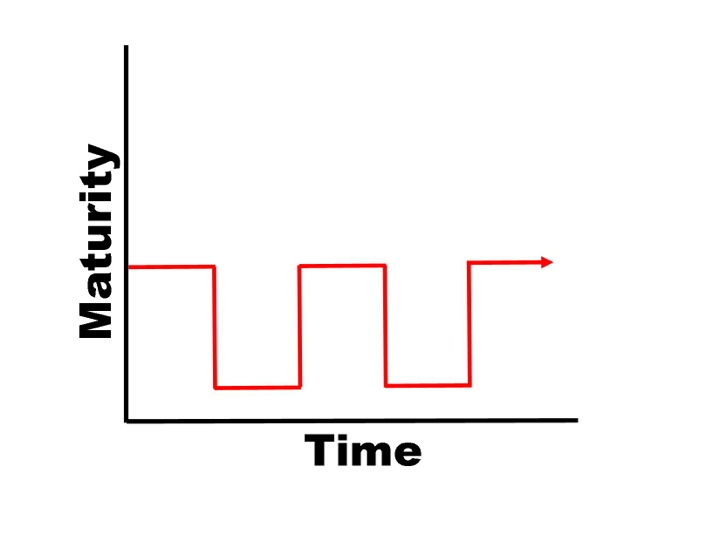
In our P119 Spiritual Workout series, we’ve looked at the similarities between an exercise program for our physical bodies, and spiritual growth for our souls. There are so many parallels for us to look at, but one of them that rings true for everyone is the up-and-down, on-and-off cycles that so many of us experience.

You know how it goes…

  • Your diet is going great and you are dropping some pounds (yea!), and then you go on vacation and all of your gains are lost (boo!).
  • You are doing really well at sticking with your new exercise routine (yea!), and then a head cold and some rainy weather knock you off your plan and it’s really hard to start back up again (boo!).
  • You are reading your Bible, and praying, and feeling so close to God (yea!), and then relationship issues, trouble at work, and a leaky hot water tank send you reeling (boo!).

We all hope our spiritual growth (or diet or exercise routine) would take us to new heights, but this up-and-down again cycle makes it feel like we aren’t getting anywhere:

In Psalm 119:49-56 the psalmist experienced this exact same up-and-down cycle:

  • He’s tight with God (v. 49)
  • Then he experiences suffering (v. 50a)
  • Only to recall God’s promises (v. 50b)
  • And then he’s getting mocked for this faith (v. 51)
  • But he’s quick to remember God and find comfort in Him (v. 52)
  • Only to get his eyes off of God and onto the godless, which causes him trouble (v. 53)
  • But he remembers God’s ways again and is comforted by singing songs about God (vv. 54-55)

Sound familiar? Up-and-down. Close-to-God-and-far-away. On-and-off. Yea!-and-Boo!

HOW DO WE BREAK OUT OF THIS?!?

The key is found in the final verse—This has been my practice: I obey Your precepts (v. 56, NIV). Look how some other translations render this verse:

  • This I had, because I kept Thy precepts (KJV).
  • This is how I spend my life: obeying Your commandments (NLT).
  • This I have had [as the gift of Your grace and as my reward]: that I have kept Your precepts… (AMP).

When we put this all together we get the solution that helps us break free from the up-and-down again cycle—

It’s ONLY by focusing on God’s GRACE everyday!

When we focus on God and His gift of grace to us, we minimize the ups-and-downs. How? Because the focus is not on what I’m doing or what others aren’t doing, but on God, His faithfulness, and His grace to us.

When God’s grace becomes our focus, we can break free from the up-and-down cycle—

If you have missed any of the messages in our P119 series, you can access them all by clicking here.

Praying For Your Healthy Friends

When do people typically ask you to pray for them? My guess it’s when things aren’t going so well for them.

How about you? When do you usually ask others to pray for you? When things are going well, or when you’re in a tough spot.

Why is it that we usually only think about prayer for sick friends or for friends in desperate need?

The apostle Paul wrote a letter to the Christians at Ephesus to encourage them. This church, as far as we know, wasn’t asking Paul for advice, and they weren’t facing intense persecution. They were mostly a spiritually healthy group.

So Paul wrote this to his healthy friends—

I have not stopped thanking God for you. I pray for you constantly. (Ephesians 1:16)

Paul went on to share with us his prayer for strong, spiritually healthy people (vv. 17-22). He asked God to make his healthy friends even stronger. He asked God to give them:

  • a super-abundance of the Holy Spirit
  • more wisdom and revelation
  • deeper intimacy with God
  • greater hope
  • greater power
  • and more strength

I’m not suggesting we stop praying for people in need. We definitely need to keep doing that. But perhaps it’s time to make a list of your healthy friends, and ask God to give them even more of Himself!

Conformed To His Image (book review)

Oswald Chambers challenges my thinking about the Christian walk like few other authors can. His insights are always so profound, and yet at the same time awaken me to the realization that I am the one who makes the Christian walk something complex. In Conformed To His Image, I was yet again challenged to simply follow Jesus.

Chambers brilliantly turns secular psychology upside down. He takes what psychology wants to ascribe to our minds and emotions, and brings it back to a Scriptural basis that puts these things where they are supposed to be: in the soul.

The thought of being “conformed” rubs against the human desire to be free and in charge of our own destiny. Somehow being “conformed” feels like being controlled and giving up our unique personality. So Chambers contrasts the natural human tendencies for freedom and calling our own shots with what the Bible says about surrendering to God.

Chambers presents Jesus not as some superhuman, extraordinary Man. But He shows the life of Jesus to be what we should all be able to live out daily. Jesus was perfectly conformed and submitted to the will of His Father. And, he says, if we will submit as well, the Holy Spirit will conform us into the image of Jesus.

Beware: this book is not light reading. This is a heavy-duty, confrontational book that will challenge you to submit to the Holy Spirit as perhaps you never have before in your Christian walk. However, if you are ready to take the plunge into a much deeper, more intimate relationship with your Heavenly Father, Conformed To His Image is the resource for you. 

Miserable

The Apostle Paul asked the Christians in Galatia an important question:

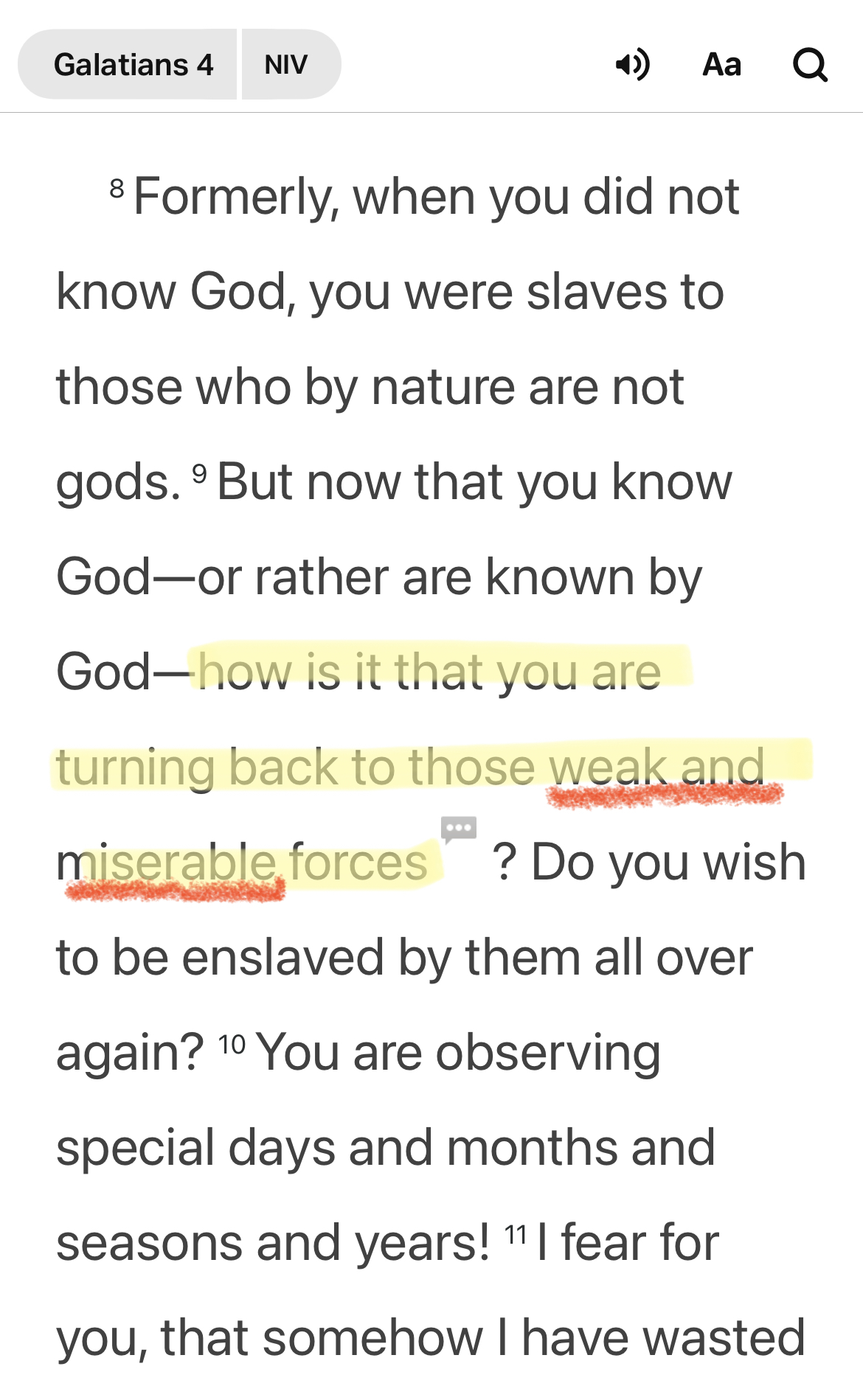
How is it that you are turning back to those weak and miserable principles? (Galatians 4:9)

The two words together in the Greek—weak and miserable—imply things that impoverish us and reduce us to lowly paupers and beggars. That’s not a pretty picture!

Look at the contrast between the princely life and the pauper’s life.

Those who follow Christ:

  • Are called sons of God (Galatians 4:6a)
  • Experience Abba Father’s favor (4:6b)
  • Are heirs to God’s Kingdom (4:7)

Those who don’t follow Christ:

  • Live as slaves (4:7)
  • Are separated from God’s favor (4:1-3)
  • Live as miserable beggars (4:9)

Why would anyone choose the miserable beggar’s life?

Here’s the principle: Everyone serves someone! I will either serve God and be called His son, or I will serve myself (my desires, my passions, my way of doing things) and be called a stranger to God.

Do I want to be in control, or do I want to let God be in control? When I try to control my own life, not only am I not in control, but I actually become a slave to my own passions. Ironic, isn’t it?

The choice is simple, but the choice must be made every day. I must choose to serve God in every moment of every day. It’s the only way to avoid the miserable life, and live the blessed life God has for me.

Artificial Maturity—How To NOT Move From College To Career

Artificial Maturity is a must-read book by Dr. Tim Elmore for parents, pastors, youth pastors, teachers, coaches, and managers—anyone who works with youth. You can read my full review of this invaluable book by clicking here.

Perfect? Yes!

The opening words of Psalm 119 describe the end result of going through what I’m calling the P119 Spiritual Workout. In a word: Blessed.

In fact, this word is so exciting that the Hebrew language uses the emphatic thought here. Bringing that into English means that the first two verses of this chapter both begin…

O!! How blessed!!

That’s a wonderful goal, but the next two verses seem to bring us crashing back to earth. In order to enjoy these heights of blessing we are asked to live like this:

  • They do nothing wrong as they walk in His ways (v. 3).
  • God’s precepts are to be fully obeyed (v. 4).

Yikes! Nothing wrong?! Full obedience?! No mistakes?!

Even Jesus said, “Be perfect, therefore, as your Heavenly Father is perfect” (Matthew 5:48).

But pay attention to this: The sign of a maturing Christian is not one who never sins; the sign of a maturing Christian is one who is closing the gap between sin and repentance.

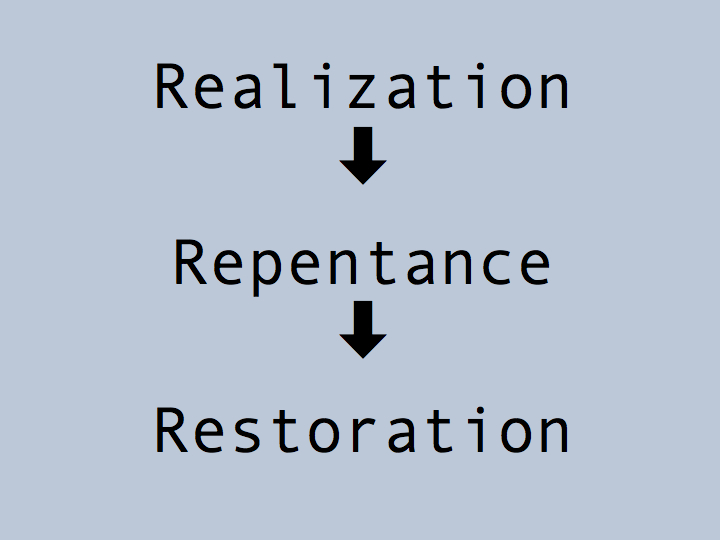
How does that work? Here’s the progression…

Realization of sinRepentance of sin → Restoration of God’s blessing

The time gap between our repentance and God’s restoration is faster than the blink of an eye—faster than you can even comprehend. What often takes us a while is moving from realization to repentance. Instead, we explain, and justify, and make excuses, and drag our feet.

But a maturing Christian invites the inspection of the Holy Spirit through the reading of God’s Word and then is quick to realize sin and repent from it. When God restores us, do you know how we appear to Him? PERFECT!!

So realizing our sin, repenting of that sin, and experiencing God’s restoration is the fastest way to live as those who do nothing wrong and who are fully obeying God’s precepts.

Don’t wait any longer: realize and repent, and then experience God’s restoration as you stand perfect in His presence!

If you have missed any of the messages in our P119 series, you can access them all by clicking here.

No Puffiness, Please

Here’s a quick fill-in-the-blank statement:

Now about ______________________: We know that we all possess knowledge. Knowledge puffs up, but love builds up. (1 Corinthians 8:1)

Fill in this blank with something you consider (as Dr. Charles Ryrie calls them) a “morally indifferent” practice. In other words, something that is not a black-in-white, do-it-and-you’re-sinning issue. What goes in your blank?

  • …skipping church?
  • …drinking alcohol?
  • …smoking a cigar?
  • …dancing?

We all have knowledge about such things, but where’s the love?

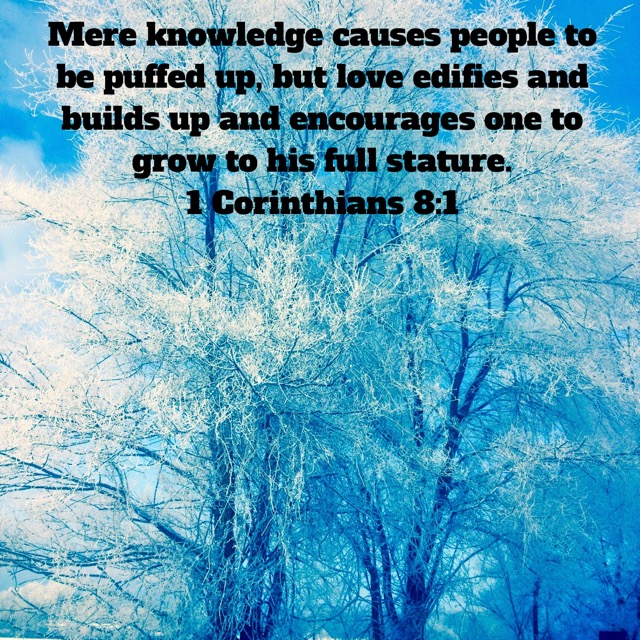
Love builds up. Knowledge only benefits me; love benefits all. The Amplified Bible says it this way, “love edifies and builds up and encourages one to grow to his full stature.

The Greek word for builds up means “to promote growth in Christian wisdom, affection, grace, virtue, holiness, blessedness; to grow in wisdom and piety.”

The question, “Does this fill-in-the-blank item hinder a weaker brother?” is too puffy. The better question is, “Does this help my weaker brother grow?”

That’s the question love asks.

Love avoids the negative-growth items and even the neutral-growth items. Love seeks only those things which promote positive growth.

It’s too puffy to ask, “Does this hurt someone.”

It’s too puffy to say, “This is no big deal!”

We need to ask, “Does this help everyone?” If we can’t answer “yes,” leave it alone!