Links & Quotes

link quote

“When something drops into your life that seems to threaten your future, remember this: The first shock waves of the bomb are not sin. The real danger is yielding to them. Giving in. Putting up no spiritual fight. And the root of that surrender is unbelief—a failure to fight for faith in future grace. A failure to cherish all that God promises to be for us in Jesus.” —John Piper

“The ultimate test of man’s conscience may be his willingness to sacrifice something today for future generations whose words of thanks will not be heard.” —Gaylord Nelson

My fellow pastors, may this be said of us: “Even now the Lord is raising up godly watchmen to speak for Him in these times. These shepherds are grieving, weeping and repenting as they seek God’s face. And I believe they’re hearing and understanding the Lord’s message behind the present events. Moreover, they’re not afraid to proclaim dire warnings, because they know they’ve heard from God. They’re compelled to speak of His purposes behind our calamities.” —David Wilkerson

“Who is doing exploits for God today? Where is the enemy being driven back? That is the great yearning of all spiritually-minded people. They are not enchanted with polished sermons and slick organizational technique. Where are the mighty men and women anointed by God to truly make a difference?” —Jim Cymbala

Good read for anyone in church leadership: 10 Fine Lines Of Church Leadership Tension.

Medical science validates what Scripture tells us: Unforgiveness can be lethal.

In the United States, roughly 10% of people struggle with dyslexia. Here are some helpful ways to make your materials more dyslexic-friendly for them.

J. Warner Wallace shares 6 pieces of evidence that point to our  universe having a beginning.

[VIDEO] Probably the best baby announcement I have seen yet—

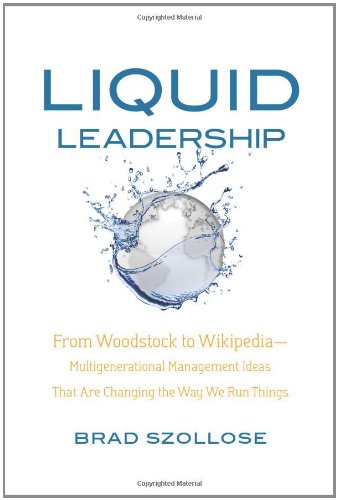
Liquid Leadership (book review)

Liquid LeadershipIn Liquid Leadership, Brad Szollose proposes to teach leadership principles for those who have younger employees, or for those who lead organizations that need to relate to a younger demographic. Brad says that liquid leaders are able to flow effortlessly between older and younger generations.

Brad’s seven laws say that a liquid leader…

  1. …places people first.
  2. …cultivates an environment where it is free and safe to tell the truth.
  3. …nurtures a creative culture.
  4. …supports reinvention of the organization.
  5. …leads by example.
  6. …takes responsibility.
  7. …leaves a lasting legacy.

I agree with all of these points: not just for “liquid leaders” but for all leaders. If leadership principles (or laws, as Brad calls them) are true, then they are also applicable in every setting: Gen Y or Baby Boomer, for-profit or charity, Western or Eastern.

The “meat” of Liquid Leadership comes in the opening chapter, with the remaining chapters consisting primarily of Brad’s personal experiences, or his observations of other success/failure stories, to help bolster his point.

If you are looking for a book with good stories to make your case for leadership, check this out. But if you are looking for a book about serious leadership development, look elsewhere.

A Legacy Of Faith (book review)

Legacy Of FaithIt sometimes distresses me to see great men and women who stumble later in life. But one man who has lived a life full of integrity is Billy Graham. If anyone can speak about “legacy” with the full support of his life’s message, it is Rev. Graham!

In the same format as Zig Ziglar’s Inspire To Be Great, and John Wooden’s Winning With Principle, A Legacy Of Faith is a collect of noteworthy quotes from Billy Graham. Time and time again I was impressed with Dr. Graham’s words, but more impressed that he lived them out so publicly for all to see.

If you haven’t read any of Billy Graham’s sermons or books, this book is a good place to start. Even if you are familiar with his works, this is still an excellent resource for his wise quotes.

What a great read!

Delightful Fear

Delightful FearThe 112th Psalm begins with an interesting idea that almost sounds like an oxymoron: delightful fear—

Blessed is the man who fears the Lord, who finds great delight in His commands. (v. 1)

  • Fear and delight
  • Worship and obedience
  • Reverence and action
  • Awe and love

These are not contrasting ideas, but two sides of the same coin. They are completions of each other, and they are essential to a healthy relationship with Jehovah. And then, oh!, the blessings that flow from God to me!

  • Mighty children (v. 2)
  • Abundant household (v. 3a)
  • Enduring righteousness (v. 3b)
  • Brightly shining life (v. 4)
  • Reciprocated generosity (v. 5)
  • Security in troubled times (v. 6a)
  • A lasting legacy (v. 6b)
  • No fear of calamity (v. 7)
  • Eternal life (v. 8)
  • Highly honored (v. 9)

After nine verses of these amazing blessings to the one who delightfully fears God, only one verse is left for the one who doesn’t—he is vexed, wasting away, and frustrated.

I don’t know about you, but I want to delightfully fear—worship, obey, revere and love—Jehovah my God!

The Legacy Of My Parents

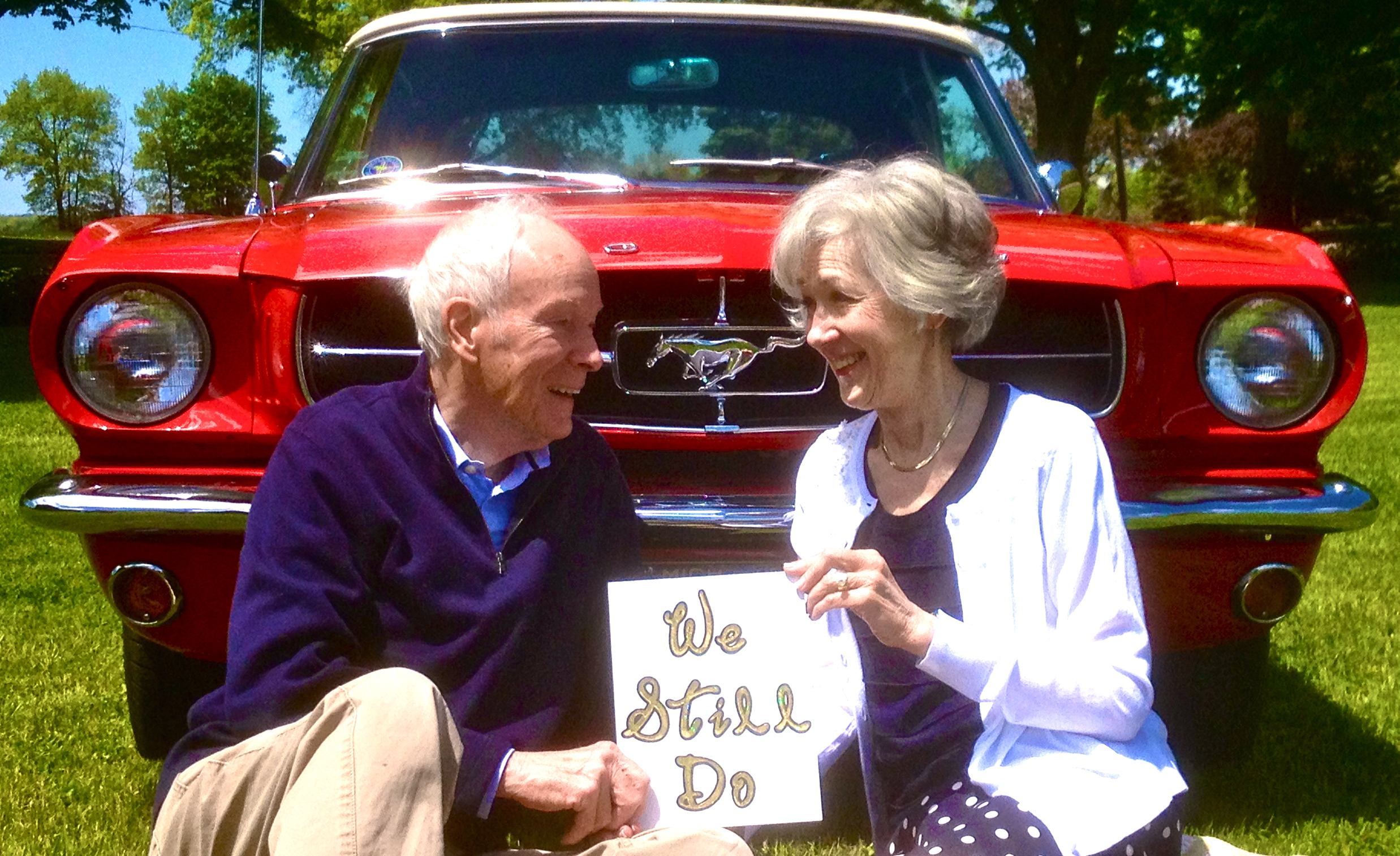
MustangThis past weekend we celebrated my parents golden anniversary. Long-time friends gathered around the dinner table and shared some great memories of how my Mom & Dad had impacted their lives. Other friends who couldn’t attend sent in letters and videos. My biggest takeaway from that weekend is something I already knew: My parents are ministers.

They don’t have a title like reverend or pastor or missionary. But for their entire marriage they have ministered like Jesus described in Matthew 25: they fed the hungry, clothed the naked, provided shelter for the homeless, and love for the hurting.

See for yourself…

I am so blessed by the legacy my parents have left!

Links & Quotes

link quote

Some great reading I found today.

“Pray till you pray. Pray till you are conscious of being heard. Pray till you have received an answer.” —Moody Stuart

Anxiety about our family is natural, but we shall be wise if we turn it into care about our own character. If we walk before the Lord in integrity, we shall do more to bless our descendants then if we bequeathed them large estates. A father’s holy life is a rich legacy for his sons. … Our integrity may be God’s means of saving our sons and daughters. If they see the truth of our religion proved by our lives, it may be that they will believe in Jesus for themselves.” —Charles Spurgeon

Marriage exists to bring a man and a woman together as husband and wife to be father and mother to any children their union produces. It is based on the anthropological truth that men and women are different and complementary, the biological fact that reproduction depends on a man and a woman, and the social reality that children need both a mother and a father. Marriage predates government. It is the fundamental building block of all human civilization. Marriage has public purposes that transcend its private purposes. This is why 41 states, with good reason, affirm that marriage is between a man and a woman.Read more from the Heritage Foundation about the value of marriage.

The Incense Of Prayer

E.M. Bounds has challenged and inspired my prayer life probably more than any other author. Check out these words from his book Purpose In Prayer

Purpose In Prayer“God shapes the world by prayer. Prayers are deathless. The lips that utter them may be closed in death, the heart that felt them may have ceased to beat, but the prayers live before God, and God’s heart is set on them and prayers outlive the lives of those who uttered them; outlive a generation, outlive an age, outlive a world.

“That man is the most immortal who has done the most and the best praying. They are God’s heroes, God’s saints, God’s servants, God’s deputies. A man can pray better because of the prayers of the past; a man can live holier because of the prayers of the past, the man of many and acceptable prayers has done the truest and greatest service to the incoming generation. The prayers of God’s saints strengthen the unborn generation against the desolating waves of sin and evil. Woe to the generation of sons who find their censors empty of the rich incense of prayer; whose fathers have been too busy or too unbelieving to pray, and perils inexpressible and consequences untold are their unhappy heritage. Fortunate are they whose fathers and mothers have left them a wealthy patrimony of prayer.” (emphasis added)

When God gave Moses instructions for building the tabernacle, the altar of incense was placed before the curtain that separated the Holy Place from the Holy of Holies. The Bible does not tell us how the high priest passed through or by the curtain, so many believe that as he worshiped God, his prayers mingled with the incense, and God translated him through the curtain and into His presence.

There are other verses to support this:

  • Let my prayer be set forth as incense before You, the lifting up of my hands as the evening sacrifice. (Psalm 141:2)
  • The book of Revelation gives us a glimpse into Heaven, and twice we see the prayers of the saints being linked with the incense of worship (see Revelation 5:8 and 8:3-4).

Notice what E.M. Bounds says … our prayers TODAY are providing the incense the NEXT GENERATION will need! If we fail to pray now, we’re not only hurting ourselves, but we’re putting our children and grandchildren on a path toward “perils inexpressible and consequences untold.”

Instead, let’s leave them “a wealthy patrimony of prayer”! Will you pray? Today?

The Destiny Of Nations

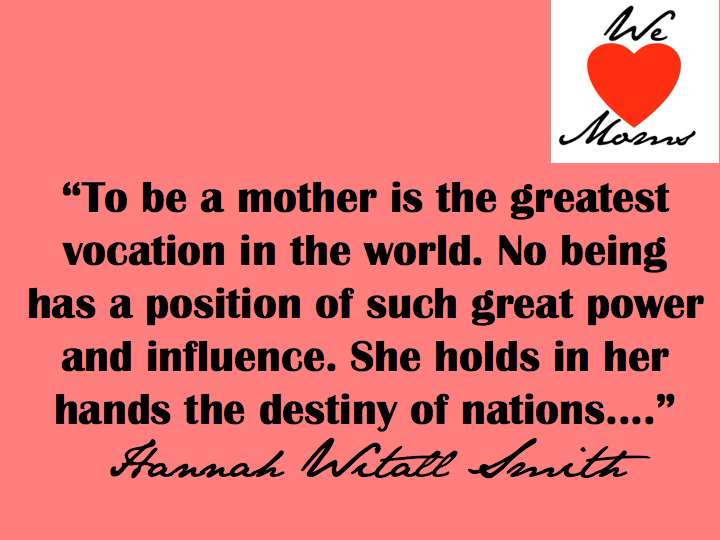
Destiny of nations“To be a mother is the greatest vocation in the world. No being has a position of such great power and influence. She holds in her hands the destiny of nations….” —Hannah Whitall Smith

A great example of this is a woman by the name of Rahab who lived in ancient Jericho. She was doing her best to provide for her family in a very unsavory way: she was a prostitute. Yet this is a woman who is commended for her faith in God (Hebrews 11:31) and her righteous actions (James 2:25).

I know many moms who work hard to provide for their families, sometimes taking jobs that are very difficult and pay a low wage. They still find the time to buy the groceries, fix the meals, do the laundry, help with homework, attend after-school functions, and a million other things. Even after all this they feel inadequate, like they are not quite measuring up to the “best mom” standard.

To those moms, I say this: Look at Rahab, and learn what she learned. Rahab tried to provide for her family too, but when she got to the point where she was completely desperate she turned her family over to God. By helping the young Jewish spies, she turned her back on her countrymen and lost any other options for help. She said, “I believe in God, and I’m willing to trust Him with my family completely” (see Joshua 2:1-13).

Legacy of faithfulnessAs a result, God’s faithfulness to her is something we still are blessed by today. In giving us the genealogy of Jesus Christ, Matthew says this: Salmon the father of Boaz, whose mother was Rahab, Boaz the father of Obed, whose mother was Ruth, Obed the father of Jesse, and Jesse the father of King David (Matthew 1:5-6). Rahab went all-in with God, and is now an indispensable part of the lineage of Jesus Christ!

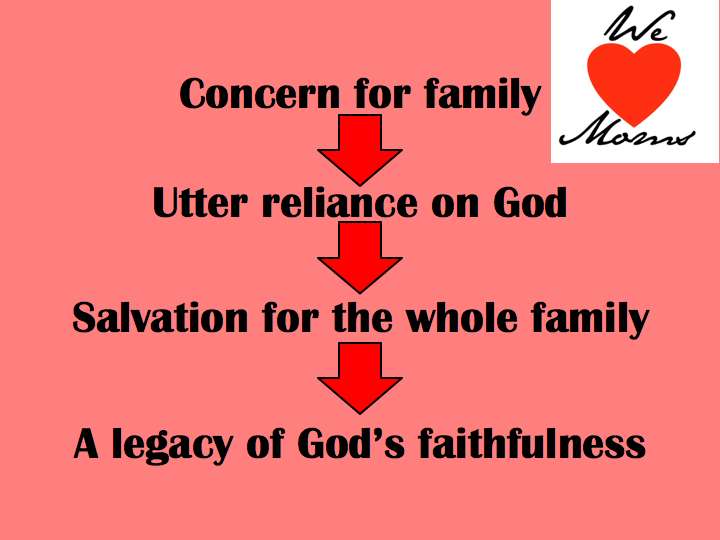
Here’s the pattern for all moms to follow:

Concern for your family → Your utter reliance on God → The salvation of all in your family who will listen → A legacy of God’s provision and faithfulness

Moms, you have great power and you hold in your hands the destiny of nations, if you will just turn your concerns for your family over to God, and leave them in His loving hands.

Firsthand (book review)

FirsthandWhile I was reading Firsthand by Ryan & Josh Shook, I felt a little bit like I was reading my own autobiography. Ryan & Josh write about their journey to embrace faith in God as something personal for them—something firsthand. Prior to this point in their lives, these brothers felt like they were living and believing in a secondhand relationship with God.

I can relate. I’m a fourth-generation Christian, with my parents, grandparents, and great-grandparents professing a relationship with Jesus Christ. I remember vividly my “crisis of faith” as I wrestled with my burning questions: Do I believe what the Bible says about God just because my parents believed it, or do I believe it because it’s true?

I would encourage all Christian parents to purchase a copy of this book for their kids. Ryan & Josh’s words will resonate with them, and will prepare them for their own journey of discovery. We Christian parents must do all we can to help our children successfully navigate this crucial time in their lives, and Firsthand will be an invaluable resource.

Here’s a video review I did for WaterBrook Multnomah Publishers—

I am a WaterBrook book reviewer. Here are some quotes I shared from this book.

23 Quotes From “The 5 Levels Of Leadership”

5 Levels of LeadershipThere is always so much rich content in a John Maxwell book, and The 5 Levels Of Leadership is no exception. You can read my full book review by clicking here. These are a few of the quotes that especially caught my attention. Unless otherwise noted, these quotes are from John Maxwell.

“At any level, a leader doesn’t automatically stay at that level. You must earn your level of leadership with each person, and that level can go up or down at any time.” 

“You have no control over how much talent you possess. You control only what you do with it.”

“Leadership is accepting people where they are, then taking them somewhere.” —C.W. Perry 

“Often to make themselves look better or to keep people from rising up and threatening them, positional leaders make other people feel small. How?

  • By not having a genuine belief in them.
  • By assuming people can’t instead of assuming they can.
  • By assuming people won’t rather than believing they will.
  • By seeing their problems more readily than their potential.
  • By viewing them as liabilities instead of assets.”

“Anytime you think you’ve arrived—whether your position is the lowest or the highest in the organization—you’ve lowered your expectations for yourself, sold your leadership short, and fallen into a no-growth mind-set.”  

“Above all else, good leaders are open. They go up, down, and around their organizations to reach people. They don’t stick to established channels. They’re informal. They’re straight with people. They make a religion out of being accessible.” —JackWelch

“You see, when there is danger, a good leader takes the front line. But when there is celebration, a good leader stays in the back room. If you want the cooperation of human beings around you, make them feel that they are important. And you do that by being humble.” —Nelson Mandela 

“People will not get ahead with others unless they are willing to work behind others.”

“[Good leaders] have more than an open-door policy—they know the door swings both ways. They go through it and get out among their people to connect.” 

“If you want to be successful on Level 2, you must think less in terms of systems and more in terms of people’s emotions. You must think more in terms of human capacity and less in terms of regulations. You must think more in terms of buy-in and less in terms of procedures. In other words, you must think of people before you try to achieve progress.”

“Care without candor creates dysfunctional relationships. Candor without care creates distant relationships. But care balanced with candor creates developing relationships. …Caring values the person while candor values the person’s potential. …Caring establishes the relationship while candor expands the relationship. … Caring defines the relationship while candor directs the relationship.” 

“Before having a candid conversation, make sure you can answer yes to the following questions:

  • Have I invested enough in the relationship to be candid with them?
  • Do I truly value them as people?
  • Am I sure this is their issue and not mine?
  • Am I sure I’m not speaking up because I feel threatened?
  • Is the issue more important than the relationships?
  • Does this conversation clearly serve their interests and not just mine?
  • Am I willing to invest time and energy to help them change?
  • Am I willing to show them how to do something, not just say what’s wrong?
  • Am I willing and able to set clear, specific expectations?”

“If achieving the vision is worth building the team, it is also worth risking the relationship. Building relationships and then risking them to advance the team creates tension for the leader. That tension will force you to make a choice: to shrink the vision or to stretch the people to reach it. If you want to do big things, you need to take people out of their comfort zones. They might fail. They might implode. They might relieve their own tension by fighting you or quitting. Risk always changes relationships. If you risk and win, then your people gain confidence. You have shared history that makes the relationship stronger. Trust increases. And the team is ready to take on even more difficult challenges. However, if you risk and fail, you lose relational credibility with your people and you will have to rebuild the relationships. Risk is always present in leadership. Anytime you try to move forward, there is risk. Even if you’re doing the right things, your risk isn’t reduced. But there is no progress without risk, so you need to get used to it.” 

“You can issue all the memos and give all the motivational speeches you want, but if the rest of the people in your organization don’t see you putting forth your very best effort every single day, they won’t either.” —Colin Powell

“The job of a leader is to build a complementary team, where every strength is made effective and each weakness is made irrelevant.” —Stephen Covey

“If you want to be an effective leader, you must move from perfectionist to pragmatist.”

“Since you can’t prevent mistakes, why not adopt and attitude in which you and your team learn from them?” 

“The individual leads in order that those who are led can develop their potential as human beings and thereby prosper.” —Socrates

“The highest goal of leadership is to develop leaders, not gain followers or do work.”

“Leadership is an opportunity to serve.” —J. Donald Walters

“No matter where you are in your leadership journey, never forget that what got you to where you are won’t get you to the next level.” 

“The reality is that no one is indispensable. Worse, allowing others to become dependent does little more that satisfy a leader’s ego. It is a very limiting leadership style that has a very short life span. The first step in developing leaders is to have a desire to develop people so that they can succeed without you. …If you want to develop people, you must help them discover and build upon their strengths. That’s where people have the most potential to grow. Helping to develop their strengths is the only way to help leaders become world-class.”

“What you do daily, over time, becomes your legacy.”