Listen to the podcast of this post by clicking on the player below, and you can also subscribe on Apple, Spotify, or Audible.
We are more likely to act ourselves into feeling good than we are to wait until we feel good about something before we act on it. That self-initiative is a true leadership separator.
Listen to the podcast of this post by clicking on the player below, and you can also subscribe on Apple, Spotify, or Audible.
I am sure everyone has heard the comical philosophical question, “Which came first: the chicken or the egg?” At Creation, the chicken clearly came first. But in other instances, sometimes the correct answer is not either-or but both-and.
The apostle Paul warned his protege Timothy, “For the time will come when men will not put up with sound doctrine. Instead, to suit their own desires, they will gather around them a great number of teachers to say what their itching ears want to hear” (2 Timothy 4:3). In other words, the people are saying, “The truth makes us uncomfortable, so tell us something that makes us feel good. If you do, you will be rewarded by our popular support.”
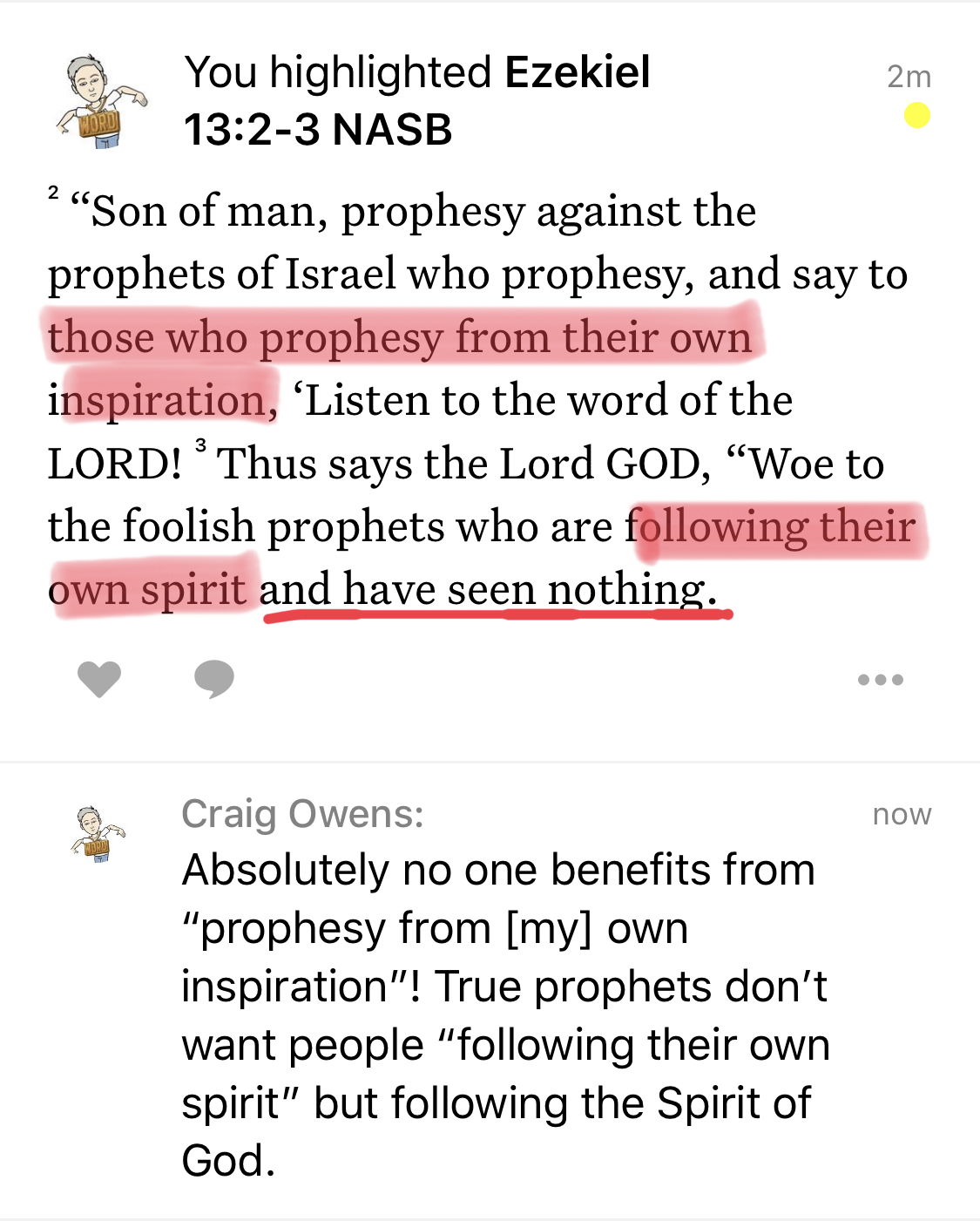
Nearly 600 years earlier, God had something to say to those popular teachers, “Woe to the foolish prophets who follow their own spirit and have seen nothing!” (Ezekiel 13:3). The New King James Version says they “prophesy out of their own heart” and the New American Standard Bible says they “prophesy from their own inspiration…following their own spirit.” In other words, they are speaking a popular message, not a truthful message.
So which came first: the chicken of people with itching ears or the egg of false prophets with a popular message intended for itching ears? I think this is a true both-and. It’s both people looking for a feel-good message, and false prophets realizing they can be rewarded for sharing a popular feel-good message.
Absolutely no one benefits from a prophecy from my own inspiration. True prophets of God don’t want people following their own spirit but following the Spirit of God.
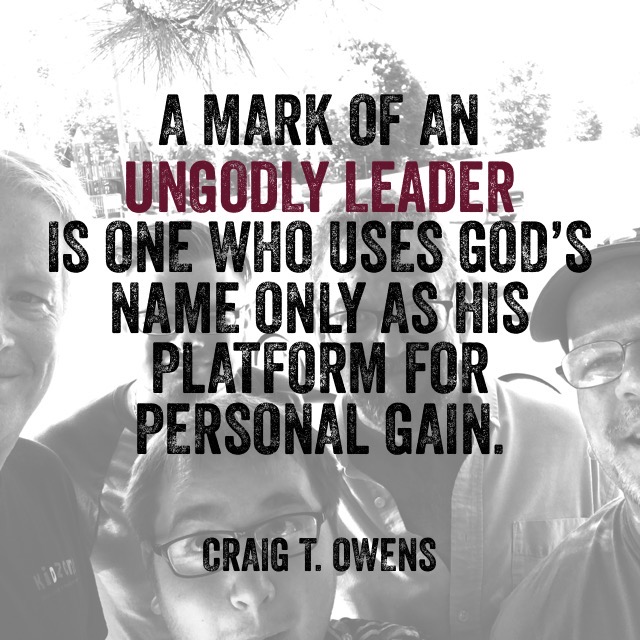
A mark of anungodlyleader is one who uses God’s name only as his platform for personal gain.
To those false prophets, God says, “Woe are you, for My judgment will fall on you.” To those with itching ears who trade popularity for truth, Paul says to Timothy, “Have nothing to do with them” (2 Timothy 3:1-5).
This is part 72 in my series on godly leadership. You can check out all of my posts in this series by clicking here.
When someone wants to “grow” an organization, what exactly does that look like? Is growth only numeric or is it something that’s perhaps a bit more difficult to count? The leader needs to have this clear in their mind, and they need to regularly communicate this metric to their team. I unpack this in greater detail in my book Shepherd Leadership. Check out more of this message here. And be sure to check out all of my videos on my YouTube channel.
It appears that creativity is largely fueled by two things: proper sleep and finding your “sweet spot” each day. If you are an early bird, protect that creative time. If you are a night owl, don’t try to become an early bird to emulate someone else, but lean into your productive time. Check out this full post.
I love reading, but even I have trouble finding time to sit down with my books. But this insight from John Piper totally rejuvenated my thinking about reading. “Suppose that you can read about 250 words a minute. Now, that’s not real fast; most of us can do that—250 words a minute. And suppose that you set aside fifteen minutes a day to read a great book—a classic or some book that you’d been longing to read that would help you grow in your wisdom, your understanding. Now, fifteen minutes a day for 365 days is 5,475 minutes a year. Now, you multiply 5,475 times 250, and you get 1,368,750 words that you could read in a year at fifteen minutes a day. Now, an average book has about 300 to 400 words on a page. So we’ll take 350, which is kind of in the middle, and divide that into 1,368,750. And you know what you get? You get 3,910—almost 4,000 pages a year. An average book has about 200 pages. You see the implication of that? You could read twenty books by this time next year by setting aside fifteen minutes a day.”
An ancient Hebrew inscription consisting of 48 letters was discovered on Mt. Ebal in Israel and is centuries older than any known Hebrew inscription from ancient Israel. This is yet another archeological discovery that speaks to the historicity of the Bible.
T.M. Moore wrote one of the endorsements of my book Shepherd Leadership. His thoughts here about the role of godly shepherds is right on the mark: “The work of shepherds consists of helping the people of God to connect with Him—to know, love, fear, and serve Him in every area of their lives. This work cannot be fulfilled by one who is merely a good speaker, an effective organizer, or an inspiring motivator. This work must be done by one who truly knows the Lord. For unless we know the Lord, the Lord will not know us, and He will not honor our labors.”
You are one-of-a-kind! There has never, ever been anyone like you, and there never will be. God made you on purpose and for a purpose. And God wants to reveal the purpose He has for your life. You be you—that is how God is most glorified through you.
Listen to the audio-only version of this podcast by clicking on the player below, or scroll down to watch the video.
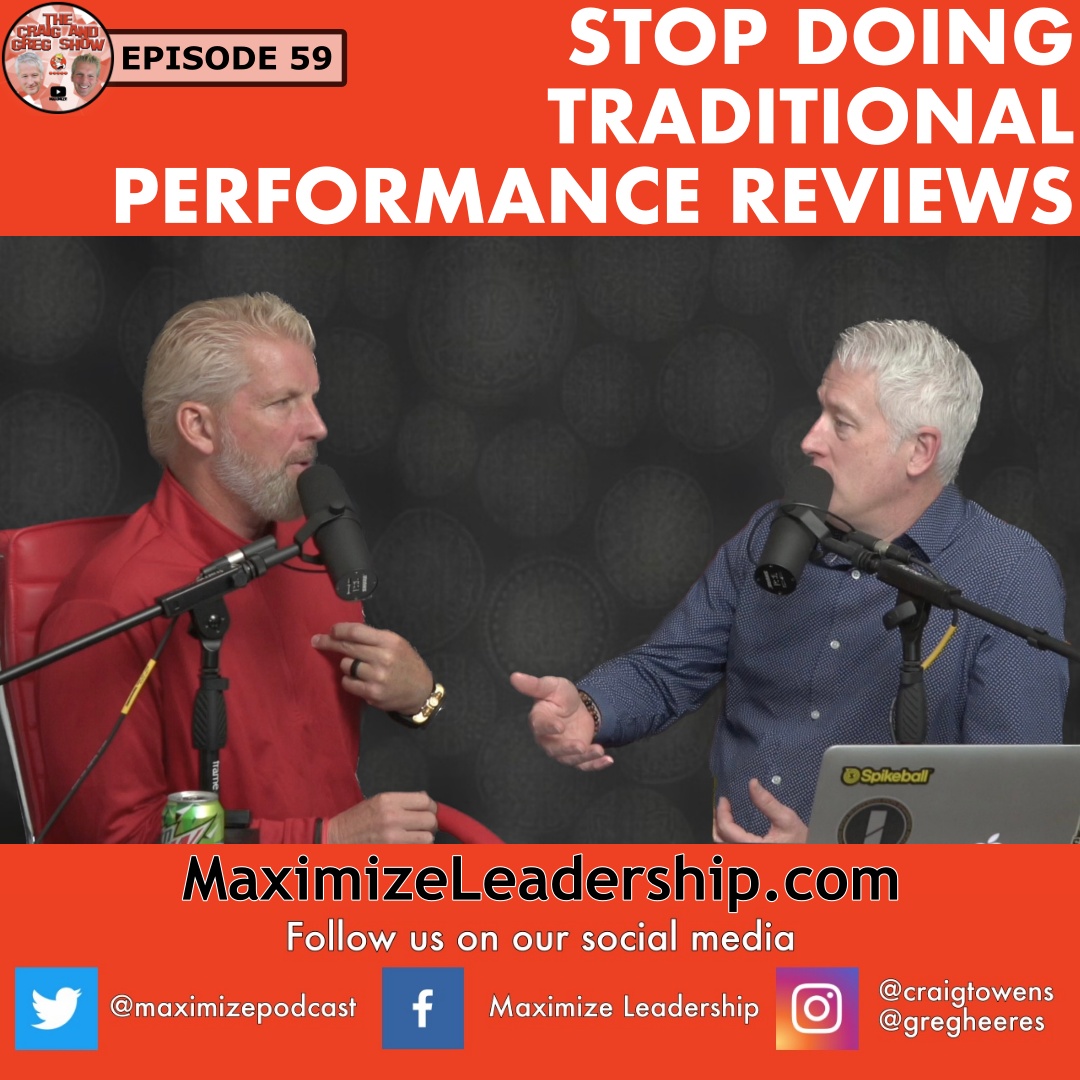
Performance reviews are a great tool to help leaders measure and celebrate the growth of their team, but the standard model of quarterly and yearly reviews is a terrible way to go about it. In this episode, Greg and I suggest a different approach to reviews that relies on frequent coaching and giving your team “the answers to the test” to set them up to succeed.
[0:15] We all have “have to” and “get to” leadership tasks in our organization, but we think performance reviews never should be in the have to” category.
[1:29] Performance review times are a great time to unleash potential in our teammates.
[2:44] Greg shares how his daughter’s school does this well and how an organization he worked with did this poorly.
[4:02] I teach leadership principles to a group of young men called “Guys With Ties,” and I always have them focus on future growth.
[5:22] Leaders can only do effective reviews by having regular interactions with their teammates.
[7:00] We suggest a better way to give out compliments and corrections.
[8:35] Three key elements in performance reviews: (1) honesty, (2) timeliness, (3) looking forward.
[10:54] How do we handle situations where the review doesn’t match the projected employee bonus?
[12:55] Many of our teammates have probably had a bad experience with a previous performance review, so we need to address that upfront.
[13:16] Accountability is a heavy word but it is a vital growth piece.
[15:23] What happens when leaders are tired?
[17:27] What does it say to our teammates if we’re always too busy to schedule a time for a performance review?
[21:13] The culture we need to foster in our organization is an “improvement culture.”
Check out this episode and subscribe on YouTube so you can watch all of the upcoming episodes. You can also listen to our podcast on Spotify and Apple.
Listen to the podcast of this post by clicking on the player below, and you can also subscribe on Apple, Spotify, or Audible.
Every organization has a culture and has some sacred cows.
I define culture as the unwritten rules that everyone who’s been around for a while knows, but seldom thinks to share with any newcomers. Those newcomers usually don’t know they have broken one of those unwritten rules until they actually break one of those rules!
Sacred cows are the untouchable things in every organization. Those things that have always been in place and can never be changed or removed.
But what if you’re the new leader coming into an organization? How do you navigate the new culture? How do you keep from messing with those sacred cows? Greg and I discussed this on a recent episode of our leadership podcast.
Check out the full episode this clip came from by clicking here.
A prominent Chinese scholar, Dr. Wang Yun Wu (1888-1979), abandoned atheism in 1924 after he witnessed the miraculous healing of his sister’s eyesight. Dr. Wang later became Vice Premier of the Republic of China (Taiwan). Check out this miraculous story in the Pentecostal Evangel.
What it is: May is mental health awareness month, making mental health and suicide prevention bigger topics than ever. #mentalhealthmatters has around 42 billion views on TikTok, and #mentalhealthawareness has racked up 20 billion.
Why the conversation is changing: The CDC’s Youth Risk Behavior survey showed that suicidal ideation, especially for teenage girls, is continuing on a concerning trajectory. In 2021, 30% of girls said that they had seriously considered suicide in the past year, and 24% said they had an actual plan to end their life. According to data published by Mental Health America, 16.4% of youth reported experiencing a major depressive episode within the last 12 months. This news comes at a time when adults are feeling so lonely that the US surgeon general has declared loneliness a public health emergency. Stigma around mental health topics appears to be eroding, but that isn’t necessarily leading to better mental health outcomes for teens and for the population at large.
Conversation Starter:What do you think are the biggest contributors to mental health issues for your generation? (Check out our new video series on Mental Health for more help having this conversation!)
“A pessimist is one who makes difficulties of his opportunities and an optimist is one who makes opportunities of his difficulties.” —Harry Truman
Is pain good or bad? Dr. Matthew Loftus makes the case that avoiding suffering undermines the role of medicine and also stunts our ability to feel and express compassion. Check out this full article and the thoughts John Stonestreet shared about them.
“What a sweetness lies in the little word ‘our’; how much is God’s glory endeared to us when we consider our interest in Him as ‘our Lord’ [Psalm 8:1].” —Charles Spurgeon, in Spurgeon and the Psalms
Listen to the podcast of this post by clicking on the player below, and you can also subscribe on Apple, Spotify, or Audible.
Confidence can become a detriment to a leader’s growth when our confidence keeps us in a place where we refuse to ask for help. Nick Vujicic wisely noted, “An arrogant person does not ask for help and thus is helpless. An arrogant person claims to know everything and thus is clueless. A humble person attracts helpers and teachers.”
Sadly, too many leaders think that if they admit they don’t know something, that will diminish their standing in the minds of those around them. I’ll be the first to confess that this is how I used to view myself in my leadership roles.
But a huge breakthrough for me was in humbly admitting my need and seeing how others delighted to come alongside me to help.
During a training time with some other pastors, I was asked what I thought about “self-help books.”
There are many leaders that believe the lie that God helps those who help themselves. In reality, God delights in those who admit their need for help. The Bible says, “God opposes the proud, but shows favor to the humble” (James 4:6). Unhealthy or insecure leaders don’t admit their need for help, and as a result they put a lid on their leadership potential.
Swallow your pride … humbly admit your need for help … receive the help of God and others … and then watch your leadership influence grow!
Listen to the audio-only version of this podcast by clicking on the player below, or scroll down to watch the video.
Recently Greg got a call from an educational institute asking him for advice on how to help their athletes “toughen up.” Unfortunately, they’re not alone, it seems like resilience is in increasingly shorter supply across the board these days. As a leader, it is your job to help instill grit into your team. Not tearing them down, but showing them that you view them with more potential.
[17:54] Data from the Mayo Clinic that encourages us to develop grit.
[19:34] What happens to reach that have teammates who don’t show stick-to-it-iveness?
[21:04] A leadership separator is action over feelings.
[24:00] The wrong and right ways to handle disappointments.
[25:53] We can help coach you to bring out the resilience in yourself and your team.
Check out this episode and subscribe on YouTube so you can watch all of the upcoming episodes. You can also listen to our podcast on Spotify and Apple.
Listen to the podcast of this post by clicking on the player below, and you can also subscribe on Apple, Spotify, or Audible.
If you’ve been promoted to a new position, be very aware of how you arrive. If you come in overly confident, you could alienate your new teammates before you even get a chance to get started with them. We have an idea that will help you arrive well and make great connections right from the beginning.
Check out this full conversation on The Craig And Greg Show by clicking here.
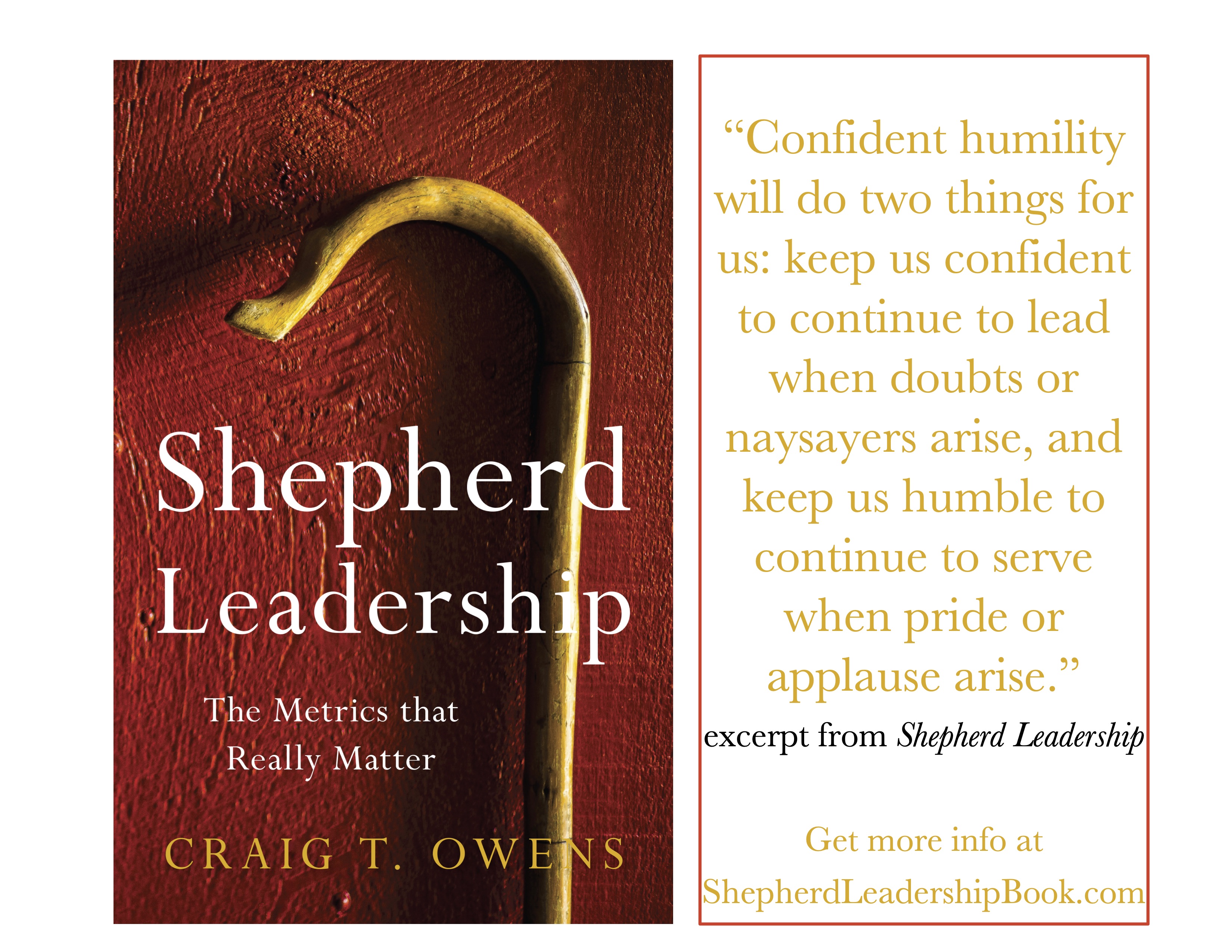
Shepherd Leadership: The Metrics That Really Matter is available in print or ebook, and in audiobook through either Audible or Apple.







 Craig T. Owens