Listen to the podcast of this post by clicking on the player below, and you can also subscribe on Apple, Spotify, or Audible.
When we have a difficult coworker or team member, it’s very easy to fall into the trap of talking about them to others and avoid talking directly to them.
Getting counsel from others about this difficult person is important, but then we must use those insights to have a productive conversation directly with that team member. If we don’t talk directly to them, we’re ultimately gossiping about them, which is never productive. In fact, that gossiping will actually make the situation worse.
Listen to the audio-only version of this podcast by clicking on the player below, or scroll down to watch the video.
Have you thought about what you’d like said at your funeral? Stick with me here, this isn’t an episode about contemplating your death. In this episode, Greg and I want to encourage you to begin with the end in mind, and live as the type of leader that you picture yourself being remembered as.
[0:15] Hang with us on this one: We’d like you to take a moment to think about your funeral.
[3:15] We could think of our own epitaph like we’re building a house.
[4:14] Greg asks me what I would like on my epitaph.
[6:00] We aren’t talking about planning our funeral, but about doing lasting and beneficial things with “the dash” between our birth date and our death date.
[9:20] There is a leadership caution when we’re thinking about this topic.
[10:21] Greg has been thinking about one word that could sum up his life.
[13:31] Here’s what we need to live for today.
[15:41] I give an example of someone whose character and reputation didn’t align.
[18:09] I brag on something special Greg does for others.
[20:54] How do leaders get beyond themselves?
[24:05] We need to be living our leadership story every single day.
Check out this episode and subscribe on YouTube so you can watch all of the upcoming episodes. You can also listen to our podcast on Spotify and Apple.
Listen to the podcast of this post by clicking on the player below, and you can also subscribe on Apple, Spotify, or Audible.
Without a doubt, a leader plagued by feelings of guilt is a leader that is operating well-below his or her full potential.
One of the best ways to avoid these feelings of limiting guilt is for the leader to admit that he or she isn’t an expert in every aspect of their organization.
In this short clip, Karl Vaters and I are specifically addressing pastoral leaders, but the principles can be applied to leaders of any organization.
You can check out more clips from this interview by clicking here.
The two related blog posts I made reference to in this video are:
Jesus asks us to proclaim the message about Him, not argue about Him. The best witness is one who truthfully shares his or her personal life-changing experience with Jesus. There is never a reason to quarrel about this! Check out this whole message here. I have lots of new content every week, which you can check out on my YouTube channel.
“In 1977, 40 years after arriving in Guatemala, the Franklins retired from full-time ministry, returning to the United States. They made numerous short-term trips back to Guatemala to rejoice with the people who had become their family. From the five small groups of believers they found in 1937, God had blessed them with 600 established churches, 700 licensed ministers, and 55,000 Assemblies of God believers.” What an amazing testimony of faithful, Christ-honoring ministry!
“Enduring peace cannot be bought at the cost of other people’s freedom.” —Franklin D. Roosevelt
“When we are out of the way of duty, we are in the way of temptation.” —Matthew Henry
“Work of the enemy! Such deeds he loves: friend at war with friend, loyalty divided, and confusion of hearts.” —Gandalf, in J.R.R. Tolkien’s Return of the King
I absolutely love the leadership insights I discover during my daily Bible reading. I have turned many of these insights into an ongoing series called Godly Leadership.
“Before one can correctly understand the work of the Holy Spirit, he must first of all know the Spirit Himself. A frequent source of error and fanaticism about the work of the Holy Spirit is the attempt to study and understand His work without first of all coming to know Him as a Person. … If we think of the Holy Spirit as so many do as merely a power or influence, our constant thought will be, ‘How can I get more of the Holy Spirit,’ but if we think of Him in the Biblical way as a Divine Person, our thought will rather be, ‘How can the Holy Spirit have more of me?’” —R.A. Torrey, The Person and Work of the Holy Spirit
Listen to the podcast of this post by clicking on the player below, and you can also subscribe on Apple, Spotify, or Audible.
Good leaders hold themselves—at a minimum—to the same standard for the rest of their team. But the best leaders hold themselves to an even higher standard.
Check out this humorous story that makes this point so clear.
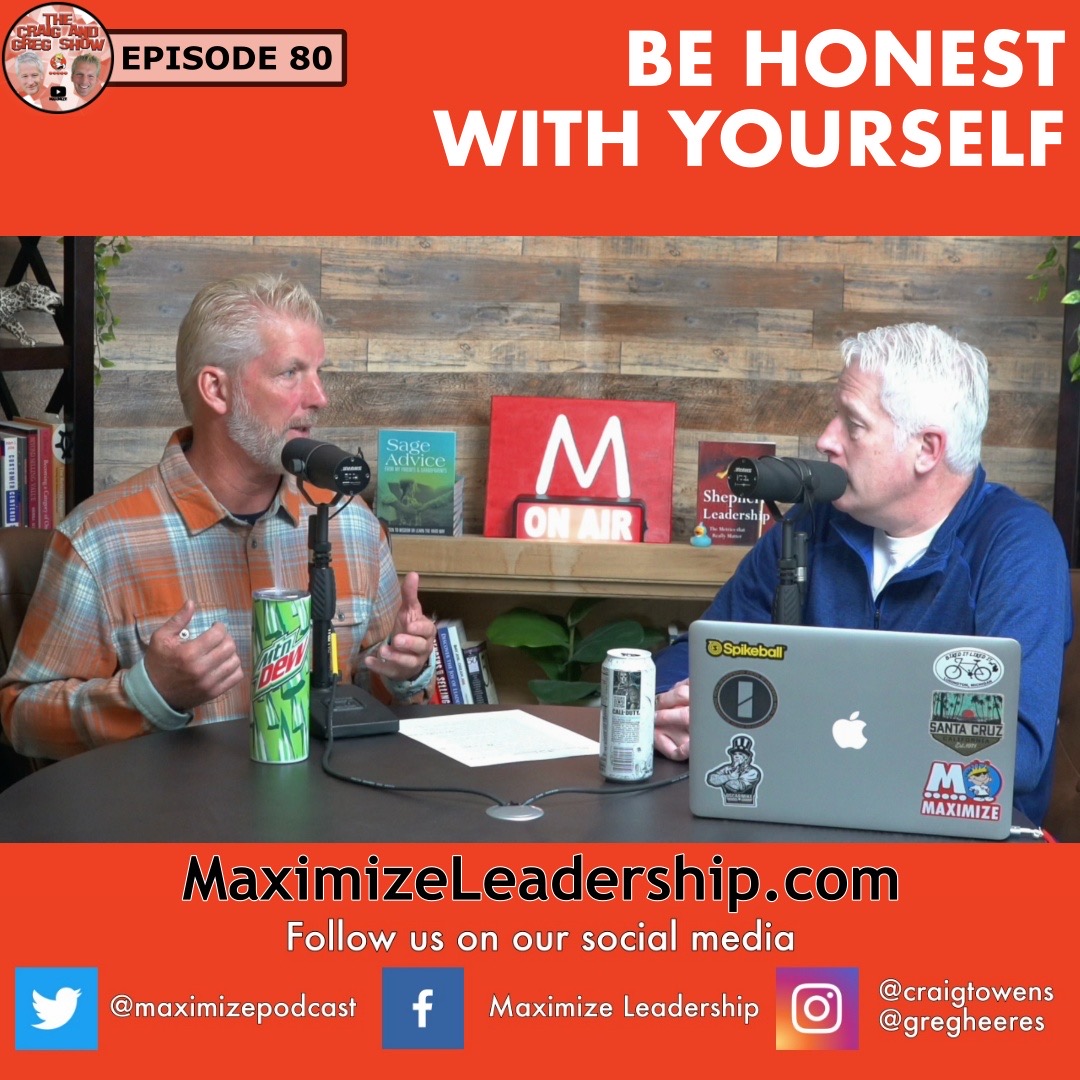
Check out this full conversation Greg and I had on an episode of The Craig and Greg Show called “Be honest with yourself.”
Listen to the podcast of this post by clicking on the player below, and you can also subscribe on Apple, Spotify, or Audible.
I’d like to tell you about a book that I think is an absolute must-read for those in church leadership. Check out my interview with Karl Vaters, the author of De-Sizing The Church, on this episode of The Podcast.
Listen to the audio-only version of this podcast by clicking on the player below, or scroll down to watch the video.
Honesty is a vital part of a successful organization, something that every good leader is well aware of. However, when was the last time you asked the question, “Am I being honest with myself?” In this episode, Greg and I unpack how honest self-reflection is a powerful tool to help improve your leadership.
[0:14] A challenging quote to kick off this episode.
[1:14] My breakthrough moment regarding my own self-assessment.
[3:37] What’s the difference between who I think I am and who I really am?
[6:00] We all operate with certain assumptions about ourselves.
[7:37] We share some good and bad experiences with interactions we have observed from other leaders.
[10:27] Leaders need to hold themselves to the same standards as the rest of their team.
[13:47] Why do leaders hesitate to self-evaluate?
[15:19] How do leaders create a safe environment to self-evaluate?
[18:45] Greg sends us down a rabbit trail!
[19:53] What does leadership integrity look like?
[22:17] Leaders need to know what their tendencies are.
Check out this episode and subscribe on YouTube so you can watch all of the upcoming episodes. You can also listen to our podcast on Spotify and Apple.
Listen to the audio-only version of this podcast by clicking on the player below, or scroll down to watch the video.
When every quality is distilled down, the two things a leader is looking for in a teammate are skill and will. Which one should come first, and what happens if you identify a deficiency in yourself or others in one of these areas? Greg and I tackle these questions, and much more, in this episode of The Craig and Greg Show.
[0:25] What goes into the hiring decision? We think there are two important categories.
[1:14] What are some key leadership skills?
[3:53] Which comes first—skill or the will to use the skill?
[4:49] Some skills are innate and some are learned.
[6:17] Willpower makes the skills go farther and work more effectively.
[8:44] Leaders love to coach those with hustle.
[11:03] Is there a trigger for someone’s willpower to kick in?
[13:18] Leaders sometimes need to adopt a no-matter-what willpower.
[13:59] Top skills that emerging leaders should cultivate.
[17:00] Positivity is an attractive quality.
[18:21] Leaders can help their teammates learn skills and willpower.
[19:52] We need to help people overcome the pull to quit too soon.
Check out this episode and subscribe on YouTube so you can watch all of the upcoming episodes. You can also listen to our podcast on Spotify and Apple.








 Craig T. Owens