If … But If … If … But If …

IfNo, I’m not repeating myself; I’m just quoting the pattern in the Bible (specifically Leviticus 26).

God’s laws are inviolate. No conditions will be made, nor any exceptions allowed. The conditions in Leviticus 26 apply as much to the Israelites in 1400 BC as they do to us in the United States of America today.

IF we obey God’s Word, He will bless us with His favor (verses 3-13).

BUT IF we disobey, He will set His face against us (verses 14-17).

IF we continue to harden our hearts and remain unrepentant, God’s punishments will grow increasingly more severe (verses 18-39).

BUT IF we repent wholeheartedly, God will again restore us (verses 40-45).

It’s time for us in America to wake up to this reality! If God held His chosen people, the Israelites, to this, how much more so will He not hold us to it.

We in America have violated God’s principles for too long. We have clearly moved through the first IF and BUT IF stages. I believe we are now in the second IF stage. But the hopeful news is that there is still another BUT IF stage for us to obtain, if only we will repent and ask God’s forgiveness.

It starts with me and with you. Will you join me in asking for repentance and praying for God’s favor to visit us once again?


Don’t Give Up!

My dear pastor, I know the ministry can seem to be unrewarding at times. Maybe you’re even wondering if all of your labors are even making a difference. Hear this loud and clear: Your ministry is making an eternal difference … Don’t give up!

Let these encouraging words from Charles Spurgeon sink into your heart:

C.H. SpurgeonPutting our hand to this plough and looking back will prove that we were unworthy of the kingdom. If there be a hundred reasons for giving up your work of faith, there are fifty thousand for going on with it. Though there are many arguments for fainting, there are far more arguments for persevering. Though we might be weary, and do sometimes feel so, let us wait upon the Lord and renew our strength, and we shall mount up with wings as eagles, forget our weariness, and be strong in the Lord and in the power of His might….

As the rain climbs not up to the skies, and the snow flakes never take to themselves wings to rise to heaven, so neither shall the word of God return unto Him void, but it shall accomplish that which He pleases. We have not spent our strength in vain. Not a verse taught to a little girl, nor a text dropped into the ear of a careless boy, nor an earnest warning given to an obdurate young sinner, nor a loving farewell to one of the senior girls, shall be without some result or other to the glory of God. And, taking it all together as a mass, though this handful of seed may be eaten of the birds, and that other seed may die on the hard rock, yet, as a whole, the seed shall spring up in sufficient abundance to plentifully reward the sower and the giver of the seed. We know that our labor is not in vain in the Lord. (emphasis added)

Keep preaching God’s Word: it IS making a difference.

Thursdays With Oswald—God’s Word In Hard Places

This is a weekly series with things I’m reading and pondering from Oswald Chambers. You can read the original seed thought here, or type “Thursdays With Oswald” in the search box to read more entries.

Oswald Chambers

God’s Word In Hard Places     

To search for a word of God to suit one’s case is never Divine guidance, but guidance by human caprice and inclination. The Holy Spirit Who brings to our remembrance what Jesus has said and leads us into all truth, does so to glorify Jesus Christ. Divine guidance by the Word always makes us realize our responsibility to God…. 

     How often have our misunderstandings of God’s Word proved to us the need for the penetrating words of our Lord, “I have yet many things to say unto you, but you cannot bear them now.” In our prayings, in our desirings, in our patience, does our knowledge of God enable us to say and really mean, “Speak, Lord; for Your servant is listening”? Would we really hear God’s Word, or are we not rather in this immediate tribulation waiting for God to persuade us that our own way is right after all?

From Christian Disciplines

There is a difference between saying, “God get me out of this” and “God, what do You want to get out of this?”

There is a difference between praying, “God, please bless what I’m doing” and “God, please show me what You’re blessing so that I may do it.”

We need to be very careful that we don’t read into Scripture something that will justify what we’re feeling or doing or experiencing. Instead, we need to let the Holy Spirit speak God’s Word to us clearly and without any hidden agenda.

I know your situation may be tough, but don’t try to find a shortcut out of it. Let God accomplish what He wants to accomplish; let His Word be your guide; let the Holy Spirit make that Word come alive to you.

Learning & Teaching

LamedhI’ve been leading my congregation through a spiritual workout from the 119th Psalm. This psalm is unique for a couple of reasons: (1) It’s the longest chapter in the Bible; (2) It’s divided into twenty-two 8-verse segments, with each segment beginning with its own Hebrew letter; and (3) All but four of the 176 verses directly mention God’s Word (using words like command, precept, statues, commands, etc.).

Something else that makes this psalm interesting to study is the Hebrew alphabet itself. In our western world, a letter is just a letter: an L is just an L. But in the Hebrew language, the letters have a name, a meaning, and even a numeric value. So the Hebrew equivalent to our English L is the letter/word lamedh.

Lamedh is the tallest of all the Hebrew letters, so that means it stands out. The section called lamedh in Psalm 119 is one of big proportions. Words like eternal, boundless, established, enduring, and forever are prominent in these eight verses. The psalmist is inviting us to climb up into God’s Word and get a bigger view, a higher vantage point of who God is.

When we are in difficult places, we tend to focus more on our problems, and less on God’s awesomeness. So lamedh is a call to shift our gaze.

But this letter/word also has a definition, and lamedh is a double-edged definition. This word can mean to learn. Indeed, as we gaze upon God’s majesty, we learn so much more about Him! But lamedh also means to teach.

I have found that as I go through difficult times and choose to change my focus from my situation to my Savior, that I learn more about His faithfulness. But at the same time, others are learning from that decision to switch my gaze to God.

So I’ve got one word of advice for you if you feel like your problem is too big and you’re thinking about throwing in the towel: DON’T!!

By focusing on God’s bigness instead of your circumstance, you will learn to grow in faith. And at the same times you will be teaching others to place their faith in God too.

Those who wait on God will soar to new heights!

If you have missed any of the messages in our P119 series, you can access them all by clicking here.

The Despised Pastor

The Despised PastorSurveys reveal that people in the United States do not have a highly favorable view of evangelical Christians, nor of pastors of evangelical Christian churches.

I agree with John Maxwell’s maxim that everything rises and falls on leadership, so this unfavorable view of evangelical Christians must be addressed first in the pastorate. The 2400-year-old words from the prophet Malachi still ring true today—

“The words of a priest’s lips should preserve knowledge of God, and people should go to him for instruction, for the priest is the messenger of the Lord of Heaven’s Armies. But you priests have left God’s paths. Your instructions have caused many to stumble into sin. You have corrupted the covenant I made with the Levites,” says the Lord of Heaven’s Armies. “So I have made you despised and humiliated in the eyes of all the people. For you have not obeyed me but have shown favoritism in the way you carry out my instructions.” (Malachi 2:7-9)

Uh oh!

Is it possible, my dear fellow pastor, that if we become men and women of the Word of God that the views of the population might begin to change?

Mouth-To-Mouth

Mouth to mouthI’ve notice that when someone feels physically tired, mentally unengaged, spiritually embattled, emotionally dry, or just plain worn out, they have an audible physical sign that is almost universal.

Those people sigh.

A sigh is an involuntary response that signifies frustration and a call for help. It should also be a reminder of the best place to find that help.

In Psalm 119, the chapter is organized in 8-verse segments. I like to look at the “bookend” verses of each section, as it usually gives a good idea of what that section is focusing on. The section called kaph has this bookended statement—

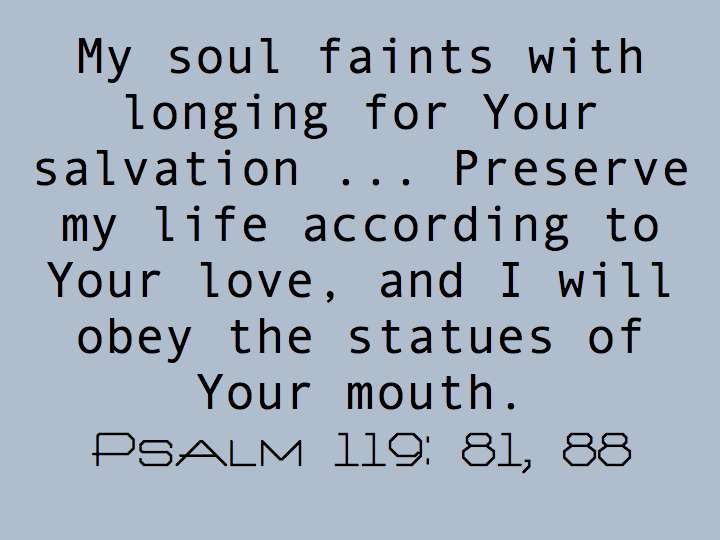
My soul faints with longing for Your salvation … Preserve my life according to Your love, and I will obey the statues of Your mouth (Psalm 119:81, 88).

Follow this progression:

  • When God created man, He breathed a soul into him. So we are created by His breath.
  • Jesus said that man does not live by bread alone, but by every word that comes from the mouth of God. God’s Word is inspired, which means it is literally God-breathed. So our soul is sustained by the breath of God.

The psalmist says his soul is sighing and wasting away, but he recognizes that his God-breathed soul can be restored through the God-breathed word. So in verse 88 he is asking God to give him mouth-to-mouth (or perhaps mouth-to-soul) resuscitation! 

The psalmist talks about clinging tenaciously to God’s Word as if it were his only lifeline … because it is! So whenever you find yourself sighing, let that be a reminder that you can get your spiritual resuscitation from the breath of God: His Word. Hold on to it as if your very life depended on it … because it does!

If you have missed any of the messages in our P119 series, you can access them all by clicking here.

Sola Scriptura

Of all the other sola statements that came out of the Reformation, sola scriptura has to be one of the most foundational. Without a firm understanding of the truthfulness of God’s Word, all other doctrinal statements are without authority. Sola scriptura means that we use the Bible as our authoritative guide for everything in our lives.

Jesus confronted the religious leaders for their misuse and abuse of Scripture. The Sadducees had a tendency to ignore the parts of Scripture which didn’t fit their “theology.” The Pharisees, on the other hand, would over-exaggerate some Scriptures which would leave other passages dwarfed or forgotten.

In Matthew 23, Jesus took on both of these incorrect approaches. What I love is that Jesus didn’t share His opinion, He didn’t argue with them, He didn’t try to convince them to accept His viewpoint. Jesus just took them back to Scripture.

  • You are in error because you do not know the Scriptures or the power of God (23:29).
  • Have you not read what God said to you (23:31).
  • David, speaking by the Spirt…says(22:43).

When Jesus said, “You are in error,” the verb tense is the passive voice. This means it was something done to them, not something they did. These religious leaders were not purposely straying from Scripture, but by listening to men instead of God they allowed themselves to be lead astray.

That’s why this insight from Luke is so powerful:

Now the Bereans were of more noble character than the Thessalonians, for they received the message with great eagerness and examined the Scriptures every day to see if what Paul said was true. (Acts 17:11)

This is great counsel for all of us. We should all listen to pastors and teachers, or read authors, through the filter of Scripture. We need to make sure we aren’t passively straying, and we do this by examining the Scripture.

If you have missed any of the messages in this series, you can find them all here.

Savoring It

For those of you who asked, here is the quote I shared this morning from John Piper—

“If you don’t read the Word and memorize the Word and meditate on the Word daily and delight in the Word and savor it and have your mind and emotions shaped by the Word, you will be a weak Christian at best. You will be fragile and easily deceived and easily paralyzed by trouble and stuck in many mediocre ruts. But if you read the Word and memorize important parts of it and meditate on it and savor it and steep your mind in it, then you will be like a strong tree planted by streams of water that brings forth fruit. Your leaf won’t wither in the drought and you will be productive in your life for Christ.”

Filled To Be Emptied

This is a post especially for my pastor friends. 

Dear Friend,

I know you have a lot on your mind. You’re probably reviewing how Sunday went and thinking about what you’re going to share next Sunday. You’ve probably got a pretty full agenda this week: staff meetings, board meetings, maybe a counseling appointment or two, and a hospital visit. There’s lots happening (there always is, right?).

Can I break into your week to ask you a simple question: What did you read in your Bible this morning for you? You know, your personal devotional time—what was God’s Word saying just to you?

Dietrich Bonhoeffer wrote this:

“We are reading the Word of God as God’s Word for us. Therefore, we do not ask what this text has to say to other people. For those of us who are preachers that means we will not ask how we would preach or teach on this text, but what it has to say to us personally.”

Here’s a simple principle: You cannot give to others what you have not received yourself. So you need to be filled up so that you can be emptied out.

Although your week may be busy, please, please, please take the time to read God’s Word for yourself. It will help you and your congregation as well.

May God fill you and then empty you, my friend, for His glory!

Cheering you on, I am your friend,

Craig

The Hard Word

As a pastor, you are going to have to deliver the hard word from time to time. You will have to address touchy subjects, both corporately and privately. It is very instructive to see how the apostle Paul approached the hard word.

In Romans 9, Paul is getting ready to address one of the most sensitive subjects of his day. The Jews felt they were “in” with God just because they were Jews, and the Gentiles were “out” with God just because they weren’t Jews. Paul is going to have to deliver the word that both Jews and Gentiles can be accepted by God because of what Jesus did on the Cross.

So notice how he begins:

I speak the truth in Christ—I am not lying, my conscience confirms it in the Holy Spirit—I have great sorrow and unceasing anguish in my heart.

1. I speak the truth in Christ. It wasn’t his opinion, but the word from God. I must settle this matter before delivering the hard word. Far too often we can put our preferences on par with God’s Word. I cannot do this!

2. My conscience confirms it in the Holy Spirit. Before I speak a hard word that people may not like to hear, I need to make sure my conscience is right before the Holy Spirit. He alone confirms His Word. The reaction of the audience, however, may or may not confirm what God says.

3. I have great sorrow and unceasing anguish in my heart. It should be a major red flag if I looked forward to delivering a painful/challenging/correcting word. I need to put myself in their place, not try to put someone else in their place!

My job as a pastor is not to condemn, nor even to convict; the Holy Spirit will do that. My job is to (a) hear God’s truth, (b) get my conscience right with the Spirit, and (c) empathize with people as I lovingly speak the truth to them.