Using The Bible To Pray

Listen to the podcast of this post by clicking on the player below, and you can also subscribe on AppleSpotify, or Audible.

During the first year of [Darius’] reign, I, Daniel, learned from reading the Word of the Lord, as revealed to Jeremiah the prophet, that Jerusalem must lie desolate for seventy years. So I turned to the Lord God and pleaded with Him in prayer and fasting. I also wore rough burlap and sprinkled myself with ashes. (Daniel 9:2-3 NLT) 

Reading the Word of God prompted Daniel to pray to the God that is revealed in the Word, and the prayer he offered to God was grounded in biblical promises—in God’s own promises (vv. 4-19). 

It’s like when children are speaking to their earthly fathers and say, “Dad, you promised,” it gets the attention of that father’s heart because he wants to keep his word. 

God hasn’t forgotten His promises; in fact, He is always at work to fulfill what He has said. But when we pray, “Father, according to Your promise to me,” we are praying words that resonate with His heart. He delights for His children to see Him at work. And He is glorified when we praise Him for fulfilling what He has promised. 

When we end our prayer with “in the name of Jesus, Amen,” that is not just some magical phrase that we tag on, but it is a reminder that we can come boldly before God’s throne with our petition. And prayers that are aligned with the heart of God—prayers that are grounded in the Word of God—have the “Amen” of Jesus added to them (Hebrews 10:19-22; 2 Corinthians 1:20). 

We never need to be at a loss for words when we go to our Heavenly Father in prayer. Read His Word, see the Holy Spirit illuminate and apply the Word to your circumstances, and then pray confidently in the name of Jesus.

For pastors and shepherd leaders, my book Amen Indeed contains over 100 biblically-based prayers for many of the situations we face in our ministries. My prayer for you is that this book will help you learn how to use the Bible as your Prayer Book.

►► Would you please prayerfully consider supporting this ministry? My Patreon supporters get behind-the-scenes access to exclusive materials. ◀︎◀︎
Links & Quotes

When you are waiting for God to fulfill His promise, keep watching with a smile. Let your childlike trust become your testimony as you entrust yourself to your heavenly Father.

I have a lot of new video content on my YouTube channel every week. Please check it out and subscribe so you don’t miss anything.

“The case for the reliability of the New Testament Gospel eyewitness accounts is dependent on the trustworthiness of its authors. In cold-case criminal trials, eyewitness accounts are typically evaluated through the lens four critical questions.” J. Warner Wallace then gives a succinct overview of each of these four questions and the evidence supporting them.

“One can sometimes do good by being the right person in the wrong place.” —G.K. Chesterton 

“A great leader never sets himself above his followers except in carrying responsibility.” —Jules Ormont 

“There is a great difference between worry and concern. A worried person sees a problem, and a concerned person solves a problem.” —Harold Stephens

God Provides For His Servants

Listen to the podcast of this post by clicking on the player below, and you can also subscribe on AppleSpotify, or Audible. 

God promised to provide for Jeremiah if he remained faithful to preach the word God had given him. Jeremiah did deliver a hard message that turned out to be highly unpopular, and as a result those who heard his sermon became quite angry with Jeremiah. 

In what I think is a very human response, Jeremiah began to complain to God—

   Your words were found, and I ate them; and Your words were to me a joy and the rejoicing of my heart, for I am called by Your name, O Lord God of hosts. I sat not in the assembly of those who make merry, nor did I rejoice; I sat alone because Your powerful hand was upon me, for You had filled me with indignation. Why is my pain perpetual and my wound incurable, refusing to be healed? Will You indeed be to me like a deceitful brook, like waters that fail and are uncertain? (Jeremiah 15:16-18 AMPC) 

God had to speak a correcting word to Jeremiah— 

   If you return and give up this mistaken tone of distrust and despair, then I will give you again a settled place of quiet and safety, and you will be My minister; and if you separate the precious from the vile—cleansing your own heart from unworthy and unwarranted suspicions concerning God’s faithfulness—you shall be My mouthpiece. Let them return to you—not you to the people. (v. 19) 

Jeremiah got over his pity party and once again continued to faithfully deliver God’s message, despite what people thought of him or said about him. Jeremiah even remained resolute in his devotion to God when the rulers of the people abused Jeremiah or threw him into prison or threatened to kill him. 

Just as God promised, as the Babylonians pressed in on Jerusalem, the people flocked back to Jeremiah to ask him to intercede before God on their behalf (21:1-2; 37:3; 42:2)

Remember that God had promised to take care of Jeremiah, assuring him of a place of quiet and safety. God also said, 

   Truly your release, affliction, and strengthening will be for good purposes; surely, Jeremiah, I will intercede for you with the enemy and I will cause the enemy to ask for your aid in the time of evil and in the time of affliction. (15:11) 

This promise was fulfilled when Nebuzaradan—the commander of the imperial guard in Nebuchadnezzar’s army—came to Jerusalem:

   Now Nebuchadnezzar king of Babylon had given these orders about Jeremiah through Nebuzaradan commander of the imperial guard: “Take him and look after him; don’t harm him but do for him whatever he asks.” … [Nebuzaradan] had found Jeremiah bound in chains among all the captives from Jerusalem and Judah who were being carried into exile to Babylon. When the commander of the guard found Jeremiah, he said to him, “The Lord your God decreed this disaster for this place. And now the Lord has brought it about; He has done just as He said He would. All this happened because you people sinned against the Lord and did not obey Him. But today I am freeing you from the chains on your wrists.” (39:11-12; 40:1-2) 

God never promises His servants their task will be easy, but He does promise both temporal provision and eternal rewards for His servants who remain faithful to Him and to His calling. 

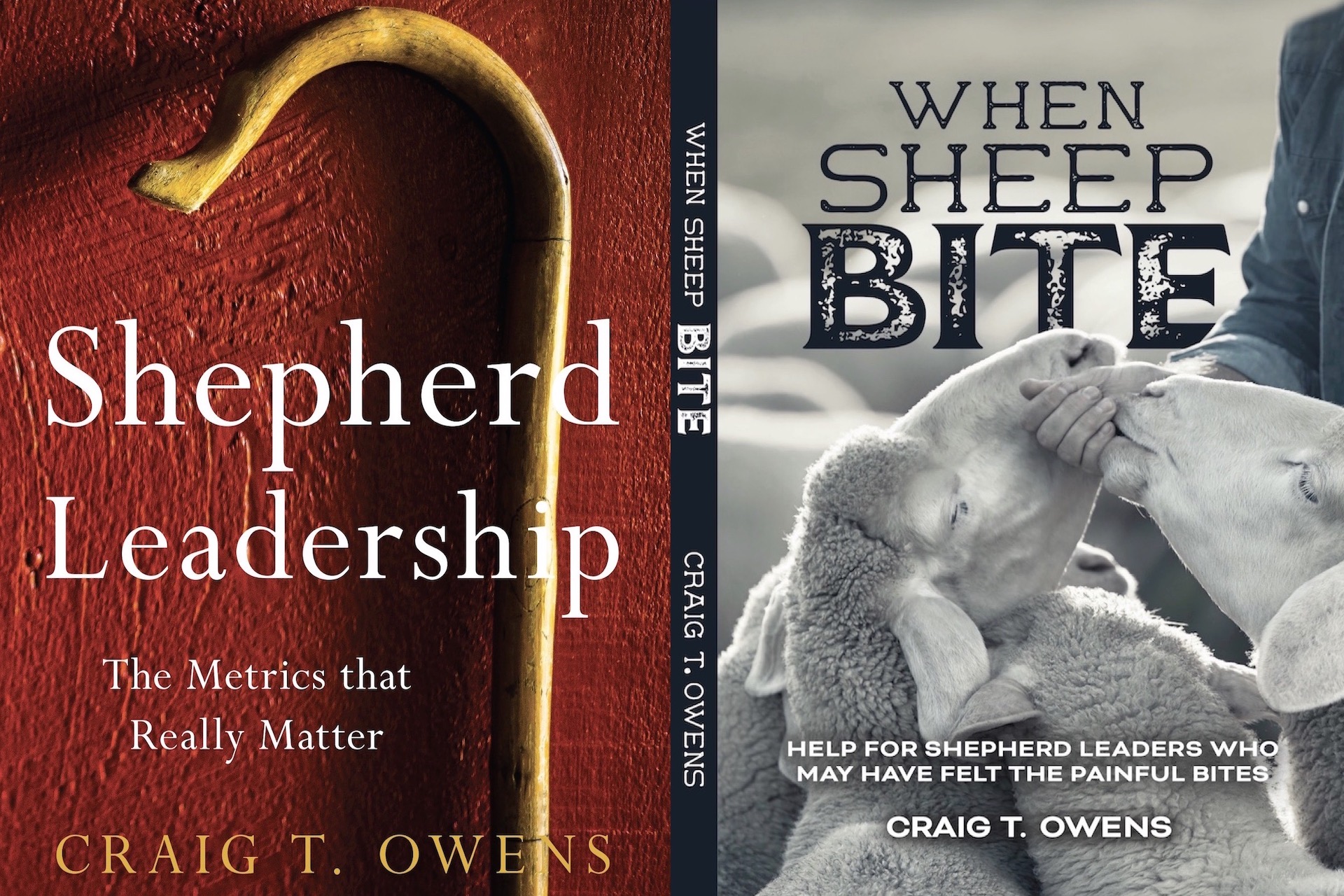
In my book Shepherd Leadership, I talk about a time God had to correct me when I was throwing myself a pity party. 

And in my book When Sheep Bite, the entire third section contains biblical strategies to help God’s servants not give in to the very natural response of fight-or-flight, but how to tap into the supernatural response of faithfulness. 

If you are a spiritual leader, I would encourage you to pick up a copy of both of these books. And keep in mind that God always provides for His servants. 

►► Would you please prayerfully consider supporting this ministry? My Patreon supporters get behind-the-scenes access to exclusive materials. ◀︎◀︎
When I Feel Afraid

Listen to the podcast of this post by clicking on the player below, and you can also subscribe on AppleSpotify, or Audible. 

Can we take just a couple of minutes to talk about fear? This isn’t on the list of anyone’s favorite topics, but it is something we all have to confront. 

The Scriptures I reference in this episode are from John 8:12, 9:5; Revelation 1:8; and Psalm 56:3-4, 10-11. 

I also mentioned how many times the Bible shows us God saying, “Do not be afraid.” Here are several of those instances. 

I shared a whole series of messages called “Do Not Be Afraid” which you can check out here. Some other related posts are: 

But when I am afraid, I will put my trust in You. I praise God for what He has promised. I trust in God, so why should I be afraid? What can mere mortals do to me? … I praise God for what He has promised; yes, I praise the Lord for what He has promised. I trust in God, so why should I be afraid? What can mere mortals do to me? (Psalm 56:3-4, 10-11 NLT)

►► Would you please prayerfully consider supporting this ministry? My Patreon supporters get behind-the-scenes access to exclusive materials. ◀︎◀︎

Don’t Let This One Thing Block God’s Blessings

Listen to the podcast of this post by clicking on the player below, and you can also subscribe on AppleSpotify, or Audible. 

There is one word that people seem to speak that is blocking the blessings that God wants to send to them. 

Check out this latest episode of The Podcast. 

Get into God’s Word, and let His Word build your faith to cling to Him in faith until His promise ultimately appears. Don’t let the negative people around you, or your current circumstance, or anything else cause you to walk away from the blessing God wants to give you! 

The Scriptures I reference in this episode are Numbers 13:1-28 and 2 Corinthians 1:20. 

You may also be interested in these related posts: 

►► Would you please prayerfully consider supporting this ministry? My Patreon supporters get behind-the-scenes access to exclusive materials. ◀︎◀︎

The Glorious Gospel

Listen to the podcast of this post by clicking on the player below, and you can also subscribe on AppleSpotify, or Audible. 

Paul opens his letter to the saints at Rome with two powerful words: the gospel (Romans 1:1).

(Check out all of the biblical references in this post by clicking here.)

The word gospel simply means the good news about the salvation that comes only through Jesus.

Paul loves this word! 

Interestingly, although we refer to the first four books of the New Testament as “The Gospels,” the word itself barely appears: 

  • Matthew—4 times 
  • Mark—8 times 
  • Luke—0 times 
  • John—0 times

And even though these four opening books are the Gospels about Jesus, He Himself only uses the word nine times, with the other three times attributed to someone else mentioning what Jesus was doing. 

Peter only uses this word twice (Acts 15:7; 1 Peter 4:17). And John uses it just once (Revelation 14:6). 

Paul, however, uses this word 64 times! 

It becomes such a part of who he is and how he thinks, that he calls it “my gospel” twice (Romans 2:16, 16:25) and “our gospel” three times (2 Corinthians 4:3; Colossians 1:23; 2 Thessalonians 2:14). 

For Paul and for us this Good News is—

  • God’s promises fulfilled 
  • salvation power 
  • the fullness of God’s blessing 
  • the opening of mysteries 
  • the guide for godly living 
  • glorious light 
  • the expression of God’s grace 
  • the standard of all truth 
  • a key part of the Christian’s spiritual armor 
  • the empowerment for ministry 
  • the anchor of unshakable hope 
  • the means by which we experience Christ’s glory 
  • the only door to life and immortality 

For those of us who have been called to preach this Gospel, these thoughts should both humble and empower. 

For those of us who have been saved by believing this Gospel, these thoughts should cause us to desire to know more, and more, and more about our Savior. 

What a glorious Gospel this is! 

►► Would you please prayerfully consider supporting this ministry? My Patreon supporters get behind-the-scenes access to exclusive materials. ◀︎◀︎
No Such Thing As Karma

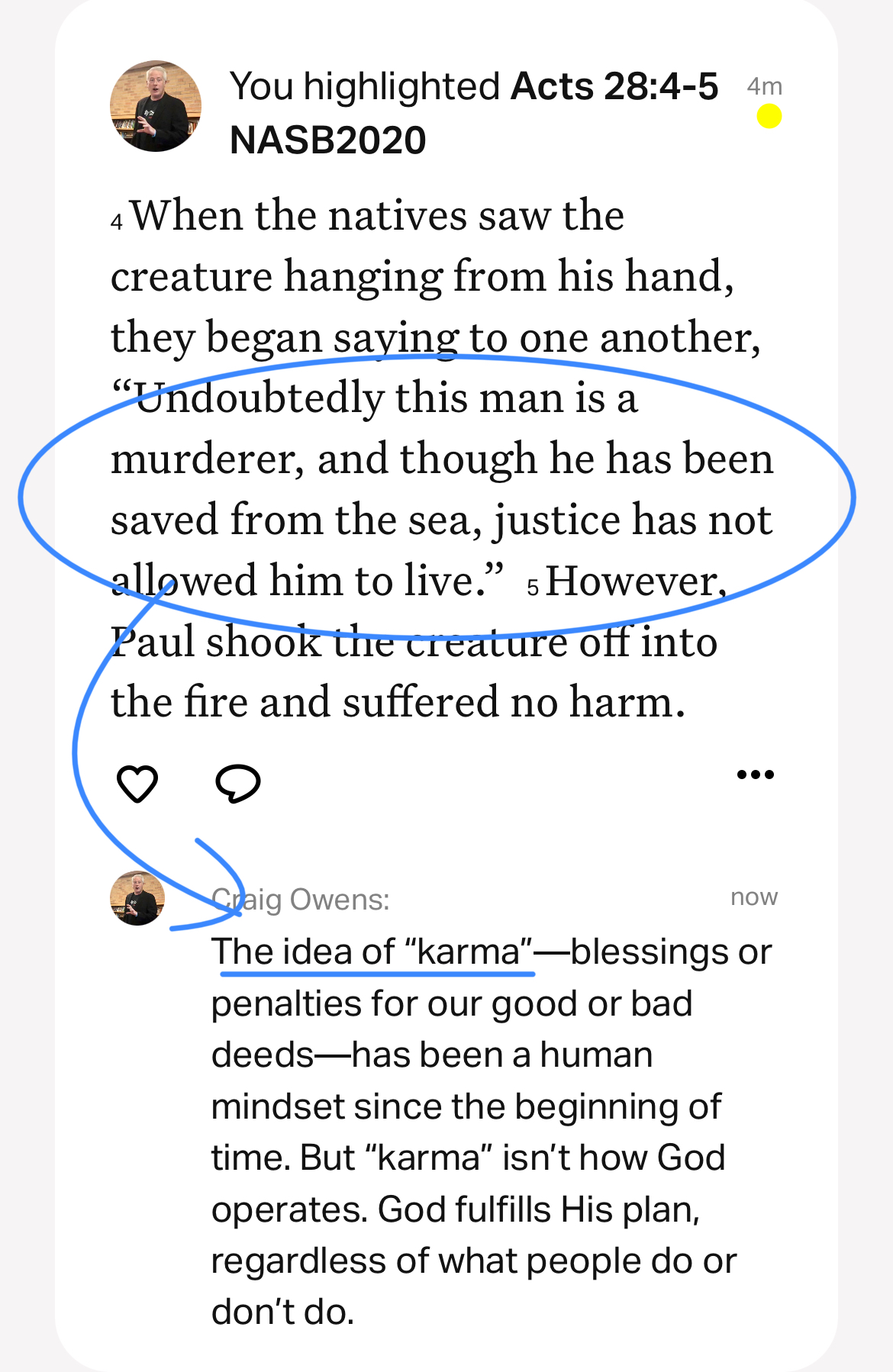
When the natives saw the creature hanging from his hand, they began saying to one another, “Undoubtedly this man is a murderer, and though he has been saved from the sea, justice has not allowed him to live.” However, Paul shook the creature off into the fire and suffered no harm. (Acts 28:4-5) 

The residents of Malta thought the apostle Paul was experiencing karma. 

The idea of “karma”—blessings or penalties for our good or bad deeds—has been a human mindset since the beginning of time. 

This is really the mindset among Job’s three friends: Good things always happen to good people and bad things always happen to bad people. Except Job’s friends were wrong. We know this because we see behind the scenes in Heaven at the beginning of the story, and we hear God reprimand these men at the end of the story.

“Karma” isn’t how God operates. God fulfills His plan, regardless of what people do or don’t do. 

In this story in Acts 28, God had promised Paul, “You must testify about Me in Rome,” so Paul was invincible until that promise from God was fulfilled.

To chalk things up to “karma” is to deny God’s sovereign plan. We have to guard our minds against this kind of thinking because it slips in so naturally. A part of renewing our minds (Romans 12:1-2) is not jumping to our conclusion, but trusting that God is sovereignly at work. 

You may also want to check out these related blog posts:

Links & Quotes

Leaders may have to talk about people on their team, but how do we do this without crossing the line into gossip? Greg and I discussed this on a recent episode of our leadership podcast.

I have lots of new content every week, which you can check out on my YouTube channel.

“The Christian ideal has not been tried and found wanting. It has been found difficult; and left untried.” —G.K. Chesterton

“Christianity does not consist in telling the truth, or walking in a conscientious way, or adhering to principles; Christianity is something other than all that, it is adhering in absolute surrender to a Person, the Lord Jesus Christ.” —Oswald Chambers, in Baffled To Fight Better 

I really like the He Gets Us campaign! Here is a recent one.

“Critics may nitpick the Scriptures upon which we base our beliefs, but each year, the Lord will increasingly demonstrate that His Word contains no errors, exaggerations, or omissions. … We won’t feel ashamed of our hope. It will unfold just as the Lord has promised. We will be nourished, guided, blessed, and comforted. Our Lord will return, and then our days of sorrow will be over. How we will exult in the Lord, who first gave us a vibrant hope and then fulfilled that which we hoped for!” —Charles Spurgeon 

Rise Above The Storm

Listen to the podcast of this post by clicking on the player below, and you can also subscribe on AppleSpotify, or Audible.

My friend Tom Kaastra shared an encouraging message at Calvary Assembly of God on Sunday about handling life’s storms. 

Just like the disciples of Jesus in a boat on a stormy sea…

  • …storms make us feel like we’re on water without any sure footing
  • …and the wind is against us (Mark 4:35-41) 

In the Psalms, David used similar language:

Even the well-known hymn The Solid Rock has the line that says, “When all around my soul gives way.” 

Isaiah 40:27-30 gives us a helpful example from the eagle of how we can handle life’s storms. 

Eagles have huge wingspans and can travel up to 125 miles in a single flight. When they see storms coming, they lock their wings in place and stop flapping on their own. Instead, they sense the warm currents of air and rides those up and over the storm. 

So Tom gave us these steps: 

  1. Disengage from our own efforts—don’t try to handle the storm on our own. 
  2. Perceive the warmth of God’s promises. 
  3. Trust the everlasting God (Isaiah 40:28). “Everlasting” means that God is infinite, vigorous, strong, faithful, and capable. 
  4. Ride up and over the storm in God. When God says we mount up on wings like eagles (Isaiah 40:31), it means we are braided together with God. 
  5. Live in the renewed strength that only God can give us. 

Jesus went through the most unimaginable life storm that any human has ever had to endure, and He said, “Father, into Your hands I commit My spirit” (Luke 23:46). We need to trust our Heavenly Father just like Jesus did when we face storms! 

►► Would you please prayerfully consider supporting this ministry? My Patreon supporters get behind-the-scenes access to exclusive materials. ◀︎◀︎

So Good!

Listen to the podcast of this post by clicking on the player below, and you can also subscribe on AppleSpotify, or Audible. 

You may have heard it this last weekend. Someone says, “Jesus is risen,” and their friend responds, “He is risen indeed!” Jesus Christ’s resurrection from the dead is the greatest event ever! And yet some people just can’t seem to grasp how good this truly is.

We’ve been trained to believe if something sounds too good to be true, then it probably is. So we are careful to be skeptical of any too-good-to-be-true claims that we may hear. Our heart might get excited at the possibilities, but then our logical mind begins to shout, “Wait!” 

Here’s what a logical argument looks like: P1 + P2 + P3 = C. 

The Ps are premises, and if we put true premises all together, then the C (conclusion) is true as well. All I have to do is invalidate one of the Ps and the whole argument falls apart. Then my logical mind can say, “See! I told you it was too good to be true!” 

People heard the teachings of Jesus, they saw His miracles, thousands of them had even tasted the bread and fish He miraculously multiplied. They had hoped He was the One they had been longing for—the Messiah that would deliver them. But then He was crucified and their excitement was extinguished. 

On the Sunday morning after His crucifixion, rumors began to swirl that Jesus had been resurrected back to life. Others said they had actually seen Him and talked with Him. Hearts began to swell with excitement again. But for many of them, their logical minds began to shout, “Wait! Don’t fall for another too-good-to-be-true story!” 

We meet a couple of men who felt like this in Luke 24:13-24. They so wanted it to be true that Jesus was the Messiah they had longed for, but I notice that they use the word “but” three times. That’s their logical mind trying to invalidate any one of the premises. 

Jesus was indeed resurrected from the dead. There is so much evidence that I don’t have time to go through today, but let me just share one item with you: Paul listed all of the people who had seen Jesus alive (1 Corinthians 15:3-8). Facing persecution and even martyrdom, none of these eyewitnesses recanted their faith. 

Chuck Colson, who was at the center of the Watergate scandal and who was not a Christian at that time, said,  

“I know the resurrection is a fact, and Watergate proved it to me. How? Because twelve men testified they had seen Jesus raised from the dead, then they proclaimed that truth for 40 years, never once denying it. Every one was beaten, tortured, stoned and put in prison. They would not have endured that if it weren’t true. Watergate embroiled twelve of the most powerful men in the world and they couldn’t keep a lie for three weeks. You’re telling me twelve apostles could keep a lie for 40 years? Absolutely impossible.”  

Remember our logical statement: P1 + P2 + P3 = C. 

Jesus gave one of His own in Luke 18:31-33. It would go something like this: 

  • ✔️ P1 (He was turned over to the Romans) 
  • ✔️ P2 (He mocked, flogged, killed) 
  • ✔️ P3 (He was raised from the dead)
  • ✔️ C (Jesus fulfills every promise of God) 

The disciples on their way to Emmaus used the word “but” three times, but Jesus counteracted that by using the word “all” three times (Luke 24:25-27), when He said all of the Scriptures point to Him and are fulfilled in Him! 

The Bible is packed with promises! Promises of courage, assurance, wisdom, healing, direction, provision. And they are all valid promised because of the resurrection of Jesus—

For no matter how many promises God has made, they are “Yes” in Christ. And so through Him the “Amen” is spoken by us to the glory of God. … What, then, shall we say in response to these things? If God is for us, who can be against us? He who did not spare His own Son, but gave Him up for us all—how will He not also, along with Him, graciously give us all things? (2 Corinthians 1:20; Romans 8:31-32)

It may seem like these promises are too-good-to-be-true, but Jesus is so good that He makes all of the promises true! 

If you missed any of the messages in our series looking at how Jesus fulfilled the smallest of details of prophecy, check them out here. 

►► Would you please prayerfully consider supporting this ministry? My Patreon supporters get behind-the-scenes access to exclusive materials. ◀︎◀︎