God’s Faithful Love

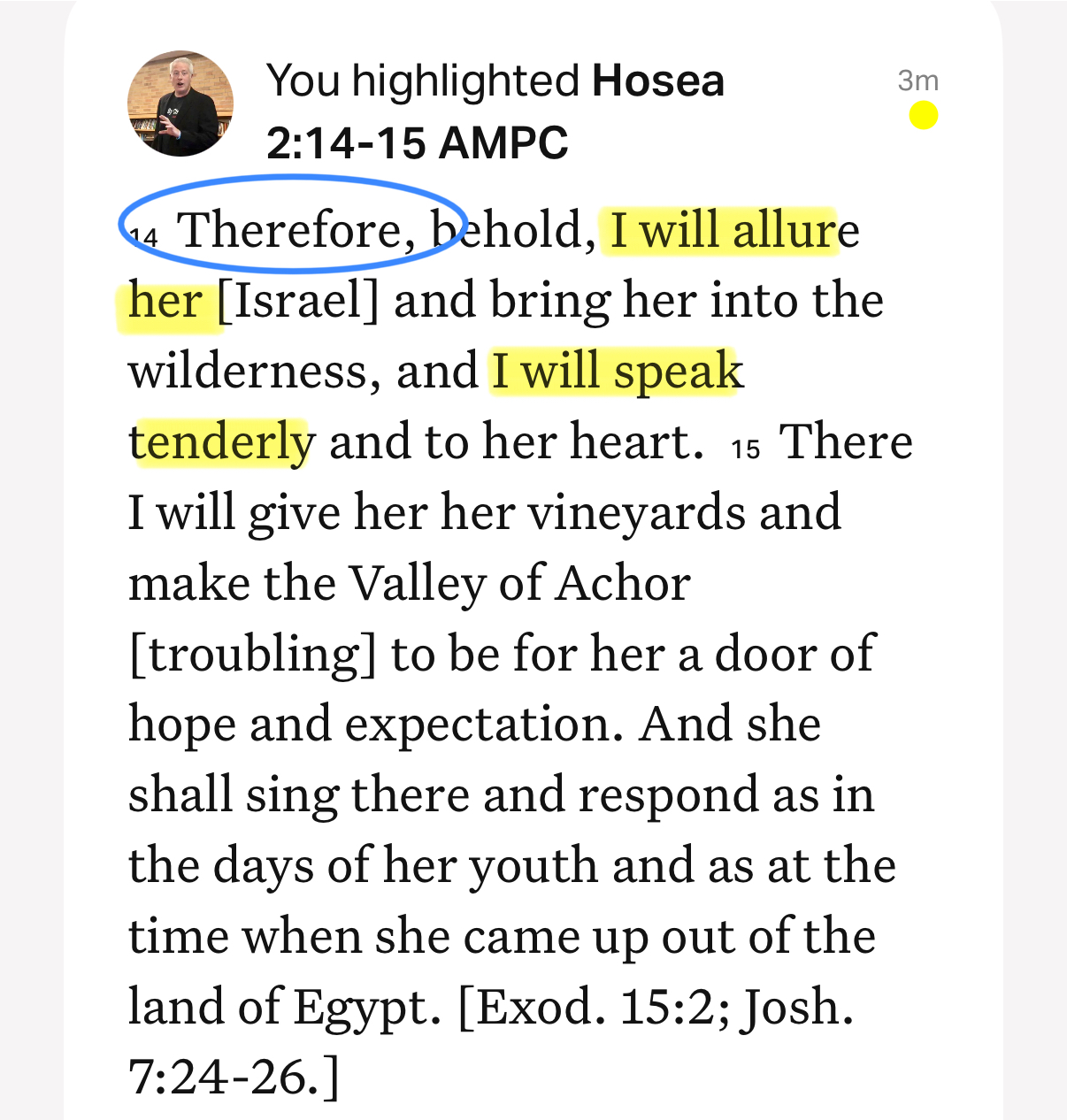
Therefore, behold, I will allure her [Israel] and bring her into the wilderness, and I will speak tenderly and to her heart. There I will give her her vineyards and make the Valley of Achor [troubling] to be for her a door of hope and expectation. And she shall sing there and respond as in the days of her youth and as at the time when she came up out of the land of Egypt. (Hosea 2:14-15 AMPC)

This “therefore” seems out of place. God has just finished listing the sins of the people (vv. 1-13), so I would expect Him to say something like, “Therefore, behold, I will punish you.” God would be just in this judgment. 

But even when we are faithless, God remains faithful! “If we are faithless, He remains faithful, for He cannot disown Himself” (2 Timothy 2:13). 

So He says He will speak tenderly and turn your trouble into blessing. How amazing and undeserved is the love that our God lavishes on us! 

Related posts:

(Extra)Ordinary People

Listen to the podcast of this post by clicking on the player below, and you can also subscribe on AppleSpotify, or Audible. 

Paul addresses his letter to the church at Philippi like this, “all God’s holy people … the overseers and deacons” (Philippians 1:1). Notice that Paul addresses all of the saints, whether they are in a position of leadership or not. 

In verse 5, Paul says he is grateful for their “partnership in the Gospel.” Some translations use the word “fellowship” instead of partnership. This is the Greek word koinonia. By the use of this word Paul is recognizing the close relationship the church members have with their leaders, with each other, with Paul, and even with other Christians in other cities. 

The root word is koinos. The Levitical Jews used this word to designate anything that their religious rules deemed unclean, common, or ordinary. One of the things these Jewish leaders would have called unclean are Gentile people. Which means they would have referred to the saints who made up the bulk of this assembly at Philippi as unclean and unworthy of God’s love! 

But here is Paul using this ordinary word in an extraordinary way. That is, he is calling ordinary people something extraordinary: saints! Remember in the opening verse he addressed his letter to “God’s holy people.” The word holy here means the exact opposite of common or unclean—it means people set apart for God’s special use. 

The “extra” that elevated common, ordinary, unclean people to the extraordinary position of being called a saint is their personal relationship with Jesus as their Savior and Lord. 

Jesus makes the ordinary extraordinary!

Still today, our koinonia is something extraordinary. When common, ordinary, blood-cleansed people remain in relationship with Jesus and other fellow saints, God can do extraordinary things through them. Our common bond with our Savior and with other saints is itself a testimony to the life-changing power anyone can have in Jesus! 

When you are in fellowship with God and in fellowship with God’s holy people, there is nothing ordinary about you. You are an extraordinary testimony of God’s loving, transforming, and keeping power! 

►► Would you please prayerfully consider supporting this ministry? My Patreon supporters get behind-the-scenes access to exclusive materials. ◀︎◀︎

God’s Infinite And Eternal Love

G.K. Chesterton wrote, “The whole difference between construction and creation is exactly this: that a thing constructed can only be loved after it is constructed; but a thing created is loved before it exists, as the mother can love the unborn child.”

God loved you before you were born. He had a plan in mind for your life before you were conceived. 

For we are God’s handiwork, created in Christ Jesus to do good works, which God prepared in advance for us to do. (Ephesians 2:10) 

Even as God formed you in your mother’s womb, He implanted in you all that you would need to live for His glory. 

Your eyes saw my unformed body; all the days ordained for me were written in Your book before one of them came to be. (Psalm 139:16) 

God couldn’t love you any more than He already does because His love for you is infinite and eternal❣️

God’s Loving “Stop!”

Listen to the podcast of this post by clicking on the player below, and you can also subscribe on AppleSpotify, or Audible. 

Does it sound loving when the Bible says that God’s hand was against His people to defeat them when they went out to battle? It’s actually one of the most loving things God could do for them. 

Check out the full message from which I took this clip. 

Not only does Judges 2:15 say, “Whenever Israel went out to fight, the hand of the Lord was against them to defeat them,” but these words from Isaiah 63 are just as startling—

In all their distress [God] too was distressed, and the angel of His presence saved them. In His love and mercy He redeemed them; He lifted them up and carried them all the days of old. Yet they rebelled and grieved His Holy Spirit. So He turned and became their enemy and He Himself fought against them. (Isaiah 63:9-10) 

But this got their attention: “Then His people recalled the days of old” (v. 11), repented of their evil ways, and turned wholeheartedly back to God. 

Remember that the opposite of love is not hate, but the opposite of love is apathy. If God simply ignored their sin, He would not be loving them. It is God’s love that causes His loving hand to be against us in our sinful ways so that we will recall, repent, and return. 

►► Would you please prayerfully consider supporting this ministry? My Patreon supporters get behind-the-scenes access to exclusive materials. ◀︎◀︎

Links & Quotes

I’ve found that in helping my teammates receive feedback about areas that need to be addressed, asking questions is the best way to do this. Check out the full conversation Greg and I had about blind spots.

I have a lot of new video content on my YouTube channel every week. Please check it out and subscribe so you don’t miss anything.

William Shakespeare was a master at a well-timed insult when one of his characters zinged another! Reader’s Digest has a list of 53 Shakespearian insults that are still good today!

What happens when you hold your breath? Among other things “your blood is delivering the last of oxygenated blood cells to your tissues while carbon dioxide is rapidly building up (hypercapnia). At the same time, there is a steady decrease of blood oxygen (hypoxia). The pH of your blood is getting slightly lower (acidic), and your heart starts to beat faster. God designed your brain to sense the increased carbon dioxide levels and initiates the effort for you to breathe. This will last for about a minute before there will be an involuntary intake of air via the contraction of your diaphragm.” And yet God designed aquatic mammals in a way uniquely suited to thrive in water. Amazing! 

When the Bible says that God’s hand was against His people, that is actually a very loving thing! Consider this example of a parent with a small child. Please watch this full sermon.

I have been sharing a series of messages with my church about how God turns our grief into joy. As a tie-in with this series, John Piper has Fifteen Tactics for Joy.

Anyone? No One!

Listen to the podcast of this post by clicking on the player below, and you can also subscribe on AppleSpotify, or Audible. 

The dictionary defines a rhetorical question this way: A question asked solely to produce an effect or to make an assertion of affirmation or denial. In other words, the question is asked with the assumption that the answer is obvious. 

The apostle Paul does this five times in five consecutive verses at the end of Romans 8 (see verses 31-35). These questions are Paul’s way of getting us to reaffirm our rock-solid assurance of just how amazing it is that God holds us so securely. 

Even though these are rhetorical questions, I want to add the extra assurance by giving you the answer to each question. 

(1) Who can stand against me? No one! 

Because Almighty God is for me. 

(2) Who can cause God’s blessings to be withheld from me? No one! 

Because God didn’t withhold His Son Jesus, He won’t withhold any other lesser blessing either. 

(3) Who can bring a charge against me? No one! 

Because God has justified me. 

(4) Who can condemn me? No one! 

Because Jesus intercedes for me and imputes His righteousness to me. 

(5) Who can separate me from God’s love? No one! 

Not a single thing, person, or circumstance can diminish any part of God’s love for me. 

Don’t ever buy into the devil’s lies—not even for a second—that somehow you have put yourself in a place where God’s love for you is questionable. Whenever you hear these lies, return again and again to these five powerful rhetorical questions to reassure your heart, mind, and soul of just how securely you are held in God’s grip of grace. 

►► Would you please prayerfully consider supporting this ministry? My Patreon supporters get behind-the-scenes access to exclusive materials. ◀︎◀︎

Defeating My Internal Enemies

     Remember not the sins (the lapses and frailties) of my youth or my transgressions; according to Your mercy and steadfast love remember me, for Your goodness’ sake, O Lord. … The troubles of my heart are multiplied; bring me out of my distresses. Behold my affliction and my pain and forgive all my sins of thinking and doing. Consider my enemies, for they abound; they hate me with cruel hatred. (Psalm 25:7, 17-19 AMPC)

In this prayer, it appears that David’s enemies are his own accusing thoughts brought on by his sinfulness. 

But David also knows that with God there is full forgiveness. Because of His “mercy and steadfast love,” God forgives our confessed sins and forever forgets them. 

The way to vanquish the internal enemies that accuse and torment us is to bring our “sins of thinking and doing” into the light of our Savior’s presence—only there will we be freed from those enemies.

How Long?

Listen to the podcast of this post by clicking on the player below, and you can also subscribe on AppleSpotify, or Audible. 

Last week we saw that if we make prayer our priority, we can expect that our eyes will be opened to the answers that God has for us. Hagar and Eliezer seemed to get pretty quick answers. Nehemiah had to wait four months for the answer to his prayer. 

We saw in Psalm 5 that David laid his requests before God first thing in the morning, and then he went out of his prayer closet in expectation of an answer (Psalm 5:1-3). But how long did he wait? 

(Check out all of the Scriptures in this post by clicking here.) 

Psalm 6 may not happen historically right after Psalm 5, but listen to David’s heart, “Have mercy on me, LORD, for I am faint; heal me, LORD, for my bones are in agony. My soul is in deep anguish. How long, LORD, how long? (Psalm 6:2-3). And then again in Psalm 13:1-3, David asks, “How long?” four times in the first two verses! 

When we read the training Jesus gave His disciples about prayer in Luke 11:9-10, we see how He implores them (and us) to keep on praying. It becomes even more emphatic in the Amplified Bible—

So I say to you, ask and keep on asking and it shall be given you; seek and keep on seeking and you shall find; knock and keep on knocking and the door shall be opened to you. For everyone who asks and keeps on asking receives; and he who seeks and keeps on seeking finds; and to him who knocks and keeps on knocking, the door shall be opened. 

But once again we have to ask: how long are we to continue asking, seeking, and knocking? This is what Job asked in the middle of his trial (Job 6:8, 11-13). 

Charles Spurgeon said, “God has measured the crosses of all His children: Israel in Egypt, 430 years; Joseph in prison, 3 years; Judah in Babylon, 70 years.” That means that God knows what He is doing, God knows His timing for answering, and that our part is to simply to continue to ask, seek, and knock as we throw our total trust on Him! 

I remember my affliction and my wandering, the bitterness and the gall. I well remember them, and my soul is downcast within me. Yet this I call to mind and therefore I have hope. Because of the LORD’s great love we are not consumed, for His compassions never fail. They are new every morning; great is Your faithfulness. I say to myself, “The LORD is my portion; therefore I will wait for Him.” (Lamentations 3:19-24) 

During these times of waiting, we need to keep recalling what we know:

  1. God’s love is unfathomable—Romans 5:5, 8:38-39 
  2. God’s timing is perfect—Deuteronomy 32:4 
  3. God’s method is flawless—Romans 8:28 
  4. God’s gifts are good—Luke 11:11-13, 12:32  

In Psalms 6 & 13, David doesn’t record any answers from God, but listen to this assurance from Jesus, “Blessed are those who mourn, for they will be comforted” (Matthew 5:4). 

Jesus doesn’t tell us how or when God will bring us comfort, but He does assure us that we will be comforted! 

In a couple of the examples from David, you can see this assurance as he continues his prayers (Psalm 6:2-4, 8-10; 13:1-6). Paul also experienced this confidence (2 Corinthians 12:7-10), and so did Jesus (Matthew 26:38-39, 50-54). 

The writer of Hebrews assures us that Jesus was heard in His, “How long?” cries, and therefore He knows exactly how to intercede for us today as we lift up the same cry (Hebrews 5:7-8; 2:10, 14, 17-18)! 

How long? Quite simply stated: Until God answers or until He lifts our burden. 

In the meantime, the examples in Scripture and the assurance of Christ’s intercession for us us encourages us to…

  1. Keep asking with full confidence that God hears you 
  2. Keep expecting an answer 
  3. Keep worshiping God for Who He is 
  4. Keep trusting that your Heavenly Father wants to give you the very best!  

If you have missed any of the other messages in our prayer series, you can find them all here. 

►► Would you please prayerfully consider supporting this ministry? My Patreon supporters get behind-the-scenes access to exclusive materials. ◀︎◀︎

Links & Quotes

I’ve got a great Christmas gift idea for you to give to your favorite pastor: a copy of my book When Sheep Bite. I promise you that your pastor has been bitten and that there will be more bites in the future. This book will bring about the healing and restoration that your pastor needs.

I have lots of new content every week, which you can check out on my YouTube channel.

“Good advice is always certain to be ignored, but that’s no reason not to give it.” —Agatha Christie 

Skeptics of the Bible will often point to incidents in the Scripture that they would consider genocide. How are Christians to respond to these claims? J. Warner Wallace helps us respond thoughtfully and biblically. 

Our Creator crafted a perfect environment for life to flourish on Earth. This isn’t random chance, but intelligent precision. Check out this short clip that outlines the devastation that would occur with even the smallest of changes.

“Let us remember, dear friends, that as we meet at our tables today with our sisters and brothers from distant parts, we are also invited by our elder Brother, our divine Friend, to join with Him in a higher feast, the way there sprinkled with His own blood. Let us not forget, as we are blessed with the providential bounties for the nourishment of these frail bodies that Christ the Lord summons us to a spiritual feast.” —Rev. James Cruickshanks, November 21, 1861 

“The apostle Paul explained that the power of God at work within us, the power of His indwelling Holy Spirit, is exceedingly abundantly greater than all we could ever ask or think (Ephesians 3:20). Greater for what? For a clearer vision of Christ and more intimate communion with Him (Colossians 3:1-3; 2 Corinthians 3:12-18). More continuous and abundant yields of spiritual fruit (Galatians 5.22-23). Greater consistency and effectiveness in the exercise of spiritual gifts for ministry (1 Corinthians 12:7-11). More power to bear witness for Christ, to love God and our neighbors, and to advance His rule of righteousness, peace, and joy on earth as it is in heaven (Acts 1:8; Matthew 22:34-40; Romans 14:17-18).” —T.M. Moore [check out all of the Scripture here

The Above-And-Beyond Disciple

Listen to the podcast of this post by clicking on the player below, and you can also subscribe on AppleSpotify, or Audible. 

It is nearly impossible to overstate how fearful Christians in the first century were of the Jewish zealot named Saul of Tarsus. Saul called himself “extremely zealous for the traditions of my fathers” (Galatians 1:14) as he sought to seek out and destroy all who were followers of The Way. 

(Check out all of the verses in this post by clicking here.)

Not only was he personally bent on his ruthless mission, but he had the full sanctioning of the Sanhedrin (Acts 8:3, 9:1-2). This was the religious body that had successfully goaded Pontius Pilate into crucifying Jesus. 

So you can imagine the apprehension in Ananias’ heart when Jesus calls him to visit with Saul after he had encountered Jesus for himself. Ananias said, “I’ve heard all about this man and the harm he has done. And I also know he has come to my city with the authority to drag Christians off to prison” (Acts 9:13-14). 

Ananias’ interaction with Jesus seems to me to echo the prayer that Jesus prayed in the Garden of Gethsemane. It is as if Ananias is praying, “Is there another way? But not my will but Yours be done, Lord” (see Luke 22:42). 

Ananias is called a disciple of Jesus (Acts 9:10), and Paul even refers to him later as “a devout observer of the law and highly respected by all the Jews” (22:12). In other words, Ananias is an early church leader. What he does or doesn’t do here will set the pace for other Christians. 

So I love the fact that Ananias didn’t just begrudgingly do only what Jesus instructed him, but he said and did only what Christ’s love could empower him to say and do. 

Jesus told Ananias to lay his hands on Saul and pray for the restoration of his sight (9:12). Ananias did more. He laid his hands on him in such a loving way (9:17), that Luke uses the same word as when Jesus laid His hands on people for their healing (c.f. Luke 13:13). Ananias even called him “brother Saul” (9:17). 

Jesus told Ananias to simply pray for Saul’s physical healing, but Ananias did more: he prayed for Saul to be baptized in the Holy Spirit as well (9:17, 22:13). 

Jesus told Ananias what His plan was for Saul’s ministry, but He didn’t tell Ananias that he had to repeat that to Saul. Ananias did more: He reaffirmed to Saul what Jesus had already said to him and encouraged him to get up, be baptized, and began to do what Jesus had told him to do (9:15-16, 22:14-16). 

When Ananias called Saul “brother,” he used the term that fellow Christians used for each other (Philippians 4:1; Hebrews 2:11; 1 John 3:14). That means that Ananias is the first one to recognize the genuine conversion of Saul the persecutor to Paul the Christian. 

When the love of Jesus is in us, we will not be looking for ways to begrudgingly obey what Jesus tells us, but we cannot wait to lavishly do more loving things out of the overflow of Christ’s love in us. What a fantastic example Ananias has give all of us who call ourselves Christians! 

►► Would you please prayerfully consider supporting this ministry? My Patreon supporters get behind-the-scenes access to exclusive materials. ◀︎◀︎