Jesus Prepares Us For The Path

In His final week of ministry leading up to the Cross, Jesus got the most out of every minute He had. 

After a busy Monday where He cleared the temple, Jesus went back to Bethany, where He spent the night, only to return to the same temple courts Tuesday morning to teach His disciples. 

Tuesday is a preparation day. This is His last day in public before His trial and crucifixion and He has many final words to impart to His followers. Much of His teaching comes in response to the increasing onslaught from the religious leadership, who are desperately trying to find a way to silence Him once and for all.

It’s important to note that Jesus doesn’t prepare the path for us, but He prepares us for the path. 

Jesus prepares us for… 

1. OPPOSITION

Not only did Jesus face opposition, but He told His followers that we would too (see Matthew 5:11; 10:17-22). Indeed as Jesus sat in the temple courts teaching on this Tuesday, group after group of religious leaders attacked Him (Matthew 21:23; 22:15, 23, 34-35). There are many lessons we can learn, but here are a few important takeaways: 

    • Answer entrapping questions with a question of your own. 
    • You don’t have to answer everything people ask you.  
    • Either-or questions probably need a both-and answer. 
    • The better we know the Scriptures, the better we can know those both-and answers.
    • Consider the source of the questioner. 
    • We shouldn’t have an unhealthy obsession with nonessential things. 
    • Love fulfills the law. 
    • When we teach in love, some people will finally get it.

2. DAILY LIVING

Between all of the entrapping questions, Jesus taught some valuable lessons. 

    • The power of faith-filled prayer
    • Obedience to God is valuable whenever it happens and in whomever it occurs 
    • We are only stewards of God’s resources 
    • The ugliness of hypocrisy

3. END TIMES EVENTS

Jesus doesn’t want us to be surprised, so He tells us upfront what is coming. Some of what He teaches here would have partial fulfillment in about 30 years when the Romans besieged Jerusalem, but the ultimate fulfillment is still to come—Matthew 24-25; Mark 13; Luke 21. 

Christ’s passionate journey was out of love for us. Which means everything He taught us was for our benefit. To honor Him, we need to know the Scriptures and God’s power (Matthew 22:29). 

So we study the Word of God to get to know the God of the Word. Keeping our eyes on Jesus will keep us prepared for the path ahead of us, no matter how rough it is. 

Christ’s Powerful “I”

“…I…” (Jesus in John 14:2, 3, 6)

The disciples of Jesus, by their words and actions, have made it perfectly clear that they are “troubled” at the thought of being on their own. Jesus assures them with three powerful “I” truths:

  1. I go to prepare a place for youyour future home is secure.
  2. I will come againwe will be with Jesus forever.
  3. I am the way, the truth, and the lifethere is no need to second-guess, no confusion; just perfect, heart-cheering clarity!

The disciple’s job—and therefore our job as well—is simply this: “Believe Me” (v. 11). 

When we believe what Jesus says—I go, I will, I am—then we unleash the power of God in our lives. The power to…

  • … do greater works (v. 12)
  • … pray more powerful prayers (vv. 13, 14)
  • … know the companionship of the Holy Spirit (vv. 16-18)

Whenever fear tries to creep in and paralyze us, may we quickly drive out that fear by believing and reaffirming what Jesus says: I go … I will … I AM!

Thursdays With Oswald—The Golden Rule Is The Golden Measure

This is a weekly series with things I’m reading and pondering from Oswald Chambers. You can read the original seed thought here, or type “Thursdays With Oswald” in the search box to read more entries.

The Golden Rule Is The Golden Measure

     Christian grace comprehends the whole man. “You shall love the Lord your God with all your heart, and with all your soul, and with all your mind, and with all your strength.” Salvation means not only a pure heart, an enlightened mind, a spirit right with God, but that the whole man is comprehended in the manifestation of the marvelous power and grace of God, body, soul, and spirit are brought into fascinating captivity to the Lord Jesus Christ. …  

     The limit to the manifestation of the grace of God in us is our body, and the whole of our body. We can understand the need of a pure heart, of a mind rightly adjusted to God, and a spirit indwelt by the Holy Spirit, but what about the body? That is the margin of righteousness in us. We make a divorce between a clear intellectual understanding of truth and its practical outcome. Jesus Christ never made such a divorce; He takes no notice of our fine intellectual conceptions unless their practical outcome is shown in reality. … 

     So in everything, do to others what you would have them do to you, for this sums up the Law and the Prophets (Matthew 7:12). Our Lord’s use of this maxim is positive, not negative. … What would we like other people to do to us? “Well,” says Jesus, “do that to them; don’t wait for them to do it to you.” The Holy Ghost will kindle your imagination to picture many things you would like others to do to you, and this is His way of telling you what to do to them. …  

     This verse is our Lord’s standard for practical ethical conduct. … We are to be written epistles, “known and read of all men.” There is no allowance whatever in the New Testament for the man who says he is saved by grace but who does not produce the graceful goods.  

From Studies In The Sermon On The Mount

It’s pretty simple—is the Holy Spirit prompting you to do good to others? Are you obeying? 

If so, then you are living epistle that allows everything to read of God’s love through your life. 

If not, your lack of “graceful goods” is showing you don’t really understand what “saved by grace” means, and neither are you letting others see that wonderful reality. 

Stop Letting Fear Limit Your Life

Listen to the podcast of this post by clicking on the player below, and you can also subscribe on AppleSpotify, or Audible.

It’s inescapably true: We let fears limit us when we listen to them. 

John Piper wrote, “I call you today to stop defining and limiting your future in terms of your past and start defining it in terms of your God.”

When we have a spirit of fear instead of the confidence that comes from a right relationship with God through Jesus, the smallest of things sends us ducking for cover! “As for those of you who may be left, I will also bring weakness into their hearts in the lands of their enemies. And the sound of a driven leaf will chase them, and even when no one is pursuing they will flee as though from the sword, and they will fall.” (Leviticus 26:36 NASB) 

God says, “Fear not—there is nothing to fear—for I am with you; do not look around you in terror and be dismayed, for I am your God. I will strengthen and harden you to difficulties, yes, I will help you; yes, I will hold you up and retain you with My victorious right hand of rightness and justice.” (Isaiah 41:10 AMPC)

“When God calls you to be free from fear (to overcome this natural emotion and have peace), He does not leave the command hanging in the air. He puts pillars under it. Five of them in Isaiah 41:10. That’s the nature of all biblical commands. They come with divine support.

  1. Fear not . . . God is with you.
  2. Fear not . . . God is your God.
  3. Fear not . . . God will strengthen you.
  4. Fear not . . . God will help you.
  5. Fear not . . . God will uphold you.” —John Piper

When we grasp that God is with us, that God is helping us, that God is bigger than the things we wrongly fear, there is nothing we cannot do! 

As Jonathan said to his young armor-bearer, “Come, and let us go over to the garrison of these uncircumcised; it may be that the Lord will work for us. For there is nothing to prevent the Lord from saving by many or by few.” (1 Samuel 14:6 AMPC)

O Sovereign Lord! You made the heavens and earth by Your strong hand and powerful arm. Nothing is too hard for You! (Jeremiah 32:17 NLT)

“Because you’re not yet taking God seriously,” said Jesus. “The simple truth is that if you had a mere kernel of faith, a poppy seed, say, you would tell this mountain, ‘Move!’ and it would move. There is nothing you wouldn’t be able to tackle.” (Matthew 17:20 MSG)

►► Would you please prayerfully consider supporting this ministry? ◀︎◀︎

Thursdays With Oswald—The Leap Of Faith

Oswald ChambersThis is a weekly series with things I’m reading and pondering from Oswald Chambers. You can read the original seed thought here, or type “Thursdays With Oswald” in the search box to read more entries.

The Leap Of Faith

     Suppose Jesus tells you to do something that is an enormous challenge to your common sense, what are you going to do—hang back? If once your nerves are in the habit of doing anything physically, you will do it every time, until you break the habit deliberately; and the same is true spiritually. Over and over again you will get up to what Jesus wants and turn back every time when it comes to the point, like a man balking a hurdle, until you break the habit and abandon resolutely. Jesus Christ demands of the man who trusts in Him the same reckless sporting spirit that the natural man in exhibits in his life. If a man is going to do anything worthwhile, there are times when he has to risk everything on a leap, and in the spiritual world Jesus Christ demands that we risk everything we hold by our common sense and the leap into what He says. Immediately we do, we find that what He says fits on as solidly as our common sense.

     Following Jesus Christ is a risk absolutely; we must yield right over to Him, and that is where our infidelity comes in, we will not trust what we cannot see, we will not believe what we cannot trace, then it is all up with our discipleship. The great word of Jesus to His disciples is Abandon. When God has brought us into the relationship of disciples, we have to venture on His Word; trust entirely to Him and watch that when He brings us to the venture, we take it. …  

     It is not only wrong to worry, it is real infidelity because it means we do not believe God can look after the little practical details of our lives, it is never anything else that worries us. Notice what Jesus said would choke the Word He puts in—the devil? No, the cares of this world. That is how infidelity begins. It is ‘the little foxes that spoil the vines,’ the little worries always. The great cure for infidelity is obedience to the Spirit of God. Refuse to be swamped by the cares of this world, cut out nonessentials and continually revise your relationship to God and see that you are concentrated absolutely on Him. … 

     At the bar of common sense Jesus Christ’s statements are those of a fool; but bring them to the bar of faith and the Word of God, and you begin to find with awestruck spirit that they are the words of God. 

From Studies In The Sermon On The Mount

Wow, I don’t think I can add anything else to that! Except to repeat Chamber’s words: “If a man is going to do anything worthwhile, there are times when he has to risk everything on a leap.” 

Do you trust God enough to take a faith leap beyond your common sense? 

People Are Watching 👀

 “…they watched Him closely… (Luke 14:1). 

The skeptics were always watching Jesus. As with our Master, so with us.

They wanted to find an inconsistency with which they could discount all that Jesus stood for. Thankfully, they found none! May the same be said of you and me.

May our lives and speech (or silence) never cause skeptics to discount the Gospel or—even worse—blaspheme God, nor may our lives cause a weak Christian to doubt or stumble.

This requires from us—

  • Self-awareness … I have to know my tendencies and avoid those things that cause offense.
  • Boldness … to speak the truth in love.
  • Knowledge of the Scripture … and its correct application.
  • God-confidence … so that we’re not intimidated by man’s disapproval.
  • Humility … to not seek things for our own benefit.
  • Charity … as we demonstrate our faith in loving action.
  • Focus … on eternity and on the greater treasure in Heaven.

Holy Spirit, empower us to live like our Master every day. “Adam’s likeness now efface, stamp Thine image in its place.” May people see and hear Jesus in us. No matter how closely they watch us, may they see no inconsistencies.

Thursdays With Oswald—Becoming Carefully Careless

Oswald ChambersThis is a weekly series with things I’m reading and pondering from Oswald Chambers. You can read the original seed thought here, or type “Thursdays With Oswald” in the search box to read more entries.

Becoming Carefully Careless

     Faith is our personal confidence in a Being Whose character we know, but Whose ways we cannot trace by common sense. … Common sense is mathematical; faith is not mathematical, faith works on illogical lines. …  

     To have faith tests a man for all he is worth, he has to stand in the common-cents universe in the midst of things which conflict with his faith, and place his confidence in the God Whose character is revealed in Jesus Christ. …  

     Most of us are pagans in a crisis; we think and act like pagans, only one out of a hundred is daring enough to bank his faith in the character of God. …  

     Jesus does not say, “Blessed is the man who does not think about anything”; that man is a fool; He says, “Be carefully careless about everything saving one thing—your relationship to God.” … Many people are careless about what they eat and drink, and they suffer for it; they are careless about what they put on, and they look as they have no right to look; they are careless over property, and God holds them responsible for it. Jesus is saying that the great care of the life is to put the relationship to God first and everything else second. Our Lord teaches a complete reversal of all our practical sensible reasonings. Do not make the ruling factor of your life what you shall eat, or what you shall drink, but make zealous concentration on God the one point of your life. … Jesus Christ says, “Reverse the order, get rightly related to Me first, see that you maintain that as the great care of your life, and never put the concentration of your care on the other things.”

From Studies In The Sermon On The Mount

It does seem illogical from our human perspective to not think about the basics of life first and foremost, but Jesus is clear and consistent in His message to us that God should be THE priority. Seek Him first and all the other things fall into place. Be “carefully careless” about everything except your relationship with Jesus! 

Don’t be a pagan atheist in a time of trial. Don’t be that 99 out of a hundred that abandons God when times are tough. Instead, be that “one out of a hundred [that] is daring enough to bank his faith in the character of God” no matter what the circumstances are! 

When Your Walking Is Your Praying

Have you ever been in the right place at the right time to experience something wonderful? Maybe you got to meet someone important, or you got the job, or you got the money, or you got to ride in that fancy car. 

Some will call you “lucky” or say you “caught a break,” but both of those statements imply that something unexpected happened to you. 

Is it still “lucky” to be in the right place at the right time if you knew ahead of time that it was coming? For praying Christians, to be in the right place at the right time when we are expecting God to provide is called “an answer to prayer.” 

David prayed, “In the morning, Lord, You hear my voice; in the morning I lay my requests before You and wait expectantly” (Psalm 5:3). The Aramaic word for prayer means “to set a trap.” If we pray, and we live in expectation, then it isn’t luck when we’re in the right place at the right time, but it’s a “trap” that caught the answer to our prayer. 

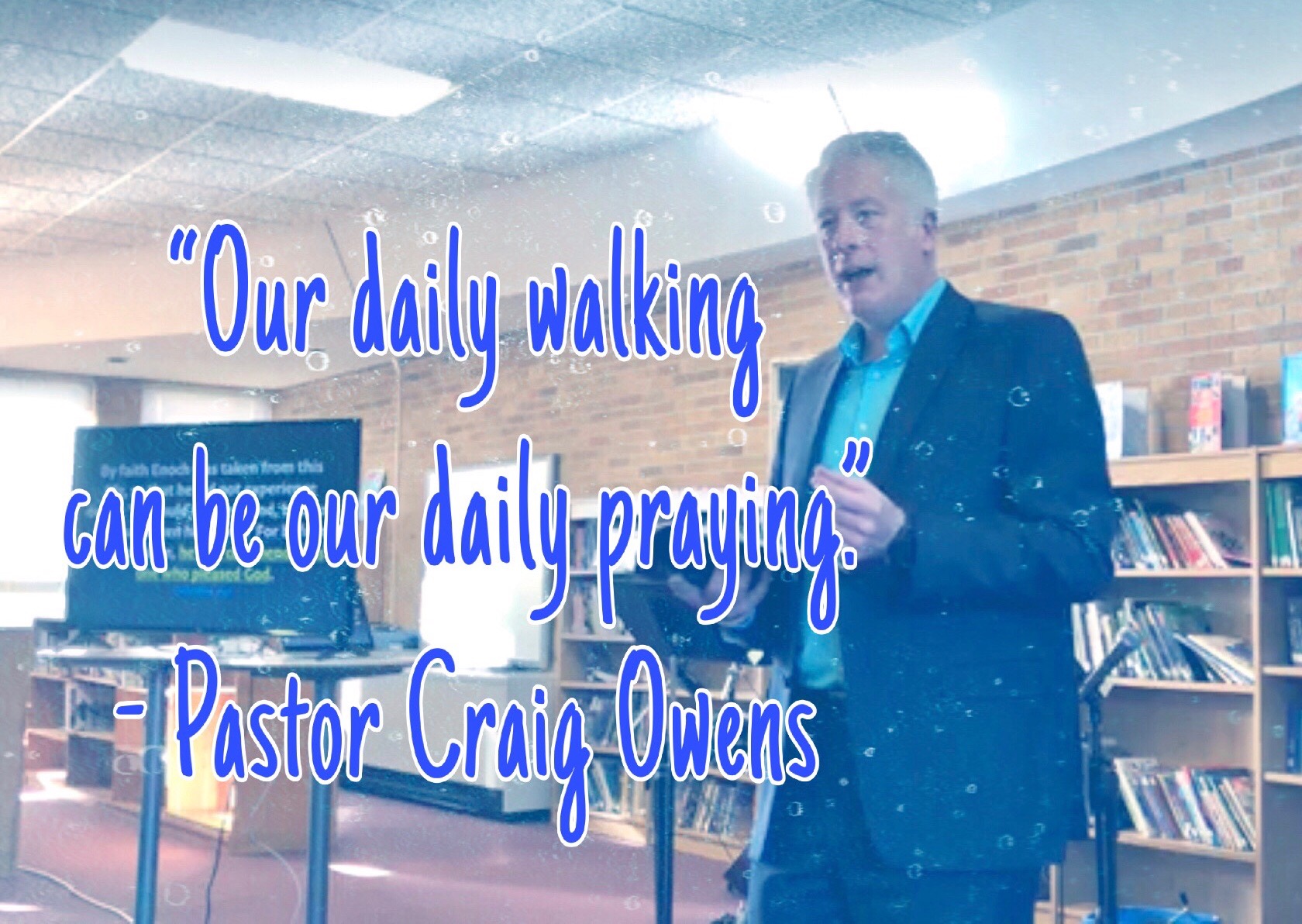
Our daily walking can be our daily praying, as long as we’re walking in faith in the direction God pointed us. 

One man who—literally!—walked this principle out was Elisha.

Before we look at Elisha’s expectant, prayerful walking, let’s look at his prayer request—

When they reached the other side, Elijah said to Elisha, “What can I do for you before I’m taken from you? Ask anything.” Elisha said, “Your life repeated in my life. I want to be a holy man just like you (2 Kings 2:9 MSG).

Elisha was essentially asking to be like Elijah’s firstborn son, to be his spiritual heir. This was the original promise God gave when He told Elijah to anoint Elisha as his successor (1 Kings 19:16). From that point onward, Elisha steadily walked in expectation of God answering this prayer. 

Elisha wouldn’t stay in a place of military victory, or in a significantly spiritual place, or even in a place surrounded by godly leaders. Elisha wouldn’t be held back by a lucrative family business, or the warning words of friends or his spiritual mentor, or even the seemingly uncrossable Jordan River. He kept on walking (see 2 Kings 2:1-15).

He kept on walking.

He kept on walking until “suddenly” God showed up and answered his prayer. 

But was it really “suddenly”? Elisha knew it was coming. He believed what God had promised. He clung to it even when Elijah told him he had asked “a difficult thing.” Elisha kept on walking until he was in the right place at the right time to receive all that God had planned. 

If you have prayed in faith, start walking. Settling anywhere else is robbing yourself of a blessing and robbing God of glory. 

Just keep walking! And let your walking be your praying. Don’t get discouraged. Don’t settle. Don’t stop eagerly expecting that the next step you took could be the “suddenly” you’ve been waiting for. Just keep walking!

Join me this Sunday as we learn a valuable lesson from another bold pray-er from the Bible. 

Boldly Praying

As a general rule, God would like us to pray much more boldly than we typically do. 

Jesus told us that we could pray mountain-moving prayers! But C.S. Lewis rightly observed, “If we consider the unblushing promises of reward and the staggering nature of the rewards promised in the Gospels, it would seem that our Lord finds our desires, not too strong, but too weak.” 

This Sunday we begin a new series of messages called Boldly Praying, in which we are going to consider how we can replace our weak prayers with bold prayers. We’ll be looking at the requests of four bold pray-ers that we meet in the pages of Scripture, and each one of them will teach us a new aspect of bold praying. 

Join us either in person or on Facebook Live. 

If you have missed any of the messages in this series, check out these recaps—

Get Up And Get Moving

When Joseph woke up, he did what the angel of the Lord had commanded him… (Matthew 1:24). 

I was reading an article posted on WebMD about how much damage we can do to our hearts by spending more time in front of the TV or computer than we do exercising. You’re probably thinking, “Well, duh! isn’t that obvious?!” It should be, and yet all of us still have a natural tendency to just sit there.

One quote especially stood out to me —

“It’s not even about the exercise. It’s about not sitting,” says Suzanne Steinbaum, DO, a preventive cardiologist at Lenox Hill Hospital in New York City. “I think that sort of points us in a little different direction. In order for you not to cause harm to yourself, you really need to focus on getting up and moving.”

This reminds me of Joseph (Mary’s husband) in the Bible. God spoke to him three times in dreams. After Joseph woke up, instead of just sitting there contemplating the vision, there’s a phrase that shows up after every single vision—“Joseph got up and did.” 

A mark of a godly leader is one who obeys God quickly.

I’m convinced that if Joseph had not obeyed the first God-given vision, he wouldn’t have been given anymore. 

Has God given you a vision for your life? If so, just sitting there may do damage to your heart and limit any other visions from God. So follow Joseph’s example and get up and get moving!

This is part 32 in my series on godly leadership. You can check out all of my posts in this series by clicking here.