Thursdays With Oswald—Faith And Common Sense

Oswald ChambersThis is a periodic series with things I’m reading and pondering from Oswald Chambers. You can read the original seed thought here, or type “Thursdays With Oswald” in the search box to read more entries.

Faith And Common Sense 

     Common sense is not faith and faith is not common sense; they stand in the relation of Ishmael and Isaac, of the natural and the spiritual, of individuality and personality, of impulse and inspiration. Faith in antagonism to common sense is fanaticism, and common sense in antagonism to faith is rationalism. The life of faith brings the two into right relationship.

     How am I going to find out what the will of God is? In one way only, by not trying to find out. If you are born again of the Spirit of God, you are the will of God, and your ordinary common sense decisions are God’s will for you unless He gives you an inner check. When He does, call a halt immediately and wait on Him. Be renewed in the spirit of your mind that you may make out His will, not in your mind, but in practical living. God’s will in my common sense life is not for me to accept conditions and say—“Oh well, it is the will of God,” but to apprehend them for Him, and that means conflict, and it is of God that we conflict. Doing the will of God is an active thing in my common sense life.

From Not Knowing Where [italics in original; bold font added by me]

Have you ever considered that we find the will of God by not trying to find the will of God? I love Chambers’ conclusion that as a Christian you are the will of God, now we just need to be renewed in our spirits to hear His voice and direction for us.
What Does God Want Me To Do?

BibleI often hear people say, “I’m waiting for a word from God” when they are making a decision. Or sometimes someone will say, “I’m not sure what God wants me to do here.”

Many years ago the phrase WWJD―what would Jesus do?―was all the rage. It came from a renewed interest in Charles Sheldon’s book In His Steps. In order to do what Jesus would do (and say), we must be familiar with what Jesus did (and said). Jesus Himself said that the Holy Spirit would remind us of everything He had done and said (John 14:26).

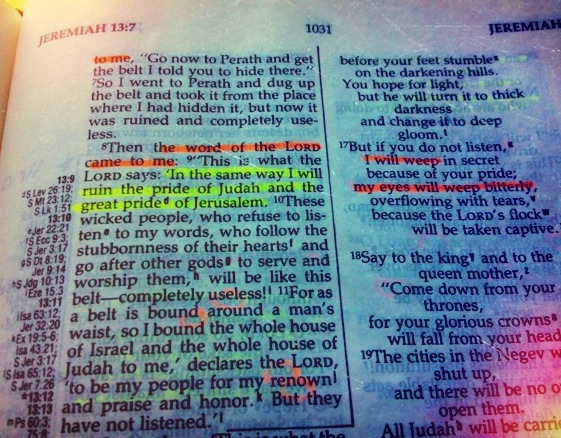
Jeremiah was one of the most prolific prophets of Israel, with his writings making up the longest book in the Bible. Yet one thing clearly stands out―over 420 times Jeremiah uses phrases like:

  • The Word of the Lord came to me
  • Declares the Lord
  • The Lord said to me
  • What the Lord says
  • Hear the word of the Lord
  • Open your ears to the words of His mouth

It’s hard to know what Jesus would do, or the direction God would have you go, or the God-honoring decision that you should make if you haven’t read His Word! He has so much to say to you, and the Holy Spirit is just waiting to help you apply God’s Word to your particular situation.

If you want to make better decisions, and do and say things more like Jesus did and said, be like Jeremiah and be immersed in God’s Word more and more.

Links & Quotes

link quote

Some interesting reading (and watching and listening) from the last couple of days.

Great D-Day history! You can listen to CBS Radio as they reported the D-Day invasion on June 6, 1944.

Watching porn not only decreases brain size, but it also weakens the watcher’s ability to make good long-term decisions.

Parents: kids can download apps to hide pictures and videos on their electronic devices. Check out the latest news from uknowkids.com.

The Congressional Budget Office now reports that ObamaCare costs are so outrageous that it is impossible for them to calculate the total economic impact.

“It is delightful to worship God, but it is also a humbling thing; and the man who has not been humbled in the presence of God will never be a worshiper of God at all. He may be a church member who keeps the rules and obeys the discipline, and who tithes and goes to conference, but he’ll never be a worshiper unless he is deeply humbled. … There’s an awesomeness about God which is missing in our day altogether; there’s little sense of admiring awe in the Church of Christ these days.” —A.W. Tozer

[VIDEO] Clay Christensen on the importance of religious freedom to democracy.

“The most paralyzing thing we can do for our relationship is to define our spouse by their past, rather than by who they are in the present.” Read more from this post Top 10 Relationship Killers.

Fasting is beneficial spiritually and physically: Fasting can regenerate immune system.

11 Quotes From “How High Will You Climb?”

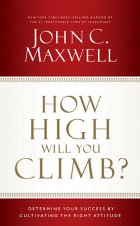
How High Will You Climb?How High Will You Climb? is an abridgment of Dr. John Maxwell’s amazing book The Winning Attitude. Truly, attitude will determine your success in life. I highly recommend either of these books (you can check out my review by clicking here). Below are some attitude quotes I highlighted and one helpful infographic.

“The attitude is an inward feeling expressed by behavior. That is why an attitude can be seen without a word being said.” 

“It is impossible to perform consistently in a manner that is inconsistent with the way we see ourselves. In other words, we usually act in direct response to our self-image. … We should also remember God’s unconditional love and acceptance. He thinks more of us than we do of ourselves. … This principle works in reverse too. How we see ourselves reflects how others see us. If we like ourselves, it increases the odds that others will like us.”

“Others can stop you temporarily, but you are the only one who can do it permanently.”

“Usually wrong decisions are made at the wrong time, and right decisions are made at the right time. The reason? We let our environment control our thinking, which controls our decisions. Therefore, the more decisions that are made in the calm of life, the fewer times storms can bring us down.”

“Failure—we hide it, deny it, fear it, ignore it, and hate it. We do everything but accept it. By acceptance, I don’t mean resignation and apathy. I mean understanding that failure is a necessary step to success. The person who never makes a mistake never does anything.”

“Fear of failure grips those who take themselves too seriously.”

“First, discouragement hurts our self-image. … Discouragement causes us to see ourselves as less than we really are. This fact becomes even more important when we realize that we cannot consistently perform in a manner that is inconsistent with the way we see ourselves. Second, discouragement causes us to evade our responsibilities. … Third, discouragement causes us to blame others for our predicaments. … Fourth, discouragement causes us to blur the facts.”

“When our attitude crashes, we have two alternatives. We can either alter the difficulty or alter ourselves. What can be changed for the best, we must change. When that is impossible, we must adjust to the circumstances in a positive way.”

“We are either the masters or the victims of our attitudes. It is a matter of personal choice. Who we are today is the result of choices we made yesterday. Tomorrow we will become what we choose today.” 

“It is a sad day for any person when he becomes so satisfied with his life, his thoughts, and his deeds that he ceases to be challenged to do greater things in life.”

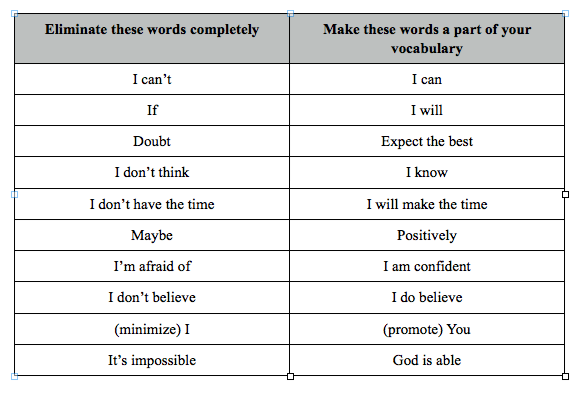
“When an opportunity for growth is open to you, what do you tell yourself? Will you grasp the chance with a tingle of excitement and say, ‘I can make it work!’ or do you smother it by saying, ‘That’s impractical… too difficult… I don’t think it can be done’? In that moment, you choose between success and failure. You helped to form a habit of either positive or negative thinking by what you tell yourself. So give your ‘better’ self a chance to grow. Form the habit of positive reaction followed by positive action.”

Change your vocabulary


Decision Points (book review)

Decision PointsOne of my life goals is to read an (auto)biography of every U.S. President. I’m well on my way. My latest one is Decision Points by President George W. Bush.

This book is laid out in a rather intriguing way. Instead of being told chronologically, it’s told through the prism of the major decisions President Bush faced. Written in this style, we are able to stick with one situation from inception, to decision, to the management of that decision. Now that we are 10+ years down the road from some of these decisions, we get to see the wisdom or folly of those decisions.

The book is a great inside look into the weighty decisions that land on a president’s desk throughout his term in office. As a Christian who has a biblical command to pray for my elected officials, it’s a helpful guide for my daily prayers.

I throughly enjoyed reading Decisions Points, and I think other students of history will appreciate the thoughtful way this book is presented too.

Pray Long

How long is a long prayer? Do you get tired (or bored!) after just a few minutes? Do you start to nod off to sleep if the prayer goes longer than expected? Does your mind wander? Are you too busy to pray more than just bullet-point prayers?

Jesus was about to make a huge decision. Of all of the people who called themselves His disciples (there were a lot of them), Jesus was going to choose twelve to be His apostles (Luke 6:13, 17). These were the men who would spend the most time with Jesus; the ones who would hear His most explicit instructions; the ones who would be called upon to take the gospel to the four points of the globe after Christ’s ascension into Heaven.

How did Jesus choose The Twelve from the huge multitude?

“He spent the night praying to God” (Luke 6:12).

This Greek word for spent the night is unique in all of Scripture. Only Luke uses it here to describe how Jesus prayed. Doctor Luke—who would know better than most how the body craves sleep—uses this unique word. In essence Jesus was going to cease from all activity AND avoid any inactivity (like sleep) to pray about this important decision.

Principle: The bigger the issue = the longer the prayer.

  • How many times do I pray just one-and-done prayers?
  • How many times am I too distracted/tired/busy to pray more than a few minutes?
  • What wisdom am I robbing myself of by my short prayers?

Don’t get me wrong, God does answer the one word prayers (like HELP!). But there is something powerful about praying long.

Making Choices

The unusual or out-of-the-ordinary always seems to grab my attention. So when I was reading through a long, long (long!) list of names in 1 Chronicles, I stopped when I read, “Their sister was named Hazzelelponi.”

My first thought: What parent names their little girl Hazzelelponi?!?

My second thought: Why does the biblical writer mention her? First off, there are scarcely any other women mentioned in these genealogies. And then to mention such an unusual name without any other commentary seems weird.

Her name is a compound of two words: to turn toward + shadows.

The Hebrew word for shadows can have two meanings: (1) The cool, protected place; or (2) Something which is transitory or short-lived. One positive definition, and one negative definition. Since all the other times this word is used in the Bible the second definition is used, we can assume that the negative usage is meant here too.

Since I doubt that anyone makes a decision to turn to the shadowy “dark side” all at once, Hazzelelponi made small choices day after day after day.

Small choices every day to rely in things that would not last. And now her history is nothing but a single line: “Their sister was named Hazzelelponi.” No descendants, no heritage, no legacy; just a footnote because of the small choices she made.

“There is a choice you have to make in everything you do. So keep in mind that in the end, the choice you make, makes you.” – John Wooden

What choices are you making today?

An Extra Hour Of Sleep

I’m a morning person. I absolutely love getting up early and spending some quiet time alone with my Bible. This is the time of day I most absorb all that God is saying to me. It’s my most creative time too. In fact, I so love getting up early that most mornings I’m awake before my alarm clock goes off.

But not this morning.

Today my alarm clock began playing Way-FM and I felt like I was in a fog. It took me a minute or so to even open my eyes and sit up.

I was about to press ahead with my morning, when I thought, “I should sleep some more.”

You see, I’ve learned a few things about myself. When I’m tired…

  • I have a shorter attention span.
  • I’m not as creative.
  • I’m not as patient.
  • I am more prone to give in to temptation.
  • I make decisions that are too short-sighted.
  • I’m more susceptible to colds and flu.

So I re-set the alarm and slept another hour.

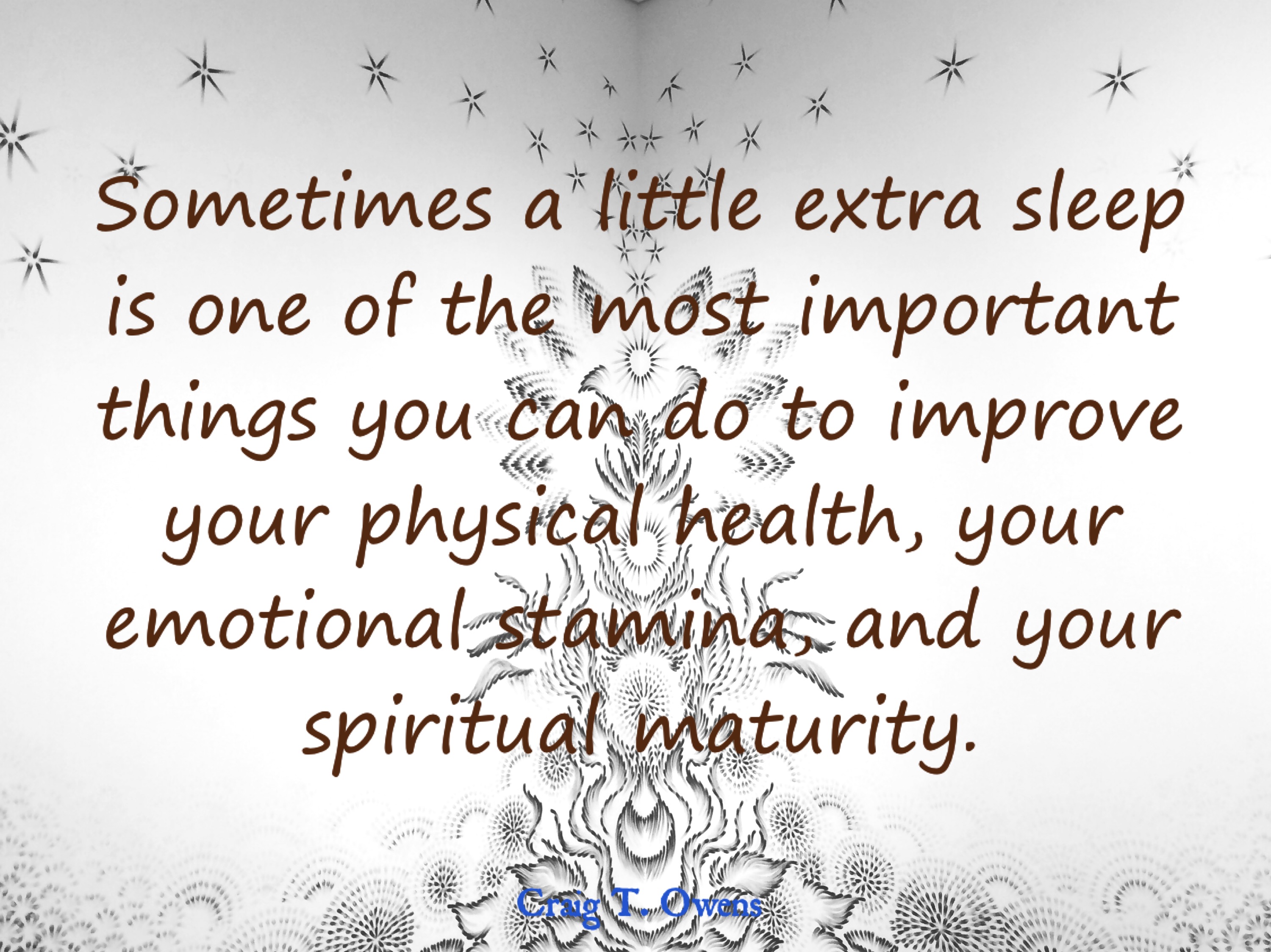
Sometimes a little extra sleep is one of the most important things you can do to improve your physical health, your emotional stamina, and your spiritual maturity.

UPDATE: In my book Shepherd Leadership: The Metrics That Really Matter I have five chapters about a leader’s health—mental, physical, spiritual, and emotional health is vital to a leader’s effectiveness and longevity.

Wise Guys

I’m facing a big decision. I have an idea of the right way to go, but I’m taking some time to run my options by some wise guys. After all, even King Solomon—who was wiser than any other man, and probably could advise himself—wrote, “The more wise counsel you follow, the better your chances” (Proverbs 11:14, Message).

I also like what George Washington Carver said, “How much of God are we missing because we don’t stop to listen to the many voices God uses to speak to us?”

Of all the voices speaking to me, how am I choosing which wise guys to listen to?

Friendship—I have to know that my counselors are my friends. William Shakespeare asked the question, “Can he that speaks with the tongue of an enemy be a good counselor, or no?” I would answer “no.” I need wise guys that want me to be successful.

B.T.D.T.—I choose wise guys who have Been There Done That. Guys who have walked through the same scenario I’m facing now. Not a travel agent to point the way, but a tour guide who knows the path and will walk it with me.

Scarred—It’s hard to be helpful to someone else when you still have a gaping wound. I need wise guys who have been wounded in the past but now have the scars to show where they’ve been healed. It’s from this vantage point that they can be of the most help to me.

Successful—Finally, I choose to listen to wise guys who are successful. I don’t need some to tell me what should work—I want to hear what does work.

There’s an old attorney’s adage that says, “He who represents himself has a fool for a client.” If you have a decision to make I would modify this to say, “He who takes advice only from himself is taking counsel from a fool.”

What else would you look for in a wise guy? 

When Friends Wound

Bill Hybels wrote in Axiom, “The nature of human beings is such that we tend not to drift into better behaviors. We usually have to be asked by someone to consider taking it up a level.” I have learned that this is true not only for behaviors but for crucial decisions too.

I’m in the process of contemplating some major decisions for my life. During this time I am grateful for friends that can give me their counsel and can share with me their wisdom.

I’m also grateful that they wound me.

Huh?

Yes, I am glad for friends who wound me!

The wise King Solomon wrote, “Wounds from a friend can be trusted, but an enemy multiplies kisses” (Proverbs 27:6). So true. Those who don’t care about you don’t ask the tough questions; those who care about you challenge your logic and your reasoning. Those who don’t care about you let the little things slide; those who care about you challenge you to not settle for the status quo.

The New Living Translation renders this verse, “Wounds from a sincere friend are better than many kisses from an enemy.I would much prefer to be wounded by a friend during the decision-making time, than to have lots of so-called love upfront, only to walk smack-dab into a huge problem later. Wouldn’t you? So when I have an important decision to make, I get around people who love me enough to wound me.

And not only for the big decisions, but I need sharp friends for the day-in-day-out things that will help me “take it up a level.” Solomon also said, “Become wise by walking with the wise; hang out with fools and watch your life fall to pieces” (Proverbs 13:20, The Message).

Many years ago a Romanian friend shared with me a proverb from his homeland: “Show me who your friends are and I will tell you who you are becoming.”

What does your choice in friends say about you? Do your friends love you enough to wound you? Do your friends help you take it to the next level?