Inventive Faith

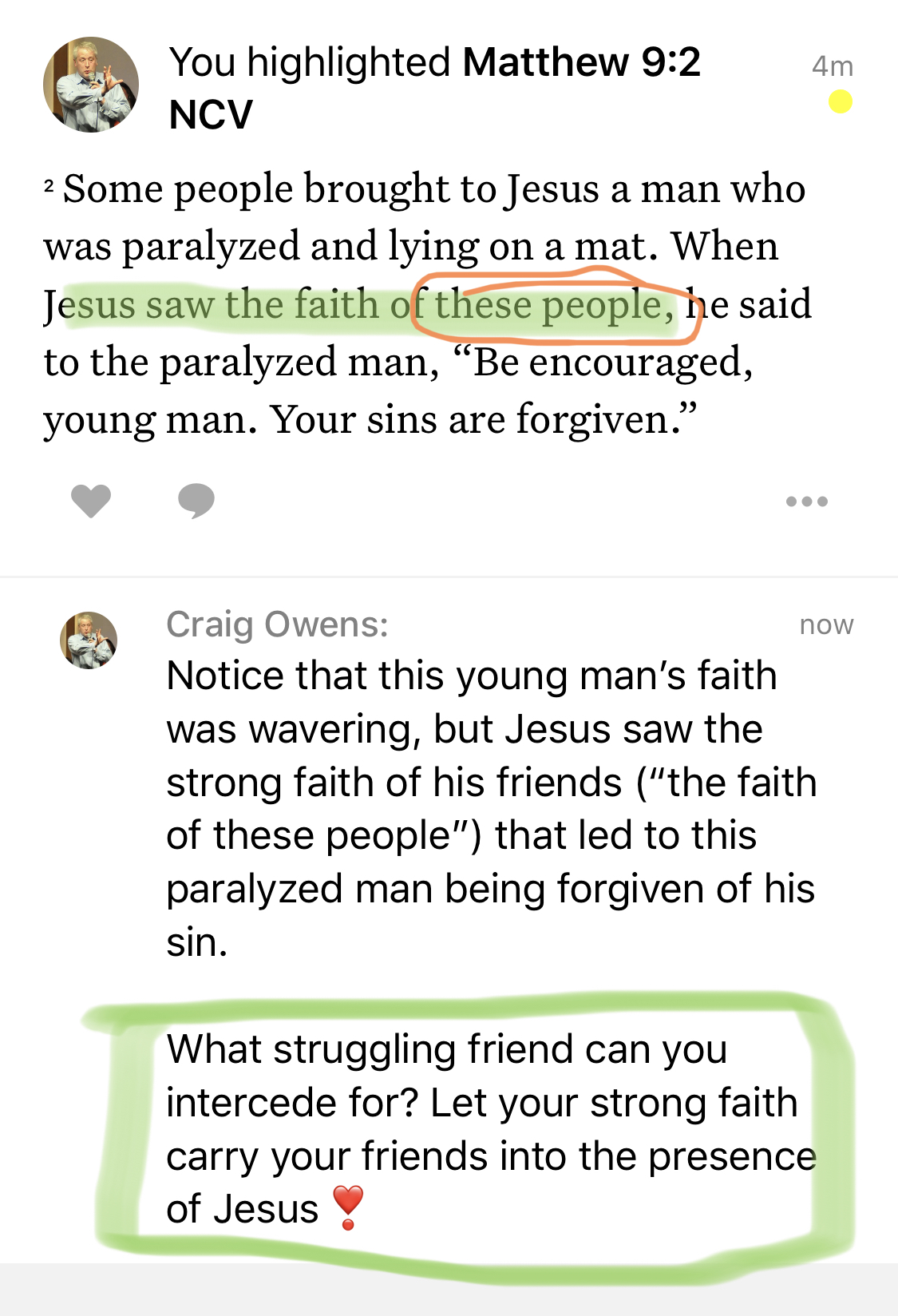
I love the story of the four friends who wanted to get their sick companion in to see Jesus. They had heard about Jesus healing others, and they believed that He would heal their friend too. But when they arrived at the house where Jesus was, they found it packed with people, and the doors and windows blocked by crowds who also wanted to see and hear Jesus. So these four friends made an appointment with one of Jesus’ disciples to come back at a more convenient time.

Ummm, not so much!

These guys were so convinced that Jesus could heal their friend, that they didn’t let crowds stop them. They climbed up on top of the house, ripped off some of the roof tiles, and lowered their friend down to Jesus. I love their inventive faith!

How many times do circumstances stop me?

  • there were too many people
  • or not enough people
  • they seemed busy
  • they seemed uninterested
  • it was raining

Oh, so many flimsy excuses that seem to derail my faith!

I love this thought from Charles Spurgeon:

“Faith is full of inventions. The world is constantly inventing; genius serves all the purposes of human desire: cannot faith invent too, and reach by some new means the outcasts who lie perishing around us?

“…Through door, through window, or through roof, let us, breaking through all impediments, labor to bring poor souls to Jesus. All means are good and decorous when faith and love are truly set on winning souls. If hunger for bread can break through stone walls, surely hunger for souls is not to be hindered in its efforts. O Lord, make us quick to suggest methods of reaching thy poor sin-sick ones, and bold to carry them out at all hazards.”

How much more inventive can your faith be?
Hmmm

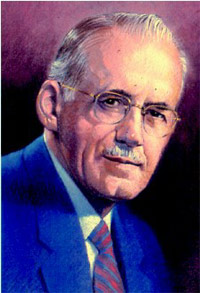
Feats of thinking may create reputation, but habits of thinking create character. —A.W. Tozer

If this is true, then I’ve got some questions to ask myself:

  • How do I think?
  • How am I processing the world around me?
  • Do I see the hand of God in daily events?
  • Can I find His truth at work?
  • Am I learning from what I experience each day?
  • Do I think positively or negatively?
  • Do difficulties cause faith or fear?
  • Am I thinking long enough?
  • Do my thoughts produce a Christ-like attitude?
  • Do I take time to think about my thoughts?

Two more thinking quotes for today:

Life consists of what a man is thinking about all day. —Ralph Waldo Emerson

Summing it all up, friends, I’d say you’ll do best by filling your minds and meditating on things true, noble, reputable, authentic, compelling, gracious—the best, not the worst; the beautiful, not the ugly; things to praise, not things to curse.Philippians 4:8

Who Are You Talking To?

I love team leadership. I really enjoy getting a group of creative thinkers around me to do some serious brainstorming. I find it so beneficial to seek out the counsel of some wise people who have been around for a while.

But, let’s see, who have I left off this list?

Oh, yeah, I remember now—I didn’t consult God!

Be honest: have you ever done that? Have you ever consulted with a lot of wise—even God-fearing—people, but forgotten to consult with God Himself? If you have (and I certainly have), we’re in good company.

When King David got ready to move the ark of the covenant to Jerusalem, the Bible says,

David conferred with each of his officers….

How’d that work out for him? Not so good.

  • Uzzah died
  • David got mad at God
  • David got scared of God
  • The ark’s arrival in Jerusalem was delayed another three months

Then David had his “Oh yeah!” moment. When he got ready to try again, David said,

We did not inquire of God about how to do it in the prescribed manner….

So here’s my simple reminder to myself (and to you too): It’s fine to consult with others, but consult with God first.

Thought Patrol

Have you ever found yourself in circumstances that weren’t exactly what you had planned or hoped for? You know, things are just not going your way? What do you do then? How do you handle this? I suggest the first place to start is by thinking about your thinking.

I know that may sound a little unusual, but I have often times had to stop to think about what I’m thinking about. To ask myself, “Why am I thinking that?”

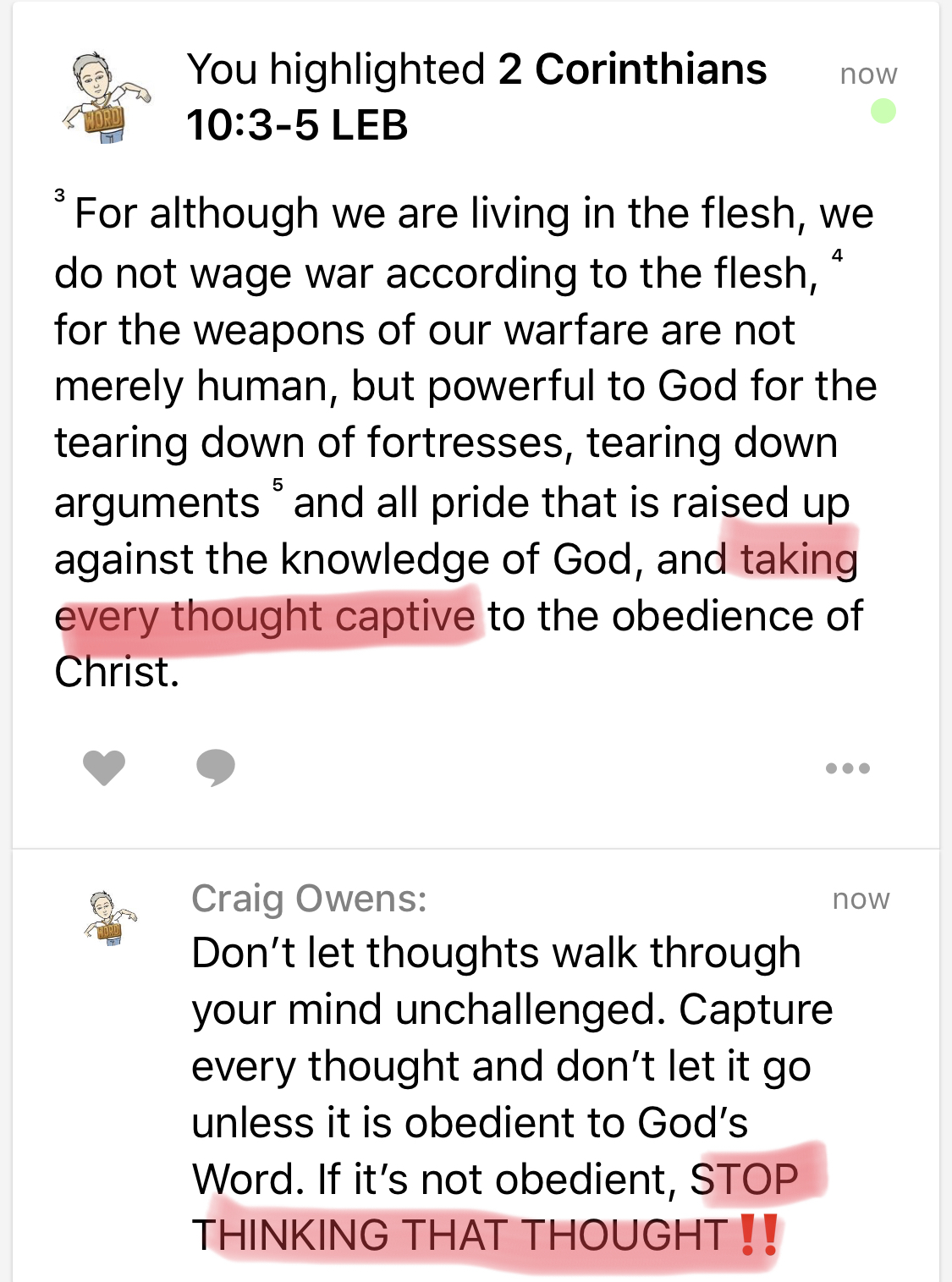
I believe this is what the Bible is really saying when it tells us to take every thought captive. If we don’t, our negative thoughts can lead us to unplanned places and can keep us trapped there. But if we will take time to think about what we’re thinking about, we can discover the key to freedom from that undesirable place.

A few quotes to get us started:

“No man has ever succeeded who kept his mind on negative things… and no man ever rises above his thoughts of himself.” —C.M. Ward

“You are today where your thoughts have brought you. You will be tomorrow where your thoughts take you.” —James Allen, As A Man Thinketh

“They themselves are makers of themselves by virtue of the thoughts which they choose and encourage; that mind is the master-weaver, both of the inner garment of character and the outer garment of circumstance, and that, as they may have hitherto woven in ignorance and pain they may now weave in enlightenment and happiness.” —James Allen, As A Man Thinketh

“Only when you assume full accountability for your thoughts, feelings, actions, and results can you direct your own destiny; otherwise, someone or something else will.” —Roger Conners, Tom Smith & Craig Hickman, The Oz Principle

“Summing it all up, friends, I’d say you’ll do best by filling your minds and meditating on things true, noble, reputable, authentic, compelling, gracious—the best, not the worst; the beautiful, not the ugly; things to praise, not things to curse. Put into practice what you learned from me, what you heard and saw and realized. Do that, and God, who makes everything work together, will work you into his most excellent harmonies.” —Philippians 4:8, The Bible

Let’s all work on patrolling our thoughts today.

So Long, Status Quo!

What’s holding you back from making a change today? What’s keeping you from breaking with the pack? What status quo in your life needs to go bye-bye?

“Status quo, you know, is Latin for ‘the mess we’re in.’” —Ronald Reagan

“The soft-minded man always fears change. He feels security in the status quo, and he has an almost morbid fear of the new. For him, the greatest pain is the pain of a new idea.” —Martin Luther King, Jr.

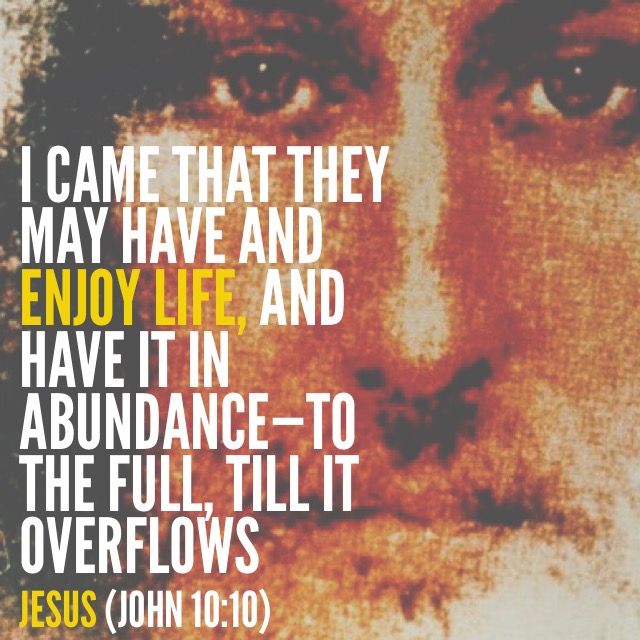
“I have come that you might have life to the full [away from the status quo].” —Jesus Christ

The gate is wide
The road is paved in moderation
The crowd is kind and quick to pull you in
Welcome to the middle ground
You’re safe and sound and
Until now, it’s where I’ve been

‘Cause it’s been fear that ties me down to everything
But it’s been love, Your love, that cuts the strings

So long status quo
I think I just let go
You make me want to be brave
The way it always was
Is no longer good enough
You make me want to be brave
Brave, brave

I am small
And I speak when I’m spoken to
But I am willing to risk it all
I say Your name
Just Your name and I’m ready to jump
Even ready to fall

Why did I take this vow of compromise?
Why did I try to keep it all inside?

I’ve never known a fire that didn’t begin with a flame
Every storm will start with just a drop of rain
But if You believe in me
That changes everything
So long, I’m gone

—Nicole Nordeman, Brave

Synergy

The dictionary defines synergy as the combined action of two items, where their output is greater than the sum of their individual efforts. I like the Bible’s definition better:

Five of you will chase a hundred, and a hundred of you will chase ten thousand, and your enemies will fall by the sword before you (Leviticus 26:8).

God’s synergy has an “if” attached to it. A few verses earlier God says, “If you follow Me and obey My principles, then this is what you can expect from Me.”

So God’s synergistic math looks like this:

5 = 102 = 104

Five people motivated by their devotion to God and trusting Him for victory = 100 enemies defeated.

One hundred people doing the exact same thing = 10,000 enemies defeated.

The first synergy is a 20-fold increase, while the second synergy is a 100-fold increase! The more people that buy into this truth, the greater the synergy.

Imagine if you could get just four other people to join you in prayer and in seeking God for…

  • …the lost in your city
  • …the healing of an “incurable” diseases
  • …the alleviation of poverty
  • …the strengthening of marriages
  • …the end of abortion

Imagine!

God’s synergy is an amazing thing! Be a part of it!

Thanksgiving Challenge


Yesterday I began a two-part series at Calvary Assembly of God sandwiched around Thanksgiving Day. The series is simply called Thanks and is based on the premise that thankfulness is the soil for healthy growth.

Have you ever grown a garden? If you have, you know that even though you plant the best seeds in the best soil, if you simply leave it unattended, weeds will find their way into your well-manicured garden. If you leave your garden unattended for long enough, the weeds will eventually take over.

It’s just as true for our minds. We can cultivate the best soil in our minds and plant only the finest seeds. But if we do nothing more, the weeds will take over and eventually choke out anything good that was growing there.

A spirit of continual thankfulness will keep the soil free from the choking weeds. But pulling out weeds by our thankfulness must be a continual process. So I gave our church the 365/730/1095 challenge.

Start a thanksgiving journal. If you just write down one unique thing every day for which you are thankful, you will have recorded 365 things in a year. More challenging: write down two things every day, or even—are you brave enough to attempt this?—three things every day. If you find two things each day, you will have 730 weed busters by the end of the year, or three items will give you 1095 weed busters.

Are you ready for the challenge?

I’m going to attempt to find three unique things each day for the next year. I hope this is encouraging to you, and I hope you will accept the 365/730/1095 challenge too.

I Am What I Think I Am

Years ago I read a book that transformed the way I read and studied. This one book probably caused me to become a more discriminating reader than any other factor. Although it’s less than 50 pages long, As A Man Thinketh by James Allen revolutionized my thinking. Over the last couple of days, I’ve been listening to the audiobook as I have been driving around.

Here’s a quote from James Allen:

A man is literally what he thinks, his character being the complete sum of all his thoughts. … A noble and Godlike character is not a thing of favor or chance, but is the natural result of continued effort in right thinking, the effect of long-cherished association with Godlike thoughts.”

This is what the Bible says about the seeds of great thoughts:

“Finally, brethren, whatever things are true, whatever things are noble, whatever things are just, whatever things are pure, whatever things are lovely, whatever things are of good report, if there is any virtue and if there is anything praiseworthy—meditate on these things.”

What are you thinking about today? What’s going in? You are making yourself by what you are thinking, so choose those thought-stimulators wisely.

Sharper Thoughts

John Maxwell said, “Some of my best thinking has been done by others.” I believe that what Dr. Maxwell was saying is that our creative thoughts can become even better when someone else helps sharpen them.

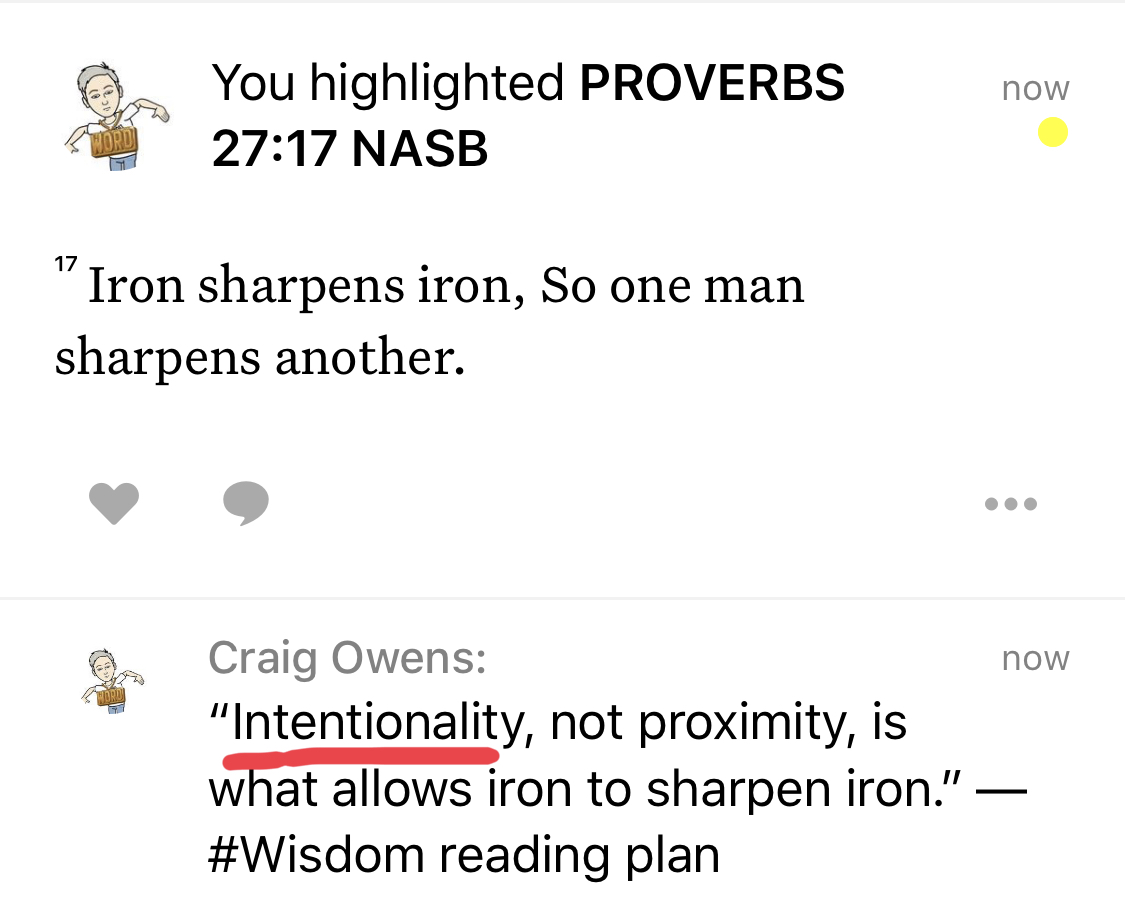
King Solomon, a pretty fair thinker himself, said the same thing when he wrote, “As iron sharpens iron, so one man sharpens another” (Proverbs 27:17). In other words, you need some pretty sharp people to help you think better thoughts, sharper thoughts.

Check out what John Stuart Mill wrote in On Liberty

“Nor is it enough that he should hear the arguments of adversaries from his own teachers, presented as they state them, and accompanied by what they offer as refutations. That is not the way to do justice to the arguments, or bring them into real contact with his own mind. He must be able to hear them from persons who actually believe them; who defend them in earnest, and do their very utmost for them. He must know them in their most plausible and persuasive form; he must feel the whole force of the difficulty which the true view of the subject has to encounter and dispose of; else he will never really possess himself of the portion of truth which meets and removes that difficulty. Ninety-nine in a hundred of what are called educated men are in this condition; even of those who can argue fluently for their opinions. Their conclusion may be true, but it might be false for anything they know: they have never thrown themselves into the mental position of those who think differently from them, and considered what such persons may have to say; and consequently they do not, in any proper sense of the word, know the doctrine which they themselves profess.”

General George C. Marshall, chief of staff of the Army during World War II, created the largest army the world had ever seen (13 million soldiers) in the shortest time possible. General Omar Bradley tells of being called into Marshall’s office in 1939, a week after the outbreak of war in Europe. Marshall was disappointed in Bradley, “You haven’t disagreed with a single thing I have done all week!” Marshall wanted to make sure he was doing his very best so he was calling on another sharp comrade to challenge his thinking.

Do you have some sharp people around you? Do you listen to those who disagree with you? If you do, your creative thoughts can become even sharper.

Doing Thinking Doing

To think or to act? That is the question. Or maybe the question should be, which comes first: the thinking or the acting? Do I think about something and then go do it? Or do I do something first and then think about what I’ve done and how I could do it better next time?

The answer, I believe, is yes.

You could be the most creative thinker in the world, your thoughts could be off on another plane, but if you do nothing with what you’re thinking, all of those great insights are wasted.

On the other hand, many people hold to the axiom that experience is the best teacher, so they just do and do and do. But experience is not the teacher; we only learn when we stop to think about what we’ve done.

William Wilberforce was already a rising star in British politics when he experienced a deeper understanding of his relationship to God. Suddenly this man of word and action wanted to do nothing more than meditate on the greatness of God. Wilberforce believed that he could best serve God by withdrawing from society and simply thinking about God.

His good friend and future prime minister William Pitt disagreed. Pitt wrote to Wilberforce, “Why then this preparation of solitude which can hardly avoid tincturing the mind either with melancholy or superstition? … Surely the principles as well as the practice of Christianity are simple and lead not to meditation but to action.” Or as the line from Amazing Grace has it, “We humbly suggest you can do both.”

I love Oswald Chambers’ counsel—

“God will never allow us to divide our lives into sacred and secular, into study and activity. We generally think of a student as one who shuts himself up and studies in a reflective way, but that is never revealed in God’s book. A Christian’s thinking ought to be done in activities, not in reflection, because we only come to right discernment in activities.”

Whether it starts with thinking or starts with action, successful thinking-doing must include both. Think about it → act on it → think about your results → do it again better than last time.

Paul wrote to the Romans how thinking and action work together when he said, “for their own conscience and thoughts either accuse them or tell them they are doing right” (Romans 2:5 NLT). The Amplified Bible renders this phrase, “their consciences (sense of right and wrong) also bear witness; and their decisions (their arguments of reason, their condemning or approving thoughts) will accuse or perhaps defend and excuse them.”

Think about it → do it → think about it → do it = the pattern for success.