Listen to the podcast of this post by clicking on the player below, and you can also subscribe on Apple, Spotify, or Audible.
Both mentoring and coaching are valuable skills in leadership development, but they are not interchangeable skills. Check out how Greg and I unpack this important distinction.
Listen to the audio-only version of this podcast by clicking on the player below, or scroll down to watch the video.
You might be checking out this episode with the hope of one day being a leader. Well, Greg and I have good news for you—you already are! Leaders are not just the person at the top, but if you have a leadership mindset you can be a leader in whatever position you currently occupy. Join us as we chat about how important it is to start being a leader before you have the “leader” title.
[0:24] What if you’re not the point leader in your organization?
[1:22] Regardless of your title or position, you are still a leader.
[3:13] Leaders—whether at the top or in the middle—need to try to raise up other leaders.
[5:29] One trait that will increase your value to the organization is cross-training.
[8:20] Another trait is curiosity that keeps you a lifelong learner.
[11:07] An example from Tom Brady about how important passion is for those who aren’t starters yet.
[13:47] Two other important traits for emerging leaders is patience and self-discipline.
[14:37] How do point leader keep their bench players engaged until there is a new leadership position available for them?
[17:07] Mentoring and coaching aren’t the same things. How do we know which one to use in our organizations?
[23:21] What you can do if you don’t have any mentors within your organization?
Check out this episode and subscribe on YouTube so you can watch all of the upcoming episodes. You can also listen to our podcast on Spotify and Apple.
Listen to the audio-only version of this podcast by clicking on the player below, or scroll down to watch the video.
In today’s episode we’re going to—IMPATIENCE! Yes, we’re talking about impatience. As a leader it can be hard to resist the temptation of impatience, but Greg and I believe that developing patience is a vital skill for leaders. In this episode we’ll explore some of the pitfalls of impatience, and share strategies for you to develop into a more thoughtful and patient leader.
[0:14] We’re looking at the leadership builder vs. killer of patience vs. impatience.
[1:41] Patience is sometimes misperceived as not being in control—like we’re simply waiting around for something to happen.
[2:27] Can patience be developed?
[3:50] Patience allows a process to mature, and helps people grow.
[7:35] Warning: patience can cross a line into procrastination.
[8:30] Leaders need to avoid the temptation of impatiently answering too quickly.
[10:50] What leadership pressures make us give in to impatience?
[12:59] Leaders can help their teammates with their own impatience by asking some thoughtful questions.
[15:28] Ego + Bad advice = Dangerous impatience
[16:40] Patience helps leaders trust both the process and the people around them.
[18:33] Leaders need to be aware of what’s happening in themselves when their patience is stretched. Patient leaders grow their leadership influence.
[22:24] Greg quizzes me about the origins of patience.
[24:45] I make a confession about my impatience in my early years.
[25:55] Greg shares an insightful quote about the value of patience.
Check out this episode and subscribe on YouTube so you can watch all of the upcoming episodes. You can also listen to our podcast on Spotify and Apple.
Leaders may have to talk about people on their team, but how do we do this without crossing the line into gossip? Greg and I discussed this on a recent episode of our leadership podcast.
I have lots of new content every week, which you can check out on my YouTube channel.
“The Christian ideal has not been tried and found wanting. It has been found difficult; and left untried.” —G.K. Chesterton
“Christianity does not consist in telling the truth, or walking in a conscientious way, or adhering to principles; Christianity is something other than all that, it is adhering in absolute surrender to a Person, the Lord Jesus Christ.” —Oswald Chambers, in Baffled To Fight Better
“Critics may nitpick the Scriptures upon which we base our beliefs, but each year, the Lord will increasingly demonstrate that His Word contains no errors, exaggerations, or omissions. … We won’t feel ashamed of our hope. It will unfold just as the Lord has promised. We will be nourished, guided, blessed, and comforted. Our Lord will return, and then our days of sorrow will be over. How we will exult in the Lord, who first gave us a vibrant hope and then fulfilled that which we hoped for!” —Charles Spurgeon
Listen to the podcast of this post by clicking on the player below, and you can also subscribe on Apple, Spotify, or Audible.
On our most recent leadership podcast, Greg and I were talking about the idea of not trying to eliminate stress from our workplaces. I know that may initially sound counterintuitive, but it actually makes a lot of sense when you really think about it.
“A great team begins to happen when you have the right people on the bus in the right seats and the bus breaks down…. They work through the crisis, they get back on the bus, they’re sweating and tired. All of the sudden something magical happens: They begin to talk to each other. Culture happens through crisis. Unfortunately, many team environments have structured the crisis out.”
Here’s a couple of other quotes for you to ponder:
“Crisis is a powerful motivator. It enables you to do things you should have been doing all along. Whoever said that nothing focuses the mind like the sight of the gallows had it right.” —Anne Mulcahy, CEO of Xerox
“If you really want to see innovation happen, find a crisis. It’s in the middle of a crisis when we come to the realization that either the end is near or a new future is being born. On the verge of a crisis, we are also on the verge of our greatest moment. It’s at that moment that we must decide: innovate or die.” —Dave Ferguson, in his book On The Verge
Leaders should be able to use mistakes as growth opportunities. Check out these wise words from the book Spiritual Leadership.
I have lots of new content every week, which you can check out on my YouTube channel.
T.M. Moore encourages Christian to be ready to help their neighbors answer their burning questions: “Christians, Charles Taylor insists, must not be guilty of crushing human flourishing by a too-small vision of God and an unloving or unenergetic approach to our neighbors. Instead, we must study and prepare to ‘respond most profoundly and convincingly to what are ultimately commonly felt dilemmas.’ We must be ready to guide our neighbors out of the dark woods of wrong belief into the radiant meadows of the Sun of Righteousness, risen with healing in His wings. But to do this, we must be ready guides. We must anticipate the questions our groping neighbors will ask and prepare to answer them clearly and intelligently (1 Peter 3:15).”
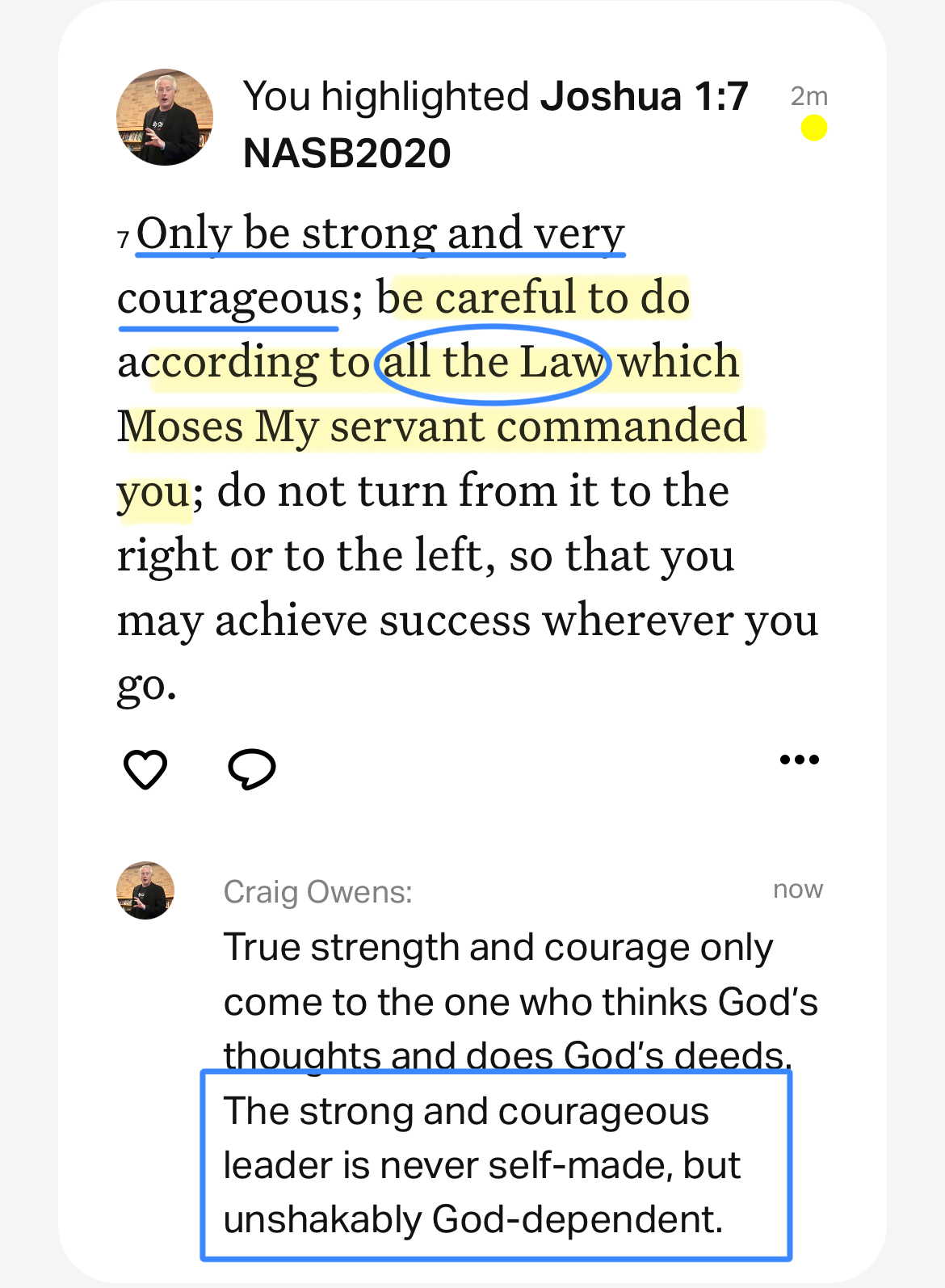
True strength and courage only come to the one who thinks God’s thoughts and does God’s deeds (see Joshua 1:7). The strong and courageous leader is never self-made, but unshakably God-dependent.
On the latest Craig and Greg Show podcast, this the quote from Andy Murray that I shared: “A great team begins to happen when you have the right people on the bus in the right seats and the bus breaks down…. They work through the crisis, they get back on the bus, they’re sweating and tired. All of the sudden something magical happens: They begin to talk to each other. Culture happens through crisis. Unfortunately, many team environments have structured the crisis out.”
Mabel Dean went to Egypt at 40 years old and stayed there for nearly 40 years without taking a single furlough! “All of Dean’s life, people did not expect her to amount to much. Despite what others said, Dean believed that she had a mandate from God for missions work in Africa. She later stated, ‘I was the only homely one in my family. Yet I was the one that He chose for His work.’”
One of the prayers in the Songs of Ascent calls us to mature (or ascend) in our prayers for those who have hurt us.
“There is always a better way of doing things, and either you or your competitor will find it.” —Brad Anderson
Listen to the podcast of this post by clicking on the player below, and you can also subscribe on Apple, Spotify, or Audible.
When people attack their leader—or when sheep bite—it hurts!
Our first best response is to acknowledge, “That hurt!” but then we need to pause. Our natural response to an attack is fight-or-flight, but healthy leaders take time to learn why that bite occurred.
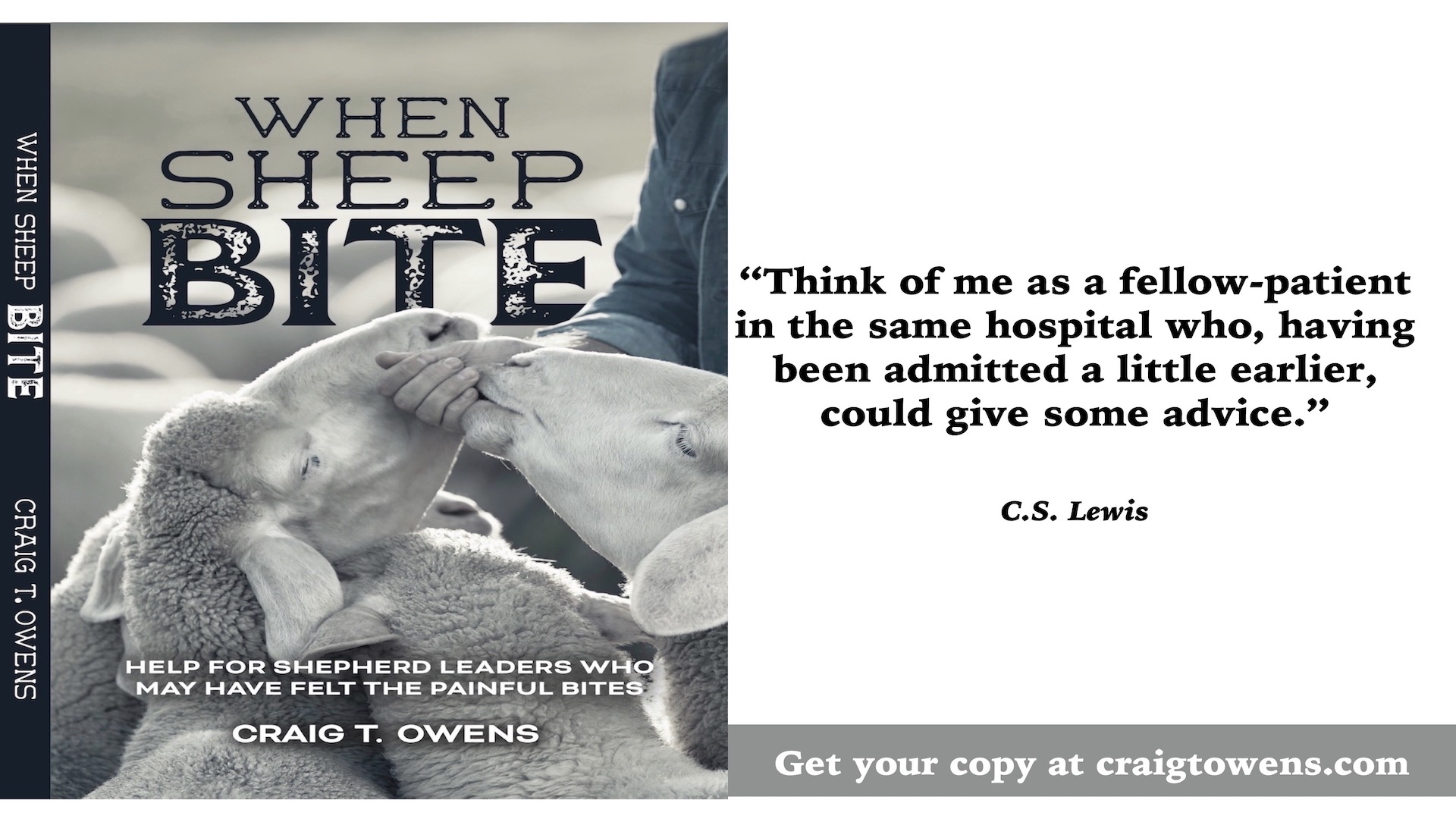
This is an excerpt from an episode of The Craig and Greg Show where Greg interviewed me about my new book When Sheep Bite.
If you would like to watch the full episode of our leadership podcast, you can find that here.
I am getting ready to facilitate a cohort for pastors who have gone through painful sheep bites—or perhaps they are feeling them right now! If you are a pastor, or if you know of a pastor who has been bitten, please check out this cohort here.
And if you would like to pick up a copy of When Sheep Bite for yourself, you can get that here.
John Piper was asked to weigh-in on the value of repetitive phrases in worship songs. He said, “The issue’s not repetition per se but whether there is enough substance, enough rich content of truth about God woven into the repetitions to justify them, to warrant them. That’s the issue. There’s a difference between repetitions that are called forth by the repeated crescendo of new, glorious truth, and repetitions that serve as a kind of mantra without sufficient truth that is simply used to sustain or intensify a mood. Moods in worship should be awakened and sustained primarily by truth, assisted by music—not primarily by music with a little truth thrown in to justify the singing.”
Pastor John Piper used Psalm 136 as an example in the post above. T.M. Moore also shared this thought about Psalm 136: “The term most frequently used to describe this everywhere-present-and-always-at-work love of God is translated as ‘lovingkindness’ or, in some versions, ‘steadfast love.’ Especially Psalm 136, with its antiphonal arrangement of verses, insists that the cosmos is upheld, sustained, and pervaded by the lovingkindness of God. … It would improve our learning to pray without ceasing if we simply took some time out during the day to thank the Lord for the many ways His steadfast love surrounds, sustains, and swarms us at every moment!”
“When people refer to a man as a man of the Book, meaning the Bible, he’s generally found to be a man of multitudinous books, which simply isolates the one Book to its proper grandeur. The man who reads only the Bible does not as a rule know it or human life.” —Oswald Chambers
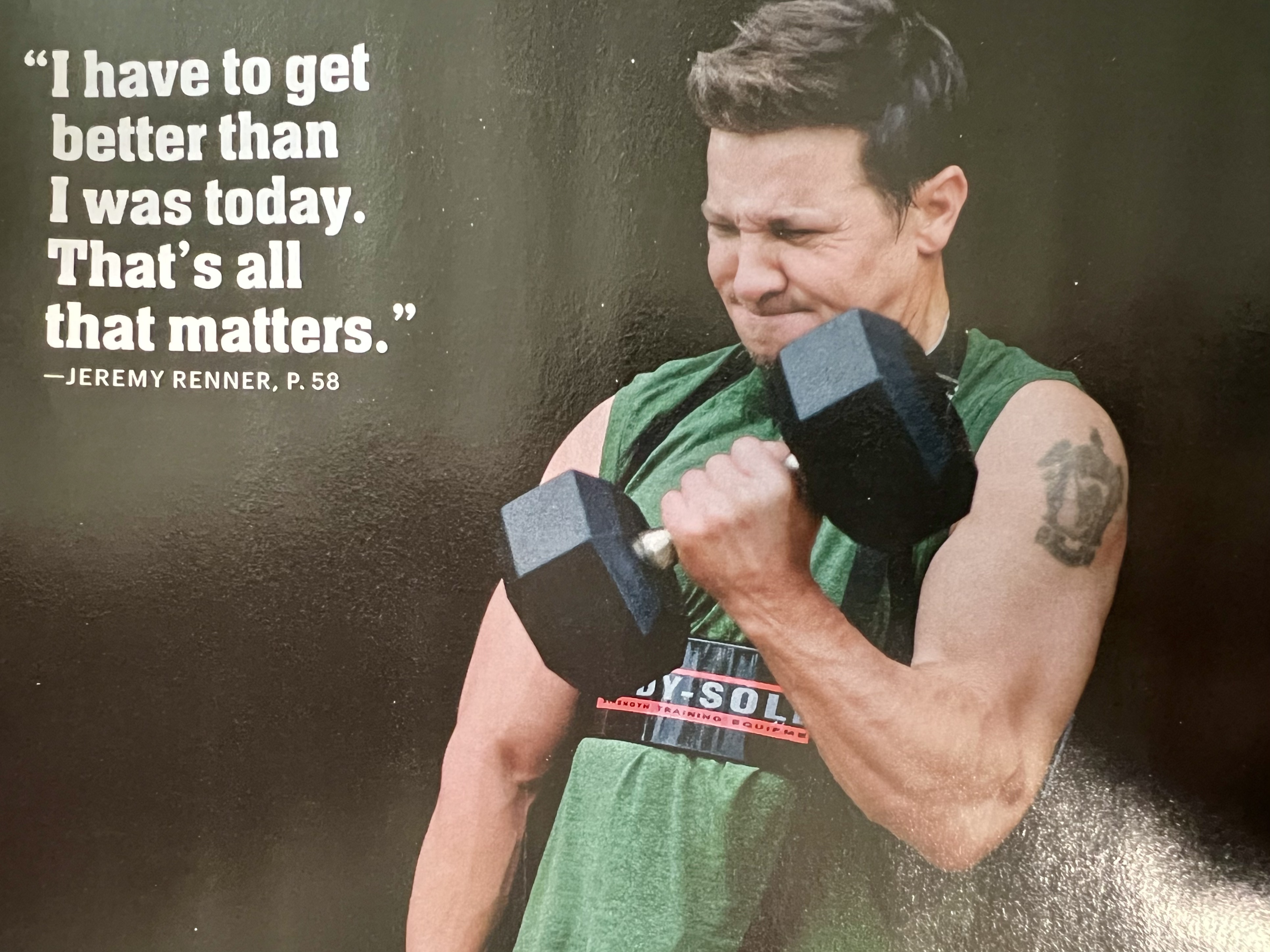
Men’s Health magazine shared an interview with Jeremy Renner, who was nearly killed in a tragic accident. I love his attitude about making today better than yesterday. His words remind me of a poem my grandma used to use to motivate me to keep “besting” what I had already done.
Christopher Ash writes about reading the Psalms through the lens of Jesus. He concludes this way: “I remember seeing on the wall of a church the words of Psalm 20:4: ‘May [the Lord] grant you your heart’s desire and fulfill all your plans!’ How wonderful, you might think. The Bible promises me all that my heart desires. Until you read the psalm and realize that Psalm 20 is a prayer for the king in David’s line. Ultimately, it is a prayer that Jesus will have His heart’s desire granted and that His plans will be fulfilled. And they will! The Psalms are not all about me. If I think they are, I will end up disillusioned. But when I grasp that they are all about Christ, my heart lifts in joy that He is the blessed Man and I belong to Him.”
Listen to the audio-only version of this podcast by clicking on the player below, or scroll down to watch the video.
Stress might have six letters, but it seems like some leaders have a knee-jerk reaction to treat it like a four-letter word. While it might be nice to fantasize about an stress-free life, this is both entirely unrealistic and detrimental to your leadership. The truth is, a mild amount of stress can be helpful to you personally, as well as your organization as a whole. Join us as Greg and I unpack why you should embrace a bit of stress in your life.
[0:14] I have a brain block to start the show!
[0:59] Let’s define stress in a work environment, as opposed to simply work tension.
[1:51] An interesting study about allowing moderate stress to remain in the workplace.
[5:30] Mild stress is helpful for our brains.
[7:37] Stress expands and strengthens our team connections too.
[10:26] Can stress help increase someone’s work performance?
[13:01] Our physical bodies use a stress hormone called cortisol. How can leaders maximize its effects?
[14:38] Stress can help us rise to the challenge in a way that easy times can’t.
[16:02] I share an example of a teammate who grew through stress, as well as a supporting quote.
[18:40] Greg shares a negative example of an organization that became stress-free and drifted toward failure.
[19:30] When times are easy, we can begin to slide into apathy.
[22:40] Should we teach crisis leadership to our teams? If so, how should we do this?
Check out this episode and subscribe on YouTube so you can watch all of the upcoming episodes. You can also listen to our podcast on Spotify and Apple.
Listen to the audio-only version of this podcast by clicking on the player below, or scroll down to watch the video.
Empathy is an essential trait for leaders, but it’s not innate in any of us. As I joked, “behind ‘mama’ and ‘dada,’ the first word most babies learn is ‘mine.’” The skill of empathy is like a muscle, the more we practice, the stronger it gets. In this episode, Greg and I discuss why empathy is so important for leaders, and give helpful advice on how to remain proficient in your use of empathy.
[0:24] Empathy is a powerful leadership skill that underlines so many other leadership skills.
[1:08] Empathy has to be earned.
[3:07] What blocks empathy in leaders?
[4:02] When you start learning empathy it will feel awkward, but you have to stick with it.
[5:06] Empathy ≠ sympathy, but it is caring.
[7:07] How do leaders show their empathy to their teammates?
[10:10] Here is an example of how to express empathy.
[12:22] What lessons can we learn when we misfire on empathy?
[14:03] Three things Greg has worked on to enhance empathy.
[16:32] Sometimes leaders do for one team member what they cannot do for all.
[19:51] Leaders need empathetic eyes, ears, and heart. There is a huge leadership power in this.
[21:59] Greg shares an interesting study reported in Forbes.
[25:15] One of the most powerful leadership attributes is simply the leader’s availability.
Check out this episode and subscribe on YouTube so you can watch all of the upcoming episodes. You can also listen to our podcast on Spotify and Apple.









 Craig T. Owens