Copartnership

Do you want your church services to be more engaging?

Do you want your pastor to preach more effectively?

Do you want to come away from church more energized?

If so, you need to enter into a partnership. E.M. Bounds, in his fascinating book The Weapon of Prayer, wrote this—

“Prayerlessness, therefore, as it concerns the preacher is a very serious matter. If it exists in the preacher himself, then he ties his own hands and makes the Word as preached by him ineffective and void. If prayerless people be found in the pew, then it hurts the preacher, robs him of an invaluable help, and interferes seriously with the success of his work. How great the need of a praying church to help in the preaching of the Word of the Lord! Both pew and pulpit are jointly concerned in this preaching business. It is a copartnership.”

If you want more engagement, effectiveness, and energy at your church, partner with your pastor in prayer.

If you don’t have a church home, I hope you can partner with me this Sunday at Calvary Assembly of God as I continue a series called The Danger Of Prayerlessness.

Pray More

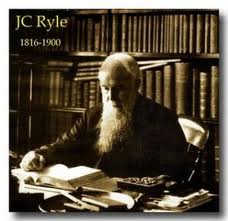
I love this passage from J.C. Ryle that I read on the J.C. Ryle Quotes blog.

Pray for yourselves—that you may know the Lord Jesus, and cleave to Him—that you may be kept from falling—that you may serve your generation—that you may be sober in prosperity, patient in trial, and humble at all times.

Pray for the congregation to which you belong—that the word of the Lord may have free course in it, and be glorified—that the household of faith may become stronger and stronger, and the household of unbelief weaker and weaker.

Pray for your country—that her ministers may preach the Gospel, and be sound in the faith—that her rulers may value the Bible, and govern according to it—and that so her candlestick may not be taken away.

And pray for your minister—that he may be strong to work, and willing to labor for your good, that all his sicknesses may be sanctified, and all his health given to the Lord—that he may be ever taught of the Spirit, and thus be able to teach others—that he may be kept faithful unto death, and so be ready to depart when he is called.

Let us all pray, one for the other—I for you, and you for me—and we shall be blessed in our deed!

We can never pray too much!

Men, Not Boys

This is an in-your-face, no-punches-pulled, right-on-target message. Watch it, think about it, and share your thoughts in the comment below…

Was Your Church Successful?

These thoughts are especially for my fellow pastors (although I think they pertain to anyone who attended a church service recently).

So… how successful was your church gathering this weekend?

Was it successful because lots of people were there? Or because the pastor preached a good sermon? Or maybe the offering was better than usual? Or because you could feel something special as the worship team sang and played their instruments?

How about these measurements:

“The great business of the church is not our number by addition, but by grace, by growing up in Christ.” (John Owen)

“The perfect church service would be one we were almost unaware of. Our attention would have been on God.” (C.S. Lewis)

“Revival is the church getting back to ‘normal.’” (A.W. Tozer)

I hope these quotes have you thinking about church “success” as much as they are working on me!

UPDATE: This post was one of the seed thoughts that went into fashioning my book Shepherd Leadership: The Metrics That Really Matter.

In Visible Fellowship (book review)

This is the second book that Jon Walker has written as a modern-day commentary of a classic Dietrich Bonhoeffer work. This time around Jon takes a look at Bonhoeffer’s Life Together in his book called In Visible Fellowship. (Jon’s first book is Costly Grace, looking at Bonhoeffer’s The Cost Of Discipleship. You can read my review of that book by clicking here.)

In visible fellowship is a phrase that Dietrich Bonhoeffer used to describe the importance of how Christians interact with each other. To Bonhoeffer, it wasn’t so much how Christians behaved in church on Sundays, but how they interacted with each other the other six days of the week. He wanted those outside of the Christian community to see something so attractive and appealing about the way the Christian community operated “in visible fellowship” with each other.

In Visible Fellowship is an excellent companion piece to Life Together. Whereas Costly Grace could almost stand on its own, In Visible Fellowship is probably best read in conjunction with Life Together. In other words, I would highly recommend that both be read at the same time.

Since Jon notes, “There is no such thing as independent study in the curriculum of Christ,” I would further recommend that In Visible Fellowship and Life Together be read with other Christians. A small group could read Life Together, and then use In Visible Fellowship as their study guide as they gather together. Toward this end, each chapter has some excellent questions that should really stimulate lively conversations.

I’m a huge fan of Dietrich Bonhoeffer, and Jon Walker has done an excellent job in bringing some thought-provoking contemporary views to these classic works. I recommend In Visible Fellowship (especially when read with Life Together).

I am an ACU Press book reviewer.

Lousy {Churches} And The Rare Search For Wonder

Seth Godin wrote a blog post entitled “Lousy tomatoes and the rare search for wonder.” I tweaked it just a bit in looking at the typical local church. You can see the parts I’ve modified as marked by {brackets}.

Lousy {churches} and the rare search for wonder

My local {church does things the way they’ve always done things}. They even do this {even when church attendance is declining}, when a {church service should be one of the most anticipated events of the week}.

Are they clueless, evil or incompetent?

Perhaps none of these. This {church}, like most {churches}, is a checklist institution, one that is in the business of providing good enough, in quantity, {in a format} that’s both cheap and profitable. You need a staple, they have it. They have {coffee} and {songs} and {an offering} and {a sermon}. They’ve trained their {attendees} to see them as an invisible vendor, as an organization that satisfices demand. It’s too much work, too demanding and too risky to do the alternative…

They could {add the wow factor to} the {church service} instead.

{Add} it the way a great theater programs the stage. No one goes to the theatre two or three times a week, expecting a good enough show. No, we only go when we hear there’s something magical or terrific happening.

Over time, as institutions create habits and earn subscribers, they often switch, gradually making the move from  magical (worth a trip, worth a conversation) to good (there when you need it). Most TV is just good. Magazines, too. When was the last time {your church} did something that made you sit up and say, “wow!”? Of course, you could argue that they’re not in the wow business, and you might be right.

One of the disrupting forces of the new media is that it makes harder and harder to succeed without wow. Since you have to earn the conversation regularly, phone it in too often and, in fact, attention disappears.

What do you think?

Since Jesus is the ultimate “wow factor,” I think the church should be the most exciting, innovative, conversation-starting, heart-healing, mind-expanding, life-changing force in any community because it makes Jesus real for all who attend.

Why isn’t it?

Christian Disconnect

The Barna Group just released a study that looks at some of the disconnects between what Christians believe and how they live. You can read the full report by clicking here, but here are the main disconnects:

  • 81% of Christians say Jesus is important to them; but only 18% are committed to developing their relationship with Jesus.
  • 64% of Christians have confessed their sins to God; but only 12% realize how devastating their personal sin is.
  • Lots of Christians participate in “normal” religious activities every week; but “less than one out of ten have talked about their faith with a non-Christian, fasted for religious purposes, and had an extended time of spiritual reflection during the past week.”
  • Most Christians feel “comfortable” in their church; but their comfort level is only surface-deep, with no accountability nor confession.

As a pastor, I place the responsibility for these disconnects squarely on the pastors. On me.

Unless pastors are teaching this stuff—and living this stuff—the disconnects will always remain.

Gregory the Great (ca. 540-604) wrote, “There are some who investigate spiritual precepts with cunning care, but what they penetrate with understanding they trample on in their lives: all at once they are teaching the things which not by practice but by study they have learnt; and what in words they preach, by their manners they impugn. Whence it comes to pass that when the shepherd walks through steep places, the flock follows to the precipice.”

I’m challenged by this, and I’m going to spend some time in prayer this week regarding these disconnects. I want to take a good look at what I’m teaching and living, and allow the Holy Spirit to correct what needs to be corrected.

More Amateurs Needed

Did you know that the origin of the word clergy comes from the Latin meaning “learned men”? These are the men and women who are supposed to lead our churches, because they have the education that others don’t. They are professionals.

Now compare that with the definition of laity: “the people outside of a particular profession, as distinguished from those belonging to it.”

Did you catch that? The laity are outside and uneducated. They are amateurs.

The origins of clergy is traced back to the 12th century, and laity first appears in the 16th century. But long before this, the Apostle Paul had a different idea —

Take a good look, friends, at who you were when you got called into this life. I don’t see many of “the brightest and the best” among you, not many influential, not many from high-society families. Isn’t it obvious that God deliberately chose men and women that the culture overlooks and exploits and abuses, chose these “nobodies” to expose the hollow pretensions of the “somebodies”? (1 Corinthians 1:26-28 from The Message, emphasis added)

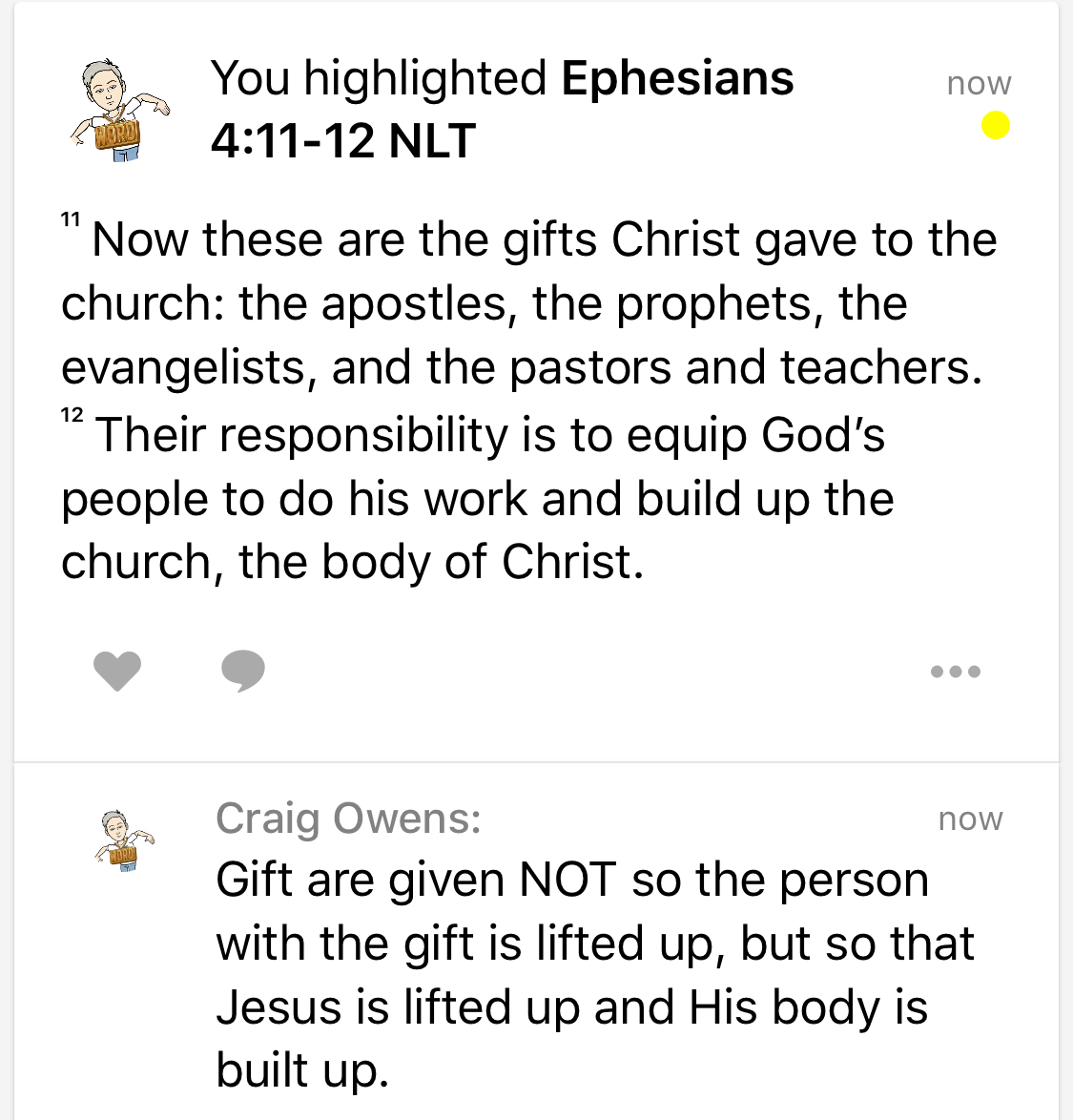
There is a HUGE PROBLEM when we think that only the professional clergy is equipped to do the ministry of the church! What makes a healthy church (like the first century church we read about in the book of Acts) is when EVERYONE is actively involved in ministry.

These words from Howard Hendricks are tough to hear, but right on target:

“I believe a great problem in evangelicalism today—whether in the local church, missions, seminary education, or what have you—is we have too many big-time operators! And too few servants. … 

“The typical church hires a clergyman to rob them of the privilege of exercising Christ’s gifts. … The greatest curse on the Church today is that we are expecting a small group of professionals to get God’s work done.”

I hope I haven’t stepped on too many toes with this one. My intent is not to offend, but to get the church thinking. I want to see EVERYONE that calls themselves a Christian actively involved in ministry.

United Redux

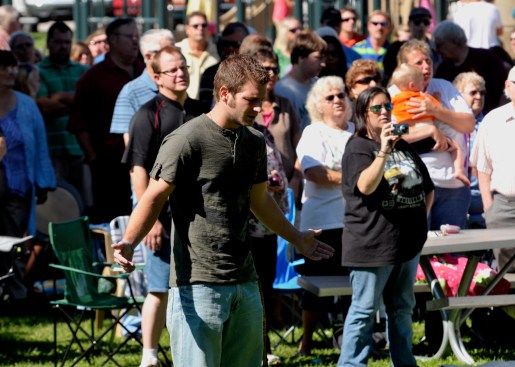
What a fantastic day we had yesterday! All of the churches in Cedar Springs joined together in a united worship service—which was very appropriately named UNITED.

In the book of Acts there is a great word that characterizes the first Church: together.

They all joined together constantly in prayer (1:14)

They were all together in one place (2:1)

All the believers were together and had everything in common (2:44)

Every day they continued to meet together (2:46)

They raised their voices together in prayer to God (4:24)

They gathered the church together and reported all that God had done (14:27)

We came together to break bread (20:7)

I love the fact that the other pastors in the Cedar Springs Ministerial Association want to work together. We realize that it will take our combined efforts to make a significant impact in our community for the Kingdom of Heaven.

Our annual UNITED service is a visible reminder of what’s going on year-round in Cedar Springs. We are together to bring glory to Christ.

On The Verge (book review)

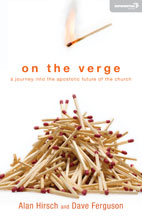
I’ve only been acquainted with the writings of Alan Hirsch for a short time, but—wow!—do his thoughts resonate with me. On The Verge, which was co-authored with Dave Ferguson, is a thought-provoking, paradigm-challenging look at the potential of the church.

Alan and Dave make it very clear right from the outset that the church in America is at a crucial make-or-break point. They point out that the church in Europe and Australia have already lost their effectiveness in their cultures, and if the church in America doesn’t wake up soon, it will soon head down that same sad path toward irrelevancy.

The good news is that everything the church needs to become the disciple-making, missionally-minded, Christ-centered force it should be is right within it. If churches are willing to realign themselves with the apostolic gene at their core, they are right on the verge of something great!

On The Verge focuses on how churches can imagine, shift, innovate, and then move. Both Alan and Dave are well-suited to inspire their readers to take up this challenge before it’s too late. Alan’s thoughts about the church are so far ahead of the curve, and Dave is not just a church theorist, but he’s successfully doing all of the practices shared in this book.

Pastors and church leaders especially need to read this book. But—as Alan and Dave point out—this is not an issue just for professional clergy. In fact, if the church in America is going to survive and thrive, everyone needs to be involved. This will be a challenging book to read, but well worth your time.

I received a free copy of this book for review.