More Amateurs Needed

Did you know that the origin of the word clergy comes from the Latin meaning “learned men”? These are the men and women who are supposed to lead our churches, because they have the education that others don’t. They are professionals.

Now compare that with the definition of laity: “the people outside of a particular profession, as distinguished from those belonging to it.”

Did you catch that? The laity are outside and uneducated. They are amateurs.

The origins of clergy is traced back to the 12th century, and laity first appears in the 16th century. But long before this, the Apostle Paul had a different idea —

Take a good look, friends, at who you were when you got called into this life. I don’t see many of “the brightest and the best” among you, not many influential, not many from high-society families. Isn’t it obvious that God deliberately chose men and women that the culture overlooks and exploits and abuses, chose these “nobodies” to expose the hollow pretensions of the “somebodies”? (1 Corinthians 1:26-28 from The Message, emphasis added)

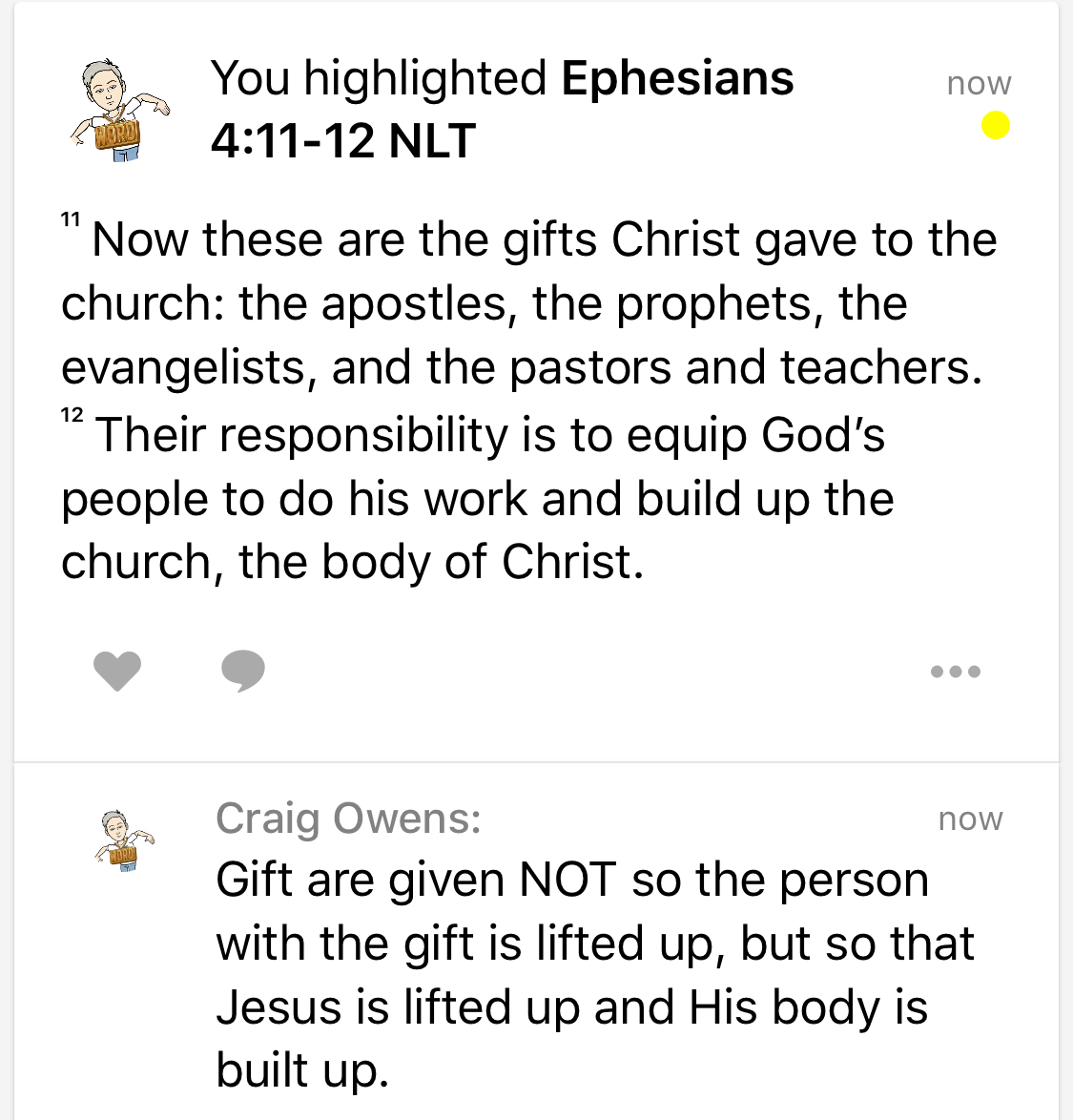
There is a HUGE PROBLEM when we think that only the professional clergy is equipped to do the ministry of the church! What makes a healthy church (like the first century church we read about in the book of Acts) is when EVERYONE is actively involved in ministry.

These words from Howard Hendricks are tough to hear, but right on target:

“I believe a great problem in evangelicalism today—whether in the local church, missions, seminary education, or what have you—is we have too many big-time operators! And too few servants. … 

“The typical church hires a clergyman to rob them of the privilege of exercising Christ’s gifts. … The greatest curse on the Church today is that we are expecting a small group of professionals to get God’s work done.”

I hope I haven’t stepped on too many toes with this one. My intent is not to offend, but to get the church thinking. I want to see EVERYONE that calls themselves a Christian actively involved in ministry.

United Redux

What a fantastic day we had yesterday! All of the churches in Cedar Springs joined together in a united worship service—which was very appropriately named UNITED.

In the book of Acts there is a great word that characterizes the first Church: together.

They all joined together constantly in prayer (1:14)

They were all together in one place (2:1)

All the believers were together and had everything in common (2:44)

Every day they continued to meet together (2:46)

They raised their voices together in prayer to God (4:24)

They gathered the church together and reported all that God had done (14:27)

We came together to break bread (20:7)

I love the fact that the other pastors in the Cedar Springs Ministerial Association want to work together. We realize that it will take our combined efforts to make a significant impact in our community for the Kingdom of Heaven.

Our annual UNITED service is a visible reminder of what’s going on year-round in Cedar Springs. We are together to bring glory to Christ.

On The Verge (book review)

I’ve only been acquainted with the writings of Alan Hirsch for a short time, but—wow!—do his thoughts resonate with me. On The Verge, which was co-authored with Dave Ferguson, is a thought-provoking, paradigm-challenging look at the potential of the church.

Alan and Dave make it very clear right from the outset that the church in America is at a crucial make-or-break point. They point out that the church in Europe and Australia have already lost their effectiveness in their cultures, and if the church in America doesn’t wake up soon, it will soon head down that same sad path toward irrelevancy.

The good news is that everything the church needs to become the disciple-making, missionally-minded, Christ-centered force it should be is right within it. If churches are willing to realign themselves with the apostolic gene at their core, they are right on the verge of something great!

On The Verge focuses on how churches can imagine, shift, innovate, and then move. Both Alan and Dave are well-suited to inspire their readers to take up this challenge before it’s too late. Alan’s thoughts about the church are so far ahead of the curve, and Dave is not just a church theorist, but he’s successfully doing all of the practices shared in this book.

Pastors and church leaders especially need to read this book. But—as Alan and Dave point out—this is not an issue just for professional clergy. In fact, if the church in America is going to survive and thrive, everyone needs to be involved. This will be a challenging book to read, but well worth your time.

I received a free copy of this book for review.

Radical Together (book review)

In Radical Together, David Platt follows up on his book Radical by focusing on how followers of Jesus need to rethink the purpose of the church.

Throughout the book, David continually challenges the age-old paradigms of “church,” and he calls on Christians to return to a more biblical approach to living out their faith. Some of my favorite wake-up calls come in these quotes:

“So we decided to stop planning, creating and managing outreach programs and to start unleashing people to maximize the ministry opportunities God had already planned and created for them.”

“Be careful not to let programs in the church keep you from engaging people in the world with the Gospel.”

“Discussions in the church more often revolve around what we want than what [God] wills. Almost unknowingly, the church becomes a means of self-entertainment and a monument to self-sufficiency.”

And he also addresses pastors specifically in the way they lead their churches. One quote from David really caused me to pause—

“The Bible is not in a church leader’s hands so he or she can give people answers to every question they have and guidance for every situation they face. Instead, the Bible is in a church leader’s hands to transform people into the image of Christ and to get people in touch with the Holy Spirit of God, who will not only give them counsel for every situation they face but will also walk with them through those situations. And when church leaders use God’s Word for this purpose, then church members develop a healthy dependence on God’s Spirit and a healthy admiration of God’s glory.”

Although Radical Together was really written as a sequel to Radical, I didn’t read the first book. With that being said, I didn’t feel like I was only getting part of the story, as Radical Together clearly stands alone.

If you are tired of same-old-same-old church, Radical Together just might be the wake-up call that you need.

I am a Multnomah book reviewer.

An Unabashed Appeal To Join Religion And Government

Talk about taking a passing remark out of context! In a personal letter, Thomas Jefferson mentions how church and state should be separate. But I’m convinced where we’ve ended up is no where close to what he intended! I’m so tired of historical revisionists trying to convince us that biblical values and Judeo-Christian ethics had no place in the founding of our nation. Or—worse yet—that they have no place now. Consider these founding remarks…

“…Having undertaken, for the Glory of God, and advancements of the Christian faith and honor of our King and Country, a voyage to plant the first colony in the Northern parts of Virginia….” —Mayflower Compact

“And for the support of this Declaration, with a firm reliance on the protection of Divine Providence….” —Declaration Of Independence

“I have lived, Sir, a long time; and the longer I live the more convincing Proofs I see of this Truth, That God governs in the Affairs of Men!—And if a Sparrow cannot fall to the Ground without His Notice, is it probable than an Empire can rise without His Aid? — We have been assured, Sir, in the Sacred Writings, that ‘except the Lord build the House, they labor in vain that build it.’ I firmly believe this; and I also believe that without His concurring Aid we shall succeed in this political Building no better than the Builders of Babel…. I therefore beg leave to move, That henceforth Prayers, imploring the Assistance of Heaven, and its Blessing on our Deliberations, be held in this Assembly every Morning before we proceed to Business.” —Benjamin Franklin, Constitutional Convention

It is impossible to rightly govern a nation without God and the Bible.” —George Washington

“Suppose a nation in some distant Region should take the Bible for their only law Book and every member should regulate his conduct by the precepts there exhibited! What a Utopia, what aParadise would this region be.” —John Adams

And, of course, the quotes could go on and on and on. But one of my favorites:

“Yes, if our religion had more to do with our politics; if, in the pride of our citizenship, we had not forgotten our Christianity; if we had prayed more and wrangled less about the affairs of our country, it would have been infinitely better for us at this day.” —John Mitchell Mason (1770-1829), in his book published in 1800

Happy Birthday, America! May GOD bless you!

What’s Your Take On “Church”?

Here’s what I want to see…

From the book of Acts:

All the believers devoted themselves to the apostles’ teaching, and to fellowship, and to sharing in meals (including the Lord’s Supper), and to prayer. A deep sense of awe came over them all, and the apostles performed many miraculous signs and wonders. And all the believers met together in one place and shared everything they had. They sold their property and possessions and shared the money with those in need. They worshiped together at the Temple each day, met in homes for the Lord’s Supper, and shared their meals with great joy and generosity—all the while praising God and enjoying the goodwill of all the people. And each day the Lord added to their fellowship those who were being saved. (Acts 2:42-47, New Living Translation)

Here’s how N.T. Wright puts it:

“The life of believers, individually and collectively, is intended to incarnate the biblical reality of human dignity. The church is called to be an alternative society, living in contrasting style in the midst of the world. Its members are, in God’s design, not self-promoting, as the world is; they are not competitive, as the world is; they do not advance at the expense of others, as the world does; they do not take advantage of the weakness of others, as the world does. They love one another and do good to and for one another. Failing that, there is no compelling reason for the world to pay attention. Which is to say that the only means by which Christians can commend a truly godly vision of human rights is to incarnate them in their individual and collective lives, to announce God’s actions and intentions that constitute the Gospel, and to act justly in the name of God.”

And Rubel Shelly’s take:

“It is a mistake of monumental proportions to think that the priestly ministry of the church is a Sunday-focused event. It is the whole life of the whole church that is our living-body sacrifice to the Lord. Sunday praise is to be joined with Tuesday work and Thursday golf, Wednesday family life and Saturday yard work. Everything in the life of a Christian is to be seamless in terms of its appropriateness for displaying the excellence of God’s heart and character.”

What’s your take?

I Knew Jesus Before He Was A Christian (book review)

You know the cliché: “Never judge a book by its cover.” But with Rubel Shelly’s book, it’s really hard not to give in to this! The complete title is I Knew Jesus Before He Was A Christian… And I Liked Him Better Then. Provocative, huh?

His idea is that the Jesus that is presented in the Bible—which is also the Jesus that is presented to someone who doesn’t have a personal relationship with Him—is different from the Jesus people see in the organized church and in professing Christians. The Jesus in the Bible (or before someone becomes a Christian) is seen in freedom and abundant life. But the Jesus in the church (or after someone becomes a Christian) is a rule-keeping killjoy.

Honestly, I expected this book to be a church-bashing book. I excepted Rubel Shelly to come out blasting away on the rephrase I-love-Jesus-but-I-can’t-stand-His-followers! So I was more than pleasantly surprised right from the first chapter—appropriately titled “Pro-Jesus and Pro-Church”—that this book was not taking that track. Instead, Shelly makes the distinction between “institutionalized religiosity” and a vibrant personalized relationship between God and mankind. Then out of the overflow of this personalized relationship with God, a Christian’s outward lifestyle toward others should be notably more Christ-like.

This book is not targeted at any one segment. There are parts that every pastor would do well to heed. Then there are other parts that anyone who calls themselves Christian should read. And there are even parts that those not involved in a church or a relationship with Christ should take note of.

If, by the title, you were expecting to see the church get beat up, you will be sadly disappointed. However, if you feel like the Church has no room for improvement, you will not only be disappointed, but probably a bit angered too! On the other hand, those who love Christ and love His Bride (the Church), and want to see the Church operating more as she should, you will find much to process in this book.

I am an ACU Press book reviewer.

Help! I’m A Single Parent!

I believe God brings us to certain places and experiences in our lives to develop more of His nature in us. One of the aspects of God’s nature is His empathy. That word literally means to be in suffering with someone. Throughout all of history, God continually tells humanity, “I feel what you feel. When you suffer, I suffer too.” The Bible also tells us that Jesus experienced everything we will ever experience, and knows just how we feel.

So this week I’m experiencing what it’s like to be a single parent. Betsy is visiting her family in California, so I’m home with our kids. Granted this is not even close to what true single parents have to cope with. They do it for years, and I’m struggling with just a week. But my week-long experience is developing greater empathy in me.

I’ve got my usual slate of activity for this week, and then I come home to a crying child who is dealing with a rough relationship issue at school. And then I’m trading texts with a coach, trying to work out details for a practice schedule for another child. And then I’m juggling how to get my kids to three different activities, which all start at almost the same time. And then I’m trying to figure out the family meals, and squeezing in a trip to the grocery store. And then I’m having a discussion with my kids about a housekeeping issue. And then … and then … and then …

God’s design was for our kids to have two parents: a Mom and a Dad. When one parent is missing, I believe God gives extra grace to the remaining parent to operate in both roles. But that isn’t God’s ideal. Into this void, Christians are supposed to step in.

  • Support organizations that assist single parents.
  • Better yet: volunteer at one of these organization.
  • Invite a single-parent family over to dinner at your house.
  • Be a mentor.
  • If your kids are going somewhere a single parent’s kids are, offer to help carpool.
  • Guys, be a father-figure to fatherless kids.
  • Ladies, be a mother-figure to motherless kids.
  • Let a single parent drop off his/her kids at your house so that parent can have some alone time.
  • Take a single parent out for coffee and let them vent.
  • Provide a scholarship to a camp for single-parent kids.

The cliché said, “It takes a village to raise a child.” I think it’s even better this way: It takes a loving Church to raise a healthy, well-balance FAMILY.

It’s time for Christians to be that Church!

Wandering In The Wilderness (book review)

Brian Simmons addresses a vital topic for church leaders and parents: why are emerging adults leaving the church? Wandering In The Wilderness is chock full of timely research and observations that are vital for us to see a healthy future for the church.

Brian is a real boots-on-the-ground author. He works in a college setting and is very involved in the life of his students outside of the classroom. In fact, the prompting to write this book was a conversation with a former student who shared that she felt she was lost and wandering.

Wandering In The Wilderness has a very conversational tone, but it is by no means simply a collection of anecdotal observations from one college professor. On the contrary, the volume of research that is presented in this book is quite impressive. This level of research gives an authoritative tone to the conversation.

As a church leader, I was particularly drawn to the attitudes that emerging adults have about the church and organized religion. I found myself jotting down plenty of notes in the margin. I also have three children of my own who will soon be entering the emerging adult phase of their life, and I found ample information to help me guide them through this important transitional stage in their lives.

Recently I read and reviewed Tim Elmore’s outstanding book Generation iY. That book was a brilliant insight into the thought processes of emerging adults. I would recommend Wandering In The Wilderness as a companion piece, especially for church leaders who want to make sure this generation is well prepared to transition into leadership positions in healthy, growing, vibrant churches.

I am an ACU Press book reviewer.

Stuff Christians Like (book review)

As a fourth-generation Pentecostal, I’ve grown up in the church. I readily recognize that Christians (like any other group) develop their own vocabulary and set of “acceptable” behaviors. But can you spot them? Jon Acuff has spotted them, and puts them on display in Stuff Christians Like.

This book is funny! I know some people think every discussion about anything related to the Bible and church needs to be stone-faced serious. I don’t happen to be one of those people. I see some great comedy in Scripture, and I have certainly seen even more in the church.

Jon writes—as any comedian does—in exaggerated terms. This is what makes his topics so enjoyable to read. He comes close to being irreverent, but never quite crosses the line. But in the process, Jon helps us to see what we often miss, but what those who don’t regularly attend church see so clearly.

If you’re easily offended, or don’t think Christians should laugh at themselves, stay away from this book. But if you enjoy lighthearted comedy with an underlying purpose, you will enjoy Stuff Christians Like.