Thursdays With Spurgeon—Froth Or Substance?

This is a weekly series with things I’m reading and pondering from Charles Spurgeon. You can read the original seed thought here, or type “Thursdays With Spurgeon” in the search box to read more entries.

Listen to the podcast of this post by clicking on the player below, and you can also subscribe on AppleSpotify, or Audible. 

Froth Or Substance?

     Many of you will read a novel from beginning to end, and what have you got? A mouthful of froth when you have done. But you cannot read the Bible—that solid, lasting, substantial, and satisfying food goes uneaten, locked up in the cupboard of neglect, while anything that man writes, as a catch of the day is greedily devoured. ‘I have written for him the great things of My law, but they were considered a strange thing’ [Hosea 8:12].

From The Bible

The Bible is the most important book anyone can read, contemplate, and apply to their lives. Yet far too many people say, “I just don’t have enough time to sit down to read the Bible.” Sadly, these same people take a lot of time on much less meaningful activities. 

One thing that has been immensely helpful to me is the Urgent/Important grid Stephen Covey talks about in his book The Seven Habits Of Highly Effective People. Your Bible reading is never urgent—that is, an alarm will not go off to tell you it is time to read. However, your Bible reading is hugely important. 

Covey discusses how we can put all of our activities into one of the four quadrants in this chart:

Your Bible reading time is definitely a Quadrant II activity, and the best place to find time for this activity is by eliminating things in Quadrant IV—the activities Spurgeon would call froth. In my book Shepherd Leadership: The Metrics That Really Matter, I discuss how leaders can use this grid to increase their leadership effectiveness. 

The bottom line: We all must make sure we are eliminating the froth so that we have time for the great Substance that can only be found in God’s Word. 

You can download Covey’s Urgent/Important grid here → Urgent Important [Covey quadrants]

And then check out chapter 10 in Shepherd Leadership—“Can’t, Won’t or Don’t”—to learn how to use this grid to help you make the time for those important Quadrant II activities.

►► Would you please prayerfully consider supporting this ministry? My Patreon supporters get behind-the-scenes access to exclusive materials. ◀︎◀︎

Thursdays With Spurgeon—Proof Of God’s Love

This is a weekly series with things I’m reading and pondering from Charles Spurgeon. You can read the original seed thought here, or type “Thursdays With Spurgeon” in the search box to read more entries.

Listen to the podcast of this post by clicking on the player below, and you can also subscribe on AppleSpotify, or Audible. 

Proof Of God’s Love

I have written for him the great things of My law, but they were considered a strange thing. (Hosea 8:12) 

     It is no mean proof of His goodness, that He stoops to, rebuke His erring creatures. It is a great argument of His gracious disposition, that He bows His head to notice terrestrial affairs. … He might dwell alone, far, far above this world, up in the seventh heaven, and look down with calm and silent indifference upon all the doings of His creatures. He might do as the heathens supposed their Jove did, sit in perpetual silence, sometimes nodding his awful head to make the Fates move as he pleased. But Jove never thought of the little things of earth, disposing of them as beneath his notice, engrossed within his own being, swallowed up within himself, living alone and retired. … 

     We see from our text that God looks upon man, for He says of Ephraim, ‘I have written for him the great things of My law, but they were considered a strange thing.’ But see how when He observes the sin of man He does not dash him away and spurn him with His foot? He does not shake him by the neck over the gulf of hell until his brain does reel and then drop him forever. But rather, He comes down from heaven to plead with His creatures. He argues with them, He puts Himself, as it were, upon a level with the sinner, states His grievances, and pleads His claim.

From The Bible

In my sermon this last Sunday I was leading my congregation through Psalm 89. I noted that there were two important blessings that Ethan the Ezrahite tells us of: 

  1. The blessing of God’s favor on our obedience 
  2. The blessing of God’s discipline on our disobedience

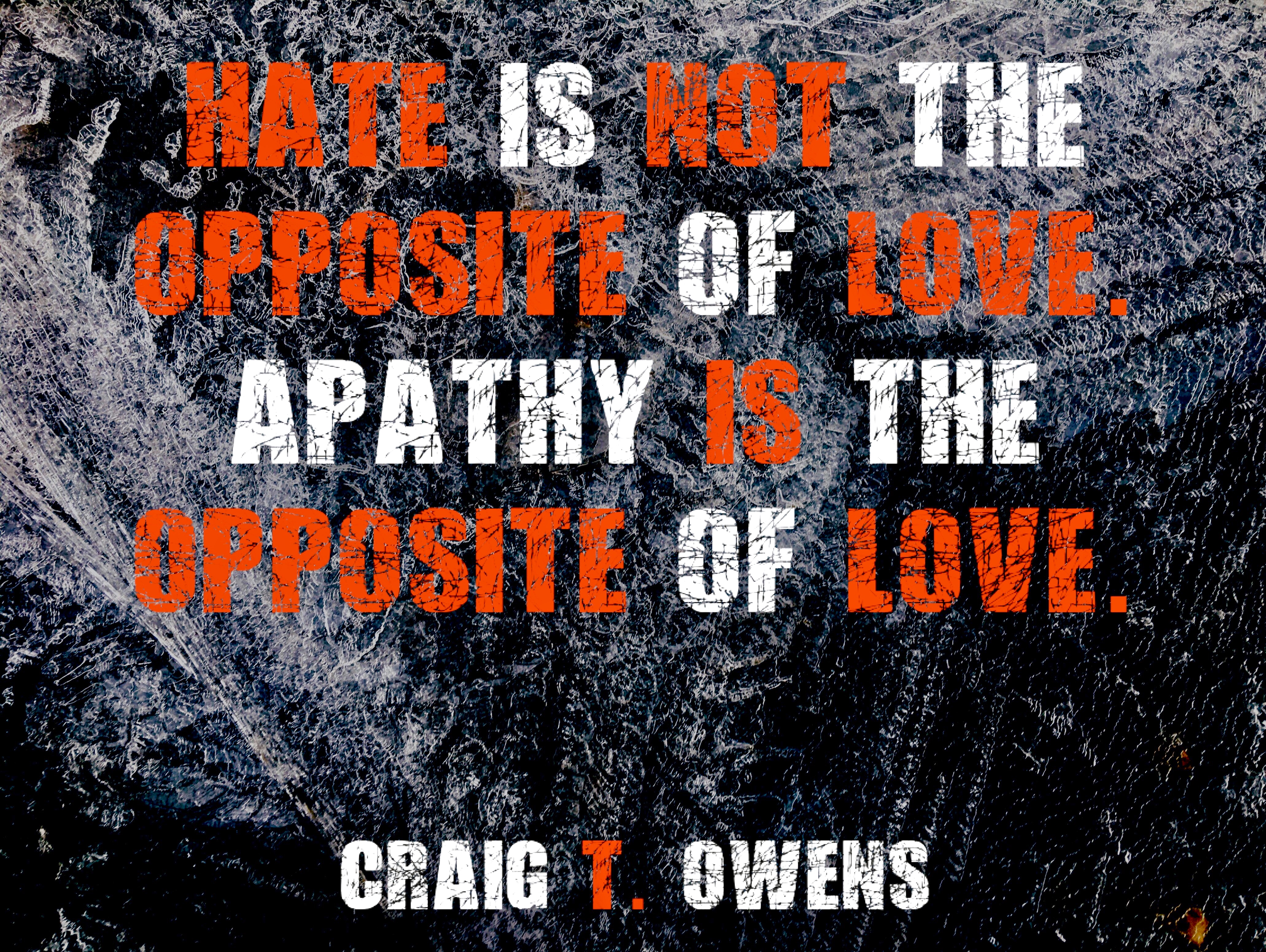
Yes, the fact that God disciplines us—that He “stoops to rebuke His erring creatures”—is positive proof of His immense, unending love for us. The opposite of love is not hate but apathy. If God didn’t love us, He wouldn’t personally involve Himself in our lives because neither our obedience or disobedience would mean a thing to Him. 

Consider this passage—

In all their affliction He was afflicted,
and the Angel of His Presence saved them;
in His love and in His pity He redeemed them;
and He bore them and carried them
all the days of old.
But they rebelled and grieved His Holy Spirit;
so He turned Himself against them as an enemy,
and He fought against them
. (Isaiah 63:9-10)

In His love, God both carries us in our adversity AND turns to confront us in our waywardness. BOTH of these actions are proof of His love. My friend, wherever you are and whatever you may be facing, be assured of God’s unquenchable love for you!

►► Would you please prayerfully consider supporting this ministry? My Patreon supporters get behind-the-scenes access to exclusive materials. ◀︎◀︎
Thursdays With Spurgeon—This Bible Is God’s Bible

This is a weekly series with things I’m reading and pondering from Charles Spurgeon. You can read the original seed thought here, or type “Thursdays With Spurgeon” in the search box to read more entries.

Listen to the podcast of this post by clicking on the player below, and you can also subscribe on AppleSpotify, or Audible. 

This Bible Is God’s Bible

     Here lies my Bible—who wrote it? I open it, and I find it consists of a series of tracts. The first five tracts were written by a man called Moses. I turn on and I find others. Sometimes I see David is the penman, at other times, Solomon. Here I read Micah, then Amos, then Hosea. As I turn further on, to the more luminous pages of the New Testament, I see Matthew, Mark, Luke, and John, Paul, Peter, James and others. But when I shut up the Book, I ask myself who is the author of it? 

     Do these men jointly claim the authorship? Are they the compositors of this massive volume? Do they between themselves divide the honor? Our holy religion answers, ‘No!’ This volume is the writing of the living God. Each letter was penned with an Almighty finger. Each word in it dropped from the everlasting lips; each sentence was dictated by the Holy Spirit. Albeit that Moses was employed to write his histories with his fiery pen, God guided that pen. It may be that David touched his harp and let sweet Psalms of melody drop from his fingers, but God moved his hands over the living strings of his golden harp. It may be that Solomon sang canticles of love, or gave forth words of consummate wisdom, but God directed his lips, and made the Preacher eloquent. If I follow the thundering Nahum when his horses plow the waters, or Habakkuk when he sees the tents of Cushan in affliction, if I read Malachi, when the earth is burning like an oven, if I turn to the smooth page of John, who tells of love, or the rugged, fiery chapters of Peter, who speaks of the fire devouring God’s enemies; if I turn to Jude, who launches forth anathemas upon the foes of God, everywhere I find God speaking. It is God’s voice, not man’s. The words are God’s words, the words of the Eternal, the Invisible, the Almighty, the Jehovah of this earth. This Bible is God’s Bible.

From The Bible

I love God’s Book! I hope you love it and love is Author more and more. 

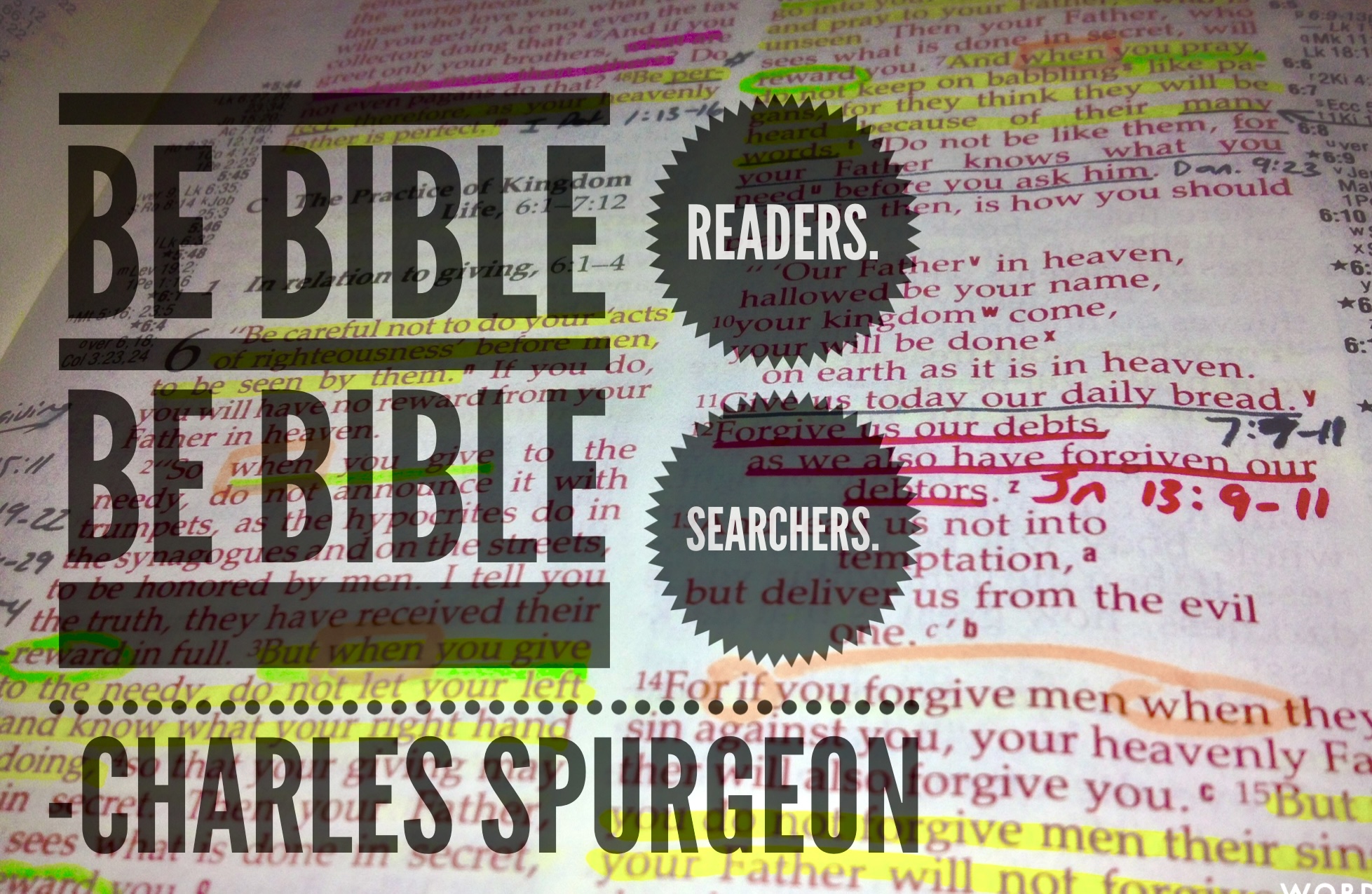
One final word from Charles Spurgeon: “Be Bible readers. Be Bible searchers.” 

To that, I can only say, “Amen!”

►► Would you please prayerfully consider supporting this ministry? My Patreon supporters get behind-the-scenes access to exclusive materials. ◀︎◀︎
Thursdays With Spurgeon—God Means What He Says

This is a weekly series with things I’m reading and pondering from Charles Spurgeon. You can read the original seed thought here, or type “Thursdays With Spurgeon” in the search box to read more entries.

Listen to the podcast of this post by clicking on the player below, and you can also subscribe on AppleSpotify, or Audible. 

God Means What He Says

…For the mouth of the Lord has spoken (Isaiah 1:20).

     You talk about God as being ‘love,’ and if you mean by this that He is not severe in the punishment of sin, I ask you what you make of the destruction of Jerusalem? Remember that the Jews were His chosen nation and that the city of Jerusalem was the place where His temple had been glorified with His presence. Brethren, if you roam from Edom to Zion and from Zion to Sidon and from Sidon to Moab, you will find, amid ruined cities, the tokens that God’s words of judgment are sure. Depend on it, then, when Jesus says, ‘These will go away into everlasting punishment’ (Matthew 25:46), it will be so. When He says, ‘If you do not believe that I am He, you will die in your sins’ (John 8:24), it will be so. … 

     It is of no avail to sit down and draw inferences from the nature of God and to argue, ‘God is love, and therefore He will not execute the sentence upon the impenitent.’ He knows what He will do better than you can infer. He has not left us to inferences, for He has spoken pointedly and plainly. He says, ‘He that believes not shall be damned’ (Mark 16:16), and it will be so, ‘for the mouth of the Lord has spoken.’ Infer what you like from His nature. But if you draw an inference contrary to what He has spoken, you have inferred a lie and you will find it so. …

     I know why you do not believe in the terrible threats. It is because you want to be easy in your sins. … Yet if you do not believe its loving warnings nor regard its just sentences, they are true all the same. If you dare its thunders, if you trample on its promises, and even if you burn it in your rage, the Holy Book still stands unaltered and unalterable. ‘The mouth of the Lord has spoken.’ Therefore, I pray you, treat the sacred Scriptures with respect and remember that ‘these are written that you may believe that Jesus is the Christ, the Son of God, and that believing you might have life through His name’ (John 20:31).

From The Infallibility Of Scripture

Spurgeon delivered this sermon on March 11, 1888. Nearly 2000 years earlier, Asaph delivered a similar message from God—

“Call upon Me in the day of trouble; I will deliver you, and you shall glorify Me.” But to the wicked God says: “What right have you to declare My statutes, or take My covenant in your mouth, seeing you hate instruction and cast My words behind you? When you saw a thief, you consented with him, and have been a partaker with adulterers. You give your mouth to evil, and your tongue frames deceit. You sit and speak against your brother; you slander your own mother’s son. These things you have done, and I kept silent; you thought that I was altogether like you; but I will rebuke you, and set them in order before your eyes. Now consider this, you who forget God, lest I tear you in pieces, and there be none to deliver: Whoever offers praise glorifies Me; and to him who orders his conduct aright I will show the salvation of God.” (Psalm 50:15-23) 

Commenting on this passage from Psalm 50, T.M. Moore wrote, “Surely, this is the most fundamental error of thinking humans ever make: To think of God, spiritual things, worship, human life, the world, and everything else from our vantage point rather than His. … Asaph could see what was happening. And even though the nation was safe, strong, and surfeited with wealth, he knew that, spiritually, things were going awry. The people had persuaded themselves that God was just like them, that He thought like they did, and so was agreeable to their doing things their own way, indulging all their base desires, and pursuing their schemes for success—all the while continuing an outward show of faith.”

Let us take the Bible as what it truly is: Words the mouth of God has spoken. Let us not play games with them, changing the message to words we like. But if the Word of the Lord makes us uncomfortable, let us repent and return to Him. It is those who accept God’s Word as His Word, and obey it, that will see the salvation of God.

►► Would you please prayerfully consider supporting this ministry? My Patreon supporters get behind-the-scenes access to exclusive materials. ◀︎◀︎

Thursdays With Spurgeon—Accepting It For What It Is

This is a weekly series with things I’m reading and pondering from Charles Spurgeon. You can read the original seed thought here, or type “Thursdays With Spurgeon” in the search box to read more entries.

Listen to the podcast of this post by clicking on the player below, and you can also subscribe on AppleSpotify, or Audible. 

Accepting It For What It Is

…For the mouth of the Lord has spoken (Isaiah 1:20).

     In the Word of God the teaching has unique dignity. This Book is inspired as no other book is inspired, and it is time that all Christians avowed this conviction. …  

     Where are we if our Bibles are gone? Where are we if we are taught to distrust them? If we are left in doubt as to which part is inspired and what is not, we are as badly off as if we had no Bible at all. I hold no theory of inspiration. I accept the inspiration of the Scriptures as a fact.

From The Infallibility Of Scripture

I, too, accept the inspiration of the Scriptures as a fact. Every single word is perfectly inspired by the Holy Spirit. Even the order in which the words are spoken.

During the summer months, I like to lead my congregation through a study of the Book of Psalms. Currently, we are looking at the psalms that contain the word Selah. 

It is distressing to me to see how many “modern” translations of the Bible either relegate the word Selah to a footnote (like the NIV which says, “The Hebrew has Selah [a word of uncertain meaning] here”), or completely disregard this word (e.g. The Message, The Contemporary English Version, and The Living Bible, to name a few). 

Why? Do we think we are so much smarter now that we know which words the Holy Spirit truly inspired, and which ones we can leave out?

Once we start down this path, what is to stop us from modifying any word in the Bible? Many liberal-minded people want to tell us “what God really meant” in some passages, or to water down the inspiration so much to try to make it “culturally relevant” that they end up destroying its very meaning. This is not only a slippery slope, but it is something that God has already warned us against doing: 

I warn everyone who hears the words of the prophecy of this scroll: If anyone adds anything to them, God will add to that person the plagues described in this scroll. And if anyone takes words away from this scroll of prophecy, God will take away from that person any share in the tree of life and in the Holy City, which are described in this scroll. (Revelation 22:18-19)

Let us accept the Word of God for what it is: Words that the mouth of Almighty God has spoken, not words that we think can be modified, improved, or eliminated. 

►► Would you please prayerfully consider supporting this ministry? My Patreon supporters get behind-the-scenes access to exclusive materials. ◀︎◀︎
Thursdays With Spurgeon—Top Priority

This is a weekly series with things I’m reading and pondering from Charles Spurgeon. You can read the original seed thought here, or type “Thursdays With Spurgeon” in the search box to read more entries.

Listen to the podcast of this post by clicking on the player below, and you can also subscribe on AppleSpotify, or Audible. 

Top Priority

…For the mouth of the Lord has spoken (Isaiah 1:20).

     Every word that God has given us in the Bible claims our attention because of the infinite majesty of Him who spoke it. … See that you refuse not Him who speaks. O my hearer, let it not be said of you that you went through this life, God speaking to you in His book, and you refusing to hear! It matters very little whether you listen to me or not. But it matters a very great deal whether you listen to God or not. It is He who made you. In His hands is your breath. And if He speaks, I implore you, open your ears and be not rebellious. There is an infinite majesty about every line of Scripture, but especially about that part of Scripture in which the Lord reveals Himself and His glorious plan of saving grace in the Person of His dear Son Jesus Christ. …  

     For what He has spoken He still speaks to us, as freshly as if He spoke it for the first time. … 

     God’s Word has a claim, then, upon your attention because of its majesty and its condescension. But, further, it should win your ear because of its intrinsic importance. ‘The mouth of the Lord has spoken,’ so it is no trifle. God never speaks vanity. No line of His writing treats of the frivolous themes of the day. That which may be forgotten in an hour is for mortal man and not for the eternal God. When the Lord speaks, His speech is Godlike, and its themes are worthy of one who is dwelling in infinity and eternity. … 

     He speaks to you of great things that have to do with your soul and its destiny. It is not a vain thing for you, because it is your life. Your eternal existence, your happiness or your misery, hang on your treatment of that which the mouth of the Lord has spoken. … Treat not the Word of the Lord as a secondary thing that might wait your leisure and receive attention when no other work is before you. Put all else aside and hearken to your God.

From The Infallibility Of Scripture

Charles Spurgeon is so on-target with these words. Believe it or not, this sermon was actually delivered to his fellow pastors. But the words are true for all of us—we must make listening to God’s Word our first priority. 

Every single word of Scripture is inspired by the Holy Spirit. And I do mean every single word. Even the order in which the words are listed is inspired. So when you read your Bible, ask the Holy Spirit—the Author of the text—to illuminate the words to you. Ask questions like:

  • What did that mean then? 
  • What does it mean now? 
  • What does it mean for me? 
  • Does something in my life need to change? 

If you make your time with God a priority, He will reveal more of Himself to you each time you open your Bible.

►► Would you please prayerfully consider supporting this ministry? My Patreon supporters get behind-the-scenes access to exclusive materials. ◀︎◀︎

Thursdays With Spurgeon—Encouragement For Preachers

This is a weekly series with things I’m reading and pondering from Charles Spurgeon. You can read the original seed thought here, or type “Thursdays With Spurgeon” in the search box to read more entries.

Listen to the podcast of this post by clicking on the player below, and you can also subscribe on AppleSpotify, or Audible. 

Encouragement For Preachers

…For the mouth of the Lord has spoken (Isaiah 1:20).

     We preach because ‘the mouth of the Lord has spoken.’ It would not be worth our while to speak what Isaiah had spoken if in it there was nothing more than Isaiah’s thought—neither should we care to meditate hour after hour upon the writings of Paul, if there was nothing more than Paul in them. … The true preacher, the man whom God has commissioned, delivers his message with awe and trembling because ‘the mouth of the Lord has spoken.’ … 

     Woe unto us if we dare to speak the Word of the Lord with less than our whole heart and soul and strength! Woe unto us if we handle the Word as if it were an occasion for display! If it were our own word, we might be studious of the graces of oratory. But if it is God’s Word, we cannot afford to think of ourselves. … Because the mouth of the Lord has spoken the truth of God, we therefore endeavor to preach it with absolute fidelity. …  

     Believing that ‘the mouth of the Lord has spoken,’ it is my duty to repeat God’s Word to you as correctly as I can after having heard it and felt it in my own soul. It is not mine to amend or adapt the gospel. …  Again, dear friends, as ‘the mouth of the Lord has spoken,’ we speak the divine truth with courage and full assurance. Modesty is a virtue, but hesitancy when we are speaking for the Lord is a great fault. …  

     We preach not the gospel by your leave. We do not ask tolerance nor court applause. We preach Christ crucified, and we preach boldly as we ought to speak because it is God’s Word not our own. … We cannot use ‘ifs’ and ‘buts,’ for we are dealing with God’s ‘shalls’ and ‘wills.’ If He says it is so, it is so. And there is the end of it. Controversy ceases when Jehovah speaks [Jeremiah 1:17-19].

From The Infallibility Of Scripture

Preaching God’s Word is not for the faint of heart. It takes one who is confidently humbled—confident that God has spoken and humbled that He would choose someone like me to speak His Word to His people. 

In my book Shepherd Leadership: The Metrics That Really Matter I wrote: 

Check this out: “Now Moses was a very humble man, more humble than anyone else on the face of the earth” (Numbers 12:3). Who wrote the book of Numbers? If you answered “Moses,” you are correct. Doesn’t that sound a bit brash to declare that you are more humble than anyone else on the earth? Yet, God allowed Moses to pen those words, making that a Holy Spirit-inspired statement of fact. Humility is a double-edged sword: it can serve a leader well when it is balanced with appropriate confidence, but it is a detriment to an organization’s health if it is self-de-basing humility that undercuts a leader’s credibility. 

The God-honoring preacher gets his message from the mouth of the Lord, and then confidently endeavors “to preach it with absolute fidelity.” Whether others praise of criticize, the humble leader says, “I am only God’s servant speaking God’s Word.” 

Preachers, let’s make sure that everything we confidently and humbly share from our pulpits is the whole counsel of what has been spoken by the mouth of the Lord.

►► Would you please prayerfully consider supporting this ministry? My Patreon supporters get behind-the-scenes access to exclusive materials. ◀︎◀︎

Spurgeon And The Psalms (book review)

Listen to the podcast of this post by clicking on the player below, and you can also subscribe on AppleSpotify, or Audible. 

Spurgeon And The Psalms hits a sweet spot for me: Charles Spurgeon is one of my favorite preachers and the Psalms are my go-to resource when I need encouragement, perspective, or vocabulary for my heartfelt prayers. The combination of the Prince of Preachers and the Psalter grabbed my attention before I even opened the cover.

After I opened the cover, I was not disappointed. I love the format of each chapter. For each chapter your eyes go to Charles Spurgeon’s commentary first, and then you can read the chapter itself. The reason why I like this layout is because Spurgeon has a tendency to tell us not what the psalmist says, but what we should look for as we read that psalm. This remains true to what Spurgeon himself felt about biblical commentaries.

I always make my Bibles my own. By that I mean that I underline, highlight, circle, and write margin notes throughout my Bible. The wide margins in this book make it ideal to use as a prayer companion. I believe the Bible is not a Book to be read through, but a Book to be prayed through. Nowhere is that more true than in the Psalms, where such deep emotions are poured out in God’s presence, helping us give voice to our deepest prayers.

If you have never read anything from Charles Spurgeon, this is an excellent place to get started. After you have read his insights here, I’m confident that you will want to read more. Even if you are familiar with Spurgeon’s sermons and books, this book is going to be an excellent addition to your library.

I am a member of the Bible Gateway Blogger Grid and I reviewed this book at their invitation 

►► Would you please prayerfully consider supporting this ministry? My Patreon supporters get behind-the-scenes access to exclusive materials. ◀︎◀︎
Thursdays With Spurgeon—Prayer Preparation And Prayer Expectation

This is a weekly series with things I’m reading and pondering from Charles Spurgeon. You can read the original seed thought here, or type “Thursdays With Spurgeon” in the search box to read more entries.

Listen to the podcast of this post by clicking on the player below, and you can also subscribe on AppleSpotify, or Audible. 

Prayer Preparation And Prayer Expectation

In the morning, Lord, You hear my voice; in the morning I lay my requests before You and wait expectantly. (Psalm 5:3) 

     Do we not miss very much of the sweetness and efficacy of prayer by a want of careful meditation before it, and hopeful expectation after it? … We too often rush into the presence of God without forethought or humility. We are like people who present themselves before a king without a petition, and what wonder is it that we often miss the end of prayer? We should be careful to keep the stream of meditation always running, for this is the water to drive the mill of prayer. … Prayer without fervency is like hunting with a dead dog, and prayer without preparation is hawking with a blind falcon. Prayer is the work of the Holy Spirit, but He works by means. God made man, but He used the dust of the earth as a material. The Holy Ghost is the Author of prayer, but He employs the thoughts of a fervent soul as the gold with which to fashion the vessel. Let our prayers and praises be not the flashes of a hot and hasty brain but the steady burning of a well-kindled fire.

From Spurgeon And The Psalms

Sadly, I think we’ve become so accustomed to instant-everything in our society that it has seriously limited our prayer life. We walk into our prayer closet without an idea of what we’re going to pray, rattle off a few requests, say “Amen,” and walk out of our prayer closet exactly the same as we walked in. 

There is certainly help for us when we are so distressed—so at our wits’ end—that we don’t even know what to pray, but this is not what David is saying in Psalm 5. David is making it a regular practice to come into God’s presence with his requests at the ready, and he is walking away from his prayer time in eager expectation of God’s soon-to-be-realized answers. 

The Amplified Bible says, “I prepare a prayer…and watch and wait for You to speak to my heart.” 

I think it is a good idea for us to:

As Spurgeon said, “Let our prayers and praises be not the flashes of a hot and hasty brain but the steady burning of a well-kindled fire.”

►► Would you please prayerfully consider supporting this ministry? My Patreon supporters get behind-the-scenes access to exclusive materials. ◀︎◀︎
Thursdays With Spurgeon—The Final, Authoritative Word

This is a weekly series with things I’m reading and pondering from Charles Spurgeon. You can read the original seed thought here, or type “Thursdays With Spurgeon” in the search box to read more entries.

Listen to the podcast of this post by clicking on the player below, and you can also subscribe on AppleSpotify, or Audible. 

The Final, Authoritative Word

…For the mouth of the Lord has spoken (Isaiah 1:20).

     It would not be worth our while to speak what Isaiah had spoken if in it there was nothing more than Isaiah’s thought—neither should we care to meditate hour after hour upon the writings of Paul, if there was nothing more than Paul in them. … 

     It is not mine to amend or adapt the gospel. What? Shall we attempt to improve upon what God has revealed? The Infinitely Wise to be corrected by creatures of a day? Is the infallible revelation of the infallible Jehovah to be shaped, moderated, and toned down to the fashions and fancies of the hour? God forgive us if we have ever altered His Word unwittingly. … 

     One Word of God is worth more than libraries of human lore. ‘It is written’ is the great gun which silences all the batteries of man’s thought.

From The Infallibility Of Scripture

As Solomon neared the end of his writings in the Book of Ecclesiastes, he made this observation, “Of making many books there is no end, and much study wearies the body” (12:12). How true that is. Have you walked through a bookstore lately?! There is no end to the opinions that people want to share with you. 

But there is one thing that all of the books in all of the bookstores and all of the libraries have in common: not one of them is given to us by “the mouth of the Lord.” 

There are certainly many, many books that are saturated in Scripture, but they are still the opinions of man. We need to make sure that everything we read, or every wise person that we listen to, or even every conversation that we have with ourselves are all proven to be true or false based on what God has spoken.

Jesus told us that the Holy Spirit would remind us of everything God’s mouth had spoken to us (John 14:26), and that He would guide us into all truth (John 16:13). 

So go ahead and search out wise, godly books and wise, godly counselors. But remember that their word is not the final word—only the words that come from the mouth of the Lord are the authoritative words you should apply to your life.

►► Would you please prayerfully consider supporting this ministry? My Patreon supporters get behind-the-scenes access to exclusive materials. ◀︎◀︎